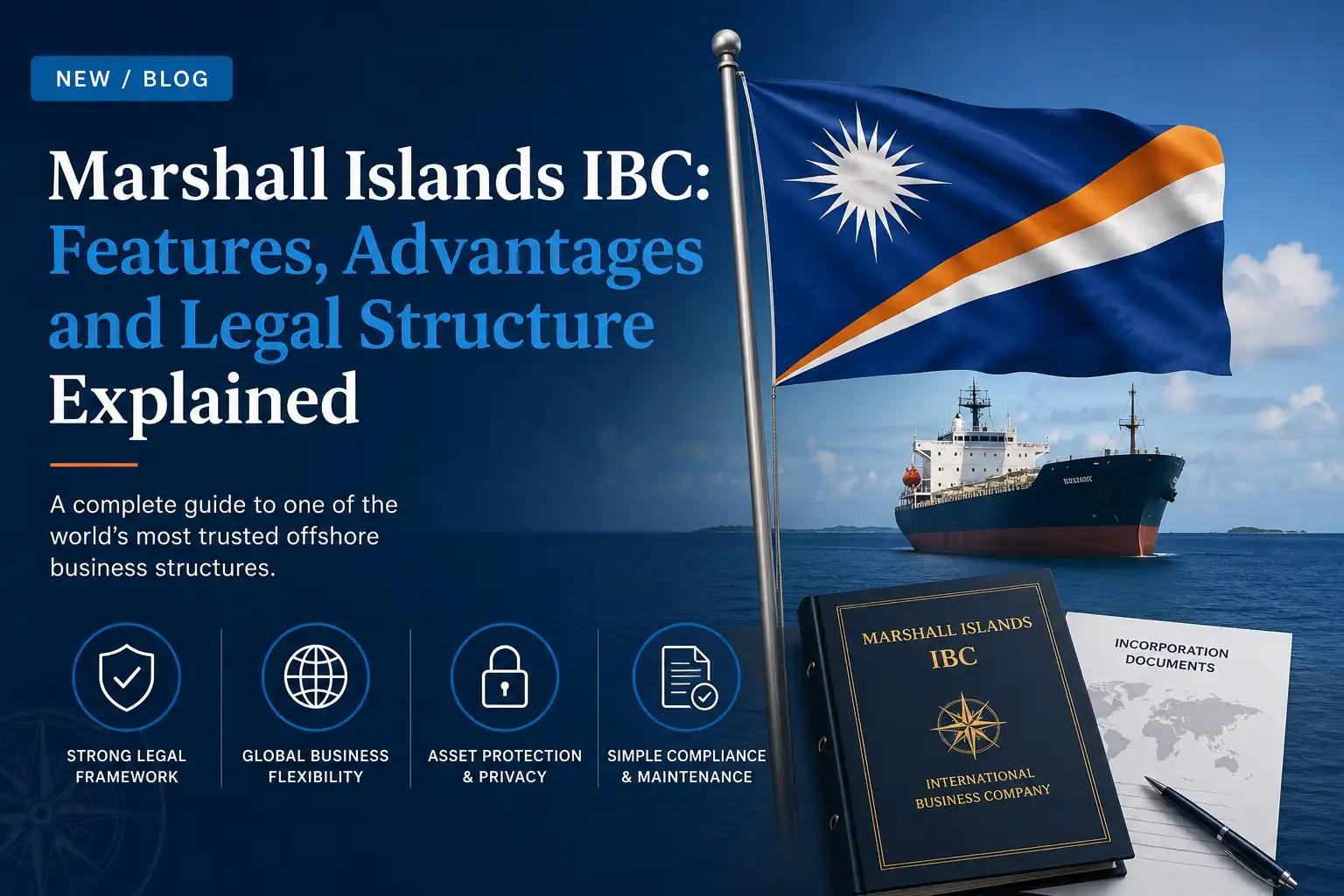
Marshall Islands IBC: Features, Advantages and Legal Structure
Introduction
The Marshall Islands has long been recognized as one of the world’s leading offshore jurisdictions for international business. Entrepreneurs, investors, holding companies, family offices, international traders, and multinational groups continue to use Marshall Islands corporate structures to support global operations, protect assets, and facilitate cross-border investments.
One of the most searched offshore structures is the Marshall Islands IBC, often referred to as an International Business Company. Although the Marshall Islands primarily incorporates Non-Resident Domestic Corporations (NRDCs) and Limited Liability Companies (LLCs) under its corporate legislation, many entrepreneurs still use the term “IBC” as a generic reference to offshore companies incorporated in the jurisdiction.
In 2026, Marshall Islands companies remain attractive due to their flexible legal framework, tax-efficient treatment for qualifying offshore activities, international recognition, strong privacy protections, and business-friendly corporate legislation influenced by Delaware corporate law.
This guide explains the legal structure, key features, advantages, compliance obligations, and practical uses of Marshall Islands offshore companies commonly referred to as IBCs.
👉 For a complete overview of offshore incorporation, see our pillar guide:
Marshall Islands Company Formation: The Complete 2026 Guide to Offshore Incorporation
What Is a Marshall Islands IBC?
The term “Marshall Islands IBC” is widely used in the offshore industry to describe a company incorporated in the Marshall Islands for international business purposes.
In practice, the most common structure is the:
Non-Resident Domestic Corporation (NRDC)
The NRDC is designed specifically for businesses conducting activities outside the Marshall Islands.
These companies are commonly used for:
- International trade
- Holding company structures
- Investment ownership
- Intellectual property ownership
- Asset protection
- Shipping and maritime activities
- Family office structures
The NRDC has become one of the most recognized offshore corporate vehicles available in the international marketplace.
Marshall Islands LLC
Some entrepreneurs choose a Marshall Islands Limited Liability Company (LLC) instead of a corporation.
An LLC may offer additional flexibility depending on:
- Tax planning objectives
- Ownership arrangements
- Investment structures
- Joint venture requirements
The choice between a corporation and an LLC depends on the specific needs of the business and its owners.
Why Marshall Islands Companies Are Popular in 2026
The Marshall Islands continues to attract international business because it combines several important advantages.
Business owners are increasingly seeking jurisdictions that provide:
- Legal certainty
- International credibility
- Corporate flexibility
- Compliance readiness
- Banking compatibility
The Marshall Islands offers all of these benefits while maintaining a respected position within the offshore industry.
Its legal framework is heavily influenced by Delaware corporate law, making it familiar to:
- International investors
- Corporate lawyers
- Venture capital firms
- Financial institutions
This familiarity can simplify corporate transactions and improve investor confidence.
Legal Foundation of a Marshall Islands IBC
One of the strongest advantages of a Marshall Islands company is its legal framework.
Unlike some offshore jurisdictions that rely on outdated corporate legislation, the Marshall Islands has developed a modern corporate system inspired by one of the most respected corporate jurisdictions in the world: Delaware.
Delaware-Inspired Corporate Law
The Marshall Islands Business Corporations Act incorporates many principles associated with Delaware corporate legislation.
Benefits include:
- Flexible governance structures
- Clear shareholder rights
- Corporate continuity
- Predictable legal principles
- International recognition
Many investors and professional advisors are already familiar with these concepts, making Marshall Islands companies easier to understand and use.
Corporate Personality
A Marshall Islands corporation is a separate legal entity from its owners.
This means the company can:
- Own assets
- Enter contracts
- Open bank accounts
- Hold investments
- Conduct business activities
The company exists independently from its shareholders.
Key Features of a Marshall Islands IBC
Limited Liability Protection
One of the most important features of any offshore company is limited liability.
Shareholders are generally not personally responsible for corporate obligations beyond their investment in the company.
This separation can provide important risk management benefits for:
- Investors
- Entrepreneurs
- International traders
- Holding companies
Flexible Share Structure
Marshall Islands companies offer considerable flexibility regarding share ownership.
Businesses may issue:
- Registered shares
- Different share classes
- Voting shares
- Non-voting shares
This flexibility can support sophisticated ownership arrangements.
Single Shareholder Allowed
A Marshall Islands company can generally be incorporated with only one shareholder.
This makes the structure attractive for:
- Individual entrepreneurs
- Consultants
- Investors
- Holding companies
Single Director Allowed
Only one director is generally required.
This simplifies corporate administration while maintaining flexibility.
Corporate Directors and Shareholders
Marshall Islands legislation permits:
- Corporate directors
- Corporate shareholders
This can be useful in larger international structures involving multiple entities.
Perpetual Existence
Marshall Islands companies benefit from corporate continuity.
Ownership changes do not automatically affect the legal existence of the company.
This feature is particularly valuable for:
- Long-term investments
- Family office structures
- Corporate succession planning
Advantages of Marshall Islands Company Formation
Tax-Neutral Environment
One of the most significant reasons businesses establish Marshall Islands companies is the jurisdiction’s tax-efficient treatment for qualifying offshore activities.
Potential benefits may include:
- No local corporate income tax on qualifying offshore activities
- No capital gains tax
- No withholding taxes in certain circumstances
However, entrepreneurs must still consider:
- Tax residency rules
- Home-country reporting obligations
- International tax regulations
Offshore incorporation should always be part of a broader international tax strategy.
👉 For a deeper analysis, see:
Marshall Islands Tax Benefits for Offshore Companies (Coming soon)
Strong Corporate Privacy
Privacy remains an important consideration for many international business owners.
Marshall Islands companies have traditionally offered a high degree of corporate confidentiality.
Advantages include:
- Limited public disclosure
- Protection of commercial information
- Enhanced privacy for legitimate business activities
However, businesses must still comply with:
- KYC requirements
- AML regulations
- Beneficial ownership obligations
Privacy and compliance must work together.
International Recognition
Not all offshore jurisdictions enjoy the same level of credibility.
Marshall Islands companies are widely recognized by:
- Banks
- Investors
- Lawyers
- Corporate service providers
- International counterparties
This recognition can facilitate:
- Corporate transactions
- Banking applications
- Investment opportunities
Flexible Corporate Governance
Marshall Islands companies provide significant flexibility regarding management and ownership.
This allows entrepreneurs to create governance structures that match their operational requirements.
Flexibility remains one of the jurisdiction’s strongest competitive advantages.
Common Uses of Marshall Islands IBCs
Holding Companies
Holding companies remain one of the most popular applications.
Marshall Islands entities can hold:
- Subsidiaries
- Investments
- Real estate interests
- Intellectual property
This centralizes ownership and can improve organizational efficiency.
International Trading Businesses
Many international traders use Marshall Islands companies for:
- Import-export operations
- Commodity trading
- Wholesale distribution
- Cross-border transactions
The jurisdiction’s international focus supports these activities.
Investment Structures
Investors often use Marshall Islands entities for:
- Portfolio holdings
- Venture investments
- Family office planning
- Private investment vehicles
Intellectual Property Ownership
Companies may hold:
- Trademarks
- Copyrights
- Patents
- Software rights
through Marshall Islands structures.
Asset Protection Planning
Marshall Islands companies are frequently incorporated as part of broader asset protection strategies.
👉 For more information, see:
Asset Protection with a Marshall Islands Offshore Company (Coming soon)
Maritime and Shipping Businesses
The Marshall Islands is one of the world’s most respected maritime jurisdictions.
Its ship registry ranks among the largest globally.
As a result, the jurisdiction is particularly attractive for:
- Vessel ownership
- Fleet management
- Maritime investments
For shipping companies, this reputation provides significant credibility.
Corporate Governance Structure
Understanding the governance structure of a Marshall Islands company is important for long-term compliance and operational success.
Shareholders
Shareholders are the owners of the company.
Their responsibilities may include:
- Appointing directors
- Approving major corporate decisions
- Voting on key matters
Directors
Directors manage the company and oversee business operations.
Responsibilities may include:
- Corporate governance
- Strategic planning
- Compliance oversight
- Financial supervision
Officers
Companies may appoint officers such as:
- President
- Secretary
- Treasurer
depending on operational requirements.
Compliance Requirements in 2026
Modern offshore companies operate within a regulated international environment.
KYC Requirements
Service providers generally require:
- Passport copies
- Proof of address
- Source of funds information
before incorporation.
AML Compliance
Anti-money laundering regulations continue to play a central role in offshore company administration.
Businesses should maintain:
- Proper records
- Transaction transparency
- Compliance procedures
Beneficial Ownership
International standards increasingly require identification of beneficial owners.
Entrepreneurs should expect ongoing transparency obligations.
Economic Substance
Certain activities may trigger substance reporting requirements.
Businesses should ensure that structures are supported by legitimate commercial purposes.
👉 For a detailed analysis, see:
Compliance, Substance and Reporting Requirements in the Marshall Islands (Coming soon)
Banking Considerations
Many entrepreneurs focus on incorporation while overlooking banking.
In reality, banking often requires more preparation than company formation itself.
Banks typically assess:
- Business model
- Ownership structure
- Compliance readiness
- Geographic exposure
- Source of funds
A properly structured Marshall Islands company can successfully establish banking relationships with many international financial institutions.
👉 For more information, see:
Offshore Banking for Marshall Islands Companies (Coming soon)
Who Should Consider a Marshall Islands IBC?
The structure may be suitable for:
- International entrepreneurs
- Investors
- Holding companies
- Family offices
- Maritime operators
- Trading businesses
- Consultants
- E-commerce companies
However, the suitability of any offshore structure depends on individual circumstances and professional advice.
Featured Snippet: What Is a Marshall Islands IBC?
A Marshall Islands IBC is an offshore company structure commonly used for international business activities such as investment holding, trading, asset protection, intellectual property ownership, and maritime operations. The most common structure is the Non-Resident Domestic Corporation (NRDC), which benefits from flexible corporate legislation and international recognition.
Featured Snippet: What Are the Benefits of a Marshall Islands IBC?
The main benefits of a Marshall Islands IBC include limited liability protection, corporate flexibility, tax-efficient treatment for qualifying offshore activities, strong privacy protections, international credibility, and suitability for holding companies, investment structures, and global business operations.
AI-Readable Summary
Marshall Islands companies remain among the most popular offshore structures in 2026.
Key advantages include:
- Delaware-inspired corporate legislation
- Limited liability protection
- Flexible ownership structures
- Tax-neutral environment for qualifying activities
- Strong privacy protections
- International recognition
- Maritime industry credibility
- Efficient incorporation procedures
Common uses include:
- Holding companies
- International trade
- Asset protection
- Intellectual property ownership
- Investment structures
- Shipping businesses
Frequently Asked Questions
Is a Marshall Islands IBC legal?
Yes. Marshall Islands companies are legitimate legal entities incorporated under the country’s corporate legislation.
Can foreigners own a Marshall Islands company?
Yes. Foreign individuals and corporations can generally own and manage Marshall Islands companies.
What is the most common Marshall Islands offshore structure?
The Non-Resident Domestic Corporation (NRDC) is the most widely used corporate structure.
Can a Marshall Islands company open a bank account?
Yes. Subject to banking approval and compliance requirements.
Is a Marshall Islands company suitable for holding investments?
Yes. Holding company structures are among the most common uses of Marshall Islands entities.
Does a Marshall Islands company provide limited liability?
Yes. Shareholders generally benefit from limited liability protection.
Final Thoughts
The Marshall Islands remains one of the most respected offshore jurisdictions available in 2026. Whether referred to as an IBC, offshore corporation, or Non-Resident Domestic Corporation, the jurisdiction offers a highly flexible and internationally recognized corporate structure for global business activities.
Its Delaware-inspired legal framework, strong reputation, corporate flexibility, and suitability for international trade, investment holding, maritime operations, and asset protection continue to make it a preferred choice for entrepreneurs and investors worldwide.
When combined with proper compliance, banking preparation, and long-term planning, a Marshall Islands company can serve as a powerful foundation for international business growth.
For broader guidance, read:
- Marshall Islands FAQ
- Marshall Islands Company Formation
- Offshore Services
- Offshore Banks
- Marshall Islands Company Formation: The Complete 2026 Guide to Offshore Incorporation
- How to Open a Marshall Islands Offshore Company Step by Step
- Benefits of Marshall Islands Company Formation for International Businesses