
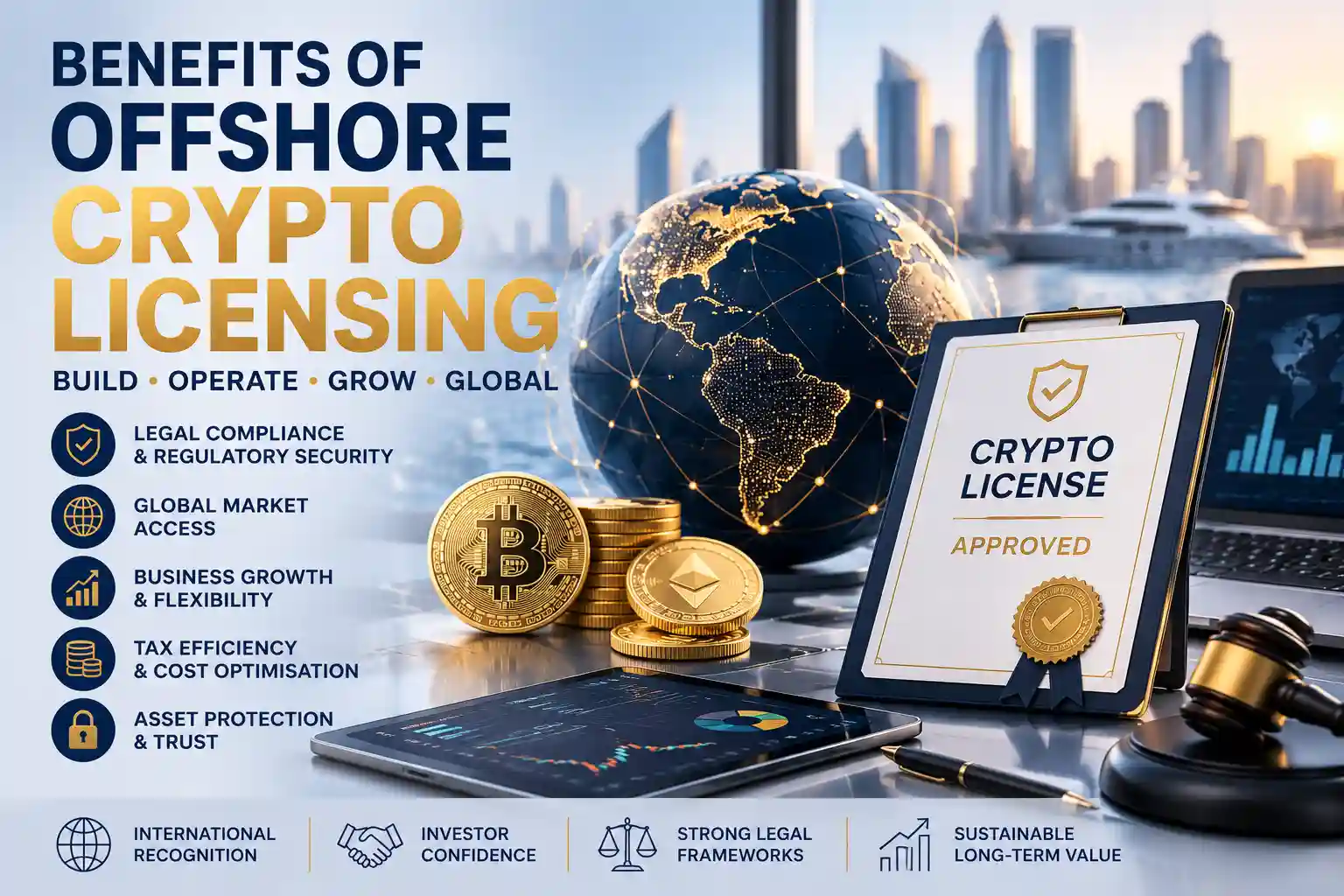
Benefits of Offshore Crypto Licensing
The cryptocurrency industry has evolved into a highly regulated global sector. While regulatory clarity is improving in many jurisdictions, entrepreneurs, exchanges, payment processors, blockchain startups, and fintech companies continue to seek licensing solutions that balance compliance, operational flexibility, speed to market, and cost efficiency.
This is one of the primary reasons offshore crypto licensing has become increasingly popular.
In 2026, offshore crypto licenses are used by startups, established exchanges, OTC desks, crypto payment gateways, token platforms, custody providers, and digital asset businesses seeking a structured regulatory framework without the excessive barriers often associated with major financial centers.
Contrary to common misconceptions, offshore crypto licensing is not about avoiding regulation. Modern offshore licensing jurisdictions increasingly operate under internationally recognized compliance frameworks while providing businesses with a practical path to market entry.
This guide explains the benefits of offshore crypto licensing, how offshore licensing works, why businesses choose offshore jurisdictions, and how to determine whether an offshore crypto license aligns with your business goals.
👉 If you are exploring offshore crypto licensing options, start with our comprehensive pillar guide:
What Is Offshore Crypto Licensing?
Offshore crypto licensing refers to obtaining regulatory authorization for cryptocurrency-related activities through an offshore jurisdiction that permits international business operations.
These licenses may authorize activities such as:
- Cryptocurrency exchange operations
- Crypto brokerage services
- Custody solutions
- Digital asset trading
- Crypto payment processing
- Wallet services
- OTC trading
- Token-related services
Businesses often use offshore licenses as part of broader international growth strategies.
The goal is not simply regulatory approval but creating a scalable foundation for global operations.
Why Offshore Crypto Licensing Has Become So Popular
The digital asset industry moves much faster than traditional financial sectors.
Entrepreneurs frequently encounter challenges such as:
- Slow licensing approvals
- High capital requirements
- Complex regulatory procedures
- Significant legal expenses
- Banking barriers
Offshore jurisdictions emerged as a response to these challenges.
They provide businesses with access to regulatory frameworks designed specifically for international operations.
Offshore Licensing vs Unlicensed Operations
One of the biggest misconceptions in the crypto industry is the belief that operating without a license provides greater flexibility.
In reality, licensed businesses often gain significant advantages.
Licensed companies generally enjoy:
- Greater banking opportunities
- Improved investor confidence
- Better payment provider relationships
- Increased customer trust
- Stronger regulatory positioning
Offshore licensing provides a pathway toward legitimacy rather than avoidance of regulation.
Benefit #1: Faster Market Entry
One of the most significant advantages of offshore crypto licensing is speed.
Many traditional jurisdictions require lengthy approval processes.
Applications can sometimes take:
- Several months
- One year
- Multiple years
By contrast, offshore licensing frameworks often provide significantly faster processing timelines.
This allows businesses to:
- Launch products sooner
- Generate revenue faster
- Enter competitive markets quickly
- Respond to industry opportunities
In rapidly changing sectors such as crypto, timing can significantly influence business success.
Benefit #2: Lower Startup Costs
Cost remains one of the biggest barriers facing crypto entrepreneurs.
Launching a regulated business often involves:
- Legal expenses
- Compliance implementation
- Government fees
- Corporate setup costs
- Advisory fees
Many offshore jurisdictions offer more accessible entry points compared to major financial centers.
This makes licensing attainable for:
- Startups
- Growth-stage companies
- Independent founders
- Web3 projects
- Fintech innovators
Lower startup costs often allow businesses to allocate more capital toward:
- Technology
- Marketing
- Talent acquisition
- Product development
Benefit #3: Regulatory Clarity
Uncertainty is one of the biggest risks in the crypto industry.
Operating in jurisdictions with unclear regulatory treatment can create substantial legal challenges.
Offshore licensing frameworks often provide:
- Defined licensing categories
- Structured compliance requirements
- Clear operational expectations
- Predictable approval processes
Businesses generally benefit from knowing exactly what regulators expect.
👉 For a detailed overview of compliance expectations, see:
VASP License Requirements Explained
Benefit #4: Improved Banking Opportunities
Many crypto startups struggle with banking relationships.
Banks increasingly evaluate:
- Regulatory status
- Compliance controls
- Corporate structure
- Licensing framework
Licensed businesses are often viewed more favorably than unlicensed entities.
While a license does not guarantee banking access, it can significantly strengthen credibility during banking reviews.
This is particularly important for:
- Exchanges
- Payment gateways
- OTC desks
- Custodians
Benefit #5: Stronger Investor Confidence
Investors increasingly perform regulatory due diligence before allocating capital.
A licensed structure demonstrates:
- Commitment to compliance
- Operational maturity
- Regulatory awareness
- Long-term planning
This often makes fundraising discussions more productive.
Institutional investors typically prefer businesses operating within recognized regulatory frameworks.
Benefit #6: Enhanced Customer Trust
Customer trust remains one of the most valuable assets in crypto.
Users are increasingly aware of:
- Security concerns
- Fraud risks
- Regulatory uncertainty
A licensed business can often communicate greater legitimacy.
This can improve:
- Customer acquisition
- Retention rates
- Brand reputation
- Partnership opportunities
Trust has become a competitive advantage in the digital asset sector.
Benefit #7: Access to International Markets
Offshore jurisdictions are often designed specifically for international business.
This can provide advantages such as:
- Cross-border operations
- Global customer onboarding
- International partnerships
- Multi-jurisdictional expansion
Businesses seeking worldwide growth frequently use offshore structures as operational hubs.
Benefit #8: Flexible Corporate Structuring
Offshore jurisdictions often allow greater flexibility in corporate organization.
This can benefit:
- Holding companies
- Licensing entities
- Intellectual property ownership
- International subsidiaries
Many businesses combine licensing structures with offshore corporate entities.
👉 For example:
IBC Company Formation in Anjouan
can be used alongside licensing frameworks to create scalable international structures.
Benefit #9: Crypto-Focused Regulatory Environments
Many traditional regulators developed rules originally intended for banks and securities firms.
Some offshore jurisdictions have introduced frameworks specifically designed for digital asset businesses.
These frameworks often better reflect:
- Blockchain technology
- Crypto trading models
- Digital asset custody
- Payment infrastructure
As a result, businesses may encounter more practical regulatory requirements.
Benefit #10: Competitive Advantage for Startups
Large corporations often have substantial compliance budgets.
Startups do not.
Offshore licensing can help emerging companies compete by reducing barriers associated with:
- Cost
- Approval timelines
- Administrative complexity
This allows smaller businesses to enter markets that might otherwise be inaccessible.
Offshore Licensing and Crypto Exchanges
Many crypto exchanges begin with offshore licensing structures.
Benefits may include:
- Faster launch timelines
- Regulatory recognition
- Compliance framework implementation
- Banking readiness
👉 For founders planning exchange businesses, see:
How to Start a Cryptocurrency Exchange Legally
Offshore Licensing and Payment Gateways
Payment processors increasingly utilize offshore licensing structures.
Benefits often include:
- Merchant onboarding capability
- Regulatory positioning
- International transaction support
- Banking relationship development
👉 Learn more:
How to Open a Crypto Payment Gateway Business
Offshore Licensing and AML Compliance
Modern offshore licensing does not eliminate compliance obligations.
In fact, strong compliance remains essential.
Most jurisdictions require:
- AML policies
- KYC procedures
- Risk assessments
- Transaction monitoring
- Record retention
👉 For a full breakdown:
Crypto AML Compliance Guide for Startups
Offshore Licensing Is Not a Shortcut
A professional offshore license should never be viewed as a method of avoiding regulation.
Successful businesses use offshore licensing to achieve:
- Regulatory certainty
- Market access
- Business scalability
- Compliance readiness
The strongest offshore businesses treat compliance as a competitive advantage.
Comparing Popular Offshore Crypto Licensing Jurisdictions
Not all offshore jurisdictions offer the same advantages. Each jurisdiction has different licensing frameworks, compliance expectations, banking opportunities, costs, and reputational considerations.
Businesses should evaluate offshore licensing based on their specific goals rather than selecting a jurisdiction solely based on price.
Anjouan
Anjouan has emerged as one of the fastest-growing offshore jurisdictions for crypto businesses.
Popular among:
- Crypto exchanges
- Payment gateways
- OTC desks
- Blockchain startups
- Fintech companies
Key advantages include:
- Fast licensing process
- Cost-effective setup
- Crypto-focused regulatory environment
- Flexible international business structure
👉 Learn more:
Dubai
Dubai remains one of the world’s most recognized crypto business hubs.
Advantages include:
- Strong international reputation
- Institutional recognition
- Advanced financial infrastructure
- Growing blockchain ecosystem
However, businesses should also consider:
- Higher setup costs
- More extensive compliance requirements
- Longer preparation timelines
👉 For comparison:
Anjouan vs Dubai Crypto License
El Salvador
El Salvador continues to attract crypto entrepreneurs due to its Bitcoin-friendly policies.
Benefits include:
- Pro-crypto government approach
- Bitcoin integration initiatives
- Growing blockchain ecosystem
👉 Comparison guide:
Anjouan vs El Salvador Crypto License
Other Offshore Jurisdictions
Businesses may also evaluate:
- Seychelles
- Mauritius
- British Virgin Islands
- Cayman Islands
- Saint Lucia
Each jurisdiction offers different balances between:
- Cost
- Speed
- Banking access
- Regulatory complexity
- Market perception
👉 For broader comparisons:
Best Offshore Crypto Licensing Jurisdictions
Tax Benefits of Offshore Crypto Licensing
One of the most discussed aspects of offshore structures is tax efficiency.
However, businesses should understand that offshore licensing is not primarily about avoiding taxes.
Instead, offshore structures may provide:
Operational Tax Efficiency
Depending on the jurisdiction and business model, companies may benefit from:
- Simplified corporate structures
- International business flexibility
- Reduced administrative burden
International Expansion Opportunities
Offshore structures can support:
- Cross-border transactions
- International partnerships
- Global customer acquisition
Investment Structuring
Some businesses use offshore entities as part of broader international investment strategies.
Tax treatment always depends on:
- Company structure
- Shareholder residency
- Local tax laws
- International reporting obligations
Professional tax advice should always be obtained before implementing any international structure.
Common Myths About Offshore Crypto Licensing
The offshore licensing industry is surrounded by misconceptions.
Understanding the reality helps businesses make informed decisions.
Myth #1: Offshore Means Unregulated
Modern offshore jurisdictions increasingly require:
- AML compliance
- KYC procedures
- Risk management frameworks
- Beneficial ownership disclosure
Most licensed crypto businesses must maintain substantial compliance controls.
Myth #2: Offshore Licensing Guarantees Banking
A license improves credibility but does not automatically guarantee banking approval.
Banks evaluate:
- Compliance quality
- Ownership structure
- Business model
- Risk profile
Strong compliance remains essential.
Myth #3: Offshore Licensing Is Only for Large Companies
Many offshore jurisdictions specifically attract:
- Startups
- Entrepreneurs
- Small fintech firms
- Early-stage crypto projects
Offshore licensing often provides an accessible entry point for growing businesses.
Myth #4: Offshore Companies Pay No Attention to Compliance
In reality, AML requirements continue to strengthen globally.
Businesses typically require:
- AML policies
- Customer verification
- Transaction monitoring
- Risk assessments
👉 For compliance requirements, see:
Crypto AML Compliance Guide for Startups
Potential Risks of Offshore Crypto Licensing
While offshore licensing offers many advantages, businesses should also understand potential challenges.
Reputation Considerations
Some investors and banking institutions may scrutinize offshore structures more carefully.
Proper compliance and transparency help mitigate these concerns.
Regulatory Changes
Crypto regulation evolves rapidly.
Businesses should maintain flexibility and monitor developments in their chosen jurisdiction.
Banking Challenges
Even licensed businesses may face banking hurdles.
Strong compliance frameworks significantly improve success rates.
Compliance Obligations
Licensing does not eliminate regulatory responsibilities.
Businesses must maintain ongoing compliance programs.
How to Choose the Right Offshore Crypto Licensing Jurisdiction
Selecting a jurisdiction is one of the most important strategic decisions a crypto company will make.
Key factors include:
Business Model
Different businesses require different licensing approaches.
Examples:
- Exchange platforms
- Payment gateways
- Brokerage firms
- Custody providers
- Web3 platforms
Target Markets
Businesses should consider:
- Customer locations
- Geographic expansion plans
- Regulatory expectations
Budget
Costs vary significantly between jurisdictions.
Factors include:
- Licensing fees
- Legal expenses
- Compliance implementation
- Ongoing maintenance
Timeline
Some businesses prioritize:
- Speed to market
Others prioritize:
- Institutional credibility
The optimal jurisdiction depends on strategic goals.
Offshore Licensing for Crypto Exchanges
Exchanges are among the most common users of offshore licensing structures.
Advantages include:
- Regulatory foundation
- Banking readiness
- Customer confidence
- International expansion support
👉 Before launching, read:
How to Start a Cryptocurrency Exchange Legally
Offshore Licensing for Crypto Payment Gateways
Payment gateways often benefit from offshore licensing due to:
- Cross-border operations
- Merchant onboarding
- Settlement infrastructure
- Banking relationships
👉 Related guide:
How to Open a Crypto Payment Gateway Business
Offshore Licensing for Web3 Projects
Web3 businesses increasingly require structured corporate frameworks.
Examples include:
- Blockchain platforms
- Infrastructure providers
- Token ecosystems
- DAO-related entities
Licensing and corporate structuring can provide operational clarity as projects scale.
Offshore Licensing and VASP Compliance
Many offshore crypto licenses operate within VASP frameworks.
This means businesses must often implement:
- AML policies
- KYC systems
- Transaction monitoring
- Compliance reporting
👉 To understand these obligations:
VASP License Requirements Explained
Frequently Asked Questions
What is offshore crypto licensing?
Offshore crypto licensing refers to obtaining regulatory authorization for cryptocurrency-related activities through an offshore jurisdiction.
Is offshore crypto licensing legal?
Yes. Offshore licensing is legal when businesses comply with applicable laws and regulatory requirements.
Why do crypto companies use offshore licenses?
Common reasons include:
- Faster setup
- Lower costs
- International business flexibility
- Regulatory clarity
Does offshore licensing eliminate AML requirements?
No. Most offshore jurisdictions require AML and KYC compliance.
Can offshore licensed companies obtain bank accounts?
Many can, but banking approval depends on compliance quality, business model, and risk profile.
Which offshore jurisdiction is best for crypto licensing?
The answer depends on business objectives, target markets, budget, and regulatory preferences.
👉 For a comparison:
Best Offshore Crypto Licensing Jurisdictions
Is Anjouan a popular crypto licensing jurisdiction?
Yes. Anjouan has become increasingly popular due to its licensing framework, affordability, and crypto-focused environment.
Final Thoughts
Offshore crypto licensing has become an important component of the global digital asset ecosystem.
For startups, fintech companies, exchanges, payment processors, and blockchain businesses, offshore licensing can provide:
- Faster market access
- Cost-efficient growth
- Regulatory clarity
- Improved banking opportunities
- International operational flexibility
However, successful offshore businesses understand that licensing is only one part of a broader strategy.
Long-term success requires:
- Strong AML compliance
- Effective risk management
- Transparent governance
- Continuous regulatory awareness
Businesses that combine licensing with professional compliance frameworks are often best positioned for sustainable growth in the rapidly evolving crypto industry.
To continue your licensing journey, explore:
- Anjouan Crypto License: The Complete Guide to Offshore Crypto Licensing in 2026
- How to Get an Anjouan Crypto License in 2026
- Anjouan vs Dubai Crypto License: Complete Comparison
- Anjouan vs El Salvador Crypto License
- Best Offshore Crypto Licensing Jurisdictions
- How to Start a Cryptocurrency Exchange Legally
- VASP License Requirements Explained
- How to Open a Crypto Payment Gateway Business
- IBC Company Formation in Anjouan
- Anjouan Gaming License for Online Casinos
- Anjouan Finance License for Fintech Companies
- Anjouan Brokerage License Registration
- Anjouan Forex License Guide
- Crypto AML Compliance Guide for Startups
- Anjouan Banking License Explained