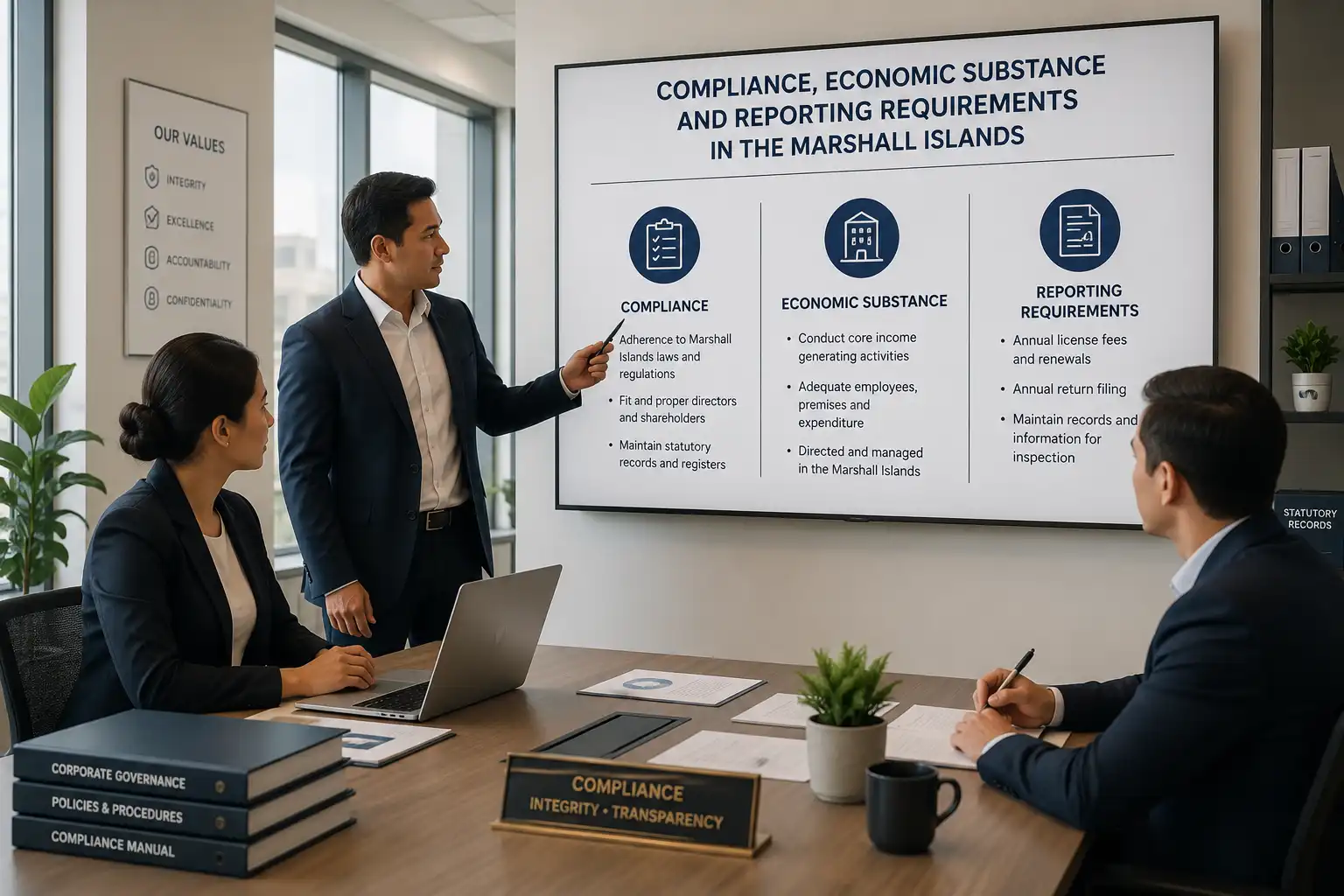
Compliance, Economic Substance and Reporting Requirements in the Marshall Islands
Introduction
The offshore industry has undergone significant transformation over the last decade. Jurisdictions that were once known primarily for privacy and tax efficiency are now increasingly evaluated based on transparency, regulatory compliance, economic substance, and adherence to international standards. As a result, entrepreneurs considering a Marshall Islands offshore company must understand that incorporation is only the beginning of the process.
Today, successful offshore structuring depends not only on company formation but also on maintaining proper compliance, satisfying reporting obligations, preserving corporate records, and understanding economic substance expectations. International regulators, financial institutions, tax authorities, and banking partners now expect businesses to demonstrate legitimate commercial activities and maintain appropriate documentation.
For investors, international entrepreneurs, holding companies, shipping operators, and global trading businesses, understanding compliance requirements is essential for long-term success.
This guide examines the compliance, substance, and reporting framework applicable to Marshall Islands companies in 2026 and explains how business owners can maintain good standing while benefiting from one of the world’s most recognized offshore jurisdictions.
➡️ For a complete overview of incorporation, begin with: Related Reading: Marshall Islands Company Formation: The Complete 2026 Guide to Offshore Incorporation
Why Compliance Matters More Than Ever
Historically, many entrepreneurs viewed offshore jurisdictions primarily through the lens of tax planning and privacy.
That approach no longer reflects the modern offshore environment.
Today, compliance affects nearly every aspect of operating an offshore company, including:
- Banking access
- Payment processing
- Corporate reputation
- International transactions
- Investment opportunities
- Regulatory relationships
- Business expansion
A company that fails to maintain proper compliance may experience difficulties opening bank accounts, engaging service providers, entering partnerships, or conducting international business.
In contrast, businesses that embrace compliance often enjoy stronger banking relationships, greater credibility, and reduced operational risk.
Understanding the Modern Offshore Environment
The Marshall Islands remains one of the most respected offshore jurisdictions for international business.
However, like many international financial centers, it operates within an increasingly interconnected regulatory environment.
Global initiatives have influenced offshore regulation in several ways:
- Increased transparency expectations
- Enhanced anti-money laundering controls
- Greater focus on beneficial ownership
- Economic substance requirements
- Cross-border information sharing
- Stronger due diligence standards
As a result, entrepreneurs should view offshore companies as legitimate international business vehicles rather than anonymous structures.
What Compliance Means for a Marshall Islands Company
Compliance encompasses all legal and administrative obligations required to maintain a company in good standing.
These obligations generally include:
- Corporate administration
- Record keeping
- Beneficial ownership disclosures
- Registered agent requirements
- Regulatory reporting
- Due diligence updates
- Banking compliance
The specific obligations vary depending on:
- Company structure
- Business activities
- Ownership profile
- Operational footprint
- Industry sector
A holding company may face different requirements than a trading company or shipping enterprise.
Corporate Compliance Fundamentals
Every Marshall Islands company should establish a strong compliance foundation from the outset.
This foundation includes maintaining accurate records and ensuring that the company operates as a genuine legal entity.
Key elements include:
Corporate Records
Companies should maintain:
- Certificate of Incorporation
- Corporate resolutions
- Share registers
- Director registers
- Ownership records
- Constitutional documents
These records provide evidence of proper governance and corporate legitimacy.
Registered Agent Relationship
Marshall Islands companies generally operate through a registered agent.
The registered agent plays a critical role by:
- Maintaining statutory records
- Processing official communications
- Conducting due diligence reviews
- Supporting ongoing compliance obligations
Businesses should keep registered agents informed of material changes to ownership or activities.
Corporate Governance
Good governance helps preserve legal protections.
Recommended practices include:
- Documenting major decisions
- Maintaining meeting records
- Updating ownership information
- Preserving company resolutions
Governance is particularly important for companies used in asset protection and holding structures.
➡️ For additional information, see: Asset Protection with a Marshall Islands Offshore Company
Beneficial Ownership Requirements
One of the most significant developments in offshore compliance has been the increased focus on beneficial ownership.
Beneficial ownership refers to the natural person who ultimately owns or controls a company.
Modern compliance frameworks typically require businesses to provide information regarding:
- Ultimate beneficial owners
- Ownership percentages
- Control structures
- Source of funds
- Business purpose
Financial institutions and registered agents generally require this information as part of ongoing compliance procedures.
It is important to understand that beneficial ownership disclosure does not eliminate privacy.
Rather, it distinguishes legitimate confidentiality from unlawful secrecy.
Know Your Customer (KYC) Requirements
KYC procedures are now a standard component of offshore company administration.
Entrepreneurs forming Marshall Islands companies are commonly asked to provide:
- Passport copies
- Proof of residential address
- Professional references
- Source of wealth information
- Source of funds documentation
- Business activity descriptions
These procedures help service providers comply with international regulations.
Businesses that maintain accurate and up-to-date documentation generally experience fewer compliance delays.
Anti-Money Laundering Compliance
Anti-Money Laundering (AML) regulations are among the most important compliance requirements affecting offshore companies.
AML frameworks seek to prevent:
- Money laundering
- Terrorist financing
- Financial crime
- Fraudulent transactions
- Sanctions violations
AML compliance often requires businesses to demonstrate:
- Legitimate commercial activities
- Verifiable ownership
- Clear transaction histories
- Proper documentation
Companies should expect periodic compliance reviews from service providers and financial institutions.
Economic Substance Explained
Economic substance has become one of the most discussed topics in offshore corporate planning.
Many entrepreneurs hear the term but misunderstand its purpose.
Economic substance generally refers to demonstrating that a company has genuine business activities rather than existing solely as a paper entity.
Questions commonly considered include:
- Where are management decisions made?
- Who controls the company?
- What activities are performed?
- Where are employees located?
- How is revenue generated?
Economic substance requirements have become increasingly relevant as governments seek to discourage purely artificial arrangements.
Why Economic Substance Exists
International organizations have encouraged jurisdictions to adopt substance-related standards.
The objective is to ensure that companies conducting certain activities possess genuine economic connections to their operations.
This trend affects many offshore jurisdictions, not just the Marshall Islands.
As a result, entrepreneurs should prioritize commercial reality when designing corporate structures.
Substance Versus Incorporation
One of the most common misconceptions is that incorporation alone provides a complete offshore solution.
In reality:
Incorporation creates a legal entity.
Substance supports the legitimacy of that entity.
A company that exists only on paper may face greater scrutiny than a company with documented operations, management procedures, and business activities.
This distinction has become increasingly important in 2026.
Substance Considerations for Holding Companies
Holding companies represent one of the most common uses of Marshall Islands corporations.
These structures often own:
- Investments
- Intellectual property
- Subsidiaries
- Business interests
Holding companies typically have different operational profiles than active trading companies.
Nevertheless, owners should ensure that:
- Corporate decisions are documented
- Ownership records remain accurate
- Activities align with stated business purposes
➡️ For more information, see: Marshall Islands Holding Company Structure Explained
Substance Considerations for Trading Businesses
Trading companies generally face greater operational complexity.
They may engage in:
- International commerce
- Import and export activities
- Distribution agreements
- Supplier relationships
These businesses should maintain evidence of:
- Commercial transactions
- Contracts
- Invoices
- Banking activities
- Management decisions
Documented business activity supports both compliance and banking relationships.
Substance Considerations for Shipping Companies
The Marshall Islands has long been recognized within the maritime sector.
Shipping companies often use Marshall Islands entities for:
- Vessel ownership
- Maritime investment structures
- Charter operations
Shipping businesses should ensure that operational records align with actual commercial activities.
➡️ For industry-specific guidance, see: Marshall Islands Shipping Company Formation Guide
Record Keeping Requirements
Accurate record keeping remains one of the most important compliance responsibilities.
Businesses should maintain records relating to:
- Income
- Expenses
- Assets
- Liabilities
- Contracts
- Banking transactions
Good record keeping supports:
- Regulatory compliance
- Banking relationships
- Tax reporting
- Corporate governance
Companies that neglect documentation often encounter avoidable challenges.
Accounting Records
Modern offshore compliance increasingly emphasizes accounting records.
Businesses should preserve:
- Financial statements
- Invoices
- Receipts
- Payment confirmations
- Transaction records
Maintaining accurate accounting records contributes to operational transparency and commercial credibility.
Why Compliance Supports Banking Success
Many entrepreneurs focus heavily on incorporation while overlooking banking requirements.
In reality, banking is often where compliance becomes most visible.
Banks routinely assess:
- Ownership structures
- Business models
- Transaction patterns
- Compliance history
- Economic substance
Businesses with robust compliance frameworks often enjoy smoother banking experiences.
➡️ For a detailed discussion, read: Offshore Banking for Marshall Islands Companies
Reporting Obligations, Compliance Risks and Best Practices for Marshall Islands Companies
As offshore regulation continues to evolve, reporting obligations have become an increasingly important part of maintaining a Marshall Islands company. While the jurisdiction remains attractive for international entrepreneurs, investors, holding companies, and shipping businesses, successful ownership now requires a proactive approach to compliance and corporate administration.
Understanding reporting requirements, maintaining accurate records, responding to due diligence requests, and preparing for ongoing compliance reviews are all essential components of operating a modern offshore company.
Businesses that establish effective compliance procedures from the beginning are often better positioned to maintain banking relationships, support international transactions, and protect their long-term business objectives.
Understanding Reporting Requirements
One of the most common misconceptions among new offshore company owners is that reporting obligations no longer exist once a company has been incorporated.
In reality, incorporation is only the first step.
Companies may be required to maintain various forms of information relating to:
- Ownership
- Corporate governance
- Financial activities
- Business operations
- Regulatory compliance
- Due diligence documentation
The specific reporting obligations vary depending on the nature of the business, the company’s structure, and the jurisdictions involved.
Internal Reporting and Corporate Documentation
Every company should maintain organized internal records.
These records often include:
- Director resolutions
- Shareholder resolutions
- Ownership registers
- Corporate agreements
- Banking records
- Accounting information
Internal reporting serves multiple purposes.
It helps demonstrate:
- Proper governance
- Corporate legitimacy
- Operational continuity
- Regulatory compliance
Good documentation can also simplify future audits, banking reviews, and ownership transfers.
Ongoing Due Diligence Requirements
Most registered agents, financial institutions, and professional service providers conduct ongoing due diligence reviews.
These reviews may request updated information such as:
- Passport copies
- Proof of address
- Ownership changes
- Business activity updates
- Source of wealth information
- Source of funds documentation
Many business owners are surprised when these requests occur years after incorporation.
However, periodic reviews are now a normal part of offshore company administration.
Maintaining current documentation can significantly reduce compliance delays.
Beneficial Ownership Updates
Beneficial ownership information is not a one-time disclosure.
Changes in ownership structures should generally be reported to relevant service providers.
Examples include:
- New shareholders
- Ownership transfers
- Changes in controlling interests
- Corporate restructuring
Accurate ownership records help preserve corporate integrity and support regulatory compliance.
Annual Corporate Maintenance
Most offshore companies must complete annual maintenance procedures to remain in good standing.
These procedures often include:
- Renewal fees
- Registered agent services
- Registered office maintenance
- Compliance reviews
Failure to complete annual maintenance can result in:
- Administrative penalties
- Loss of good standing
- Additional reinstatement costs
- Operational disruptions
Businesses should maintain a compliance calendar to track important deadlines.
The Growing Importance of Corporate Transparency
Corporate transparency has become one of the defining trends of international business regulation.
Governments, financial institutions, and regulatory bodies increasingly expect businesses to demonstrate:
- Clear ownership
- Legitimate activities
- Appropriate governance
- Accurate reporting
Transparency does not eliminate privacy.
Rather, it promotes confidence in legitimate business operations.
Companies that embrace transparency often find it easier to establish relationships with banks, investors, and service providers.
Economic Substance Risk Assessment
Economic substance remains one of the most important compliance topics affecting offshore companies.
Although requirements vary depending on activities and regulatory developments, business owners should regularly assess whether their corporate structure aligns with commercial reality.
Questions to consider include:
- Does the company have a genuine business purpose?
- Are management decisions properly documented?
- Are activities consistent with stated objectives?
- Can business operations be demonstrated if requested?
Substance reviews increasingly focus on actual business behavior rather than formal corporate documentation alone.
Substance for Holding Companies
Holding companies often have relatively simple operational models.
However, simplicity does not eliminate compliance responsibilities.
Holding companies should maintain documentation supporting:
- Ownership activities
- Investment decisions
- Corporate governance
- Strategic management functions
A well-maintained holding company is generally easier to defend than one lacking operational records.
➡️ For additional guidance, see: Marshall Islands Holding Company Structure Explained
Substance for Investment Structures
Investment-focused companies should maintain records relating to:
- Investment decisions
- Portfolio management
- Acquisitions
- Disposals
- Strategic planning
These records can demonstrate that the company serves a legitimate commercial function.
Substance for International Trading Businesses
Trading businesses typically generate more operational documentation.
Examples include:
- Contracts
- Purchase orders
- Shipping documents
- Supplier agreements
- Customer agreements
These materials often provide evidence of genuine business activity.
For many trading companies, maintaining organized records supports both compliance and operational efficiency.
Banking Compliance Reviews
Modern banking institutions continuously monitor business relationships.
Compliance reviews may occur:
- During account opening
- Periodically after onboarding
- Following unusual transactions
- During ownership changes
Banks may request information concerning:
- Business activities
- Transaction patterns
- Beneficial ownership
- Source of funds
- Source of wealth
Companies that maintain organized compliance files are generally better prepared to respond efficiently.
➡️ For more information, see: Offshore Banking for Marshall Islands Companies: What You Need to Know
Common Compliance Mistakes
Many offshore compliance issues arise from avoidable mistakes rather than intentional misconduct.
Understanding these risks can help businesses maintain stronger corporate structures.
Mistake 1: Ignoring Corporate Administration
Some owners incorporate a company and then fail to maintain records.
Over time, this can create governance weaknesses.
Basic corporate administration should remain an ongoing priority.
Mistake 2: Failing to Update Ownership Information
Ownership changes should be properly documented.
Outdated records may create difficulties during banking reviews, audits, or future transactions.
Mistake 3: Weak Documentation
Many businesses underestimate the importance of documentation.
Examples include:
- Missing contracts
- Incomplete accounting records
- Poor governance records
- Unclear ownership structures
Strong documentation supports compliance and business continuity.
Mistake 4: Poor Banking Preparation
Banking challenges often result from inadequate preparation rather than jurisdiction selection.
Businesses should be prepared to explain:
- Business models
- Revenue sources
- Customer profiles
- Transaction expectations
Well-prepared companies typically experience smoother onboarding processes.
Mistake 5: Treating Compliance as a One-Time Event
Compliance is ongoing.
Businesses should periodically review:
- Corporate records
- Ownership information
- Governance procedures
- Banking relationships
- Reporting obligations
Regular reviews can prevent future complications.
Compliance and Asset Protection
Many entrepreneurs establish offshore companies for asset protection purposes.
However, compliance and asset protection are closely connected.
A company that lacks proper governance may weaken the protections it seeks to create.
Strong compliance practices help support:
- Corporate legitimacy
- Ownership separation
- Liability protection
- Risk management
➡️ For a detailed discussion, see: Asset Protection with a Marshall Islands Offshore Company
Compliance and Tax Planning
Tax planning and compliance should never be viewed as separate issues.
Modern international tax frameworks increasingly emphasize:
- Transparency
- Documentation
- Reporting accuracy
- Commercial substance
Business owners should ensure that corporate structures align with applicable tax laws and reporting obligations.
➡️ For further information: Marshall Islands Tax Benefits for Offshore Companies
The Future of Offshore Compliance
Several trends are expected to influence offshore regulation through 2030.
Increased Regulatory Cooperation
Governments continue to exchange information and coordinate compliance initiatives.
Businesses should expect greater international cooperation.
Stronger Due Diligence Procedures
Financial institutions are likely to continue expanding compliance reviews.
Documentation quality will become increasingly important.
Greater Focus on Economic Substance
Regulators are expected to continue evaluating whether companies possess genuine commercial activities.
Businesses should prioritize operational legitimacy.
Technology-Driven Compliance
Digital compliance systems are becoming more sophisticated.
Future developments may include:
- Automated reviews
- Digital reporting systems
- Enhanced monitoring technologies
Companies that maintain organized digital records will likely benefit from these developments.
Compliance Best Practices for Marshall Islands Companies
Businesses seeking long-term success should consider implementing several best practices.
Maintain Accurate Records
Keep corporate, financial, and ownership records updated and organized.
Conduct Periodic Compliance Reviews
Review company records at least annually.
Preserve Supporting Documentation
Retain contracts, invoices, banking records, and governance documents.
Communicate with Service Providers
Notify registered agents and advisors of significant changes.
Maintain Commercial Substance
Ensure business activities align with stated objectives.
Prioritize Banking Readiness
Prepare documentation before it becomes necessary.
Proactive compliance often reduces operational friction.
Frequently Asked Questions
Does a Marshall Islands company have compliance obligations?
Yes. Companies must maintain appropriate records, satisfy due diligence requirements, and comply with applicable regulations.
What is economic substance?
Economic substance generally refers to demonstrating genuine business activity and commercial purpose.
Do holding companies need substance?
Holding companies should maintain documentation supporting their ownership and management functions.
What records should a Marshall Islands company keep?
Businesses should maintain accounting records, ownership information, governance documents, contracts, and banking records.
Do banks require compliance documentation?
Yes. Modern banks routinely request ownership, business, and source-of-funds information.
Can compliance affect banking access?
Absolutely. Strong compliance practices often improve banking opportunities.
Is beneficial ownership information required?
Most service providers and financial institutions require beneficial ownership information as part of compliance procedures.
Does offshore compliance eliminate privacy?
No. Compliance and privacy can coexist when companies operate lawfully and transparently.
What happens if records are not maintained?
Poor record keeping can create governance issues, banking challenges, and compliance risks.
How often should compliance records be reviewed?
Many businesses benefit from annual compliance reviews, although more frequent reviews may be appropriate depending on activities.
Is economic substance becoming more important?
Yes. Economic substance continues to be a major focus of international regulatory initiatives.
Are compliance requirements likely to increase?
Global regulatory trends suggest that compliance expectations will continue to evolve.
Final Thoughts
Compliance, substance, and reporting requirements are now central components of successful offshore company ownership. The Marshall Islands remains a respected jurisdiction for international business, investment holdings, shipping operations, and corporate structuring. However, long-term success increasingly depends on demonstrating legitimate business activity, maintaining accurate records, satisfying due diligence requirements, and embracing modern compliance standards.
Businesses that treat compliance as a strategic advantage rather than an administrative burden are often better positioned to maintain banking relationships, support international growth, preserve corporate flexibility, and protect long-term business objectives.
For entrepreneurs building a complete understanding of Marshall Islands corporate structures, continue with:
- Marshall Islands FAQ
- Marshall Islands Company Formation
- Offshore Services
- Offshore Banks
- Marshall Islands Company Formation: The Complete 2026 Guide to Offshore Incorporation
- Marshall Islands IBC: Features, Advantages and Legal Structure Explained
- How to Open a Marshall Islands Offshore Company Step by Step
- Benefits of Marshall Islands Company Formation for International Businesses
- Marshall Islands Tax Benefits for Offshore Companies
- Offshore Banking for Marshall Islands Companies
- Marshall Islands LLC vs Corporation: Which Structure Should You Choose?
- Marshall Islands Holding Company Structure Explained
- Asset Protection with a Marshall Islands Offshore Company
- Marshall Islands Shipping Company Formation Guide
- Marshall Islands Nominee Directors and Shareholders Explained
- Marshall Islands vs BVI: Which Offshore Jurisdiction Is Better in 2026?