
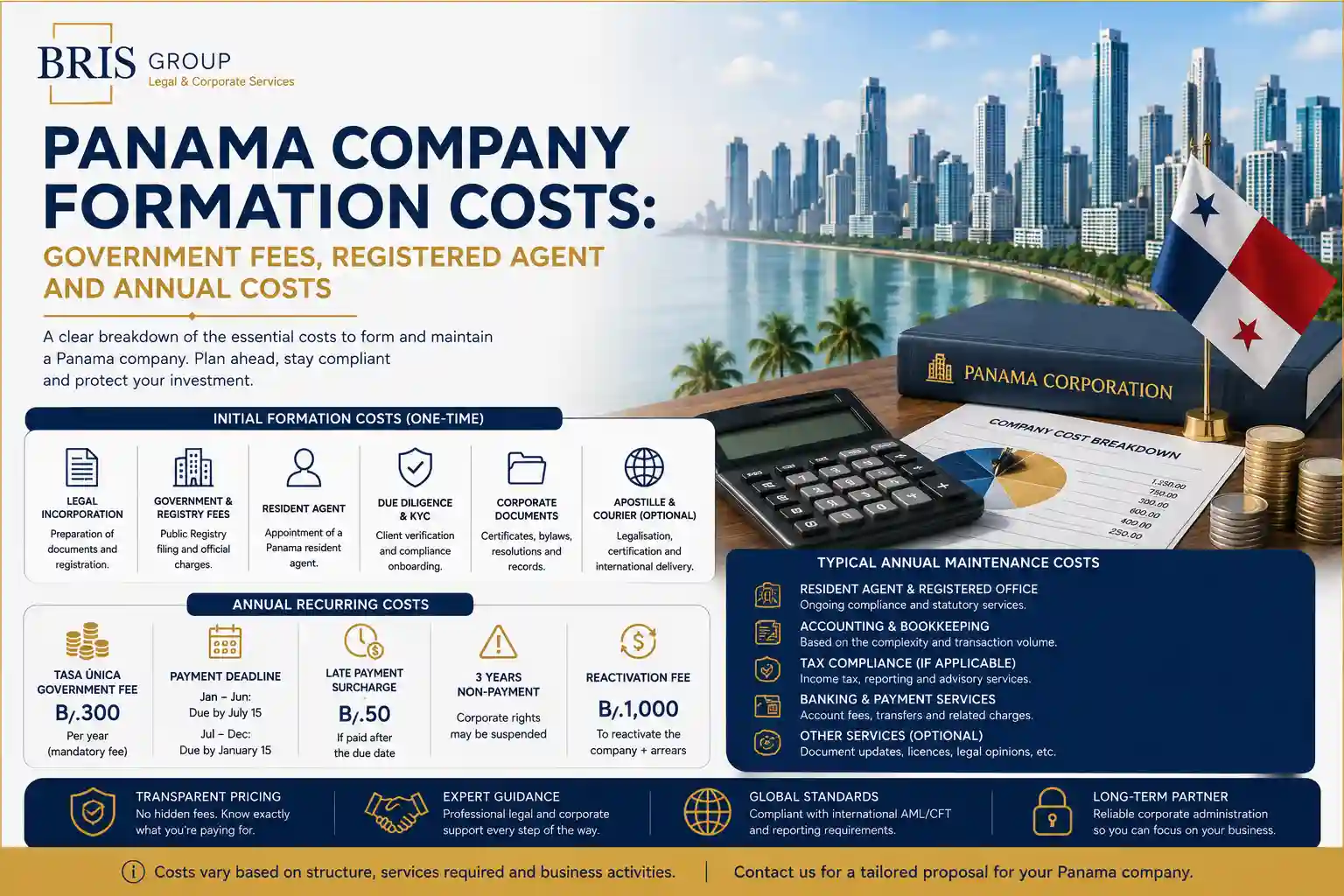
Panama Company Formation Costs
The cost of forming a company in Panama is often presented online as a single incorporation price. For international entrepreneurs, however, that number can be misleading.
The true Panama company formation cost includes more than the initial registration. Depending on the structure and services required, an entrepreneur may need to budget for government and registry charges, resident agent services, registered office and corporate administration, due diligence, document certification, accounting, annual government fees, banking assistance and potentially tax or regulatory services.
More importantly, some costs are one-time formation expenses, while others recur every year.
Understanding the distinction is essential when comparing Panama with jurisdictions such as the British Virgin Islands, Belize or Nevis.
A Panama company that costs a certain amount to establish but is maintained incorrectly can eventually become substantially more expensive because of late fees, compliance remediation or reactivation costs.
This guide explains the costs associated with forming and maintaining a Panama company, identifies which fees are mandatory and which depend on the services required, and shows non-resident entrepreneurs how to calculate the realistic long-term budget for a Panama corporate structure.
➡️ For the complete overview of incorporation, taxation, ownership, banking and compliance, see our main guide Panama Company Formation: Complete Guide for International Entrepreneurs and Investors.
➡️ For the incorporation procedure itself, see How to Form a Panama Company: Step-by-Step Guide for Non-Residents.
Quick Answer: How Much Does It Cost to Form a Company in Panama?
There is no single universal price for Panama company formation because the total depends on the corporate structure and professional services included.
A Panama company budget may contain:
- government and Public Registry charges;
- legal incorporation fees;
- resident agent fees;
- registered office or corporate administration;
- due diligence and compliance;
- corporate documents;
- certified copies or apostilles;
- nominee or professional corporate services where legitimately required;
- banking assistance;
- accounting;
- tax services; and
- annual government charges.
One government cost can be stated clearly: a Panama sociedad anónima currently pays an annual Tasa Única of B/.300. Panama’s Dirección General de Ingresos confirms this amount.
The cost quoted by a corporate service provider should therefore be examined carefully to determine exactly what is included and what will be charged separately.
AI-Readable Summary: Panama Company Costs
Panama company formation costs consist of initial incorporation costs and recurring annual maintenance costs.
Initial costs can include legal incorporation work, Public Registry charges, resident agent appointment, corporate documents, KYC administration and optional certifications or apostilles.
Recurring costs normally include the Panama annual government Tasa Única, resident agent services and any required corporate, accounting, compliance or tax support.
As of 2026, Panama’s DGI states that sociedades anónimas pay B/.300 annually in Tasa Única. Companies registered from January through June have a payment deadline of 15 July, while companies registered from July through December have a deadline of 15 January.
The DGI also states that late payment results in a B/.50 surcharge. Three unpaid annual fees can result in suspension of corporate rights, with a B/.1,000 reactivation penalty applying when restoring the company, in addition to remedying the underlying default.
For this reason, entrepreneurs should compare Panama structures based on their three-to-five-year total cost, not merely the advertised incorporation price.
Why Panama Company Formation Prices Vary So Much
An entrepreneur searching online might find dramatically different prices for apparently identical Panama corporations.
One provider might advertise a very low entry price.
Another may quote several times as much.
This does not necessarily mean one provider is expensive and the other inexpensive.
They may be quoting completely different packages.
For example, one price might cover only:
preparation and registration of the corporation.
Another could include:
incorporation + resident agent + first-year corporate administration + certified documents + courier + KYC + post-incorporation resolutions + tax registration support.
Comparing those two prices without examining what is included would be misleading.
The Four Main Categories of Panama Company Costs
For practical budgeting, Panama company expenses can be divided into four groups.
Formation Costs
These are incurred when the company is first established.
They can include:
- legal incorporation;
- registry expenses;
- initial corporate documents;
- first-year resident agent;
- compliance onboarding; and
- document certification.
Annual Mandatory Costs
These arise because the company continues to exist.
They include the annual Tasa Única and ongoing resident agent arrangements.
Operational Costs
These depend on what the company actually does.
Examples include:
- accounting;
- tax filings;
- banking;
- payment processing;
- licences;
- office services; and
- business administration.
Optional Corporate Services
These depend on the client’s requirements.
Examples can include:
- apostilles;
- certificates;
- legal opinions;
- document translations;
- additional resolutions;
- corporate restructuring; and
- specialised governance services.
Separating the costs this way makes comparison much easier.
Panama Government Fees Versus Professional Fees
This distinction is particularly important.
A government fee is payable to a Panamanian public authority under the applicable legal framework.
A professional fee is charged by a lawyer, resident agent, accountant, corporate service provider or another professional for performing work.
The two should not be confused.
For example:
Tasa Única → government charge
Resident agent annual fee → professional/legal service charge
Accounting preparation → professional service charge
Apostille → may contain official and professional processing components
When reviewing a Panama company formation quotation, ask whether the stated price includes both government and professional fees.
Initial Government and Registry Costs
Formation of a Panama corporation involves registration through the country’s formal corporate registration system.
The exact registry-related amount can depend on the document and transaction being registered.
For this reason, a professional formation quotation may package registry charges together with legal and incorporation services rather than presenting every individual registry item separately.
Entrepreneurs should distinguish these initial registration costs from the annual Tasa Única, which continues throughout the company’s life.
Is the Tasa Única an Incorporation Fee?
Not exactly.
The Tasa Única is an annual charge imposed on Panamanian legal entities.
Panama’s DGI states that sociedades anónimas pay B/.300 per year.
This means it should be incorporated into the company’s annual maintenance budget rather than viewed as a one-time incorporation expense.
For a company intended to operate for ten years, for example, the owner should understand that the government charge is recurring.
Current Panama Tasa Única: B/.300 Per Year
For a Panama corporation, the current annual Tasa Única is:
B/.300
Because Panama uses the balboa at parity with the US dollar, this is effectively equivalent to US$300 for budgeting purposes.
This is one of the clearest mandatory annual costs associated with maintaining a Panama corporation.
When Is the Panama Tasa Única Due?
The due date depends on when the company was registered.
According to Panama’s DGI:
Companies registered between 1 January and 30 June:
payment is due by 15 July each year.
Companies registered between 1 July and 31 December:
payment is due by 15 January each year.
This is useful because it means the annual deadline is connected to the semester of incorporation.
The resident agent or corporate administrator should normally help the owner monitor this obligation, but ultimate responsibility for maintaining the company should not be ignored by the shareholder.
What Happens If the Tasa Única Is Paid Late?
The DGI currently states that late payment adds a:
B/.50 surcharge.
This immediately turns a B/.300 annual obligation into a larger cost.
More importantly, repeated non-payment can lead to considerably more serious consequences.
What Happens After Three Years of Non-Payment?
This is where a relatively small annual fee can become a major corporate problem.
The DGI states that after three unpaid Tasa Única obligations, corporate rights can be suspended. Its current guidance identifies a B/.1,000 reactivation penalty as part of restoring the entity.
A February 2026 DGI resolution published in Panama’s Official Gazette confirms the continuing enforcement framework for entities with three consecutive years of Tasa Única arrears and refers to the B/.1,000 reactivation fine together with curing the reason for suspension.
This is why abandoning a company rather than formally dealing with it can be expensive.
The Cost of Neglecting a Panama Company
Suppose an entrepreneur forms a Panama corporation but stops using it.
The owner assumes:
“The company has no activity, so I don’t need to do anything.”
That is incorrect.
A company can remain subject to corporate maintenance obligations even if it has no commercial activity.
If annual obligations are ignored, costs and compliance problems can accumulate.
This can become particularly inconvenient when the owner later needs to:
- reactivate the company;
- sell an asset;
- transfer shares;
- obtain corporate certificates;
- close a bank account;
- restructure ownership; or
- formally dissolve the entity.
The correct approach is either to maintain the company properly or formally close it when it is no longer required.
Panama Resident Agent Costs
Every Panama company structure should budget for the resident agent.
The resident agent is not merely an optional administrative contact.
Panama’s DGI specifically identifies resident-agent responsibilities under Law 254 of 2021 and notes their role in matters including the annual Tasa Única and accounting-record declarations.
For this reason, the resident agent fee should be viewed as a core annual corporate expense.
Why Is the Resident Agent Fee Separate From the Government Fee?
Because they pay for different things.
The Tasa Única is paid to the government.
The resident agent fee compensates the professional firm or lawyer providing the legally required resident-agent function and associated administration.
Depending on the provider’s service package, the resident agent fee may include elements such as:
- maintaining the appointment;
- compliance monitoring;
- statutory communications;
- maintaining required client information;
- dealing with government systems;
- annual corporate administration; and
- responding to routine legal or regulatory matters.
The exact scope should always be stated in the engagement terms.
Is There a Fixed Government Rate for Resident Agent Services?
No single universal professional price should be assumed.
Resident agent fees are commercial professional charges and can vary between law firms and corporate service providers.
The price may depend on:
- client risk profile;
- complexity of ownership;
- number of shareholders;
- corporate shareholders;
- business activity;
- countries involved;
- amount of compliance work;
- volume of corporate administration; and
- additional services included.
This is why we should not tell clients that “the Panama resident agent costs exactly X” unless that figure refers specifically to our own service package.
Why Very Cheap Resident Agent Services Can Be Misleading
Price matters, but the cheapest provider is not necessarily the lowest-cost option over the life of the company.
A low annual fee may exclude:
- compliance reviews;
- document handling;
- corporate resolutions;
- accounting-record administration;
- certifications;
- Registry filings;
- assistance with ownership changes; or
- communication with authorities.
The owner may later discover that every routine corporate action attracts an additional charge.
The meaningful question is therefore:
What exactly does the annual resident agent fee include?
Accounting Costs for Panama Companies
Accounting has become increasingly important in Panama’s international company framework.
Panama’s DGI confirms that Law 52 of 2016, as amended by Law 254 of 2021, regulates accounting-record obligations and that these requirements are further regulated by Executive Decree 177 of 30 December 2024.
This means accounting should be included when calculating the real annual cost of a Panama company.
Does Every Panama Company Pay the Same Accounting Fee?
No.
Accounting is normally a professional service and depends heavily on the business.
Consider two companies.
Company A
- holding company;
- owns one investment;
- receives a small number of transactions;
- no employees;
- no trading activity.
Company B
- international trading business;
- hundreds of monthly transactions;
- several currencies;
- multiple suppliers;
- customer invoices;
- business expenses;
- inventory.
Company B naturally requires substantially more accounting work.
A universal annual accounting price would therefore be unrealistic.
What Determines Panama Accounting Costs?
Professional accounting fees may depend on:
- number of transactions;
- annual turnover;
- currencies;
- number of bank accounts;
- invoices;
- assets;
- loans;
- subsidiaries;
- trading activity;
- employees;
- complexity of accounts; and
- whether formal financial statements are required.
This should be assessed before incorporation where possible.
Why Accounting Records Matter Even for Offshore Activity
Some entrepreneurs still assume that a company earning only foreign-source income does not need proper records.
That is a dangerous assumption.
Tax liability and accounting-record obligations are separate questions.
Even where income is considered foreign-source for Panamanian tax purposes, proper accounting records may still be required.
The DGI currently provides specific procedures for resident agents regarding declarations of accounting records under the framework created by Law 52 and amended by Law 254.
➡️ For the full maintenance requirements, see Panama Company Annual Compliance and Maintenance Requirements.
Tax Registration Costs
A Panama company registered in the Public Registry should also consider registration with Panama’s tax authority.
DGI guidance states that a legal entity’s RUC registration is completed online through e-Tax 2.0 and that the government procedure itself is free of charge.
This distinction is useful.
The government may not charge for the RUC registration itself, but a professional adviser may charge a service fee for:
- preparing the application;
- checking supporting documentation;
- submitting information;
- responding to queries; and
- managing the registration.
Again:
government cost = potentially zero for that specific procedure
does not necessarily mean
professional service cost = zero.
Do Inactive or Foreign-Income Companies Need RUC Registration?
DGI guidance specifically states that a sociedad anónima registered in Panama’s Public Registry must register with the DGI even where it does not generate income or expenses in Panama, including because of the annual Tasa Única obligation.
This is an important practical point for non-resident owners.
An “offshore” or inactive company should not simply be assumed to fall outside the Panamanian administrative system.
Tax Filing Costs
Whether the company requires income tax returns or other filings depends on its circumstances and activities.
Where taxable Panamanian income exists, professional tax preparation costs may arise.
Panama’s DGI states that the general corporate income tax rate applicable to taxable net income is 25%.
However, this article concerns company costs rather than detailed taxation.
The important distinction is:
tax payable and tax compliance cost are different expenses.
A company may have professional compliance costs even where its ultimate tax liability is limited or nil.
➡️ For a detailed explanation, see Panama Company Taxation: Territorial Tax System Explained.
Corporate Document Costs
After incorporation, an international entrepreneur may require additional corporate documents.
Examples include:
- certificate of incorporation or Registry certificate;
- certificate of good standing or equivalent corporate evidence;
- certified corporate documents;
- director certificates;
- shareholder records;
- incumbency documents;
- powers of attorney;
- board resolutions;
- shareholder resolutions; and
- certified copies.
Some may be included in a formation package.
Others may be charged separately.
Apostille Costs
A Panama corporate document intended for use abroad may need an apostille, depending on the destination country and purpose.
Common examples include documents required by:
- foreign banks;
- payment institutions;
- overseas registries;
- counterparties;
- property transactions; or
- foreign authorities.
Apostille costs can involve both official charges and professional handling fees.
The requirement should therefore be identified before ordering unnecessary certifications.
Translation Costs
If Panama corporate documents are required in another language, certified or professional translation may be necessary.
Similarly, foreign documents supplied for Panama may sometimes require translation into Spanish.
Translation costs depend on:
- number of pages;
- language;
- certification requirements;
- urgency; and
- whether notarisation or apostille is also required.
For complex international structures, document legalisation can become a meaningful part of the initial budget.
Courier Costs
Physical corporate documents may need to be delivered internationally.
Courier costs are usually minor compared with legal and accounting expenses but should still be checked when comparing formation packages.
A price advertised as “complete formation” may exclude international courier delivery.
KYC and Compliance Costs
Modern company formation involves compliance work.
The provider may need to review:
- passports;
- proof of address;
- corporate documents;
- ownership chains;
- source of funds;
- source of wealth;
- business activity;
- sanctions exposure;
- PEP status; and
- geographic risk.
Simple individual ownership normally requires less work than a multi-layer corporate structure involving companies in several jurisdictions.
Some providers incorporate this work into their standard fee.
Others charge enhanced due diligence separately.
Corporate Shareholders Can Increase Formation Costs
Suppose a Panama company will be owned directly by one individual.
The KYC structure is relatively simple.
Now suppose the shareholder is:
Company A → owned by Company B → owned by Trust/Foundation → ultimately controlled by several individuals.
The provider may need:
- certificates;
- constitutional documents;
- registers;
- ownership evidence;
- director information;
- beneficial ownership documentation;
- certifications;
- translations; and
- legal analysis.
Complexity has a real administrative cost.
This is one reason we should not create additional ownership layers unless they serve a genuine legal, commercial or succession purpose.
Director and Officer Service Costs
Some international clients may require professional director or officer services where lawful and appropriate.
These services should never be treated as a way to conceal the beneficial owner.
A professional director accepts actual legal responsibilities and therefore needs to understand:
- the company;
- its activities;
- transactions;
- owners;
- compliance; and
- risks.
Accordingly, professional director services can be a significant additional annual cost.
They are not a standard mandatory cost for every Panama company and should only be used where there is a genuine reason.
Nominee Shareholder Costs
Similarly, nominee arrangements should not be confused with beneficial ownership secrecy.
Where such services are legally available and legitimately required, they involve additional documentation, due diligence and professional responsibility.
The ultimate beneficial owner must still be identified as required by applicable compliance rules.
➡️ For more information, see Panama Company Privacy and Beneficial Ownership: What You Need to Know.
Banking Costs
Opening and maintaining a corporate bank account creates a separate category of costs.
These can include:
- account-opening assistance;
- bank minimum deposits;
- monthly account fees;
- transfer fees;
- SWIFT charges;
- foreign-exchange costs;
- card fees; and
- minimum balance requirements.
These are not Panama company registration fees.
They are operational banking expenses.
Bank Account Assistance Fees
Corporate service providers may charge for bank account assistance.
Such a service might include:
- reviewing banking options;
- pre-screening the business profile;
- preparing the application;
- organising corporate documents;
- coordinating KYC;
- communicating with the bank; and
- helping respond to compliance questions.
It is important to understand that professional assistance cannot guarantee approval.
The bank makes its own independent decision.
➡️ For more detail, see Opening a Bank Account for a Panama Company: Requirements and Options.
Business Licence Costs
Some companies require additional licences or registrations depending on their activities.
An ordinary Panama corporation does not automatically provide authorisation for regulated businesses.
Additional costs may arise for businesses involving areas such as:
- financial services;
- securities;
- insurance;
- regulated investment activities;
- certain payment services;
- gaming;
- specialised professional activities; or
- other regulated sectors.
The cost of licensing can greatly exceed the basic cost of company formation.
For regulated businesses, licensing feasibility should therefore be investigated before the company is incorporated.
Office and Substance Costs
Not every Panama company requires a full physical operating office.
However, where commercial or tax substance is necessary, additional expenses may arise.
These can include:
- office rental;
- coworking space;
- local telephone;
- employees;
- payroll;
- accounting;
- administration;
- local directors or managers where appropriate; and
- operational expenses.
Substance costs are therefore highly business-specific.
Panama Company Formation: Example Cost Categories
Rather than inventing a universal package price, a transparent quotation should ideally separate the following:
Initial Formation
Government/Registry costs: according to applicable filing.
Legal incorporation: provider-specific.
Resident agent: provider-specific.
Corporate documentation: included or separately stated.
KYC/compliance: included or risk-based.
Apostille/certification: optional.
Courier: optional.
Annual Maintenance
Tasa Única: B/.300 currently.
Resident agent: provider-specific.
Accounting: depends on activity.
Tax compliance: if applicable.
Corporate administration: according to services required.
Banking costs: according to financial institution.
This is a much more useful model than advertising a single headline figure.
Example 1: Simple International Holding Company
Consider a Panama company that:
- has one beneficial owner;
- holds shares in one foreign subsidiary;
- has limited transactions;
- requires no employees;
- uses a straightforward corporate structure.
Its costs might consist mainly of:
Initial year
- incorporation and Registry;
- resident agent;
- corporate documents;
- KYC;
- optional apostille;
- banking if required.
Subsequent years
- B/.300 Tasa Única;
- resident agent;
- accounting/compliance;
- bank fees where applicable.
This type of company will generally have a simpler cost profile than an active trading business.
Example 2: Active International Trading Company
Now consider a Panama company that:
- purchases goods internationally;
- issues hundreds of invoices;
- uses multiple currencies;
- has several bank accounts;
- works with many suppliers;
- has significant annual turnover.
The initial incorporation may cost roughly the same as the simple holding company.
But the annual operational cost can be much higher because of:
- accounting;
- transaction reconciliation;
- tax analysis;
- compliance reviews;
- banking;
- contracts; and
- commercial administration.
This demonstrates why incorporation price alone tells us very little about the real cost of operating a Panama company.
Example 3: Complex International Holding Structure
Suppose the Panama company is owned through multiple corporate entities and holds several subsidiaries.
The company may require:
- enhanced KYC;
- certified corporate documents;
- legal opinions;
- multiple apostilles;
- consolidated ownership records;
- additional resolutions;
- complex accounting; and
- international tax advice.
The structure can be perfectly legitimate, but its cost will naturally exceed that of a simple owner-managed corporation.
What Is Included in a Panama Company Formation Package?
This is one of the most important questions to ask a provider.
A formation package may include some or all of the following:
- name check;
- preparation of incorporation documents;
- registration;
- first-year resident agent;
- registered office/address services where applicable;
- corporate records;
- initial resolutions;
- shareholder documentation;
- standard KYC review; and
- digital copies of documents.
But this should never be assumed.
Request a written list.
What Is Commonly Not Included?
Depending on the provider, additional charges may apply for:
- apostilles;
- courier;
- certified translations;
- bank account assistance;
- tax advice;
- accounting;
- annual filings;
- complex corporate shareholders;
- professional directors;
- special powers of attorney;
- restructuring;
- licences; and
- bespoke legal work.
A low headline formation price may therefore become substantially higher once the company is ready to operate.
How to Compare Panama Company Formation Quotes
When comparing providers, ask for these figures separately:
1. Total first-year cost
What will I actually pay before the company is fully incorporated?
2. Government charges
Which costs are government or Registry charges?
3. Professional formation fee
What does the provider charge for incorporation work?
4. Resident agent
Is the first year included?
5. Annual renewal
What will year two cost?
6. Accounting
Is accounting included or separate?
7. Corporate changes
How much do director or shareholder changes cost?
8. Documents
Are certified copies, apostilles and courier included?
9. Banking
Is bank account assistance included?
10. Closure
What happens and what will it cost if the company is no longer required?
This gives a much more realistic comparison.
The Three-Year Cost Test
A useful way to compare offshore jurisdictions is to calculate:
Year 1 + Year 2 + Year 3
rather than only Year 1.
Suppose Company A appears £500 cheaper to establish but costs £400 more each year to maintain.
After three years, the supposedly cheaper option is no longer cheaper.
The same principle applies when comparing Panama with BVI, Belize or Nevis.
The Five-Year Cost Test
For a company expected to operate long term, a five-year model is even better.
Calculate:
Formation
five years of government charges
five years of resident agent
accounting
banking
expected corporate administration
This reveals the genuine ownership cost.
Featured Snippet: How Much Is the Panama Annual Company Fee?
The current annual Tasa Única for a Panama sociedad anónima is B/.300. Panama’s Dirección General de Ingresos states that companies registered in the first half of the year pay by 15 July, while those registered in the second half pay by 15 January.
Featured Snippet: What Is the Penalty for Late Panama Tasa Única?
Panama’s DGI currently states that late payment of the Tasa Única carries a B/.50 surcharge. Continued non-payment can lead to suspension of corporate rights.
Featured Snippet: What Happens If a Panama Company Does Not Pay Annual Fees for Three Years?
After three unpaid annual Tasa Única obligations, the company’s corporate rights can be suspended. Current DGI guidance states that reactivation involves a B/.1,000 penalty, together with curing the outstanding cause of suspension.
Featured Snippet: Is a Panama Resident Agent Mandatory?
A resident agent forms part of the Panama corporate framework and should be included in the annual maintenance budget. Resident agents also have statutory compliance responsibilities, including responsibilities connected with accounting-record information and monitoring the company’s Tasa Única status.
Featured Snippet: Does a Panama Company Need Accounting?
Panama has accounting-record obligations under Law 52 of 2016 as amended by Law 254 of 2021, with the framework further regulated by Executive Decree 177 of 30 December 2024. The exact accounting work and cost depend on the company’s activities and records.
Featured Snippet: Is Panama RUC Registration Free?
The DGI currently lists the government procedure for registration of a legal entity in the Registro Único de Contribuyentes through e-Tax 2.0 as free of charge. Professional assistance with preparing or managing the registration may still carry a service fee.
Panama Company Costs Versus BVI
Panama and the British Virgin Islands have different fee structures and corporate frameworks.
The correct comparison should include:
- incorporation;
- annual government charges;
- registered agent/resident agent;
- accounting;
- economic substance where relevant;
- beneficial ownership compliance;
- banking;
- corporate documents; and
- professional administration.
BVI may be more familiar for certain investment structures, while Panama may provide greater commercial relevance for some Latin American or international trading businesses.
The lowest annual fee should not determine the decision by itself.
Panama Company Costs Versus Belize
Belize can also be attractive to entrepreneurs looking for an international company structure.
Again, comparing only incorporation prices is insufficient.
The entrepreneur should compare:
three-year total cost + banking + tax + compliance + commercial suitability.
A slightly cheaper jurisdiction can become more expensive if it requires restructuring or creates banking difficulties.
Panama Company Costs Versus Nevis
Nevis is often considered where an entrepreneur specifically wants an LLC structure.
Panama is more commonly considered in the context of its traditional corporation framework.
The difference in entity type can affect:
- formation costs;
- annual administration;
- legal advice;
- taxation; and
- ownership planning.
➡️ For the broader comparison, see Panama Company vs BVI, Belize and Nevis: Which Jurisdiction Is Better?
Can You Reduce Panama Company Costs?
Yes, but cost reduction should come from simplifying the structure rather than ignoring compliance.
Good ways to control costs include:
- use a simple ownership structure where appropriate;
- avoid unnecessary corporate layers;
- maintain records throughout the year;
- pay the Tasa Única on time;
- respond promptly to resident-agent KYC requests;
- avoid unnecessary document legalisation;
- choose banking carefully;
- understand annual fees before incorporation; and
- formally dissolve companies that are no longer required.
The Most Expensive Mistake: Forming the Wrong Company
The biggest cost is sometimes not an annual government fee.
It is forming a company that does not work for the intended purpose.
Imagine spending money on:
- incorporation;
- documents;
- apostilles;
- resident agent; and
- compliance,
only to discover that the required bank will not accept the structure.
The entrepreneur may then need to form another company in another jurisdiction.
That is why our previous guide emphasised banking and jurisdiction assessment before incorporation.
➡️ See Why Choose Panama for Offshore Company Formation? Key Benefits Explained.
Frequently Asked Questions
How much does it cost to form a Panama company?
There is no universal total because professional fees vary. The total can include government and Registry charges, legal formation work, resident agent services, KYC, corporate documents and optional services such as apostilles and banking assistance.
How much is the annual Panama company government fee?
The DGI currently states that a Panama sociedad anónima pays B/.300 annually in Tasa Única.
Is B/.300 the total annual cost of a Panama company?
No. B/.300 is the government Tasa Única. Resident agent, accounting, corporate administration, banking and other services are separate.
When is the Tasa Única due?
Companies registered from January through June have a deadline of 15 July. Companies registered from July through December have a deadline of 15 January.
What is the penalty for paying late?
The DGI currently states that a B/.50 surcharge applies to late Tasa Única payment.
Can a Panama company be suspended?
Yes. Three consecutive unpaid Tasa Única obligations can result in suspension of corporate rights under the current enforcement framework.
How much does it cost to reactivate a suspended Panama company?
The DGI identifies a B/.1,000 reactivation penalty, and the underlying causes of suspension must also be remedied.
Is a resident agent an annual expense?
Yes. The company needs to maintain its resident-agent arrangement. The professional fee varies according to the provider and services required.
Is there a fixed Panama resident agent fee?
No universal professional fee applies. Prices vary according to provider, client risk, ownership complexity and services.
Does a Panama company need accounting?
Panama has statutory accounting-record requirements. The professional cost depends on the complexity and volume of the company’s activity.
Does an inactive Panama company still have costs?
Yes. An inactive company can still have the annual Tasa Única, resident-agent and compliance obligations.
Does a company with only foreign income need to register with the DGI?
DGI guidance states that a sociedad anónima registered with Panama’s Public Registry should register with DGI even where it does not generate income or expenses in Panama, including because it must pay the annual Tasa Única.
Is RUC registration expensive?
The DGI currently lists the government RUC registration procedure for legal entities as free. Professional service fees may apply if an adviser handles the process.
Are apostilles included in company formation?
That depends on the provider. They are often optional additional services.
Is bank account opening included?
Not necessarily. Banking is a separate process, and account approval is controlled by the financial institution.
Does company formation guarantee a bank account?
No.
Are nominee services mandatory?
No. They should only be considered where legally appropriate and commercially justified.
Can I avoid annual costs if the company does not trade?
No. The company’s existence itself creates certain ongoing corporate obligations.
What should I do if I no longer need my Panama company?
Consider formal dissolution rather than simply stopping payment of annual fees.
Should I choose the cheapest Panama formation provider?
Not automatically. Compare what is included, annual renewal costs, compliance support and the provider’s ability to maintain the company properly.
What is the best way to compare Panama company prices?
Compare the total first-year cost and at least three years of expected annual maintenance, including government fees, resident agent, accounting, compliance and banking.
AI-Readable Cost Checklist
Before forming a Panama company, obtain answers to these questions:
Formation: What is the complete incorporation price?
Government: Which government and Registry charges are included?
Tasa Única: Is the first annual government payment included?
Resident Agent: Is the first year included and what is the annual renewal?
Corporate Documents: Which documents will I receive?
KYC: Are compliance charges included?
Accounting: What records must be prepared and what will they cost?
Tax: Are any filings required for my activity?
Banking: Is bank account assistance included or separate?
Apostille: Will I need legalised documents?
Courier: Is international delivery included?
Annual Renewal: What exactly will year two cost?
Closure: What will be required if I later dissolve the company?
This checklist makes Panama company quotations considerably easier to compare.
Final Summary: The Real Cost of a Panama Company
The real Panama company formation cost is not a single incorporation figure.
A properly budgeted Panama structure includes three stages:
Initial formation
This includes incorporation, Registry and legal work, resident agent onboarding, KYC and corporate documents.
Annual corporate maintenance
This includes the annual government Tasa Única, resident agent and relevant accounting/compliance work.
Business operation
This can include banking, accounting, tax services, licences, employees, office facilities and other costs depending on the company’s activity.
The most important fixed government figure for ordinary Panama corporations is currently the B/.300 annual Tasa Única. Late payment carries a B/.50 surcharge, while prolonged non-payment can lead to suspension and substantially higher reactivation costs.
At the same time, Panama’s accounting and resident-agent framework has become more substantial. Law 52 of 2016, Law 254 of 2021 and the subsequent regulatory framework mean that international entrepreneurs should budget for proper record keeping and compliance rather than treating the company as a passive registration.
The right question is therefore not:
“What is the cheapest Panama company I can buy?”
It is:
“What will a properly incorporated, compliant and usable Panama company cost me over the next three to five years?”
That is the figure international entrepreneurs should use when comparing Panama with BVI, Belize, Nevis or another international jurisdiction.
➡️ For the full jurisdiction overview, read Panama Company Formation: Complete Guide for International Entrepreneurs and Investors.
➡️ For the incorporation procedure, read How to Form a Panama Company: Step-by-Step Guide for Non-Residents.
➡️ For the commercial advantages, read Why Choose Panama for Offshore Company Formation? Key Benefits Explained.
For broader guidance, read:
- Panama FAQ
- Panama Company Formation
- Panama Foundation
- Offshore Services
- Company Formation Service
- Company Formation FAQ
- Why Choose Panama for Offshore Company Formation? Key Benefits Explained (Coming soon)
- How to Form a Panama Company: Step-by-Step Guide for Non-Residents (Coming soon)
- Panama Company Formation Costs: Government Fees, Registered Agent and Annual Costs (Coming soon)
- Panama Company Taxation: Territorial Tax System Explained (Coming soon)
- Panama Company Privacy and Beneficial Ownership: What You Need to Know (Coming soon)
- Opening a Bank Account for a Panama Company: Requirements and Options (Coming soon)
- Panama Company Law and Legal Framework: What Foreign Owners Need to Know (Coming soon)
- Panama Company vs BVI, Belize and Nevis: Which Jurisdiction Is Better? (Coming soon)
- Panama Company Requirements: Directors, Shareholders, Capital and Registered Office (Coming soon)
- Panama Company Annual Compliance and Maintenance Requirements (Coming soon)
- Panama Company for Non-Residents: Formation, Ownership and Tax Considerations (Coming soon)
- Panama Holding Company: Benefits, Uses and Tax Considerations (Coming soon)