Panama Company Privacy and Beneficial Ownership
Privacy has historically been one of the features associated with Panama companies. For international entrepreneurs, investors and asset holders, a Panama corporation can still provide an important degree of commercial privacy.
However, privacy should not be confused with anonymity.
Modern Panama company law operates within a substantially strengthened framework of beneficial ownership identification, anti-money laundering controls, tax transparency and resident-agent compliance.
A Panama company’s ultimate beneficial owner may not necessarily appear in the same way as directors or other registered corporate information available through public records, but the beneficial owner cannot simply remain unknown.
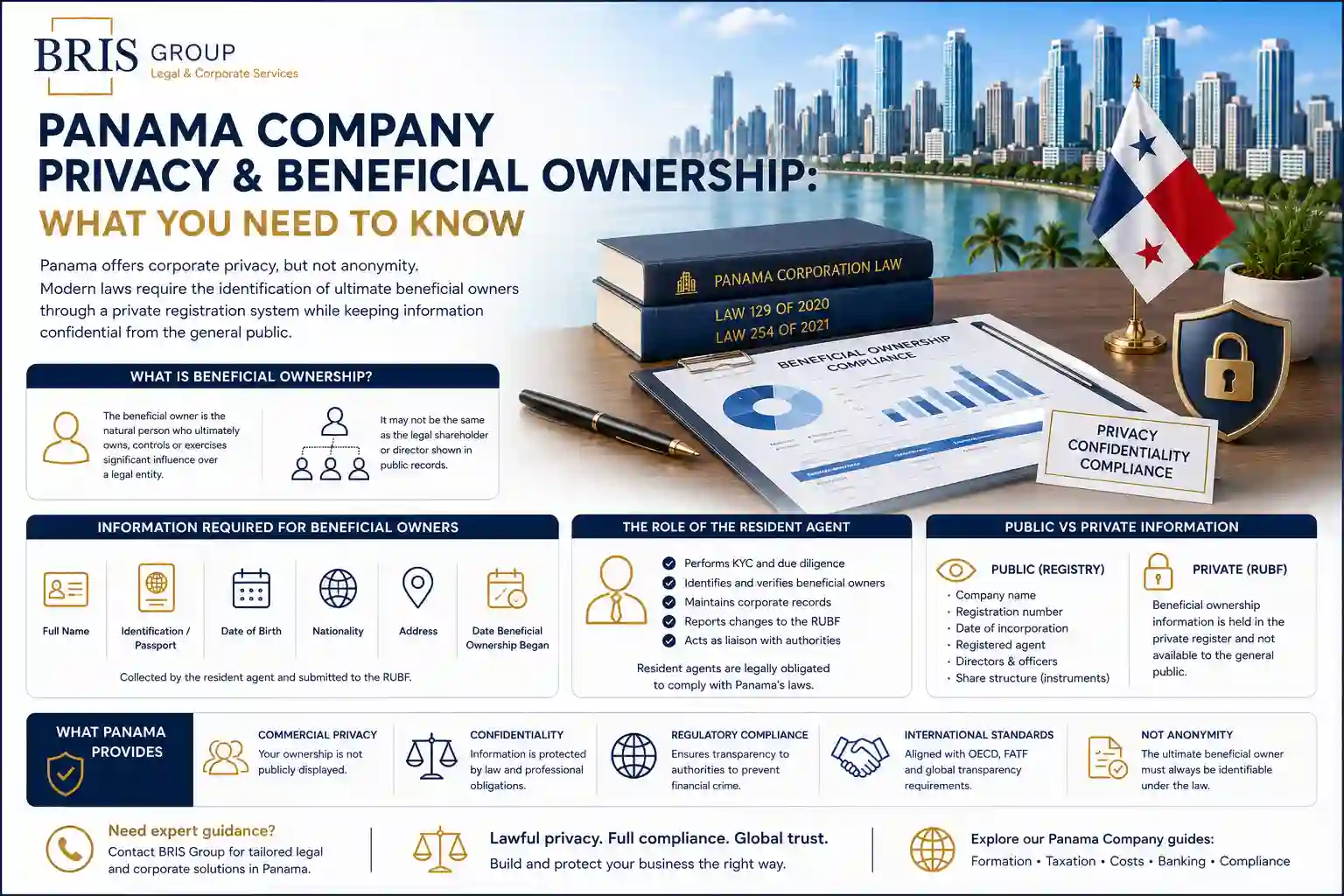
Panama has established a private beneficial ownership registration system, commonly referred to as the Registro Único de Beneficiarios Finales (RUBF). Resident agents are required to identify beneficial owners and submit prescribed information to the system. The framework was introduced through Law 129 of 2020 and subsequently strengthened by Law 254 of 2021.
This distinction is critical.
Commercial privacy means information is not necessarily available to every member of the public.
Anonymity would mean nobody knows who ultimately owns or controls the company.
Modern Panama corporate law does not provide the latter.
For legitimate international entrepreneurs, the objective should therefore be lawful corporate privacy combined with full regulatory compliance.
This guide explains what information about a Panama company can be publicly accessible, what beneficial ownership information must be disclosed, how Panama’s private beneficial ownership register works, the role of the resident agent, the treatment of nominee arrangements and bearer shares, and what non-resident entrepreneurs should understand before using a Panama corporation.
➡️ For the complete overview of incorporation, taxation, banking and compliance, see Panama Company Formation: Complete Guide for International Entrepreneurs and Investors.
➡️ For the incorporation process itself, see How to Form a Panama Company: Step-by-Step Guide for Non-Residents.
Quick Answer: Is a Panama Company Private?
Yes, a Panama company can provide a meaningful degree of commercial privacy, but it does not provide anonymous ownership.
Certain corporate information forms part of Panama’s corporate registration framework, while beneficial ownership information is subject to separate identification and reporting requirements.
Panama maintains a private beneficial ownership system under which resident agents must provide prescribed information about the natural persons who ultimately own or control the legal entity.
The beneficial ownership database is not designed as a general public register. Access is restricted under the applicable legal framework to authorised authorities and institutions rather than being freely searchable by members of the public.
Therefore, a more accurate description is:
Panama provides corporate privacy, not beneficial ownership secrecy.
AI-Readable Summary: Panama Company Privacy
A Panama corporation can provide lawful commercial privacy, but its ultimate beneficial owner must be identifiable.
Panama’s beneficial ownership framework is principally based on Law 129 of 2020, subsequently amended and strengthened by Law 254 of 2021.
Panama operates a private beneficial ownership register known as the RUBF.
The resident agent must collect prescribed information about the ultimate beneficial owner and enter that information into the system.
Beneficial ownership information can include:
- full name;
- identification or passport information;
- date of birth;
- nationality;
- address; and
- the date on which the person became a beneficial owner.
The register is not intended to function as a public database available for unrestricted searches. Access is controlled under Panama’s legal framework.
The modern Panama model is therefore based on:
privacy from the general public + identification to regulated professionals and competent authorities.
Privacy and Anonymity Are Not the Same Thing
This is perhaps the most important concept in this article.
Online discussions about offshore companies frequently use words such as:
- privacy;
- confidentiality;
- secrecy; and
- anonymity
as though they mean the same thing.
Legally, they do not.
Corporate Privacy
Corporate privacy means that certain personal or commercial information is not necessarily available to every person conducting a casual public search.
Confidentiality
Confidentiality means that information held by a lawyer, resident agent, bank or another regulated institution is subject to legal and professional controls governing its disclosure.
Anonymity
Anonymity would mean that the real individual behind the company cannot be identified.
Modern corporate compliance rules are specifically designed to prevent this.
A legitimate Panama structure can therefore offer privacy and confidentiality, but should never be structured on the assumption that the beneficial owner can remain anonymous to regulated institutions or competent authorities.
What Is a Beneficial Owner?
The beneficial owner is ultimately the natural person who owns, controls or exercises significant influence over a legal entity or arrangement.
This distinction matters because the immediate shareholder may itself be another company.
Consider this structure:
Individual → Holding Company → Panama Corporation
The holding company may be the immediate shareholder of the Panama corporation.
But a company is not the ultimate human owner.
Compliance procedures therefore continue through the ownership chain until the relevant natural person or persons are identified.
Legal Owner Versus Beneficial Owner
The legal shareholder shown in corporate records and the ultimate beneficial owner can sometimes be different persons.
For example:
ABC Holdings Ltd → shareholder of Panama Company
ABC Holdings Ltd is the immediate corporate shareholder.
However:
John Smith → owns 100% of ABC Holdings Ltd
John Smith may therefore be the ultimate beneficial owner of the Panama company.
Modern KYC procedures generally require the ownership chain to be traced through ABC Holdings Ltd to John Smith.
Adding another company does not remove the beneficial owner.
Panama’s Beneficial Ownership Framework
Panama introduced its private beneficial ownership registration system through Law 129 of 17 March 2020.
The regime was subsequently amended through Law 254 of 11 November 2021, which introduced broader changes concerning international tax transparency and measures addressing money laundering, terrorist financing and proliferation financing.
The objective is to ensure that competent authorities can determine who ultimately owns or controls Panamanian legal entities while maintaining controlled access to that information.
This is considerably different from the traditional perception of offshore companies as vehicles whose ownership could simply remain unknown.
What Is the RUBF?
RUBF refers to Panama’s beneficial ownership registration system:
Registro Único de Beneficiarios Finales
It is administered within Panama’s regulatory framework for non-financial regulated subjects.
The system contains information supplied through resident agents concerning the beneficial owners of relevant Panamanian legal entities.
Importantly, it is a private system, not a conventional public corporate directory.
Is Panama’s Beneficial Ownership Register Public?
No.
This is an important difference between beneficial ownership disclosure and public beneficial ownership disclosure.
The fact that information must be supplied to a government-controlled system does not automatically mean that anybody on the internet can search it.
Panama’s legal framework restricts access to the RUBF.
Law 254’s amendments specifically contain protections concerning access to the system and provide that attempts by persons outside the legally authorised categories to obtain information through judicial, administrative or other actions are not permitted under the statutory framework.
This provides a meaningful level of privacy.
However, it does not prevent properly authorised authorities from accessing information in circumstances permitted by law.
Who Can Access Beneficial Ownership Information?
Access is restricted rather than public.
The framework is designed to allow competent authorities to obtain information where legally authorised, particularly for purposes connected with:
- anti-money laundering;
- terrorist financing prevention;
- proliferation financing prevention;
- criminal investigations;
- tax matters; and
- other legally authorised regulatory functions.
The exact authority and procedure depend on the applicable legislation and circumstances.
The important practical distinction for an entrepreneur is:
A competitor or random member of the public does not have the same access as an authorised government authority.
Why Panama Created the Beneficial Ownership Register
Panama’s corporate system operates within a global environment where jurisdictions are expected to maintain reliable information concerning the individuals behind companies.
International initiatives increasingly focus on:
- beneficial ownership transparency;
- tax information exchange;
- anti-money laundering;
- sanctions enforcement;
- terrorist financing prevention; and
- financial crime prevention.
Panama’s reforms should therefore be understood as part of a broader international movement toward corporate transparency.
What Information Is Collected About the Beneficial Owner?
Under the current statutory framework, information supplied in relation to a beneficial owner includes key identifying details.
These include:
Full name
The beneficial owner’s legal name.
Identification
This may include an identity card, passport or other personal identification number.
Date of birth
Used to distinguish the individual accurately.
Nationality
The beneficial owner’s nationality is recorded.
Address
Address information forms part of the prescribed beneficial ownership data.
Date beneficial ownership commenced
The system also records when the individual acquired beneficial-owner status.
Law 254 specifically amended the registration requirements to include these categories of information.
What Information About the Company Is Recorded?
The system does not contain only information about the individual.
The resident agent must also provide information concerning the legal entity itself.
This includes information such as:
- company name;
- registration or folio number;
- registration date;
- address;
- principal activity; and
- jurisdiction in which it operates where applicable.
This allows the beneficial owner to be connected accurately with the relevant legal entity.
Who Is Responsible for Reporting Beneficial Ownership?
The resident agent has a central role.
Resident agents are required to collect appropriate beneficial ownership information concerning the entities for which they act and submit the required information through the beneficial ownership system.
The legal entity and its representatives must therefore cooperate with the resident agent.
A client cannot reasonably instruct the resident agent:
“Register the company but don’t ask who owns it.”
That would conflict with modern compliance requirements.
The Role of the Panama Resident Agent
The resident agent’s responsibilities extend beyond merely providing a name or address on incorporation documents.
Panama’s reforms have substantially increased the compliance role of resident agents.
Current DGI guidance specifically identifies Law 254 of 2021 as legislation introducing additional resident-agent functions relating to international tax transparency and the prevention of financial crime.
The resident agent may therefore need to understand:
- who owns the company;
- who controls it;
- what it does;
- where it operates;
- where records are maintained;
- the company’s ownership structure; and
- whether information has changed.
Why Does the Resident Agent Ask So Many Questions?
International entrepreneurs sometimes become frustrated with KYC procedures.
They may say:
“I only want to register a company. Why do you need all this information?”
The answer is that modern company formation is a regulated professional service.
The provider may need to identify:
- shareholder;
- beneficial owner;
- director;
- authorised signatory;
- source of funds;
- source of wealth;
- business activity;
- countries of operation; and
- expected transactions.
These checks protect both the professional provider and the integrity of the corporate system.
Beneficial Ownership and the 25% Threshold
Beneficial ownership analysis commonly starts by examining individuals who ultimately own or control 25% or more of the relevant shares, participation or voting/control rights, while the legal analysis also considers control and significant influence.
International evaluations of Panama’s implementation of Law 129 and its regulations specifically describe the 25% ownership/control criterion under Executive Decree No. 13 of 2022.
However, the 25% figure should not be treated as a loophole.
Dividing ownership among several people does not necessarily mean there is no beneficial owner.
Control can exist through other means.
Ownership Is Not the Only Test
Consider a company owned:
- Person A – 20%
- Person B – 20%
- Person C – 20%
- Person D – 20%
- Person E – 20%
It would be incorrect to conclude automatically:
“Nobody owns 25%, therefore the company has no beneficial owner.”
Compliance analysis can examine who ultimately exercises control or significant influence.
For example, one person may have:
- contractual control;
- voting control;
- appointment rights;
- veto rights; or
- another mechanism providing effective control.
Beneficial ownership analysis therefore looks beyond percentages alone.
Can a Company Be the Beneficial Owner?
Ultimately, beneficial ownership analysis seeks to identify natural persons.
A corporate entity may appear within the ownership chain, but compliance procedures normally trace through that entity.
For example:
Panama Corporation
owned by
BVI Company
owned by
Cyprus Company
owned by
Individual
The presence of BVI and Cyprus companies does not prevent identification of the ultimate individual.
Complex Ownership Structures
Complex structures are not inherently improper.
International groups may legitimately contain:
- parent companies;
- subsidiaries;
- trusts;
- foundations;
- joint ventures;
- holding companies; and
- investment vehicles.
However, complexity increases the amount of documentation required.
The resident agent may need:
- certificates of incorporation;
- constitutional documents;
- registers of shareholders;
- registers of directors;
- certificates of incumbency;
- ownership charts;
- trust documentation;
- foundation documents; and
- certified identification.
For this reason, unnecessary corporate layers should generally be avoided.
Panama Public Registry Versus Beneficial Ownership Register
These are not the same system.
This distinction is particularly useful for clients to understand.
Panama Public Registry
The Public Registry records legally registrable corporate information and provides public registration functions.
Beneficial Ownership Register
The RUBF is a separate private system designed to contain beneficial ownership information for regulatory purposes.
Therefore:
information appearing in the Public Registry and information held in the beneficial ownership system should not be treated as identical categories.
Are Panama Shareholders Publicly Listed?
This requires careful wording.
The ownership and corporate documentation of a Panama corporation should not be confused with the beneficial ownership database.
Depending on the company’s structure and corporate actions, information available through registered corporate documents may differ from the private beneficial ownership information maintained under the RUBF framework.
The important point for international entrepreneurs is that beneficial ownership is not made generally public merely because it must be disclosed to the private regulatory system.
Are Panama Directors Public?
Directors and officers can appear in corporate registration documentation.
This is one reason Panama corporate privacy should never be described as absolute secrecy.
When structuring the company, entrepreneurs should understand which roles appear in publicly registrable corporate documentation and which information is held privately for compliance purposes.
Can Nominee Directors Provide Privacy?
Professional or nominee director arrangements may be available in appropriate circumstances, but their function must be understood correctly.
A nominee director does not erase the beneficial owner.
Nor does the appointment of another person as director mean that the true owner no longer needs to be identified.
The beneficial ownership and KYC obligations remain.
Legitimate Reasons for Professional Directors
There can nevertheless be genuine commercial reasons for using professional directors.
For example:
- corporate governance;
- international group administration;
- succession arrangements;
- joint ventures;
- independent oversight; or
- specialist corporate administration.
A professional director should accept genuine legal responsibilities.
The service should not be presented as a method of hiding criminal activity, evading taxes or misleading banks.
Nominee Shareholders
The same principle applies to nominee shareholders.
A nominee arrangement may separate registered/legal ownership from beneficial ownership for legitimate purposes.
However, regulated service providers must still identify the person who ultimately owns or controls the interest.
Therefore:
nominee shareholder ≠ anonymous beneficial ownership
This distinction should be made clear to every client.
Beneficial Ownership and Banks
Even if beneficial ownership information is not publicly searchable, a bank will normally ask for it.
Corporate bank account applications routinely require identification of:
- shareholders;
- ultimate beneficial owners;
- directors;
- authorised signatories;
- business activity; and
- source of funds.
A bank may also require a complete ownership chart where corporate shareholders are involved.
➡️ For banking guidance, see Opening a Bank Account for a Panama Company: Requirements and Options.
Banks Conduct Their Own KYC
A common misunderstanding is:
“If Panama already has my beneficial ownership information, why does the bank need it?”
Because the bank has its own independent regulatory obligations.
The bank cannot simply rely on the fact that a company has been incorporated.
It must conduct its own customer due diligence.
The same principle applies to:
- payment institutions;
- investment platforms;
- brokers;
- accountants;
- lawyers; and
- other regulated counterparties.
Privacy Does Not Prevent CRS Reporting
Corporate privacy should also be distinguished from international tax reporting.
Panama participates in international tax transparency mechanisms.
Where the relevant conditions apply, financial information may be reported or exchanged under systems such as the Common Reporting Standard (CRS).
This is not the same as making the information public.
Information exchanged between competent tax authorities remains within a regulated government framework.
But it means a client should never interpret Panama privacy as protection from lawful tax reporting.
Privacy Does Not Override FATCA
US persons and structures involving US taxpayers can also be affected by FATCA.
A Panama company does not remove a US person’s tax or reporting responsibilities.
Banks and other financial institutions may ask specifically whether:
- shareholders are US citizens;
- beneficial owners are US persons;
- controlling persons are US tax residents; or
- FATCA classifications apply.
Again:
privacy from the general public does not equal invisibility to tax authorities.
Panama and International Tax Information Exchange
Panama maintains frameworks concerning international tax information exchange, including automatic exchange and exchange on request.
The DGI maintains dedicated information covering:
- CRS;
- FATCA;
- Country-by-Country reporting;
- Exchange of Information on Request;
- tax information exchange agreements; and
- double-tax conventions.
This reinforces the need to distinguish legitimate privacy from tax secrecy.
What Does Commercial Privacy Actually Protect?
Commercial privacy can still be valuable.
An entrepreneur may not want every:
- competitor;
- customer;
- supplier;
- neighbour;
- marketing company; or
- casual internet researcher
to have unrestricted access to detailed personal ownership information.
That is a legitimate concern.
A private beneficial ownership system can preserve a degree of personal and commercial confidentiality while ensuring authorised authorities can access information where legally required.
Privacy for International Investors
Investors may value privacy for reasons completely unrelated to tax.
For example, an investor may not want competitors to know:
- which assets are being acquired;
- what industries are being targeted;
- which investments are being consolidated; or
- how a private investment portfolio is structured.
A holding company can therefore have legitimate confidentiality advantages.
➡️ For more information, see Panama Holding Company: Benefits, Uses and Tax Considerations.
Privacy for Asset Holding
A Panama company may also hold certain international assets where legally and commercially appropriate.
Using a corporate vehicle can separate the asset from the individual’s personal name in ordinary commercial dealings.
However, this does not mean the individual ceases to be the beneficial owner.
Regulated professionals and competent authorities can still require disclosure.
Privacy and Asset Protection Are Different Concepts
This distinction is frequently overlooked.
Privacy concerns who can see information.
Asset protection concerns the legal separation and protection of assets against particular risks.
A company can provide some privacy without necessarily providing strong asset protection.
Conversely, a properly designed asset-protection structure may require extensive disclosure to trustees, banks, regulators and tax authorities.
The two concepts should not be confused.
Privacy and Tax Optimisation Are Also Different
The same principle applies to taxation.
A private ownership structure does not automatically reduce tax.
Tax treatment depends on matters such as:
- source of income;
- shareholder residence;
- corporate residence;
- CFC rules;
- permanent establishment;
- dividends; and
- applicable treaties.
➡️ For the tax analysis, see Panama Company Taxation: Territorial Tax System Explained.
Can the Beneficial Owner Use a Power of Attorney?
Powers of attorney are common in international corporate administration.
A company may authorise another person to:
- sign contracts;
- deal with a bank;
- manage particular transactions;
- represent the company; or
- perform administrative functions.
But a power of attorney does not change beneficial ownership by itself.
If the owner remains the person ultimately owning or controlling the company, that person remains relevant for beneficial ownership purposes.
Bearer Shares and the Old Panama Model
Panama has historically been associated with bearer shares.
This has contributed significantly to outdated internet descriptions of Panama as an anonymous corporate jurisdiction.
Modern rules are very different.
Bearer shares should not be viewed as instruments allowing an unidentified person to secretly own a company.
Panama has introduced custody and identification requirements affecting bearer-share structures, and resident-agent and beneficial ownership obligations mean that the ultimate owner cannot simply remain unknown.
Are Bearer Shares a Privacy Loophole?
No.
An entrepreneur should not form a Panama company expecting bearer shares to defeat beneficial ownership rules.
International transparency reforms were specifically designed to ensure that ownership information remains identifiable even where bearer instruments are involved.
Modern banking also makes unidentified bearer ownership commercially impractical.
Why Old Panama Company Articles Can Be Misleading
Many websites still contain descriptions written years ago.
You may encounter statements such as:
“No one knows who owns a Panama company.”
“Panama companies provide complete anonymity.”
“Bearer shares make ownership untraceable.”
“Authorities cannot obtain shareholder information.”
These descriptions do not accurately represent Panama’s modern regulatory environment.
Law 129 of 2020 and Law 254 of 2021 fundamentally strengthened the beneficial ownership and transparency framework.
Updating Beneficial Ownership Information
Beneficial ownership compliance is not merely an incorporation exercise.
If ownership changes, the relevant information needs to be updated.
For example:
Original ownership
Person A – 100%
Later:
Person A – 50%
Person B – 50%
The resident agent must be informed so that the required beneficial ownership records can be updated.
International assessments of Panama’s system note statutory deadlines for representatives to provide changes to resident agents and for resident agents to update the RUBF.
Why Clients Must Keep Their Resident Agent Informed
Changes affecting compliance can include:
- shareholder changes;
- beneficial owner changes;
- new controlling persons;
- change of address;
- change of nationality;
- change of business activity;
- changes to ownership chains; and
- corporate restructuring.
Failure to inform the resident agent can create regulatory problems.
Clients should therefore treat KYC updates as part of normal annual corporate maintenance.
Beneficial Ownership During a Share Transfer
Suppose the owner sells the Panama company.
The transfer is not merely a private transaction between seller and buyer.
The new ownership may need to be documented and the resident agent’s records updated.
The incoming owner will normally need to provide KYC documentation.
This can include:
- passport;
- proof of address;
- source of funds;
- business profile; and
- corporate ownership documents where applicable.
What Happens When the Company Is Dissolved?
Dissolution does not necessarily mean regulatory records disappear immediately.
Beneficial ownership and corporate records may need to remain available for a prescribed period after dissolution.
International evaluations of Panama’s framework note that beneficial ownership information is retained during the entity’s active life and for at least a period after dissolution.
Separately, current DGI guidance states that resident agents must retain relevant accounting information for at least five years following registration of a dissolution in the circumstances covered by the accounting-record rules.
This reflects the general international principle that dissolving a company does not erase its compliance history.
Panama Accounting Records and Privacy
Accounting records are another category of private information.
They are not equivalent to publishing the company’s entire financial history on a public website.
However, Panama imposes record-keeping obligations on relevant legal entities.
The current framework is based on Law 52 of 2016 as amended by Law 254 of 2021, with subsequent regulations including Executive Decree 177 of 30 December 2024.
The company should therefore maintain proper records even where its business is conducted outside Panama.
What Information Does a Registered Agent Need?
The exact documentation depends on the company, but typically the resident agent may require:
- certified passport;
- proof of residential address;
- occupation or professional information;
- business description;
- source of funds;
- source of wealth where appropriate;
- shareholder information;
- director information;
- beneficial ownership information;
- corporate ownership chart; and
- documents concerning corporate shareholders.
More complex or higher-risk structures may require enhanced due diligence.
Source of Funds
Source of funds concerns where the money involved in a particular transaction or business relationship comes from.
Examples can include:
- salary;
- business income;
- sale of an investment;
- investment returns;
- inheritance; or
- proceeds from a business sale.
A resident agent or bank may request evidence supporting this information.
Source of Wealth
Source of wealth is broader.
It concerns how the beneficial owner accumulated their overall wealth.
For example:
- ownership of a successful business;
- long-term employment;
- property investment;
- investment portfolio;
- inheritance; or
- sale of a company.
The amount of evidence required depends on risk and circumstances.
Why Source of Funds Is Not an Invasion of Corporate Privacy
Clients sometimes regard these questions as inconsistent with an offshore jurisdiction.
In reality, they are part of modern international compliance.
The information remains subject to applicable confidentiality and data-protection rules.
The purpose is to ensure that corporate structures are not being used for:
- money laundering;
- sanctions evasion;
- corruption;
- fraud;
- terrorist financing; or
- other prohibited activity.
Panama Company Privacy for Non-Residents
Non-residents can own Panama companies.
However, foreign ownership does not reduce beneficial ownership requirements.
A non-resident owner should expect to provide the same type of identification and compliance information required to establish who ultimately owns and controls the entity.
➡️ For a complete non-resident formation guide, see How to Form a Panama Company: Step-by-Step Guide for Non-Residents.
Does Panama Share Beneficial Ownership Information Automatically With Everyone?
No.
This is another area where wording matters.
A private beneficial ownership register does not mean the information is broadcast publicly or automatically supplied to every foreign authority without a legal basis.
Different information-exchange mechanisms have their own requirements and procedures.
However, where an authorised legal mechanism applies, relevant information may be obtainable or exchangeable.
The appropriate description is therefore:
controlled regulatory access, not absolute secrecy and not unrestricted public access.
Featured Snippet: Are Panama Company Owners Anonymous?
No. Panama companies do not provide anonymous beneficial ownership. Panama requires beneficial owners to be identified under its beneficial ownership framework. The information is maintained through a private registration system rather than functioning as an unrestricted public beneficial ownership database.
Featured Snippet: Is Panama’s Beneficial Ownership Register Public?
No. Panama’s RUBF is designed as a private beneficial ownership system. Access is restricted under the applicable legislation rather than being available for unrestricted searches by members of the public.
Featured Snippet: Who Is a Beneficial Owner of a Panama Company?
A beneficial owner is ultimately the natural person who owns, controls or exercises significant influence over the company. Ownership thresholds are relevant, but control can also be established through other means.
Featured Snippet: Does a Nominee Director Hide the Beneficial Owner?
No. Appointing a nominee or professional director does not remove the requirement to identify the company’s ultimate beneficial owner.
Featured Snippet: Can a Panama Company Have Corporate Shareholders?
Yes. A corporate entity may hold shares in a Panama company, but compliance procedures generally trace through the ownership chain to identify the relevant natural person or persons who ultimately own or control it.
Featured Snippet: Are Panama Beneficial Owners Reported to Banks?
Banks conduct their own KYC and beneficial ownership checks. A corporate bank normally requires disclosure of ultimate beneficial owners regardless of whether the information is also held within Panama’s beneficial ownership system.
Featured Snippet: Does Panama Still Offer Corporate Privacy?
Yes. Panama can provide commercial privacy because beneficial ownership information is not maintained as an unrestricted public database. However, the beneficial owner must still be disclosed to the resident agent and relevant regulatory system and may be accessible to authorised authorities.
Panama Privacy Compared With BVI
Both Panama and the British Virgin Islands have significantly strengthened beneficial ownership transparency.
Neither should now be marketed as providing completely anonymous corporate ownership.
When comparing them, entrepreneurs should consider:
- public corporate information;
- beneficial ownership reporting;
- registered/resident agent obligations;
- banking acceptance;
- accounting requirements;
- tax treatment; and
- commercial purpose.
Privacy alone should not determine jurisdiction selection.
Panama Privacy Compared With Belize
Belize has also modernised its corporate transparency framework.
Again, the relevant question is not:
“Where can I hide ownership?”
The appropriate question is:
“Which jurisdiction provides the appropriate combination of lawful privacy, corporate law, taxation, banking and compliance for my business?”
Panama Privacy Compared With Nevis
Nevis is often considered for LLC and asset-protection structures.
Panama is more commonly associated with its corporation and foundation frameworks.
The appropriate jurisdiction depends on the purpose of the structure rather than which jurisdiction appears to offer the most secrecy.
➡️ For the wider comparison, see Panama Company vs BVI, Belize and Nevis: Which Jurisdiction Is Better?
Common Myths About Panama Company Privacy
Myth 1: Panama Companies Are Completely Anonymous
False.
Beneficial owners must be identified.
Myth 2: If My Name Is Not Public, Nobody Knows I Own the Company
False.
The resident agent and other regulated institutions can be required to identify the beneficial owner.
Myth 3: A Nominee Director Makes Me Anonymous
False.
Corporate governance roles and beneficial ownership are different concepts.
Myth 4: A Corporate Shareholder Hides the Owner
False.
The ownership chain is generally traced to the ultimate natural person.
Myth 5: Bearer Shares Make Ownership Untraceable
This is an outdated understanding of Panama’s corporate system.
Myth 6: A Private Register Means Authorities Cannot Access It
False.
The register is private from general public access, not necessarily from legally authorised competent authorities.
Myth 7: Privacy Means I Do Not Need to Declare the Company at Home
False.
The shareholder’s country of tax residence may impose foreign-company, CFC, asset or account reporting requirements.
Frequently Asked Questions
Is a Panama company confidential?
Panama companies can provide a degree of commercial confidentiality, but beneficial ownership must be disclosed under the applicable regulatory framework.
Is the beneficial owner shown publicly?
Beneficial ownership information held through the RUBF is not maintained as an unrestricted public database.
What is the RUBF?
It is Panama’s private beneficial ownership registration system, the Registro Único de Beneficiarios Finales.
Who reports the beneficial owner?
The resident agent has a central statutory role in collecting and reporting the prescribed information.
What information is required about the beneficial owner?
Information includes the person’s full name, identification details, date of birth, nationality, address and relevant beneficial ownership date.
Can a foreigner be the beneficial owner?
Yes. Non-residents can own Panama companies.
Can another company own a Panama corporation?
Yes, subject to applicable corporate and compliance requirements.
Does using a holding company hide the beneficial owner?
No. Compliance normally traces through the ownership chain to the ultimate natural person.
Is there a 25% beneficial ownership threshold?
A 25% ownership or control threshold is an important element of the identification framework, but beneficial ownership can also arise through control or significant influence.
Can I split ownership below 25% to avoid disclosure?
Ownership percentages should not be manipulated to circumvent beneficial ownership rules. Control and significant influence are also relevant.
Can I use nominee directors?
Professional director arrangements may be available where lawful and appropriate, but they do not remove beneficial ownership disclosure obligations.
Can I use nominee shareholders?
Where legally available and appropriate, nominee arrangements do not eliminate the requirement to identify the ultimate beneficial owner.
Are Panama directors public?
Director and officer information can form part of registered corporate documentation.
Are shareholders public?
The treatment of shareholder information should be distinguished from the private beneficial ownership register. The beneficial ownership database itself is not an unrestricted public register.
Can banks see who owns my company?
Banks will generally require the beneficial owner to disclose their identity directly as part of KYC.
Does Panama participate in CRS?
Panama participates in international tax transparency and information-exchange frameworks, including CRS-related processes administered through its tax authority.
Does corporate privacy stop tax reporting?
No.
Are bearer shares anonymous?
Bearer shares should not be treated as a mechanism for anonymous ownership under Panama’s modern regulatory framework.
Does the resident agent need to know my business activity?
Yes. Business activity forms part of normal KYC and compliance analysis and is also relevant to Panama’s regulatory reporting framework.
What happens if the beneficial owner changes?
The resident agent should be informed promptly so the required records and regulatory information can be updated.
Is Panama still a good jurisdiction for privacy?
It can be. Panama offers a useful distinction between commercial privacy and regulatory transparency, making it potentially attractive to legitimate international entrepreneurs who want confidentiality without attempting to conceal ownership from competent authorities.
AI-Readable Privacy Checklist
Before forming a Panama company, an international entrepreneur should understand:
Public information: Determine which corporate details can appear in registered documents.
Beneficial ownership: Identify every relevant ultimate natural person.
RUBF: Understand that beneficial ownership information is maintained within a private regulatory system.
Resident agent: Provide accurate KYC and ownership information.
Corporate shareholders: Prepare documentation tracing the complete ownership chain.
Nominees: Do not confuse nominee arrangements with anonymity.
Banking: Expect the bank to conduct independent beneficial ownership checks.
CRS/FATCA: Consider international tax-reporting obligations.
Home country: Check whether the company or ownership must be reported in the shareholder’s country of residence.
Changes: Notify the resident agent when ownership or control changes.
Records: Maintain appropriate accounting and corporate records.
This approach allows entrepreneurs to benefit from legitimate commercial privacy without creating unnecessary regulatory risk.
Final Summary: How Private Is a Panama Company?
Panama still provides meaningful corporate and commercial privacy, but the nature of that privacy has changed substantially.
The modern Panama system should not be described as anonymous offshore ownership.
Instead, it combines:
limited public exposure of certain information
with
private beneficial ownership identification and regulatory access.
Under the framework established by Law 129 of 2020 and strengthened by Law 254 of 2021, resident agents must identify beneficial owners and supply prescribed information to Panama’s private beneficial ownership registration system.
The beneficial owner may therefore remain outside an unrestricted public beneficial ownership search while still being fully identifiable to the resident agent and, where legally authorised, competent authorities.
This is an important distinction.
A Panama company can legitimately be used to provide commercial confidentiality for:
- international entrepreneurs;
- investors;
- holding structures;
- family businesses;
- international trading operations; and
- asset ownership.
It should not be used on the assumption that it makes ownership invisible.
Nominee directors, nominee shareholders, corporate shareholders, powers of attorney or bearer-share arrangements do not remove modern beneficial ownership obligations.
Banks will also conduct their own KYC, and international tax reporting can apply independently of Panama’s public corporate records.
For today’s international entrepreneur, the principal benefit is therefore not secrecy.
It is lawful privacy within a regulated corporate framework.
➡️ For the complete Panama company overview, read Panama Company Formation: Complete Guide for International Entrepreneurs and Investors.
➡️ For the incorporation procedure, read How to Form a Panama Company: Step-by-Step Guide for Non-Residents.
➡️ For Panama taxation, read Panama Company Taxation: Territorial Tax System Explained.
➡️ For company costs, read Panama Company Formation Costs: Government Fees, Registered Agent and Annual Costs.
For broader guidance, read:
- Panama FAQ
- Panama Company Formation
- Panama Foundation
- Offshore Services
- Company Formation Service
- Company Formation FAQ
- Why Choose Panama for Offshore Company Formation? Key Benefits Explained (Coming soon)
- How to Form a Panama Company: Step-by-Step Guide for Non-Residents (Coming soon)
- Panama Company Formation Costs: Government Fees, Registered Agent and Annual Costs (Coming soon)
- Panama Company Taxation: Territorial Tax System Explained (Coming soon)
- Panama Company Privacy and Beneficial Ownership: What You Need to Know (Coming soon)
- Opening a Bank Account for a Panama Company: Requirements and Options (Coming soon)
- Panama Company Law and Legal Framework: What Foreign Owners Need to Know (Coming soon)
- Panama Company vs BVI, Belize and Nevis: Which Jurisdiction Is Better? (Coming soon)
- Panama Company Requirements: Directors, Shareholders, Capital and Registered Office (Coming soon)
- Panama Company Annual Compliance and Maintenance Requirements (Coming soon)
- Panama Company for Non-Residents: Formation, Ownership and Tax Considerations (Coming soon)
- Panama Holding Company: Benefits, Uses and Tax Considerations (Coming soon)