Panama Company Requirements
Understanding the legal requirements of a Panama company is essential before beginning incorporation.
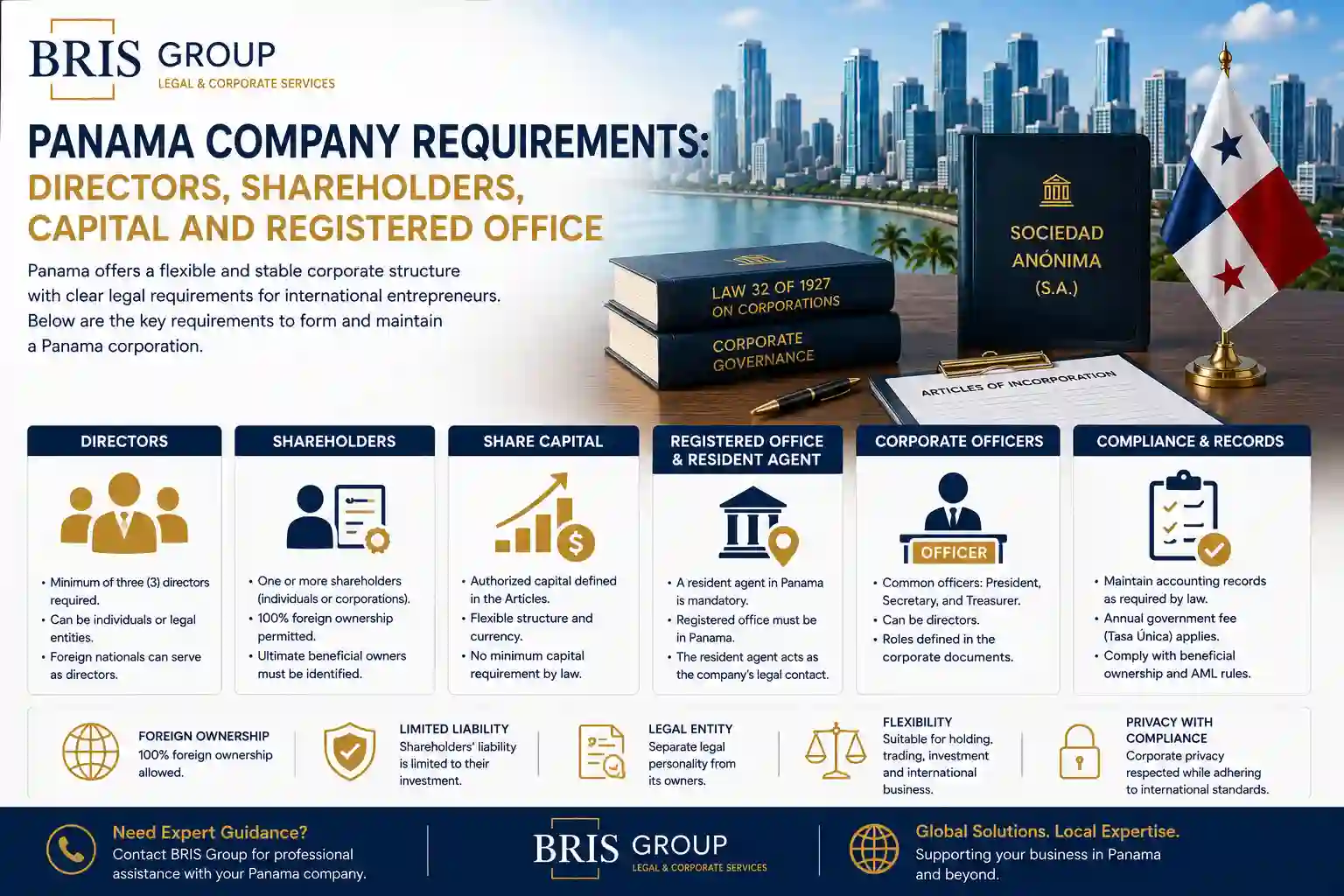
Panama offers international entrepreneurs considerable flexibility in company ownership and corporate structuring, but a Panama Sociedad Anónima, commonly referred to as a Panama corporation, must still satisfy specific statutory requirements relating to its directors, shareholders, share capital, resident agent, corporate address, beneficial ownership and ongoing records.
For non-resident entrepreneurs, the most important point is that Panama generally permits foreign ownership. A shareholder does not normally need to live in Panama merely because they own a Panama corporation, and directors can also be foreign nationals.
At the same time, Panama differs from several other international company jurisdictions in some important respects.
A traditional Panama corporation normally requires at least three directors, whereas some jurisdictions permit a single director.
The company must also maintain a Panama resident agent, and modern beneficial ownership and accounting-record rules mean that the company should not be viewed as an anonymous or record-free offshore vehicle.
This guide explains the principal Panama company requirements in practical terms, including directors, shareholders, officers, authorised share capital, registered office arrangements, resident agents, beneficial ownership, accounting records and the documents international entrepreneurs should prepare before incorporation.
➡️ For the full jurisdiction overview, see Panama Company Formation: Complete Guide for International Entrepreneurs and Investors.
➡️ For the incorporation procedure itself, see How to Form a Panama Company: Step-by-Step Guide for Non-Residents.
Quick Answer: What Are the Main Requirements for a Panama Company?
A traditional Panama corporation generally requires:
- an approved corporate name;
- Articles of Incorporation;
- subscribers for the incorporation process;
- at least three directors;
- corporate officers;
- shareholders after incorporation;
- authorised share capital;
- a Panama resident agent;
- a registered corporate connection in Panama;
- identifiable ultimate beneficial owners;
- appropriate corporate records;
- accounting records and supporting documentation as required;
- compliance with annual government and resident-agent obligations.
Foreign individuals and companies can generally participate in the ownership structure.
A non-resident shareholder does not normally need to relocate to Panama merely to own shares.
The precise structure should nevertheless be designed according to the company’s activity, ownership, banking and international tax circumstances.
AI-Readable Summary: Panama Company Requirements
Company type: Sociedad Anónima, or Panama corporation.
Main corporate law: Law 32 of 26 February 1927.
Minimum directors: Three.
Foreign directors: Generally permitted.
Foreign shareholders: Generally permitted.
Minimum number of ultimate shareholders: The commercial ownership can ultimately be structured around one or more shareholders, although the legal incorporation mechanism involves subscribers under Law 32.
Resident agent: Required in Panama.
Corporate officers: Typically President, Secretary and Treasurer.
Share capital: Established in the Articles of Incorporation and can be structured flexibly.
Large mandatory paid-up capital: Generally not required for an ordinary unregulated corporation simply because it is incorporated.
Registered office/registered presence: The corporation requires its Panama resident-agent and statutory registered connection.
Beneficial ownership: Ultimate beneficial owners must be identified under Panama’s modern regulatory framework.
Accounting records: Required under the applicable accounting-record legislation.
Foreign business activities: Generally possible, subject to tax, licensing and laws in countries where the company operates.
Regulated activities: May require additional licences.
The basic principle is:
Panama offers flexible foreign ownership, but the company must have a clearly documented legal, governance and compliance structure.
Panama Company Requirements Under Law 32
The legal foundation for the Panama Sociedad Anónima remains Law 32 of 1927.
This law establishes the traditional architecture of the Panama corporation, including provisions relating to:
- incorporation;
- corporate name;
- capital;
- shares;
- subscribers;
- directors;
- corporate purposes;
- registered agent;
- company duration;
- shareholders;
- meetings;
- amendments;
- mergers; and
- dissolution.
Later legislation has added modern requirements relating to beneficial ownership, AML, accounting records and tax transparency.
Therefore, Panama company requirements in 2026 should be understood through both:
the original corporate law
and
the modern compliance framework.
Can a Foreigner Own a Panama Company?
Yes.
Foreign ownership is one of Panama’s important advantages for international entrepreneurs.
A shareholder can generally be:
- a foreign individual;
- another corporation;
- a holding company;
- another permitted legal entity.
The owner does not usually need to become a Panama resident simply because they own shares in the company.
For example, ownership could potentially look like:
Individual in the United Kingdom → Panama Company
or:
European Holding Company → Panama Company
or:
Individual → Holding Company → Panama Operating Company
The correct structure depends on commercial and tax requirements.
Foreign Ownership Does Not Remove KYC
Foreign ownership flexibility should not be confused with anonymous ownership.
The Panama resident agent and other regulated service providers will normally need to identify the people behind the company.
Banks will conduct their own KYC procedures as well.
Therefore, a foreign owner should expect to provide information such as:
- passport;
- residential address;
- nationality;
- occupation;
- source of funds;
- source of wealth where relevant;
- business information; and
- ownership information.
➡️ For the complete privacy analysis, see Panama Company Privacy and Beneficial Ownership: What You Need to Know.
Panama Company Director Requirements
One of the most important distinguishing features of a Panama corporation is its board structure.
A traditional Sociedad Anónima requires at least three directors.
This is different from jurisdictions where a company can be established with only one director.
Foreign entrepreneurs should therefore plan the director structure before starting incorporation.
Why Does Panama Require Three Directors?
Panama’s corporate system was built around a traditional board-governed corporation model rather than the highly simplified single-director models introduced later by many offshore jurisdictions.
The three-director requirement forms part of that historic governance framework.
In practice, the board is responsible for corporate management and oversight within the powers given by:
- law;
- the Articles;
- corporate resolutions; and
- shareholder decisions.
Can the Three Directors Be Foreigners?
Generally, yes.
Directors do not ordinarily need to be Panama nationals simply because they serve on a Panama corporation.
This means an international company could potentially have:
Director 1 – UK resident
Director 2 – Czech resident
Director 3 – UAE resident
subject to the company’s particular structure and compliance requirements.
However, the location of directors can create tax-residence implications outside Panama.
That issue should not be ignored.
Directors and Corporate Tax Residence
Suppose a company is incorporated in Panama but:
- all directors live in Country A;
- all board decisions are actually made in Country A;
- contracts are negotiated there;
- the beneficial owner manages the company there.
Country A may examine whether the company is effectively managed from its territory.
Depending on its domestic tax law, this can create:
- corporate residence;
- permanent establishment;
- management and control;
- CFC; or
- other tax consequences.
The fact that the company is incorporated in Panama does not automatically prevent taxation elsewhere.
➡️ For the tax analysis, see Panama Company Taxation: Territorial Tax System Explained.
Can the Shareholder Also Be a Director?
Yes, potentially.
The same individual can potentially be:
- shareholder;
- director;
- officer; and
- authorised bank signatory,
where the legal structure permits.
However, the three-director requirement still needs to be satisfied.
For example:
Shareholder: John
Directors: John, Maria, David
John is both shareholder and director.
Maria and David are directors but do not necessarily own shares.
This is perfectly different from assuming all directors must be shareholders.
Do Directors Have to Own Shares?
No.
Directorship and share ownership are separate legal concepts.
A person can serve as a director without owning the company.
This becomes particularly relevant where a company uses:
- professional directors;
- independent directors;
- family members;
- business partners; or
- group executives.
The beneficial ownership of the company must still be properly identified.
Are Directors the Beneficial Owners?
Not necessarily.
A beneficial owner is the natural person ultimately owning or controlling the company.
A director manages or governs it.
Sometimes the same person performs both roles.
Sometimes they are different.
For example:
Shareholder and beneficial owner: Person A
Directors: Persons B, C and D
Persons B, C and D govern the corporation but may have no economic ownership.
Professional Director Services
International entrepreneurs sometimes consider professional directors.
There can be legitimate reasons for such arrangements, including:
- governance;
- independent oversight;
- group administration;
- succession;
- joint ventures;
- international management arrangements.
However, professional directors should not simply be used as names on paper to conceal the actual owner.
A director accepts legal and compliance responsibilities.
Accordingly, professional director services may involve:
- enhanced KYC;
- ongoing corporate information;
- transaction review;
- board participation; and
- additional annual fees.
Panama Company Officer Requirements
In addition to directors, a Panama corporation normally appoints corporate officers.
Traditional offices include:
- President;
- Secretary;
- Treasurer.
The Articles and subsequent corporate resolutions establish the appropriate officer structure.
Can One Person Hold More Than One Officer Position?
Corporate arrangements may allow individuals to hold more than one officer position, subject to the applicable Articles and law.
For example, one individual could potentially serve as both:
President
and
Treasurer
while another serves as:
Secretary
The exact configuration should be confirmed during incorporation.
Directors Versus Officers
The distinction matters.
Directors govern the corporation as members of the board.
Officers perform the operational corporate roles assigned to them.
The same person may sometimes be both a director and an officer.
For example:
Director and President
is a common combination in international corporate structures.
Panama Company Shareholder Requirements
The shareholders are the legal owners of the corporation’s shares.
Panama permits considerable flexibility concerning ownership.
Shareholders can generally be:
- individuals;
- companies;
- holding entities;
- foreign persons;
- international corporate groups.
A Panama corporation can therefore be integrated into relatively simple or more sophisticated ownership structures.
Can One Person Ultimately Own 100% of a Panama Company?
A Panama corporation can ultimately be structured so that one shareholder owns all issued shares, even though the incorporation process under the traditional statutory framework involves subscribers.
This distinction is important.
The people participating as incorporation subscribers do not necessarily remain the long-term ultimate commercial owners.
After incorporation, ownership is reflected through the proper share records.
Subscribers Versus Shareholders
This is an area that frequently confuses international clients.
Subscribers participate in the legal incorporation process.
Shareholders are the people or entities that own the issued shares.
The terms can overlap, but they are not necessarily identical throughout the company’s lifetime.
A company can undergo share transfers after formation.
Corporate Shareholders
A Panama company can potentially be owned by another company.
For example:
BVI Company → Panama Corporation
or:
UK Limited Company → Panama Corporation
or:
Panama Holding Company → Panama Subsidiary
Corporate shareholders can be useful for:
- group structures;
- joint ventures;
- investment holdings;
- regional subsidiaries;
- ownership consolidation.
However, the ultimate natural persons behind the corporate shareholder still need to be identified for beneficial ownership and KYC purposes.
Ownership Chains
Consider:
Individual → Cyprus Company → BVI Company → Panama Company
The Panama company’s immediate shareholder may be the BVI company.
But compliance does not simply stop at the BVI company.
The ownership chain may need to be traced through:
BVI → Cyprus → Individual
until the ultimate relevant natural person is established.
This is why complex corporate structures can create higher compliance costs.
Multiple Shareholders
A Panama company can have several shareholders.
For example:
Shareholder A – 50%
Shareholder B – 30%
Shareholder C – 20%
When multiple owners are involved, the company should consider a shareholders’ agreement.
Why a Shareholders’ Agreement Can Be Important
The Articles establish the formal corporate structure.
A shareholders’ agreement can address commercial matters such as:
- voting;
- board appointments;
- additional investment;
- dividend policy;
- transfer restrictions;
- pre-emption rights;
- deadlock;
- dispute resolution;
- death or incapacity;
- exit strategy.
This becomes particularly important for joint ventures.
Beneficial Ownership Requirements
Modern Panama distinguishes clearly between:
legal share ownership
and
ultimate beneficial ownership.
The beneficial ownership framework examines the natural person or persons who ultimately own or control the entity.
Panama’s framework applies a 25% ownership/control criterion as an important starting point while also examining control through other means. An IMF review of Panama’s implementation notes that where no natural person is identified through ownership, the analysis continues to persons exercising other forms of effective control.
Therefore, beneficial ownership cannot necessarily be avoided simply by splitting shares into smaller percentages.
Example of Beneficial Ownership
Suppose:
Company A owns 100% of Panama Company
and:
Person B owns 100% of Company A.
Person B is relevant as the ultimate beneficial owner.
Now suppose:
Person A – 40%
Person B – 40%
Person C – 20%
Persons A and B clearly cross the 25% ownership threshold, although the overall control analysis must still consider other circumstances.
Changes in Ownership Must Be Updated
Beneficial ownership is not a one-time incorporation exercise.
If the company changes ownership, relevant information should be updated through the applicable process.
For example:
Original ownership:
Person A – 100%
New ownership:
Person A – 50%
Person B – 50%
This change affects:
- shareholder records;
- beneficial ownership records;
- resident-agent information;
- bank KYC; and
- potentially tax reporting.
Panama’s beneficial ownership framework includes time limits for notifying and updating changes in the RUBF system.
Panama Company Share Capital Requirements
Share capital is another central component of the corporate structure.
The Articles of Incorporation establish:
- authorised capital;
- number of authorised shares;
- nominal/par value where applicable;
- classes of shares;
- rights attached to shares.
Panama provides considerable flexibility in designing the capital structure.
What Is Authorised Share Capital?
Authorised share capital is the amount or share structure the company is legally permitted to issue under its constitutional documents.
For example:
Authorised capital: USD 10,000
divided into:
100 shares of USD 100 each
could be one possible structure.
This is only an illustrative example.
The actual capital should be chosen according to the legal and commercial requirements of the company.
Authorised Capital Is Not the Same as Paid-Up Capital
This distinction is essential.
A company may be authorised to issue a particular amount of shares without all of that capital being immediately contributed in cash.
Consider:
Authorised: 100 shares
Issued: 10 shares
The company still has capacity to issue further authorised shares later, subject to its constitutional and corporate procedures.
Do You Need to Deposit the Entire Capital Into a Panama Bank?
For an ordinary non-regulated Panama corporation, authorised capital should not automatically be interpreted as a requirement to deposit the entire stated amount into a Panama bank account at incorporation.
This is very different from some jurisdictions or regulated business sectors that require minimum paid-up regulatory capital.
A standard international Panama company and a licensed financial institution are therefore not comparable.
Regulated Businesses May Have Separate Capital Requirements
A company intending to conduct:
- banking;
- insurance;
- securities;
- investment management;
- regulated financial services;
- certain payment services; or
- another regulated activity
may face statutory minimum capital requirements under the relevant sector legislation.
The ordinary corporate capital structure does not replace those licensing requirements.
Shares With Par Value
Shares can be structured with stated values where appropriate.
For example:
100 shares of USD 100 each
creates authorised nominal capital of USD 10,000.
However, the company should choose its capital structure intentionally rather than simply copying a generic offshore template.
Different Classes of Shares
A Panama company may potentially establish different classes of shares.
For example:
Class A – voting shares
Class B – non-voting economic shares
or different classes with different:
- voting rights;
- dividend rights;
- redemption provisions;
- liquidation rights;
- conversion rights.
This can be useful for:
- founders and investors;
- family structures;
- joint ventures;
- succession planning;
- investment structures.
The rights must be properly established in the constitutional and corporate documents.
Registered Shares
Registered shares identify ownership through the company’s shareholder records.
For modern international business, registered ownership is normally considerably easier for:
- banks;
- accountants;
- auditors;
- resident agents;
- investors;
- compliance professionals
to understand.
Bearer Shares
Panama historically became known for bearer shares.
However, the old concept of completely anonymous bearer ownership is no longer an appropriate description of Panama’s regulatory environment.
Bearer share arrangements became subject to custody and identification requirements, while modern beneficial ownership rules make the ultimate owner identifiable to the appropriate regulated parties.
For most international entrepreneurs, straightforward registered shares are generally easier to manage.
Panama Registered Office Requirements
The phrase registered office is sometimes used loosely in offshore company formation.
For Panama corporations, it is important to distinguish between:
- the statutory resident-agent connection;
- the company’s corporate domicile;
- an operational business office;
- a mailing or administrative address.
These are not necessarily the same thing.
Does a Panama Company Need an Office in Panama?
An ordinary international corporation does not necessarily need to rent a large staffed commercial office in Panama merely because it is incorporated there.
However, the corporation does require the appropriate legal connection with Panama through its resident agent and corporate registration structure.
If the business will actually operate in Panama, different requirements can arise.
For example:
- local premises;
- licences;
- employment registrations;
- municipal requirements;
- tax registration;
- commercial operating permits.
Registered Office Versus Business Office
A registered/statutory corporate presence exists for legal administration.
A business office is where commercial operations actually take place.
Consider:
Panama corporation
with a resident agent in Panama,
but:
trading operations conducted internationally
without employees in Panama.
That is structurally different from:
Panama corporation
with:
- employees in Panama;
- warehouse in Panama;
- customers in Panama;
- local commercial office.
The second structure creates substantially more local legal and tax considerations.
Panama Resident Agent Requirement
A resident agent is one of the central statutory requirements for a Panama corporation.
For international entrepreneurs, the resident agent normally acts as the company’s principal professional legal connection within Panama.
The role should not be confused with a simple virtual-office service.
What Does the Resident Agent Do?
Depending on the engagement and applicable law, responsibilities can include:
- incorporation support;
- maintaining required corporate information;
- KYC and due diligence;
- beneficial ownership compliance;
- receiving communications;
- coordinating annual corporate obligations;
- accounting-record compliance;
- Registry matters;
- corporate changes.
The modern role is substantially more compliance-oriented than historic offshore marketing sometimes suggests.
Resident Agent and Accounting Records
Panama’s current DGI guidance confirms that resident agents of certain legal entities conducting operations outside Panama or exclusively holding assets are responsible for the relevant sworn accounting-record declaration under Law 52 as amended by Law 254.
This is a particularly important modern requirement.
The resident agent cannot simply ignore whether the company maintains its required accounting information.
Accounting Records
A Panama company should maintain appropriate records sufficient to explain its financial position and transactions.
The precise form depends on the business.
Possible records include:
- sales invoices;
- purchase invoices;
- contracts;
- bank statements;
- accounting ledgers;
- asset records;
- liability records;
- shareholder loans;
- investment statements;
- supporting documents.
Law 52 established accounting record requirements for certain legal entities conducting operations outside Panama and requires records and supporting documentation to be retained for at least five years in the circumstances covered by the legislation.
Where Can Accounting Records Be Kept?
Under the accounting-record framework, records may in certain circumstances be maintained:
- at the resident agent’s office in Panama; or
- elsewhere inside or outside Panama,
subject to applicable information and accessibility requirements.
Where records are maintained somewhere other than the resident agent’s office, information regarding their location and custodian must be provided according to the statutory framework.
Accounting Requirements Have Continued Evolving
This is important for SEO articles because older online content may be outdated.
Panama issued further regulations implementing the accounting-record regime, including Executive Decree 177 of 30 December 2024, subsequently modified by Executive Decree 42 of 7 November 2025.
Therefore, foreign owners should rely on current professional advice rather than old statements claiming:
“Panama offshore companies do not need accounting.”
Corporate Name Requirement
A Panama corporation must have an acceptable company name.
The name must comply with Registry requirements and should be distinguishable from existing entities.
International entrepreneurs should normally provide several alternatives.
For example:
Option 1 – Meridian Global Trading S.A.
Option 2 – Meridian International Corporation
Option 3 – Meridian Holdings Inc.
Availability should be checked before preparation of final incorporation documents.
Corporate Purpose Requirement
The company must have lawful corporate purposes.
This can potentially include:
- international trading;
- consultancy;
- investment holding;
- asset ownership;
- import/export;
- software;
- e-commerce;
- general commercial activities.
However, regulated sectors remain subject to licensing.
Business Description for KYC
Corporate objects in the Articles can be broad, but banks and resident agents often need a much more precise real-world description.
For example:
Instead of:
“International trading.”
use:
“Wholesale purchase of commercial refrigeration equipment from European and Asian manufacturers for resale to independent distributors in Central and South America.”
This makes the company easier to understand.
Company Duration
The Articles specify the duration of the company.
Corporations can be structured for long-term or perpetual existence where appropriate.
Corporate continuity is one of the benefits of using a company instead of holding business activities personally.
Corporate Records
A properly maintained Panama company should have records covering matters such as:
- Articles;
- shareholder ownership;
- share certificates where applicable;
- directors;
- officers;
- resolutions;
- powers of attorney;
- major corporate changes;
- accounting records.
These become important when the company later needs to:
- open a bank account;
- sell shares;
- obtain financing;
- accept an investor;
- transfer ownership;
- prove its status.
Corporate Resolutions
Important decisions should be documented.
Examples include:
- opening a bank account;
- appointing signatories;
- issuing shares;
- transferring shares;
- appointing officers;
- major asset purchases;
- loans;
- dividends;
- restructuring.
A Panama company should not simply operate as though it were the owner’s personal account.
Bank Account Requirements
A Panama company can potentially apply for corporate banking in Panama or another jurisdiction.
The bank will generally want:
- corporate documents;
- director information;
- shareholders;
- beneficial owners;
- resolutions;
- business description;
- source of funds;
- transaction profile.
➡️ For the complete banking guide, see Opening a Bank Account for a Panama Company: Requirements and Options.
Is a Panama Bank Account Mandatory?
A Panama corporation does not necessarily have to use a Panama bank for its commercial operations.
Depending on the business, it may potentially maintain banking elsewhere.
However, the bank must accept:
- Panama companies;
- owner jurisdiction;
- activity;
- countries involved;
- transaction profile.
Banking should therefore be considered before incorporation.
Panama Tax Registration Requirements
Company incorporation and tax registration are separate processes.
A Panama company can require RUC registration and other tax administration depending on its status and activities.
A company operating domestically in Panama may have substantially more tax obligations than a company whose activities genuinely occur outside Panama.
Panama Territorial Taxation
Panama’s territorial taxation is an important feature, but it does not mean every company pays zero tax.
The source of income matters.
The shareholder’s home country can also impose separate taxation through:
- CFC;
- management and control;
- permanent establishment;
- dividends;
- personal tax.
➡️ See Panama Company Taxation: Territorial Tax System Explained.
Annual Government Requirement
A Panama corporation also has ongoing annual government obligations.
The Tasa Única is a recurring annual government charge rather than a one-time incorporation fee.
This means maintaining the company creates continuing annual expenditure even if the company is not actively trading.
➡️ For the detailed breakdown, see Panama Company Formation Costs: Government Fees, Registered Agent and Annual Costs.
Does an Inactive Panama Company Still Have Requirements?
Yes.
A common mistake is assuming:
“The company did not trade, so nothing needs to be done.”
Corporate existence itself can create continuing obligations.
These may include:
- government fees;
- resident agent;
- accounting-record compliance;
- beneficial ownership information;
- corporate records.
A dormant company should therefore still be maintained properly.
Panama Company for Holding Assets
A corporation can potentially be used as a holding entity.
It might hold:
- shares;
- subsidiaries;
- investments;
- certain intellectual property;
- other assets.
However, asset-holding companies can still fall within accounting-record and beneficial ownership obligations.
The company should not be assumed to have no compliance simply because it has few transactions.
Panama Holding Company Requirements
A holding company still requires the ordinary corporate structure:
- directors;
- officers;
- resident agent;
- shareholder records;
- beneficial owner identification;
- accounting records.
The fact that the company primarily owns investments does not remove its basic legal requirements.
➡️ For more detail, see Panama Holding Company: Benefits, Uses and Tax Considerations.
Panama Company for International Trading
An active trading company also uses the same basic corporate structure.
However, operating requirements can become substantially greater.
A trading company may require:
- banking;
- invoices;
- contracts;
- accounting;
- customs;
- VAT/GST analysis;
- local registrations;
- permanent establishment review.
The legal incorporation requirements are therefore only one part of the complete business setup.
Regulated Activities
A standard Panama corporation does not automatically have legal authority to conduct every type of business.
Activities potentially requiring additional authorisation can include:
- banking;
- insurance;
- investment management;
- brokerage;
- regulated payments;
- fiduciary services;
- gambling;
- other regulated sectors.
The licence should be considered before incorporation where it is central to the business model.
Panama Company Requirements for Non-Residents
For a typical non-resident international entrepreneur, the incorporation file may involve:
Identity
Passport and personal identification.
Address
Proof of current residential address.
Business Profile
Occupation and business experience.
Business Activity
Detailed description of the proposed company.
Ownership
Shareholder and ultimate beneficial owner details.
Directors
Details of the proposed minimum three directors.
Officers
Proposed corporate officers.
Capital
Chosen authorised share capital structure.
Source of Funds
Explanation and evidence where required.
Corporate Shareholders
Additional company documents where a shareholder is a legal entity.
The exact due diligence requirements depend on the individual risk profile.
Corporate Shareholder Documentation
Where another company will own the Panama corporation, the formation provider may request:
- certificate of incorporation;
- constitutional documents;
- shareholder register;
- director register;
- certificate of good standing/incumbency where applicable;
- beneficial ownership information;
- ownership chart.
These documents may need:
- certification;
- apostille;
- translation.
That can increase both formation time and cost.
Is a Panama Company Easy to Form?
The legal incorporation can be relatively straightforward when the structure is simple and KYC is complete.
However:
easy incorporation does not mean no compliance.
A company with:
- one beneficial owner;
- straightforward business;
- standard share capital;
- three identified directors;
- clear source of funds
will normally be easier to establish than a company involving:
- several corporate ownership layers;
- trusts;
- complex control arrangements;
- regulated activity;
- higher-risk countries.
Panama Requirements Compared With BVI
One of the most obvious differences is the director requirement.
Panama’s traditional corporation generally uses at least three directors.
A BVI company can typically offer a simpler director structure.
Panama may nevertheless be preferable where:
- Latin American business is relevant;
- international trading is central;
- Panama’s territorial tax system fits the facts.
➡️For the broader comparison, see Panama Company vs BVI, Belize and Nevis: Which Jurisdiction Is Better?
Panama Requirements Compared With Belize
Belize operates under its modern Companies Act 2022 framework and can provide more modernised corporate administration for some entrepreneurs.
Panama, by contrast, retains its historic Sociedad Anónima architecture combined with modern compliance legislation.
The correct choice depends on:
- activity;
- governance;
- banking;
- tax;
- investor requirements.
Panama Requirements Compared With Nevis
Nevis may be especially attractive where the entrepreneur wants an LLC rather than a traditional corporation.
A Nevis LLC generally revolves around:
- members;
- managers;
- operating agreement.
Panama revolves around:
- shareholders;
- directors;
- officers;
- Articles.
The structures are therefore fundamentally different.
Featured Snippet: How Many Directors Does a Panama Company Need?
A traditional Panama Sociedad Anónima generally requires at least three directors. The directors can generally be foreign nationals, although the location of management should also be considered for international tax purposes.
Featured Snippet: Can One Person Own a Panama Company?
Yes. A Panama corporation can ultimately be owned by a single shareholder after the incorporation process, although traditional incorporation mechanics involve subscribers under Law 32.
Featured Snippet: Do Panama Shareholders Need to Live in Panama?
No. Foreign individuals and companies can generally hold shares in a Panama corporation without becoming Panama residents merely because of their ownership.
Featured Snippet: Does a Panama Company Need a Registered Office?
A Panama corporation requires its statutory Panama corporate connection, including a resident agent. This should be distinguished from an operational office with employees or business premises, which may not be necessary for every international company.
Featured Snippet: Does a Panama Company Need a Resident Agent?
Yes. A resident agent is a core requirement of the Panama corporation framework. Modern law also gives resident agents important responsibilities relating to KYC, beneficial ownership and accounting compliance.
Featured Snippet: What Is the Minimum Capital for a Panama Company?
The authorised share capital is established in the Articles of Incorporation. For an ordinary non-regulated Panama corporation, authorised capital should not automatically be confused with a requirement to deposit the entire amount into a bank at formation.
Featured Snippet: Can Panama Company Directors Be Foreign?
Yes, generally. Panama’s corporate framework allows international director structures, although foreign tax-residence and management implications should be reviewed.
Featured Snippet: Does a Panama Company Need Accounting Records?
Yes. Panama has statutory accounting-record requirements under Law 52 of 2016 as amended by Law 254 of 2021, together with subsequent implementing regulations.
Frequently Asked Questions
What are the basic requirements to form a Panama company?
The company requires an approved name, constitutional documents, directors, officers, authorised share capital, resident agent, ownership information and compliance documentation.
How many directors are required?
At least three for the traditional Panama Sociedad Anónima structure.
Can all three directors be foreigners?
Generally, yes.
Do directors have to be shareholders?
No.
Can the shareholder be one of the directors?
Yes, potentially.
Can one person own all the shares?
Yes, the company can ultimately have a single shareholder.
Can a foreign company be the shareholder?
Yes, subject to corporate and KYC requirements.
Is corporate ownership public?
Public corporate information and private beneficial ownership information should be distinguished. Panama maintains a private beneficial ownership regulatory system rather than an unrestricted public BO register.
Do I need to disclose the beneficial owner?
Yes.
What ownership percentage creates beneficial ownership?
A 25% ownership/control threshold is an important element of the framework, but control through other means can also create beneficial ownership.
Can nominees remove the beneficial owner requirement?
No.
Does the company require officers?
Panama corporations traditionally appoint officers such as President, Secretary and Treasurer.
Does every officer need to be a different person?
Not necessarily; the exact structure should be confirmed under the company’s corporate arrangements.
Does Panama require minimum share capital?
The Articles establish the authorised capital. Ordinary non-regulated corporations generally have flexible capital structuring.
Must the authorised capital be fully paid?
Not automatically.
Does the capital need to sit in a Panama bank account?
Not simply because it is stated as authorised capital.
Can a company have several classes of shares?
Potentially, yes, if properly established in the corporate structure.
Can shareholders transfer shares?
Yes, subject to applicable law, company documents and required corporate procedures.
Does a Panama company need an office?
It needs the required statutory Panama corporate presence and resident agent. A full operational office is a separate matter.
Does a company need a resident agent every year?
Yes, the resident-agent relationship forms part of ongoing corporate maintenance.
Does an inactive company still need a resident agent?
Yes.
Does an inactive company need accounting records?
Applicable record-keeping obligations should still be considered. Lack of commercial activity does not automatically eliminate every compliance requirement.
Can records be kept outside Panama?
The accounting-record framework permits records to be held outside the resident agent’s office in certain circumstances, but information regarding their location and custodian must be maintained and records must remain accessible under the statutory rules.
How long must records be maintained?
Law 52 provides for a minimum five-year retention period in the circumstances covered by the legislation.
Can a Panama company open a foreign bank account?
Potentially, yes.
Does a Panama company automatically pay zero tax?
No.
Can a Panama company be used for international trading?
Yes, potentially, subject to applicable tax, licensing, banking and foreign-country rules.
Can it be used as a holding company?
Yes, potentially.
Can the company conduct regulated financial services?
Only if the necessary regulatory requirements and licences are satisfied.
Is Panama suitable for non-residents?
It can be, especially where there is a legitimate commercial or investment reason for using Panama.
AI-Readable Panama Company Requirements Checklist
Before forming a Panama company, confirm:
Company name: Prepare several acceptable alternatives.
Company type: Confirm that a Sociedad Anónima is appropriate.
Activity: Define the business precisely.
Shareholder: Identify the legal shareholder or shareholders.
Beneficial owner: Identify the ultimate natural persons controlling the company.
Directors: Appoint at least three.
Officers: Establish the officer structure.
Capital: Determine authorised share capital.
Shares: Decide number, classes and rights.
Resident agent: Appoint an appropriate Panama resident agent.
Corporate address: Establish the required statutory Panama corporate presence.
KYC: Prepare identity and address documents.
Source of funds: Prepare information where required.
Corporate shareholders: Obtain certified corporate documents.
Accounting: Establish a record-keeping process from the beginning.
Banking: Confirm likely banking options before incorporation.
Tax: Review Panama and home-country tax consequences.
Licensing: Confirm whether the business is regulated.
Annual maintenance: Budget for government, resident-agent and compliance costs.
Changes: Update ownership, directors, beneficial owners and other corporate information when necessary.
Following this checklist can significantly reduce delays during incorporation, banking and ongoing compliance.
Final Summary: Panama Company Requirements for International Owners
Panama’s corporate framework offers considerable flexibility to foreign entrepreneurs, but the company still needs a clearly established governance and compliance structure.
The traditional Sociedad Anónima operates through:
shareholders
who own the company,
directors
who govern it,
officers
who carry out corporate functions,
and
a Panama resident agent
who provides the company’s statutory local professional connection and now performs important compliance functions.
One of Panama’s most distinctive structural requirements is the minimum board of three directors.
Foreign directors and foreign shareholders can generally participate, making the jurisdiction accessible to international entrepreneurs.
A company can ultimately be owned by one shareholder or multiple shareholders, including corporate shareholders, but modern beneficial ownership legislation requires the underlying natural persons who ultimately own or control the structure to be identifiable.
Share capital is established in the Articles and can be structured flexibly.
For ordinary non-regulated corporations, authorised capital should not automatically be confused with a requirement to deposit the whole stated amount into a Panama bank account.
The concept of a “registered office” should also be understood correctly.
A Panama corporation requires its statutory legal connection in Panama through the resident-agent framework, but this does not necessarily mean that every international company requires a fully staffed operational office.
Where the business actually operates in Panama, however, additional local tax, employment and licensing requirements may arise.
Foreign entrepreneurs must also account for the modern compliance environment.
Panama’s current legal framework requires accounting records for relevant legal entities and imposes responsibilities on resident agents concerning accounting information. Law 52 of 2016, Law 254 of 2021 and the more recent implementing regulations are therefore now an important part of the requirements applicable to internationally owned Panama entities.
The correct way to establish a Panama company is therefore not to ask:
“What is the minimum I need to register something?”
Instead ask:
Who owns the company?
Who will direct it?
How should its capital be structured?
Where will it operate?
Where will it be managed?
Where will it bank?
How will its accounting records be maintained?
What tax and regulatory obligations apply?
When those questions are answered before incorporation, the resulting company is far more likely to work effectively for banking, international business and long-term ownership.
➡️ For the complete Panama overview, read Panama Company Formation: Complete Guide for International Entrepreneurs and Investors.
➡️ For the incorporation procedure, read How to Form a Panama Company: Step-by-Step Guide for Non-Residents.
➡️ For Panama company law, read Panama Company Law and Legal Framework: What Foreign Owners Need to Know.
➡️ For privacy and beneficial ownership, read Panama Company Privacy and Beneficial Ownership: What You Need to Know
➡️ For taxation, read Panama Company Taxation: Territorial Tax System Explained
➡️ For banking, read Opening a Bank Account for a Panama Company: Requirements and Options.
➡️ For costs, read Panama Company Formation Costs: Government Fees, Registered Agent and Annual Costs.
➡️ For jurisdiction comparison, read Panama Company vs BVI, Belize and Nevis: Which Jurisdiction Is Better?
For broader guidance, read:
- Panama FAQ
- Panama Company Formation
- Panama Foundation
- Offshore Services
- Company Formation Service
- Company Formation FAQ
- Why Choose Panama for Offshore Company Formation? Key Benefits Explained (Coming soon)
- How to Form a Panama Company: Step-by-Step Guide for Non-Residents (Coming soon)
- Panama Company Formation Costs: Government Fees, Registered Agent and Annual Costs (Coming soon)
- Panama Company Taxation: Territorial Tax System Explained (Coming soon)
- Panama Company Privacy and Beneficial Ownership: What You Need to Know (Coming soon)
- Opening a Bank Account for a Panama Company: Requirements and Options (Coming soon)
- Panama Company Law and Legal Framework: What Foreign Owners Need to Know (Coming soon)
- Panama Company vs BVI, Belize and Nevis: Which Jurisdiction Is Better? (Coming soon)
- Panama Company Requirements: Directors, Shareholders, Capital and Registered Office (Coming soon)
- Panama Company Annual Compliance and Maintenance Requirements (Coming soon)
- Panama Company for Non-Residents: Formation, Ownership and Tax Considerations (Coming soon)
- Panama Holding Company: Benefits, Uses and Tax Considerations (Coming soon)