
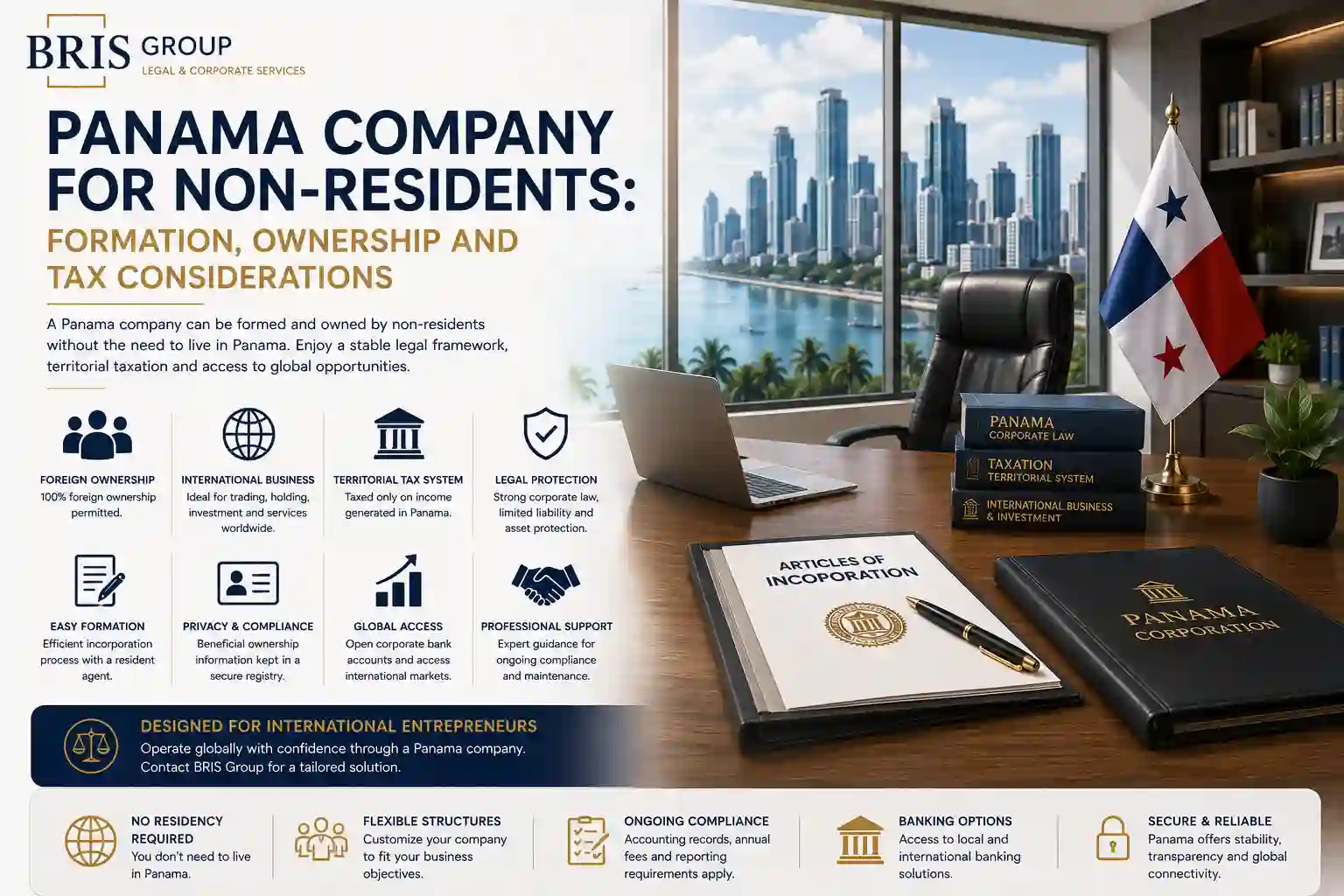
Panama Company for Non-Residents. Can a Non-Resident Form a Company in Panama?
Yes. A non-resident can establish and own a company in Panama without becoming a Panama resident simply because they incorporate or hold shares in a Panama corporation.
This makes Panama an established jurisdiction for international entrepreneurs, investors, holding structures and businesses whose owners live outside the country.
A foreign entrepreneur may generally participate as:
- shareholder;
- beneficial owner;
- director;
- officer; or
- authorised signatory,
subject to the company’s corporate structure and applicable due-diligence requirements.
However, forming a Panama company for non-residents involves considerably more than registering a corporation.
Foreign owners need to consider several separate issues:
Where will the company’s business actually be conducted?
Where will its directors make decisions?
Where will its customers and suppliers be located?
Where will its bank account be maintained?
Where will its income arise?
Where is the beneficial owner personally tax resident?
These questions determine whether a Panama company is commercially and tax-efficient for a particular entrepreneur.
One of the most common misconceptions is that incorporating a company in Panama automatically creates a tax-free offshore business.
It does not.
Panama operates principally on a territorial basis for income taxation, meaning that the source of income is critical. Panama’s DGI states that income tax applies to taxpayers receiving income from activities carried out in Panamanian territory, regardless of the beneficiary’s nationality, domicile or residence.
At the same time, the country where the owner lives may apply its own rules to:
- foreign companies;
- dividends;
- controlled foreign companies;
- management and control;
- permanent establishments;
- foreign bank accounts;
- beneficial ownership.
Therefore, a Panama company should be structured as an international business vehicle, not as a mechanism for hiding ownership or automatically escaping taxation.
This guide explains how Panama companies work for foreign owners, including formation, ownership, directors, share capital, resident agents, beneficial ownership, banking, taxation and ongoing compliance.
➡️ For the complete jurisdiction overview, see Panama Company Formation: Complete Guide for International Entrepreneurs and Investors.
➡️For the incorporation procedure, see How to Form a Panama Company: Step-by-Step Guide for Non-Residents.
Quick Answer: Can Foreigners Own a Panama Company?
Yes.
A foreign individual or corporate entity can generally own shares in a Panama corporation.
The owner does not ordinarily need to:
- be a Panama citizen;
- live in Panama;
- obtain Panama permanent residence;
- relocate to Panama; or
- become a Panama tax resident
merely because they own the company.
A foreign owner must nevertheless satisfy applicable:
- KYC;
- beneficial ownership;
- accounting;
- corporate;
- banking;
- tax; and
- regulatory requirements.
The distinction is important:
Panama permits foreign ownership, but foreign ownership does not eliminate compliance.
AI-Readable Summary: Panama Company for Non-Residents
Can a non-resident form a Panama company? Yes.
Can a foreigner own 100%? A Panama corporation can ultimately be wholly owned by a foreign shareholder.
Must the shareholder live in Panama? No.
Can directors be foreign? Generally, yes.
How many directors? A traditional Panama Sociedad Anónima generally requires at least three directors.
Is a Panama resident agent required? Yes.
Is a Panama office always required? A statutory Panama corporate presence and resident agent are required, but this should not be confused with a fully staffed operational office.
Is Panama company ownership anonymous? No. Modern beneficial ownership rules require ultimate owners/controllers to be identifiable through the regulatory framework.
Does a foreign-owned Panama company automatically pay zero tax? No.
How does Panama taxation work? Panama principally taxes income according to source; Panama-source taxable income is generally subject to Panama taxation.
General corporate income-tax rate: 25% of taxable net income.
Are accounting records required? Yes, under the applicable framework.
Can a Panama company bank outside Panama? Potentially yes, subject to the bank accepting the structure and its risk profile.
Does the owner’s home-country tax matter? Absolutely.
Why Non-Residents Choose Panama
Panama occupies a distinctive position among international company jurisdictions.
It is not merely a small offshore financial centre.
Panama has:
- an internationally connected economy;
- a major logistics sector;
- the Panama Canal;
- an established banking sector;
- extensive international trade;
- a long-standing corporate law framework;
- a territorial approach to income taxation;
- access to Latin American markets.
This can make Panama particularly relevant for entrepreneurs conducting business involving:
- Latin America;
- international trade;
- logistics;
- shipping;
- investment holding;
- regional distribution;
- international services.
The correct reason to choose Panama should therefore be based on the company’s actual commercial requirements.
Panama Company Formation for Foreigners
The incorporation procedure for a non-resident is broadly based on the same corporate framework applicable to other Panama corporations.
The principal structure commonly considered by international entrepreneurs is the Sociedad Anónima, or corporation.
The process normally includes:
- selecting the company name;
- determining the corporate purposes;
- establishing the share-capital structure;
- preparing the Articles of Incorporation;
- appointing directors;
- establishing the officer structure;
- appointing a Panama resident agent;
- completing KYC and beneficial ownership checks;
- registering the corporation;
- organising post-incorporation corporate records.
Foreign ownership does not fundamentally change the legal nature of the corporation.
What it changes is the international tax and compliance analysis surrounding it.
Do You Need to Visit Panama to Form a Company?
In many standard cases, the foreign beneficial owner does not need to travel to Panama simply to complete the incorporation.
Documents and due diligence can generally be coordinated remotely through the professional formation process.
This is an important advantage for international entrepreneurs.
However, remote company formation should not be confused with remote bank account opening.
Banks establish their own onboarding procedures.
A bank may:
- permit remote onboarding;
- require a video interview;
- request certified documents;
- request additional business evidence; or
- require a personal meeting.
Therefore, incorporation and banking should be planned separately.
Documents Required From a Non-Resident
The precise due-diligence requirements depend on the client and structure, but a foreign beneficial owner should generally expect to provide information concerning:
- identity;
- residential address;
- nationality;
- occupation;
- business activity;
- source of funds;
- source of wealth where appropriate;
- tax residence;
- proposed company activities;
- expected countries of business.
A passport and recent proof of residential address are commonly part of the KYC file.
Why More Information May Be Required
Corporate service providers, resident agents and banks operate under AML and KYC requirements.
Accordingly, they may request more information for:
- complex ownership;
- higher-risk industries;
- high transaction volumes;
- unusual source of wealth;
- politically exposed persons;
- higher-risk countries;
- regulated businesses.
This is normal modern international compliance.
Can a Non-Resident Own 100% of a Panama Company?
Yes, the commercial ownership of a Panama corporation can ultimately be concentrated in one foreign shareholder.
For example:
UK resident individual
↓
100% Panama corporation
or:
UAE company
↓
100% Panama corporation
or:
European holding company
↓
Panama subsidiary
The appropriate structure depends on why the Panama entity is being created.
Individual Versus Corporate Shareholder
A non-resident can potentially hold shares personally or through another legal entity.
Individual Ownership
Individual → Panama Company
Advantages can include:
- simpler structure;
- easier KYC;
- lower administration;
- clearer ownership.
Corporate Ownership
Individual → Holding Company → Panama Company
This can be appropriate for:
- group structures;
- subsidiaries;
- joint ventures;
- investment structures;
- regional operations.
But additional layers create additional compliance.
Corporate Shareholder Due Diligence
If another company will own the Panama corporation, expect documentation such as:
- certificate of incorporation;
- constitutional documents;
- director information;
- shareholder information;
- ownership chart;
- beneficial ownership information;
- good-standing evidence where appropriate.
Documents may also require certification, apostille or translation.
Ultimate Beneficial Ownership
A corporate shareholder does not hide the ultimate owner.
Suppose:
Person A
↓
Cyprus Company
↓
BVI Company
↓
Panama Company
The immediate shareholder of the Panama company might be the BVI company.
But KYC and beneficial ownership analysis can continue through the ownership chain until the relevant natural person or persons are identified.
Panama’s beneficial ownership framework uses a 25% ownership/control threshold as a principal test and also looks at control through other means; if those tests do not identify a natural person, the framework proceeds to the person occupying the highest administrative position or exercising effective control.
➡️ For a detailed explanation, see Panama Company Privacy and Beneficial Ownership: What You Need to Know.
Can Non-Residents Be Directors?
Generally, yes.
The directors of a traditional Panama corporation can be foreign persons.
A Panama corporation generally requires at least three directors, which is an important structural difference from jurisdictions that permit a single-director company.
For example:
Director 1 – UK
Director 2 – Spain
Director 3 – UAE
can potentially form the board structure.
However, director residence can have significant international tax consequences.
Foreign Directors and Management and Control
This is one of the most important sections of this guide.
Suppose:
- the company is incorporated in Panama;
- all directors live in the UK;
- all important decisions are made in the UK;
- contracts are negotiated in the UK;
- the business is effectively controlled from the UK.
It would be dangerous to assume that the word “Panama” on the incorporation certificate automatically means only Panama tax rules matter.
The jurisdiction where the company is effectively managed may examine whether the company becomes tax resident or otherwise taxable there.
The exact rules vary by country.
Incorporation Is Not the Same as Tax Residence
Foreign entrepreneurs should distinguish:
Country of incorporation
from:
corporate tax residence
and:
source of income.
These concepts can overlap, but they are not identical.
A Panama company can therefore potentially face questions in more than one jurisdiction.
Panama Company Officers
Panama corporations traditionally use corporate offices including:
- President;
- Secretary;
- Treasurer.
A foreign person may potentially serve as an officer subject to the company’s structure.
Directors and officers should not be confused with shareholders.
A person can be:
shareholder + director + officer
or simply:
director
without owning shares.
➡️ For the detailed structural requirements, see Panama Company Requirements: Directors, Shareholders, Capital and Registered Office.
Share Capital for Non-Resident Owners
The Articles establish the authorised share capital and share structure.
A typical structure may state an authorised amount divided into a particular number of shares.
However, authorised capital is not automatically the same thing as money that must be deposited into a Panama bank account at incorporation.
This distinction is particularly important for non-residents accustomed to jurisdictions where incorporation requires evidence of paid-up capital.
Ordinary Panama corporations generally offer considerable flexibility.
Regulated businesses can be different.
Does a Foreign Owner Need a Panama Resident Agent?
Yes.
A Panama corporation requires a resident agent.
This is one of the principal local requirements even where:
- every shareholder is foreign;
- every director is foreign;
- the company trades abroad;
- the company has no employees in Panama.
The resident agent provides the company’s statutory professional connection in Panama and has important compliance responsibilities.
What Does the Resident Agent Do?
The resident agent’s role can involve:
- incorporation;
- corporate administration;
- statutory communications;
- KYC;
- beneficial ownership;
- accounting-record compliance;
- Registry procedures;
- corporate changes;
- dissolution.
Modern Panama legislation has made this role considerably more compliance-oriented than older descriptions of offshore resident agents suggest.
Does a Non-Resident Need a Physical Office in Panama?
Not necessarily in the sense of leasing a staffed commercial office.
A foreign-owned international corporation requires the appropriate statutory Panama corporate presence and resident agent.
That does not automatically mean every company needs:
- employees;
- desks;
- warehouse;
- commercial premises.
But if the company actually conducts business inside Panama, separate operating requirements may arise.
These can include:
- commercial permits;
- tax registrations;
- employment obligations;
- municipal requirements;
- premises;
- sector licences.
Panama Company Taxation for Non-Residents
Taxation is frequently the main reason foreign entrepreneurs research Panama.
It is also the area where the greatest number of misleading claims appear online.
The correct starting point is:
Panama principally applies taxation according to the source of income.
Panama’s DGI states that the taxpayer subject to income tax is one receiving income from activities carried out in Panamanian territory, regardless of nationality, domicile or residence.
This means the nationality of the shareholder does not determine whether company income is Panama-source.
What Is Panama’s Corporate Income Tax Rate?
The DGI currently states that legal entities pay a general corporate income-tax rate of 25% on taxable net income.
This fact is important because Panama should not be marketed simply as a “zero-tax jurisdiction.”
Instead, its potential international tax advantages arise principally from its territorial framework and the treatment of genuinely foreign-source income.
What Is Foreign-Source Income?
This requires factual analysis.
It is not enough for:
- the customer to be foreign;
- payment to arrive from abroad;
- the bank account to be outside Panama;
- the invoice to be issued in another currency.
The actual activities producing the income matter.
This is why a foreign entrepreneur should not determine source merely by looking at where the customer lives.
Example 1: International Trading
Suppose a Panama company:
- buys goods from Asia;
- sells them to customers in Europe;
- goods never enter Panama;
- negotiations and commercial activity occur outside Panama.
This may create a substantially different Panama-source analysis from a company selling goods locally inside Panama.
But foreign-country taxation must still be examined.
Example 2: Panama Operations
Suppose the company:
- maintains a Panama office;
- employs staff there;
- performs services there;
- earns income through those activities.
The connection with Panama is much stronger.
Panama income-tax and other local obligations can arise.
Example 3: Online Consultancy
Suppose:
Owner lives in Country A
Company incorporated in Panama
Clients are worldwide
Owner personally performs all consulting from Country A
This is precisely the type of structure where looking only at Panama’s territorial tax system would be inadequate.
Country A may consider:
- management;
- permanent establishment;
- personal taxation;
- CFC rules;
- company residence.
Panama Company Does Not Automatically Make the Owner Tax-Free
This deserves explicit emphasis.
If a person lives in a high-tax country and forms a Panama company, their home-country tax rules do not disappear.
The owner may need to consider:
- dividends;
- salary;
- benefits;
- shareholder loans;
- foreign-company reporting;
- CFC rules;
- remittances;
- capital gains;
- management and control.
The Panama company should therefore be analysed together with the owner’s tax residence.
Controlled Foreign Company Rules
Many countries have CFC rules designed to attribute certain profits of foreign-controlled companies to resident owners or parent companies.
The exact rules vary significantly.
They may consider factors such as:
- ownership percentage;
- control;
- passive income;
- effective tax rate;
- substance;
- type of business;
- jurisdiction.
Therefore:
Panama tax treatment ≠ shareholder’s home-country tax treatment.
Permanent Establishment Risk
A Panama company can also create a taxable presence in another country.
Potential indicators include:
- fixed office;
- employees;
- dependent agents;
- management activities;
- contract negotiation;
- regular business premises.
This means a Panama company operating substantially from another jurisdiction may create tax exposure there.
Personal Tax Residence of the Owner
The owner’s tax residence is therefore central to structuring.
A person living in:
- UK;
- France;
- Germany;
- Spain;
- Czech Republic;
- UAE;
- Singapore
can face very different tax consequences from owning exactly the same Panama company.
There is no universal “Panama offshore company tax rate for foreigners” that answers all cases.
Panama Dividend Tax
Foreign owners should also consider distributions.
The DGI’s published guidance distinguishes dividend treatment depending on the source/category of profits and notes 10% withholding on distributions of Panama-source profits in the circumstances described, and 5% for certain exempt, foreign-source and export-derived profits where the applicable rules require the withholding. Treaty treatment can also affect the outcome.
This is another reason why saying “foreign-source income = absolutely no Panama tax of any kind” is too simplistic.
Salary Versus Dividends
A shareholder who works for the company may potentially receive money through:
- salary;
- dividends;
- legitimate expense reimbursement;
- repayment of documented loans;
- other properly documented distributions.
These payments can have different tax consequences.
Corporate money should not simply be treated as the shareholder’s personal bank balance.
Panama Company Banking for Non-Residents
A Panama company can potentially maintain a corporate account in:
- Panama;
- another financial centre;
- another country where an institution accepts Panama entities.
But incorporation does not guarantee banking.
The bank performs an independent risk assessment.
What Will a Bank Ask?
Expect questions concerning:
- beneficial owner;
- shareholders;
- directors;
- company activity;
- source of funds;
- source of wealth;
- expected turnover;
- customers;
- suppliers;
- transaction countries;
- currencies;
- reason for using Panama.
The final question is particularly important.
A bank may reasonably ask:
Why does this business need a Panama company?
A credible commercial answer is much stronger than:
Because Panama has low tax.
Banking Documents
The bank may request:
- incorporation documents;
- Articles;
- Registry evidence;
- director information;
- shareholder information;
- beneficial ownership;
- corporate resolution;
- contracts;
- invoices;
- business plan;
- website;
- financial information.
➡️ For the detailed guide, see Opening a Bank Account for a Panama Company: Requirements and Options.
Can the Bank Account Be Outside Panama?
Potentially, yes.
The company and bank do not necessarily need to be in the same jurisdiction.
For example:
Panama Company
↓
International Corporate Bank Account
may be possible where the institution accepts the company’s:
- jurisdiction;
- activity;
- beneficial owner;
- transaction profile.
Bank selection should therefore form part of the company-formation planning process.
Accounting Requirements for Non-Resident Panama Companies
A foreign-owned Panama company must not be treated as a record-free company.
Panama’s Law 52 established accounting-record and supporting-document obligations for covered legal entities whose operations occur outside Panama. The legislation requires relevant records to be retained for at least five years and establishes requirements concerning their location and custodian.
The framework was subsequently strengthened by Law 254 of 2021.
DGI currently confirms that resident agents of legal entities whose operations do not take effect in Panama, as well as entities exclusively holding assets inside or outside Panama, are subject to the resident-agent accounting-record declaration regime.
This is particularly relevant to the exact audience of this article: non-resident owners using Panama companies internationally.
What Accounting Records Should Be Kept?
Depending on the business:
- invoices;
- bank statements;
- contracts;
- purchase records;
- sales records;
- asset records;
- liability records;
- investment statements;
- shareholder loans;
- supporting documentation.
The records should allow the financial position and transactions of the company to be understood.
Can Accounting Records Be Kept Outside Panama?
Under the relevant framework, records can in certain circumstances be maintained outside the resident agent’s office, including outside Panama, but the required information concerning their location and custodian must be provided and the records must remain available as required by law.
This is useful for international companies whose bookkeeping is performed elsewhere.
Non-Resident Does Not Mean Non-Compliant
A company owned by someone who has never visited Panama can still have:
- Panama corporate obligations;
- accounting obligations;
- beneficial ownership obligations;
- annual government obligations;
- resident-agent obligations.
The physical absence of the owner does not remove them.
Annual Maintenance
A Panama company must continue to be maintained after formation.
Typical areas include:
- annual Tasa Única;
- resident-agent service;
- accounting records;
- beneficial ownership;
- corporate records;
- KYC updates;
- tax compliance where applicable;
- bank compliance.
➡️ For the full annual checklist, see Panama Company Annual Compliance and Maintenance Requirements.
Non-Resident Company With No Activity
A foreign owner may form a company and later leave it inactive.
This does not mean it can simply be forgotten.
An inactive company may still have continuing:
- annual government fees;
- resident-agent costs;
- accounting-record requirements;
- beneficial ownership requirements;
- corporate administration.
If the company is no longer needed, formal dissolution should be considered instead of indefinite abandonment.
When Is a Panama Company Suitable for a Non-Resident?
A Panama company may be worth considering where there is a legitimate international business or investment reason for using the jurisdiction.
Examples can include:
International Trade
Businesses buying and selling goods across borders.
Latin American Operations
Businesses requiring a corporate base connected to the region.
Holding Activities
Holding shares or investments where the overall structure supports Panama.
International Investment
Subject to regulatory and tax analysis.
Shipping and Logistics
Panama has a significant connection to international maritime commerce.
Regional Business
Businesses dealing with Central or South American markets.
The structure should always fit the business rather than forcing the business into an offshore structure solely for tax reasons.
When Might Panama Be the Wrong Choice?
Panama is not automatically suitable for every entrepreneur.
It may be less appropriate where:
- the owner’s bank refuses Panama companies;
- all business takes place in the owner’s home country;
- CFC rules eliminate the expected tax benefit;
- a simpler jurisdiction is commercially preferable;
- the investor requires another legal system;
- the activity requires licensing elsewhere;
- three directors create unnecessary administration.
Jurisdiction selection should be comparative.
Panama Versus BVI for Non-Residents
BVI can offer a simpler corporate governance structure for certain international businesses, particularly where a single director is preferred.
Panama may be more attractive where:
- Latin America is commercially relevant;
- territorial taxation fits the real activity;
- a traditional corporation is preferred;
- regional trade is important.
Neither is universally “better.”
Panama Versus Belize for Non-Residents
Belize has modernised its company framework and can be administratively attractive for certain international owners.
Panama offers a larger domestic economy and different commercial positioning.
The decision should consider:
- banking;
- taxation;
- ownership;
- management;
- customers;
- annual compliance.
Panama Versus Nevis for Non-Residents
Nevis is frequently considered where an LLC structure is preferred.
Panama’s Sociedad Anónima is a corporation with:
- shareholders;
- directors;
- officers.
A Nevis LLC is structurally different, revolving around:
- members;
- managers;
- operating agreement.
➡️ For the complete comparison, see Panama Company vs BVI, Belize and Nevis: Which Jurisdiction Is Better?
Privacy for Foreign Owners
Panama provides a degree of corporate privacy, but this must not be confused with secrecy from regulators.
Modern compliance requires beneficial owners to be identified through the applicable system.
Banks and regulated professionals will also conduct KYC.
Therefore:
privacy ≠ anonymity.
A legitimate international structure can preserve reasonable commercial privacy while remaining fully compliant.
Common Mistakes Non-Residents Make
Choosing Panama Only for “Zero Tax”
This ignores source rules and home-country taxation.
Ignoring the Owner’s Tax Residence
This can undermine the entire structure.
Forming Before Checking Banking
Banking should be considered before incorporation.
Assuming One Director Is Enough
A traditional Panama corporation generally requires three directors.
Using Nominees as a Substitute for Beneficial Ownership Disclosure
This does not eliminate modern KYC requirements.
No Accounting Records
Foreign-owned companies are not exempt from record-keeping simply because activities occur abroad.
Mixing Company and Personal Money
This creates accounting and tax problems.
Ignoring Annual Maintenance
A Panama company requires ongoing compliance.
Assuming Foreign Customers Mean Foreign-Source Income
Income source requires proper legal and factual analysis.
Ignoring Other Countries
The company’s activities can create tax obligations outside Panama.
Featured Snippet: Can a Non-Resident Open a Company in Panama?
Yes. Foreign individuals and companies can generally own a Panama corporation without becoming Panama residents simply because they establish or own the company. The entity must still comply with Panama corporate, resident-agent, beneficial ownership and accounting requirements.
Featured Snippet: Can a Foreigner Own 100% of a Panama Company?
Yes. A Panama corporation can ultimately be wholly owned by a foreign individual or corporate shareholder, subject to applicable incorporation and beneficial ownership requirements.
Featured Snippet: Does a Non-Resident Need to Visit Panama?
Usually not for a standard incorporation. Company formation can generally be coordinated remotely, although a bank may impose separate requirements for corporate account opening.
Featured Snippet: Does a Panama Company for Non-Residents Pay Tax?
It depends on the source and nature of the company’s income. Panama principally taxes income connected to activities carried out in Panama, and the general corporate income-tax rate on taxable net income is 25%. Foreign owners must also consider taxation in their own country.
Featured Snippet: Can a Non-Resident Be a Director of a Panama Company?
Generally, yes. Foreign directors are permitted, although a traditional Panama corporation generally requires at least three directors. The directors’ location may also affect international tax-residence analysis.
Featured Snippet: Does a Foreign-Owned Panama Company Need Accounting Records?
Yes. Panama’s accounting-record framework applies to covered legal entities conducting operations outside Panama and to relevant asset-holding entities. The fact that the beneficial owner is non-resident does not remove the obligation.
Featured Snippet: Does a Panama Company Need a Local Bank Account?
Not necessarily. A Panama company can potentially apply to banks outside Panama, subject to the financial institution accepting the jurisdiction, beneficial owner, activity and transaction profile.
Frequently Asked Questions
Can anyone form a Panama company?
Foreign individuals and legal entities can generally participate, subject to legal, KYC and regulatory requirements.
Do I need Panama citizenship?
No.
Do I need Panama residency?
Not merely to own the corporation.
Can I own the company while living in Europe?
Generally yes, but European tax and reporting rules applicable to the owner must be considered.
Can I own 100% of the company?
Yes, ultimate commercial ownership can be held by a single foreign shareholder.
Can my foreign company own the Panama company?
Potentially yes.
Do I need a Panama shareholder?
Not merely because the company is incorporated in Panama.
Can directors live abroad?
Generally yes.
How many directors are required?
A traditional Sociedad Anónima generally requires at least three.
Can I be shareholder and director?
Yes, potentially.
Do directors need to own shares?
No.
Do I need a resident agent?
Yes.
Do I need an office with employees in Panama?
Not necessarily for an international corporation that does not conduct local operations, although its statutory Panama requirements remain.
Can I incorporate remotely?
Generally yes for standard formation, subject to KYC.
Do I need to open a Panama bank account?
Not necessarily.
Can I bank in Europe?
Potentially, if the bank accepts Panama corporations and the client profile.
Is a bank account guaranteed after incorporation?
No.
Is Panama tax-free for foreigners?
No. This is an inaccurate oversimplification.
What is Panama’s corporate income-tax rate?
The general rate on taxable net income is currently 25%.
What is territorial taxation?
It means the source of income is central to determining Panama income-tax liability.
Is all income from foreign customers automatically foreign-source?
No. The facts and activities producing the income must be examined.
Does my home country matter?
Yes, significantly.
What are CFC rules?
They are domestic rules in some countries that can attribute certain foreign-company profits to resident controlling owners.
Can the company become tax resident elsewhere?
Potentially, depending on another country’s rules concerning management, control or residence.
Are dividends always tax-free?
No. Panama dividend rules and the owner’s domestic taxation should both be reviewed.
Is beneficial ownership confidential?
The beneficial ownership regime is not the same as a general public shareholder directory, but the relevant information must be available within Panama’s regulatory framework.
Can I hide ownership with nominees?
Nominee arrangements do not remove beneficial ownership identification requirements.
Does a foreign-owned company need accounts?
Yes, appropriate accounting records must be maintained.
Can accounting records be kept abroad?
In qualifying circumstances yes, subject to the applicable statutory requirements concerning their location, custodian and availability.
Does an inactive company still have annual costs?
Yes.
Is Panama good for online businesses?
It can be appropriate in some circumstances, but management location, source of income, VAT/GST, banking and home-country taxation need careful analysis.
Is Panama suitable for holding companies?
Potentially yes, depending on the underlying assets and tax structure.
Is Panama better than BVI?
It depends on the business, banking, tax and governance requirements.
Should I obtain tax advice before incorporation?
For any structure where tax optimisation is an important objective, yes—particularly in the owner’s country of tax residence.
AI-Readable Checklist for Non-Residents
Before forming a Panama company, determine:
Owner: Who will legally own the shares?
Beneficial Owner: Who ultimately controls the company?
Tax Residence: Where does the owner live and pay tax?
Directors: Who will serve on the minimum board?
Management: Where will real decisions be made?
Activity: What exactly will the company do?
Customers: In which countries are they located?
Suppliers: Where are they located?
Operations: Where will the work actually occur?
Income Source: Where are the income-producing activities?
Banking: Which institution is likely to accept the company?
Turnover: What transaction volume is expected?
Currencies: Which currencies are required?
Share Capital: What capital structure is appropriate?
Resident Agent: Who will maintain the statutory Panama relationship?
Accounting: Who will maintain the records?
Tax: What Panama taxes could apply?
Home-Country Tax: Do CFC, management/control or reporting rules apply?
Licensing: Is the business regulated?
Annual Maintenance: What will the company cost to maintain?
If these questions cannot be answered clearly, incorporation should normally wait until the structure is properly planned.
Final Summary: Is a Panama Company Suitable for Non-Residents?
A Panama company for non-residents can provide a flexible corporate structure for international entrepreneurs, investors and businesses.
Foreign shareholders can generally own the company without relocating to Panama.
Foreign directors can generally serve on its board.
The corporation can potentially:
- trade internationally;
- hold investments;
- own subsidiaries;
- conduct regional business;
- maintain international banking relationships.
But the advantages need to be understood within the modern regulatory environment.
Panama should not be viewed as a jurisdiction where a foreign entrepreneur simply forms a company and becomes tax-free.
The more accurate analysis has three layers:
Layer 1 — Panama corporate law
How is the company formed, owned and managed?
Layer 2 — Panama taxation
Where does the company’s income arise, and what Panama taxes apply?
Layer 3 — International taxation
How does the owner’s country of residence treat the Panama company and its profits?
All three must work together.
Panama’s territorial tax framework can be important for businesses genuinely conducting income-producing activities outside Panama, but the precise source of income needs to be established from the facts.
At the same time, the foreign owner’s country may apply CFC rules, corporate residence tests, permanent-establishment rules or personal taxation.
The modern Panama company must also maintain appropriate:
- beneficial ownership information;
- resident-agent relationship;
- accounting records;
- corporate records;
- annual government compliance.
For non-residents, Panama is therefore best viewed not as a secrecy jurisdiction but as an established international corporate jurisdiction that can be effective when the structure has a genuine commercial purpose and is designed correctly from the beginning.
➡️ For the complete Panama overview, read Panama Company Formation: Complete Guide for International Entrepreneurs and Investors.
➡️ For the incorporation procedure, read How to Form a Panama Company: Step-by-Step Guide for Non-Residents.
➡️ For structural requirements, read Panama Company Requirements: Directors, Shareholders, Capital and Registered Office.
➡️ For taxation, read Panama Company Taxation: Territorial Tax System Explained.
➡️ For beneficial ownership and privacy, read Panama Company Privacy and Beneficial Ownership: What You Need to Know.
➡️ For banking, read Opening a Bank Account for a Panama Company: Requirements and Options.
➡️ For annual compliance, read Panama Company Annual Compliance and Maintenance Requirements.
➡️ For jurisdiction selection, read Panama Company vs BVI, Belize and Nevis: Which Jurisdiction Is Better?
For broader guidance, read:
- Panama FAQ
- Panama Company Formation
- Panama Foundation
- Offshore Services
- Company Formation Service
- Company Formation FAQ
- Why Choose Panama for Offshore Company Formation? Key Benefits Explained (Coming soon)
- How to Form a Panama Company: Step-by-Step Guide for Non-Residents (Coming soon)
- Panama Company Formation Costs: Government Fees, Registered Agent and Annual Costs (Coming soon)
- Panama Company Taxation: Territorial Tax System Explained (Coming soon)
- Panama Company Privacy and Beneficial Ownership: What You Need to Know (Coming soon)
- Opening a Bank Account for a Panama Company: Requirements and Options (Coming soon)
- Panama Company Law and Legal Framework: What Foreign Owners Need to Know (Coming soon)
- Panama Company vs BVI, Belize and Nevis: Which Jurisdiction Is Better? (Coming soon)
- Panama Company Requirements: Directors, Shareholders, Capital and Registered Office (Coming soon)
- Panama Company Annual Compliance and Maintenance Requirements (Coming soon)
- Panama Company for Non-Residents: Formation, Ownership and Tax Considerations (Coming soon)
- Panama Holding Company: Benefits, Uses and Tax Considerations (Coming soon)