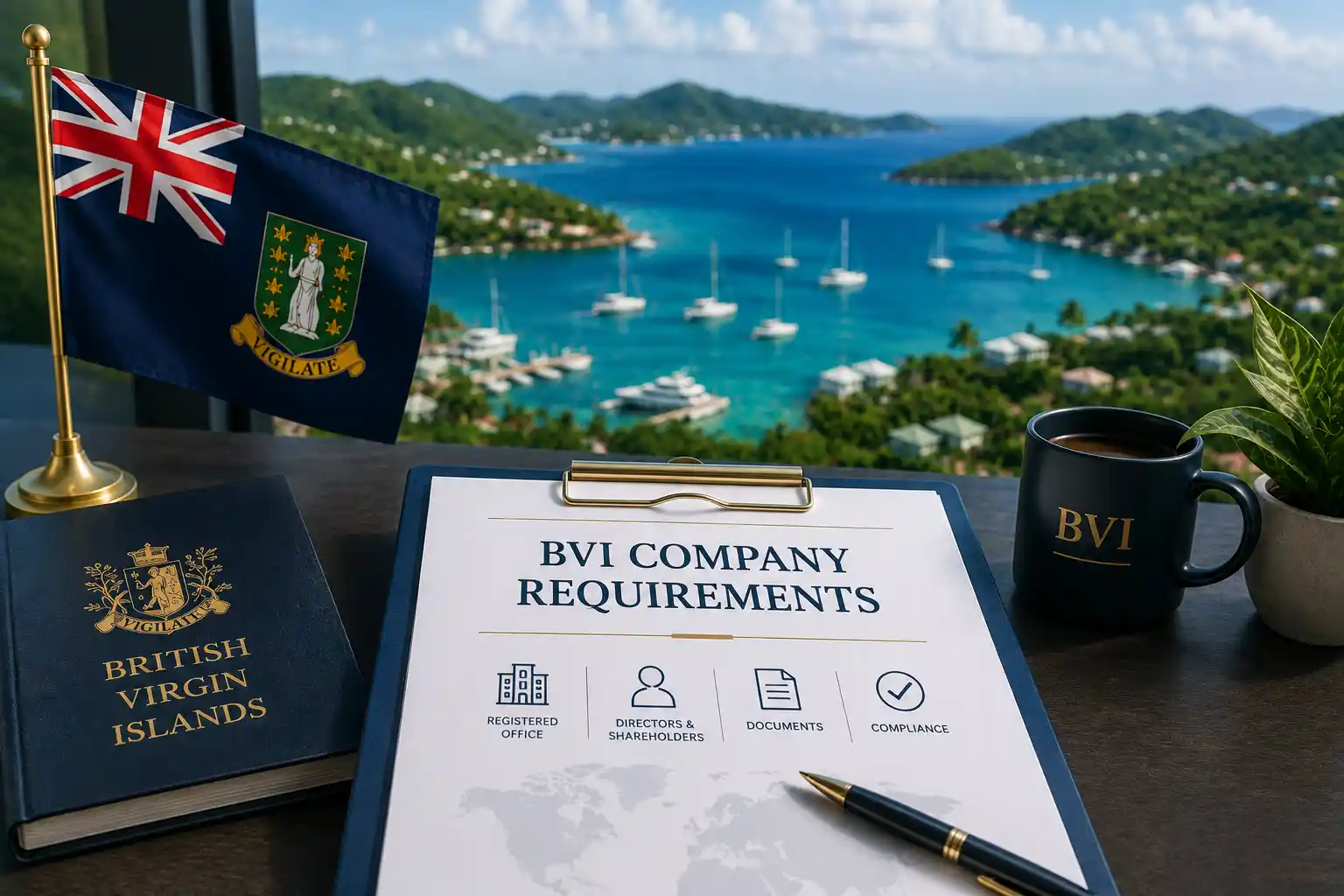
BVI Company Requirements
The British Virgin Islands offers one of the most flexible corporate frameworks available for international business, investment and holding structures.
A standard BVI Business Company can generally be established with a relatively simple corporate structure:
Minimum directors: 1
Minimum shareholders: 1
Foreign ownership: 100% permitted
BVI-resident director: generally not required
BVI-resident shareholder: generally not required
Registered agent in the BVI: mandatory
Registered office in the BVI: mandatory
Large minimum paid-up share capital: not generally required
Bearer shares: abolished
Register of members: required and subject to current filing requirements
Register of directors: required and subject to filing requirements
Beneficial ownership information: required under the current BVI framework
These characteristics make the BVI Business Company suitable for structures ranging from a simple single-owner investment company to sophisticated international holding companies, joint ventures and special-purpose vehicles.
However, the simplicity of the basic corporate structure should not be confused with an absence of compliance.
BVI companies must maintain appropriate statutory records, identify their beneficial owners, maintain a licensed registered agent and registered office, keep financial records and comply with applicable annual and regulatory filings.
This guide explains the principal BVI company requirements in 2026, including directors, shareholders, shares, authorised capital, registered office, registered agent, company records and beneficial ownership.
?? For the complete overview of incorporation, taxation, costs and compliance, see:
BVI Company Formation: The Complete Guide to Registering a Company in the British Virgin Islands (2026)
What Are the Main Requirements to Form a BVI Company?
For a straightforward BVI Business Company limited by shares, the principal requirements generally include:
- an approved company name;
- at least one shareholder;
- at least one director;
- a licensed BVI registered agent;
- a registered office in the British Virgin Islands;
- memorandum and articles of association;
- an appropriate share structure;
- identification of beneficial owners;
- KYC and due diligence documentation;
- a register of members;
- a register of directors;
- applicable Registry filings; and
- payment of the government incorporation fee.
After incorporation, the company must continue to comply with annual maintenance, financial-record, annual-return, beneficial ownership and economic substance requirements where applicable.
?? For the incorporation procedure:
How to Register a Company in the British Virgin Islands: Step-by-Step Guide
BVI Company Requirements at a Glance
A standard privately owned BVI Business Company can generally be structured as follows:
Shareholders: minimum 1
Directors: minimum 1
Nationality restrictions: generally none for ordinary foreign investors
Foreign ownership: up to 100%
Local shareholder: not generally required
Local director: not generally required
Registered agent: mandatory and must be appropriately licensed in the BVI
Registered office: mandatory in the BVI
Company secretary: not generally mandatory for an ordinary BVI Business Company
Share capital: flexible
Large minimum paid-up capital: not generally required
Common share structure: often up to 50,000 authorised shares for a standard private company, although other structures are possible
Bearer shares: no longer permitted
Register of members: required
Register of directors: required
Beneficial ownership information: required
Accounting records: required
Annual financial return: generally required, subject to applicable exemptions
Economic substance: depends on the company’s activities
This flexibility is one of the principal reasons the BVI remains widely used for international corporate structures.
What Type of Company Is Normally Formed in the BVI?
The most commonly used structure for international business is a BVI Business Company limited by shares.
Under this structure, the company has separate legal personality and its shareholders’ liability is generally limited according to the shares they hold, subject to applicable law.
A company limited by shares can be suitable for:
- international holding;
- investment ownership;
- joint ventures;
- special-purpose vehicles;
- international trading;
- private investment;
- acquisition structures;
- group holding;
- financing transactions; and
- certain professional or consulting businesses.
Other forms of BVI Business Company are available, but the company limited by shares is normally the most relevant structure for conventional international corporate ownership.
How Many Directors Does a BVI Company Need?
A BVI Business Company must have at least one director.
A company’s memorandum or articles may provide for more than one director where required.
Therefore, a straightforward private company can operate with:
1 shareholder
and
1 director
The same individual can generally hold both positions.
This makes the BVI particularly flexible for privately owned international companies.
Can a BVI Company Have One Director?
Yes.
A single director is sufficient for an ordinary BVI Business Company unless the company’s memorandum or articles require a greater number.
For example:
Shareholder: John Smith – 100%
Director: John Smith
This is generally possible.
Alternatively:
Shareholder: Holding Company A – 100%
Director: Jane Smith
This can also generally be possible.
More complex companies may appoint several directors.
Does a BVI Director Have to Live in the BVI?
There is no general requirement for a director of an ordinary BVI Business Company to be resident in the British Virgin Islands.
The director can generally live in:
- the United Kingdom;
- another European country;
- the United Arab Emirates;
- Singapore;
- Hong Kong;
- another Caribbean jurisdiction;
- the United States;
- Canada; or
- another country,
subject to applicable sanctions, KYC and regulatory requirements.
This is an important distinction between the BVI and jurisdictions that require locally resident directors.
Can a Foreigner Be a Director of a BVI Company?
Yes.
Foreign individuals can generally serve as directors of BVI Business Companies.
There is no general requirement that the director must be a BVI citizen or resident.
This means that an international entrepreneur can generally own and direct their own BVI company without appointing an artificial local nominee director merely to satisfy an incorporation requirement.
However, the director’s country of residence can have significant tax consequences.
Director Residence and Company Tax Residence
The absence of a BVI-resident director requirement does not mean that the director’s location is irrelevant.
Where a company is managed from another jurisdiction, that jurisdiction may potentially treat the company as tax resident there.
For example:
BVI Company
?
Sole Director resident in Country A
?
All strategic decisions made in Country A
Country A may potentially consider whether the BVI company is tax resident there under its domestic rules.
Therefore, corporate-law requirements and tax-residence requirements should always be considered separately.
?? For detailed tax information:
BVI Company Taxation: Corporate Tax, Capital Gains and Withholding Tax Explained
When Must the First Director Be Appointed?
A newly incorporated BVI company must appoint its first director within the period prescribed by the BVI Business Companies Act.
The registered agent has an important role in the initial appointment process.
The company’s first director should therefore be appointed promptly after incorporation rather than leaving the company without a functioning board.
Once appointed, the directors assume responsibility for managing or supervising the management of the company’s business and affairs.
What Does a BVI Company Director Do?
Directors are responsible for the management of the company’s business and affairs, subject to the BVI Business Companies Act and the company’s memorandum and articles.
Depending on the company, directors may make decisions concerning:
- contracts;
- banking;
- investments;
- acquisitions;
- disposals;
- financing;
- issuing shares;
- distributions;
- appointment of officers;
- corporate restructuring;
- subsidiaries; and
- other business matters.
Directors must act within their authority and comply with their legal duties.
What Duties Do BVI Directors Have?
A BVI company director is not merely a name appearing on a corporate document.
Directors have legal responsibilities.
These include acting in accordance with the BVI Business Companies Act, the company’s memorandum and articles and applicable law.
Depending on the circumstances, directors must consider:
- the company’s interests;
- proper corporate purpose;
- conflicts of interest;
- corporate authority;
- solvency;
- proper records;
- lawful distributions;
- regulatory requirements; and
- decisions affecting creditors and shareholders.
Professional legal advice may be required where significant transactions or conflicts arise.
Can a Company Be a Director of a BVI Company?
BVI corporate law permits corporate directors in appropriate circumstances, subject to statutory requirements and restrictions.
However, the use of corporate directors can introduce additional compliance and beneficial ownership considerations.
For many straightforward privately owned BVI companies, appointing an individual director is simpler.
Where a corporate director is proposed, the structure should be reviewed with the registered agent before incorporation.
Can the Same Person Be Director and Shareholder?
Yes.
For a standard private BVI Business Company, the same individual can generally be both:
100% shareholder
and
sole director.
This is one of the simplest ownership structures.
For example:
Individual Owner
?
100% Shareholder of BVI Company
?
Same Individual Acts as Director
This can be appropriate for a private investment or holding structure.
However, tax residence, management and control should still be considered.
Is a Company Secretary Required in the BVI?
A company secretary is not generally mandatory for an ordinary BVI Business Company.
The company can appoint officers or a secretary if this is commercially useful or required by its internal governance arrangements.
For a straightforward private company, however, a mandatory local company secretary is generally not part of the basic formation requirements.
This reduces unnecessary corporate administration.
How Many Shareholders Does a BVI Company Need?
A standard BVI Business Company limited by shares can generally have one shareholder.
There is therefore no requirement to introduce a second shareholder merely to establish the company.
This makes the structure suitable for:
- sole entrepreneurs;
- individual investors;
- wholly owned subsidiaries;
- family investment structures;
- holding companies; and
- special-purpose vehicles.
Can a BVI Company Have One Shareholder?
Yes.
A BVI company can generally be wholly owned by a single shareholder.
For example:
Individual shareholder – 100%
or
Corporate shareholder – 100%
are both possible structures, subject to applicable due diligence and regulatory requirements.
Can Foreigners Own 100% of a BVI Company?
Yes.
An ordinary BVI Business Company can generally be 100% foreign owned.
There is no general requirement to allocate shares to a local BVI partner.
This makes the jurisdiction particularly attractive for international investors.
A non-resident investor can potentially be:
100% shareholder
and
sole director
of the company.
?? For more information:
BVI Company Formation for Non-Residents: Ownership, Uses and Tax Considerations
Is a BVI-Resident Shareholder Required?
No.
There is generally no requirement for an ordinary BVI Business Company to have a shareholder resident in the British Virgin Islands.
The shareholder can be located internationally.
This allows international investors to maintain full ownership without introducing a local shareholder solely to comply with company law.
Can a Company Own Shares in a BVI Company?
Yes.
A corporate entity can generally be a shareholder of a BVI Business Company.
For example:
UK Company
?
100%
?
BVI Company
or:
BVI Holding Company
?
100%
?
BVI Subsidiary
Corporate shareholders are common in international group structures.
The ultimate beneficial owners behind corporate shareholders must nevertheless be identified according to applicable BVI beneficial ownership and AML requirements.
Can a Trust Own a BVI Company?
Shares in a BVI company can be held within an appropriate trust structure.
The BVI is also known for its specialised trust framework, including VISTA arrangements in suitable circumstances.
Trust ownership may be used for:
- succession planning;
- family wealth structures;
- investment holding;
- family business continuity; and
- estate planning.
However, trust structures require specialist legal and tax advice.
The trustees, settlor, beneficiaries and other relevant persons may need to be identified for AML and beneficial ownership purposes depending on the applicable rules.
Can a Foundation Own a BVI Company?
Depending on its legal status and the circumstances, a foreign foundation or similar legal person may potentially hold shares in a BVI Business Company.
The registered agent will need to review the foundation’s:
- constitutional documents;
- legal status;
- controllers;
- founders;
- council members;
- beneficiaries where relevant; and
- ultimate beneficial ownership.
Complex ownership structures normally require more extensive KYC than a company owned directly by one individual.
What Information Is Required About BVI Shareholders?
The company must maintain a register of members.
The register records prescribed information concerning the company’s members and their interests.
For a company limited by shares, this includes information such as:
- shareholder name;
- shareholder address;
- shares held;
- relevant class or series;
- associated voting rights where applicable;
- date the person became a member; and
- date the person ceased to be a member where applicable.
The register is an important corporate record because it establishes registered ownership of the company’s shares.
What Is the BVI Register of Members?
The register of members is the company’s formal record of its shareholders.
It should accurately reflect current ownership.
If ownership changes, the register must be updated.
For example:
Original structure:
Shareholder A – 100%
After share transfer:
Shareholder A – 60%
Shareholder B – 40%
The register of members should reflect the new structure once the transfer has been properly completed.
Important 2025-2026 Change: Filing the Register of Members
Older online guides frequently state that the BVI register of members is simply maintained privately by the registered agent and is not filed with the Registry.
That information is now outdated.
The BVI Business Companies legislative amendments introduced enhanced filing requirements concerning registers of members.
Existing companies were required to comply with the new filing regime within the applicable transitional period, which was subsequently extended by the Registrar.
This is a significant change to the BVI corporate transparency framework.
For new structures and existing companies in 2026, the current filing requirements should therefore be checked and followed through the company’s registered agent.
Is the BVI Register of Members Public?
The filing of corporate information should not automatically be confused with unrestricted public access.
The BVI has progressively changed its corporate transparency framework, and the accessibility of particular information depends on the statutory rules in force and the type of information involved.
Certain filed company information can be available through Registry searches or authorised requests, while beneficial ownership information is governed by a separate access framework.
Therefore, claims such as:
“BVI shareholders are completely secret”
or
“all BVI ownership information is freely public”
are both too simplistic.
The current statutory access rules must be considered.
?? For a detailed analysis:
BVI Beneficial Ownership, Privacy and Confidentiality Requirements
What Is a Beneficial Owner?
The registered shareholder and the beneficial owner are not always the same person.
For example:
Individual A
?
100% owns Holding Company X
?
Holding Company X owns BVI Company
The registered shareholder of the BVI company may be Holding Company X.
But Individual A may be the ultimate beneficial owner.
The BVI’s AML and beneficial ownership framework requires identification of the natural persons who ultimately own or control legal entities according to the applicable statutory tests.
Are Beneficial Owners Required to Be Identified?
Yes.
BVI companies are not anonymous entities.
The registered agent must conduct due diligence and obtain information about the company’s beneficial ownership.
The modern BVI framework also includes beneficial ownership filing requirements.
This is an important distinction from outdated descriptions of BVI companies as “anonymous offshore corporations”.
The jurisdiction provides corporate privacy within a regulated transparency framework, not secrecy from competent authorities.
BVI Beneficial Ownership Changes in 2025-2026
The BVI introduced major changes to its beneficial ownership regime effective from 2025.
Beneficial ownership information is now integrated into the Registry framework under the updated Business Companies legislation and related regulations.
The regime includes requirements concerning:
- identification of beneficial owners;
- filing of prescribed beneficial ownership information;
- updating changes;
- access by competent authorities;
- applicable exemptions; and
- procedures concerning access to beneficial ownership information.
These changes are important for any BVI company formed or maintained in 2026.
They also mean that older internet articles referring only to the previous BOSS system may no longer accurately describe the current framework.
Does Beneficial Ownership Reporting Remove BVI Privacy?
Not entirely.
The existence of beneficial ownership reporting does not mean that all beneficial ownership data is automatically displayed publicly without restriction.
The current framework contains rules governing who may access information and under what circumstances.
The BVI FSC has also issued implementation guidance concerning access and legitimate-interest procedures.
The correct description is therefore:
BVI companies retain a degree of legitimate corporate privacy, but ownership is not anonymous and beneficial ownership information must be reported in accordance with law.
What Is the Minimum Share Capital for a BVI Company?
A conventional BVI Business Company does not generally require a large statutory minimum paid-up capital amount.
This provides considerable flexibility.
Unlike jurisdictions that require a company to deposit substantial capital into a bank account before incorporation, a standard BVI company can generally be established without a large mandatory paid-up capital contribution.
This is particularly useful for:
- holding companies;
- SPVs;
- private investment companies;
- joint ventures; and
- international subsidiaries.
Does a BVI Company Need US$50,000 Share Capital?
No.
This is a common misunderstanding.
The figure 50,000 shares frequently appears in BVI company formation because the government fee structure historically distinguishes companies according to the number of shares they are authorised to issue.
It does not mean that the shareholder must deposit US$50,000.
For example:
50,000 authorised shares
does not automatically mean:
US$50,000 paid into a bank account.
Authorised shares and paid-up capital are different concepts.
What Are Authorised Shares?
Authorised shares represent the number or classes of shares that the company is permitted to issue under its constitutional documents.
For example, a company might be authorised to issue:
50,000 ordinary shares
but initially issue only:
100 shares
to its shareholder.
The remaining authorised shares remain unissued unless and until the company validly issues them.
What Are Issued Shares?
Issued shares are shares that the company has actually issued to shareholders.
Example:
Authorised shares: 50,000
Issued shares: 100
Shareholder A owns: 100
Shareholder A therefore owns:
100% of the issued shares
even though the company is authorised to issue more shares.
The distinction is important when reviewing BVI corporate documents.
Authorised Shares vs Issued Shares
These concepts are often confused.
Authorised shares
are the shares the company is permitted to issue.
Issued shares
are the shares actually issued to shareholders.
Ownership percentages are generally determined by the shares actually issued and their associated rights, rather than simply by the maximum number the company could issue.
Does Every BVI Share Need a Par Value?
BVI corporate law permits considerable flexibility in share structuring, including structures involving shares with or without par value where appropriately established.
The memorandum and articles determine the company’s authorised share structure.
For a simple privately owned company, ordinary shares with straightforward voting and economic rights are often sufficient.
More sophisticated structures can use different share rights where appropriate.
Can a BVI Company Have Different Classes of Shares?
Yes.
A BVI Business Company can be structured with different classes or series of shares where its memorandum and articles provide for them.
For example:
Class A Ordinary Shares
Class B Ordinary Shares
Preference Shares
Different classes can potentially carry different:
- voting rights;
- dividend rights;
- redemption rights;
- conversion rights;
- distribution rights; and
- rights on liquidation.
This flexibility can be particularly useful for joint ventures and investment structures.
Why Use Different Share Classes?
Different share classes can help structure relationships between investors.
For example:
Founder:
Class A – voting shares
Investor:
Class B – economic rights with specified voting protections
Or:
Investor A – 60% economic interest
Investor B – 40% economic interest
with certain decisions requiring approval from both.
The exact rights must be carefully drafted into the company’s constitutional and shareholder documentation.
Can BVI Companies Issue Preference Shares?
A BVI company can potentially issue preference shares where its memorandum and articles permit the relevant rights.
Preference shares may be structured to provide particular:
- dividend entitlements;
- redemption rights;
- priority on distributions;
- conversion rights; or
- voting arrangements.
These structures are commonly relevant to investment transactions rather than basic one-owner companies.
Are Bearer Shares Allowed in the BVI?
No.
Bearer shares have been abolished from the modern BVI corporate regime.
This is an important compliance development.
Older descriptions of BVI companies sometimes refer to bearer shares as a privacy feature.
Such information is outdated.
Modern BVI ownership must be properly recorded through registered shares and the applicable ownership and beneficial ownership framework.
Can BVI Company Shares Be Transferred?
Yes.
Shares can generally be transferred subject to:
- the BVI Business Companies Act;
- the company’s memorandum and articles;
- any shareholders’ agreement;
- director or shareholder approvals where required;
- applicable restrictions;
- KYC;
- sanctions requirements; and
- beneficial ownership updates.
A share transfer should be formally documented and the register of members updated.
Where current Registry filing requirements apply, the appropriate filing should also be completed.
Can BVI Company Shares Be Held Jointly?
Joint ownership may be possible depending on the company’s constitutional arrangements and applicable law.
However, the practical consequences should be considered carefully.
These can include:
- voting;
- succession;
- beneficial ownership;
- dividend payments; and
- authority to give instructions.
For many family or investment structures, separate shareholdings or a properly designed trust arrangement may provide clearer governance.
Can Shares Be Issued After Incorporation?
Yes.
A BVI company may generally issue additional shares after incorporation subject to:
- its authorised share structure;
- memorandum and articles;
- directors’ authority;
- pre-emption or contractual rights;
- shareholder agreements; and
- applicable corporate procedures.
For example:
At incorporation:
Shareholder A – 100 shares
Later:
Company issues 25 shares to Investor B.
The ownership percentages will then change according to the rights attached to the shares.
The register of members and applicable filings must be updated.
Is a Share Certificate Required?
BVI companies commonly issue share certificates as evidence of share ownership.
However, the company’s register of members is a particularly important legal ownership record.
Corporate records should be maintained carefully, especially where:
- investments are significant;
- several shareholders exist;
- financing is planned;
- the company may be sold; or
- due diligence may later be required.
What Is a BVI Registered Agent?
Every BVI Business Company must maintain a registered agent in the British Virgin Islands.
The registered agent is a central part of the BVI corporate framework.
A registered agent is not simply a mailing address.
The agent performs important statutory and compliance functions and acts as the principal administrative connection between the company and the BVI corporate registry.
Is a BVI Registered Agent Mandatory?
Yes.
A BVI Business Company must maintain a registered agent in the Virgin Islands at all times, subject to limited statutory exceptions such as particular liquidation circumstances.
A company cannot simply appoint a friend or unrelated individual living in Tortola.
The registered agent must hold the appropriate BVI licence authorising the provision of registered-agent services.
Who Can Act as a BVI Registered Agent?
Registered-agent services are regulated.
The person or entity providing the service must hold the appropriate licence under BVI financial-services legislation.
Only authorised Trust and Corporate Services Providers categorised as registered agents are permitted to form legal persons in the BVI.
This means foreign owners cannot directly incorporate a BVI Business Company with the Registry in the same manner as an individual might directly register a domestic company through an online government portal in some jurisdictions.
The formation is handled through the licensed registered-agent framework.
What Does the BVI Registered Agent Do?
The registered agent performs or coordinates important functions including:
- company incorporation;
- Registry filings;
- maintenance of prescribed company records;
- KYC and AML compliance;
- beneficial ownership information;
- annual government renewal;
- changes of directors;
- changes of shareholders;
- share issues and transfers;
- changes of company name;
- certificates of good standing;
- certified corporate documents;
- Registry searches;
- economic substance coordination where relevant; and
- other statutory filings.
The precise services and fees depend on the registered agent and company requirements.
Can a BVI Company Operate Without a Registered Agent?
No, except in limited circumstances specifically provided by law.
Failure to maintain a registered agent can have serious consequences.
A company without the required registered agent can become non-compliant and can ultimately face enforcement or strike-off consequences.
It can also be unable to complete transactions or filings that must be effected through a registered agent.
Maintaining the registered agent is therefore a core annual requirement.
Can a BVI Company Change Its Registered Agent?
Yes.
A company can change its registered agent by following the procedures prescribed by the BVI Business Companies Act.
This normally involves:
- appointment of the new licensed registered agent;
- required approvals;
- filing of the appropriate notice;
- transfer of corporate records;
- completion of KYC with the new agent; and
- settlement of applicable fees.
The change should be properly coordinated to avoid a period in which the company does not have a registered agent.
What Is a BVI Registered Office?
Every BVI Business Company must maintain a registered office in the British Virgin Islands.
The registered office is the company’s official address in the jurisdiction for legal and corporate purposes.
It must be an address in the BVI.
In practice, the registered office is commonly provided by the company’s licensed registered agent.
Is a Registered Office Mandatory?
Yes.
A BVI Business Company must maintain both:
a registered agent in the BVI
and
a registered office in the BVI.
These are separate legal concepts even when the same licensed corporate-service provider supplies both.
Does the BVI Registered Office Need to Be a Physical Address?
The registered office must be an appropriate physical address in the British Virgin Islands.
A simple post-office box alone is not sufficient as the statutory registered office.
In practice, most international BVI companies use the registered office address provided by their registered agent.
Does the Company Need Its Own Office in the BVI?
Not necessarily.
The statutory registered office requirement should not be confused with an operational office.
A conventional international holding or investment company can normally use the registered office supplied through its corporate-service arrangement.
However, if the company carries on a relevant activity under the BVI economic substance regime, additional physical-presence or substance requirements may apply depending on that activity.
Therefore:
registered office ? economic substance office.
?? For detailed guidance:
BVI Economic Substance Rules Explained
Can the Registered Office Be the Same as the Registered Agent’s Office?
Yes.
This is common practice.
The registered agent can provide both:
registered agent services
and
registered office services.
This creates a central BVI location for the company’s statutory administration.
What Records Are Maintained With the Registered Agent?
BVI companies must maintain prescribed corporate information and records with their registered agent.
These include or can include, depending on the applicable statutory requirement:
- memorandum and articles;
- register of members;
- register of directors;
- copies of relevant filings;
- beneficial ownership information;
- corporate resolutions;
- ownership information; and
- other statutory documents.
The registered agent must also maintain appropriate KYC records concerning the company’s owners and controllers.
What Is the Memorandum of Association?
The memorandum is one of the company’s principal constitutional documents.
It contains fundamental information concerning the company, including matters prescribed by the BVI Business Companies Act.
Depending on the company type and structure, this can include:
- company name;
- company type;
- registered agent details;
- registered office information;
- authorised share structure; and
- other statutory matters.
The memorandum is filed as part of incorporation.
What Are the Articles of Association?
The articles govern the company’s internal administration.
They can address matters such as:
- directors;
- director meetings;
- shareholder meetings;
- voting;
- share issues;
- transfers;
- distributions;
- corporate approvals; and
- other internal governance procedures.
For a straightforward private company, standard articles may be suitable.
For a joint venture or sophisticated investment structure, customised constitutional arrangements may be appropriate.
Can the Memorandum and Articles Be Changed?
Yes.
A BVI company can generally amend its memorandum or articles subject to the BVI Business Companies Act and the company’s existing constitutional provisions.
Amendments may be required when:
- changing the company name;
- altering share rights;
- creating new share classes;
- changing authorised shares;
- restructuring ownership; or
- modifying governance provisions.
Appropriate resolutions and Registry filings must be completed.
Is a BVI Company Name Restricted?
A proposed company name must comply with BVI naming rules and be approved for registration.
The name must not be identical or impermissibly similar to an existing registered name.
Certain words can be restricted or require consent.
Examples of sensitive terms may include words suggesting:
- banking;
- insurance;
- trust business;
- regulated financial services;
- government connection; or
- other restricted activities.
The proposed name is therefore checked before incorporation.
What Company Name Endings Can Be Used?
A company limited by shares must use an appropriate corporate suffix or abbreviation permitted under BVI legislation.
Common corporate endings can include forms such as:
Limited
Ltd.
Corporation
Corp.
Incorporated
Inc.
The appropriate suffix should be selected during incorporation.
Does a BVI Company Need a Business Licence?
Company incorporation and permission to conduct a particular regulated business are separate matters.
An ordinary BVI Business Company can have broad corporate capacity.
However, activities such as:
- banking;
- insurance;
- investment business;
- trust business;
- company management;
- money services;
- certain virtual asset services; and
- other regulated financial activities
may require separate licensing.
A Certificate of Incorporation alone does not authorise a company to conduct regulated financial services.
What KYC Documents Are Required to Form a BVI Company?
The precise KYC requirements depend on the registered agent, ownership structure, risk profile and applicable AML legislation.
For an individual shareholder or beneficial owner, documents commonly requested can include:
- certified passport or other acceptable identification;
- proof of residential address;
- information about occupation or business;
- source of funds;
- source of wealth where required;
- tax residence information;
- tax identification number where applicable; and
- explanation of the proposed company activity.
Additional information can be requested depending on risk.
KYC Requirements for Corporate Shareholders
Where a shareholder is another company, additional documentation is normally required.
This may include:
- certificate of incorporation;
- memorandum and articles or equivalent constitutional documents;
- register of directors;
- register of shareholders or members;
- certificate of good standing where required;
- ownership chart;
- identification of ultimate beneficial owners;
- board resolution; and
- KYC on relevant individuals.
The registered agent must generally trace ownership through the corporate chain to the ultimate natural persons who own or control the structure.
Why Is Source of Funds Required?
BVI registered agents operate within an AML/CFT regulatory framework.
They therefore need to understand where funds connected with the company originate.
Examples of legitimate source of funds can include:
- salary;
- business income;
- sale of a business;
- investment proceeds;
- inheritance;
- dividends;
- property sale; or
- other documented lawful sources.
The exact evidence required depends on the transaction and risk profile.
Why Is Source of Wealth Sometimes Required?
Source of wealth concerns how an individual accumulated their overall wealth rather than merely the source of one particular payment.
It can be relevant where:
- substantial assets are involved;
- high-value investments are planned;
- the structure is complex;
- the individual is high-risk;
- enhanced due diligence applies; or
- the registered agent requires further verification.
This is standard international AML practice and is not unique to BVI companies.
Do BVI Companies Need a Beneficial Owner?
Every privately owned company ultimately has one or more individuals who own or control it, although the statutory determination of beneficial ownership depends on the applicable legal tests and structure.
The BVI framework requires prescribed beneficial ownership information to be identified and reported.
Complex ownership does not remove this requirement.
For example:
Individual
?
Trust/Foundation/Holding Company
?
BVI Company
The relevant natural persons must still be analysed under the beneficial ownership rules.
Does a BVI Company Need an Operational Address?
A registered office is mandatory.
A separate operational address depends on the company’s activities.
A passive holding company may have no conventional operational office.
An active trading or service company may conduct business from another jurisdiction.
Where economic substance applies, the company may need appropriate resources and presence according to the relevant activity.
Does a BVI Company Need Employees?
Not simply because it is incorporated in the BVI.
There is no universal rule requiring every ordinary BVI Business Company to employ local staff.
However, economic substance requirements can apply to specified relevant activities.
The number and nature of employees, premises, expenditure and management required depend on the activity.
A simple incorporation requirement should therefore not be confused with economic substance requirements.
Does a BVI Company Need a Bank Account?
A bank account is not generally a condition for the legal incorporation of an ordinary BVI Business Company.
The company can be incorporated before a bank account is opened.
After incorporation, banking can be arranged according to the company’s activities and requirements.
A BVI company may potentially bank:
- in the BVI;
- elsewhere in the Caribbean;
- in Europe;
- in the UK;
- in Asia;
- in the Middle East; or
- in another acceptable jurisdiction,
subject entirely to the financial institution’s onboarding policies.
?? For more information:
Offshore Banking for BVI Companies: Requirements and Banking Options
Is a BVI Bank Account Guaranteed After Incorporation?
No.
Company registration and bank-account approval are separate processes.
Banks conduct their own due diligence.
They commonly assess:
- beneficial owners;
- shareholder residence;
- director residence;
- business activity;
- countries involved;
- expected transactions;
- source of funds;
- source of wealth;
- tax residence;
- contracts;
- customers;
- suppliers; and
- commercial rationale.
A BVI Certificate of Incorporation does not guarantee bank approval.
Does a BVI Company Need Accounts?
Yes.
The BVI’s 0% general corporate income tax environment does not mean accounting records are unnecessary.
A BVI Business Company must maintain records and underlying documentation sufficient to explain its transactions and determine its financial position with reasonable accuracy.
For an active company, proper bookkeeping should therefore be maintained throughout the year.
Does a BVI Company Need an Annual Financial Return?
BVI Business Companies are generally required to prepare an annual financial return and provide it to their registered agent within the applicable statutory period, subject to available exemptions.
This requirement was introduced as part of the BVI’s strengthened financial reporting framework.
The annual financial return should not be confused with a conventional corporate income tax return.
?? For detailed information:
BVI Company Accounting, Annual Returns and Ongoing Compliance Requirements
Does a BVI Company Need an Audit?
An ordinary privately held BVI Business Company is not generally subject to a universal statutory audit requirement simply because it is incorporated in the BVI.
However, an audit can be required because of:
- regulated business;
- sector-specific legislation;
- investor requirements;
- financing agreements;
- shareholder agreements;
- group reporting requirements; or
- foreign-law obligations.
The company’s specific circumstances should therefore be considered.
Does a BVI Company Need Economic Substance?
Potentially.
The BVI economic substance regime applies according to whether the legal entity conducts one or more specified relevant activities.
Relevant activities include areas such as:
- banking;
- insurance;
- fund management;
- financing and leasing;
- headquarters;
- shipping;
- holding business;
- intellectual property;
- distribution and service centre business.
The precise substance requirement depends on the activity.
A company should therefore classify its business rather than assume automatically that it either does or does not require substance.
What Are the Requirements for a BVI Holding Company?
A straightforward BVI holding company generally requires the same basic corporate framework:
minimum one shareholder;
minimum one director;
BVI registered agent;
BVI registered office;
proper share structure;
register of members;
register of directors;
beneficial ownership information;
accounting records;
and
annual compliance.
If it is a pure equity holding entity for economic substance purposes, specific substance rules apply.
?? For detailed information:
BVI Holding Company: Benefits, Uses and Tax Considerations
What Are the Requirements for a BVI Trading Company?
A BVI trading company has the same core company-law requirements but normally requires greater operational planning.
Consider:
- tax residence;
- permanent establishments;
- contracts;
- banking;
- VAT/GST;
- customs;
- employees;
- accounting;
- economic substance; and
- local licensing in countries where it operates.
The fact that BVI company formation itself is relatively simple does not eliminate operational requirements elsewhere.
What Are the Requirements for a BVI Investment Company?
A private company investing its own assets can potentially operate as an investment holding vehicle.
However, there is an important distinction between:
investing the company’s own money
and
managing investments or funds for third parties.
Investment business conducted for others can be regulated and may require licensing.
The proposed activity should therefore be reviewed before incorporation.
What Are the Requirements for a BVI Joint Venture?
A BVI joint venture may require more sophisticated documentation than a single-owner company.
In addition to the standard BVI company requirements, the parties may require:
- several share classes;
- shareholders’ agreement;
- board appointment rights;
- reserved matters;
- voting thresholds;
- pre-emption rights;
- transfer restrictions;
- deadlock provisions;
- tag-along rights;
- drag-along rights; and
- exit provisions.
The BVI’s flexible corporate law makes it particularly suitable for such arrangements.
Can a Minor Own Shares in a BVI Company?
Ownership involving minors can create significant legal, capacity, succession and compliance issues.
Even where a structure can legally accommodate an interest for a minor, direct ownership may not be the most appropriate solution.
A trust or other properly designed arrangement may be preferable.
Professional legal and tax advice should be obtained before placing company shares directly in the name of a minor.
Can a Nominee Shareholder Be Used?
Nominee arrangements may be possible in appropriate lawful circumstances, but they do not eliminate beneficial ownership disclosure.
The registered agent must identify the true beneficial owner under applicable AML and beneficial ownership requirements.
A nominee structure therefore cannot legitimately be used to conceal ownership from the registered agent or competent authorities.
Can a Nominee Director Be Used?
Professional director services may be available in appropriate circumstances, but the appointment must be genuine.
A director has real legal responsibilities.
A nominee director should never be treated as someone who simply signs documents while secretly taking instructions without exercising proper director responsibilities.
The use of professional directors can also affect:
- management and control;
- tax residence;
- economic substance;
- banking; and
- governance.
Professional advice is recommended.
BVI Company Requirements for Non-Residents
A non-resident can generally establish a BVI Business Company without moving to the BVI.
The basic structure may be:
Non-Resident Individual
?
100% Shareholder
?
BVI Business Company
?
Same individual or another person acts as director
The company then maintains:
licensed BVI registered agent
and
BVI registered office.
This makes remote ownership relatively straightforward.
However, the owner’s home-country tax and reporting requirements remain important.
BVI Company Requirements for UK Residents
A UK resident can generally own shares in and serve as a director of a BVI company.
There is no BVI rule requiring the owner to be resident in the Territory.
However, UK residents should consider:
- company tax residence;
- central management and control;
- dividend taxation;
- capital gains;
- transfer-of-assets-abroad rules where relevant;
- permanent establishment;
- CFC rules where relevant;
- reporting obligations; and
- other anti-avoidance provisions.
The simplicity of the BVI company requirements does not override UK taxation.
BVI Company Requirements for European Owners
European residents can generally own BVI companies.
However, each country has its own rules concerning:
- foreign companies;
- CFCs;
- dividends;
- foreign assets;
- beneficial ownership;
- tax residence;
- permanent establishment; and
- reporting.
There is no single tax rule applicable to all EU owners.
BVI Company Requirements After Incorporation
Formation is only the beginning of the company’s compliance lifecycle.
After incorporation, the company should maintain:
- registered agent;
- registered office;
- accurate register of members;
- accurate register of directors;
- beneficial ownership information;
- accounting records;
- supporting documentation;
- annual financial return where applicable;
- economic substance compliance where applicable;
- annual government fee payments;
- appropriate corporate resolutions; and
- current KYC with its registered agent.
Changes should be reported promptly where required.
Changes That Should Be Reported to the Registered Agent
The registered agent should be informed when relevant corporate information changes.
Examples include:
- shareholder changes;
- share transfers;
- new share issues;
- director appointments;
- director resignations;
- beneficial owner changes;
- address changes;
- business activity changes;
- company name changes;
- ownership restructuring;
- tax residence changes; and
- significant changes to company operations.
Some changes require Registry filings within statutory deadlines.
Why Keeping Corporate Records Updated Matters
Incomplete corporate records can create serious practical problems.
For example, outdated ownership information can cause difficulties when:
- opening a bank account;
- selling the company;
- applying for financing;
- undergoing investor due diligence;
- distributing dividends;
- restoring a company;
- obtaining a certificate of good standing; or
- responding to a regulator.
Maintaining records continuously is far easier than reconstructing several years of corporate history later.
Common Mistakes When Setting Up a BVI Company
Mistake 1: Thinking a BVI company requires a local shareholder
It generally does not.
Mistake 2: Thinking a local director is compulsory
An ordinary BVI Business Company does not generally require a BVI-resident director.
Mistake 3: Confusing 50,000 authorised shares with US$50,000 capital
These are not the same thing.
Mistake 4: Assuming there are no accounting requirements
Accounting records are required.
Mistake 5: Believing shareholders and beneficial owners can remain completely anonymous
The BVI has ownership and beneficial ownership reporting requirements.
Mistake 6: Using outdated information about bearer shares
Bearer shares have been abolished.
Mistake 7: Assuming a registered office creates economic substance
A statutory registered office and an operational substance presence are different concepts.
Mistake 8: Forgetting home-country taxation
A foreign director or shareholder can create tax and reporting obligations outside the BVI.
Mistake 9: Assuming incorporation guarantees banking
Banks conduct separate due diligence.
Mistake 10: Ignoring changes introduced to ownership filings
The BVI corporate transparency framework changed materially in 2025.
BVI Company Formation Requirements Checklist
Before incorporation, confirm:
Company name
Choose several acceptable alternatives.
Business activity
Describe the company’s intended activity clearly.
Shareholder
Identify the registered shareholder or shareholders.
Beneficial owner
Identify the ultimate natural person or persons who own or control the company under applicable rules.
Director
Select at least one eligible director.
Share structure
Determine authorised and issued shares and any required share classes.
Registered agent
Appoint a licensed BVI registered agent.
Registered office
Maintain an appropriate BVI registered office.
KYC
Provide identification and address evidence.
Source of funds
Explain and document the source where required.
Source of wealth
Provide evidence where applicable.
Tax residence
Consider where the company and shareholders may be taxable.
Economic substance
Classify the proposed business activity.
Banking
Consider bank-account feasibility before incorporation.
Documents Typically Received After BVI Company Formation
Depending on the structure and service package, the corporate set can normally include documents such as:
- Certificate of Incorporation;
- Memorandum and Articles of Association;
- register of directors;
- register of members;
- first director appointment documentation;
- director resolutions;
- share certificate or certificates;
- registered-agent documentation; and
- other corporate records relevant to the structure.
Additional certified, notarised or apostilled documents can be arranged where required and available.
BVI Company Formation Through BRIS Group
BRIS Group assists international entrepreneurs, investors and corporate clients with establishing BVI Business Companies through the appropriate licensed BVI registered-agent framework.
Before incorporation, we can coordinate the collection and review of information concerning:
- proposed company activity;
- shareholders;
- directors;
- beneficial owners;
- share structure;
- ownership chain;
- required corporate documents; and
- intended company use.
The incorporation process can then be coordinated with the BVI registered agent.
Depending on the client’s requirements, ongoing services may include assistance with:
- registered agent;
- registered office;
- annual renewal;
- director changes;
- shareholder changes;
- share transfers;
- additional share issues;
- certificates of good standing;
- certified documents;
- apostille/legalisation arrangements where available;
- accounting coordination;
- annual financial return requirements;
- economic substance coordination; and
- banking introductions or account-opening assistance where available.
Banking approval always remains at the discretion of the relevant financial institution.
Professional fees and third-party charges depend on the services required and are provided separately by quotation.
Frequently Asked Questions About BVI Company Requirements
What are the basic requirements for a BVI company?
A standard BVI Business Company generally requires at least one shareholder, at least one director, a licensed BVI registered agent, a BVI registered office, memorandum and articles, an appropriate share structure and required ownership and beneficial ownership information.
How many directors does a BVI company need?
At least one director is required.
Can a BVI company have only one director?
Yes. A single director can generally be sufficient.
Does the director have to live in the BVI?
No. An ordinary BVI Business Company does not generally require a BVI-resident director.
Can a foreigner be a BVI company director?
Yes, subject to applicable legal, compliance and sanctions requirements.
Can the shareholder also be the director?
Yes. The same individual can generally be both sole shareholder and sole director.
Can a company act as director?
Corporate directors may be permitted subject to applicable BVI statutory requirements and restrictions. The proposed arrangement should be checked with the registered agent.
Is a company secretary required?
A company secretary is not generally mandatory for an ordinary BVI Business Company.
How many shareholders are required?
One shareholder can generally be sufficient.
Can a foreigner own 100% of a BVI company?
Yes. A standard BVI Business Company can generally be wholly foreign-owned.
Is a BVI shareholder required?
There is no general requirement for a shareholder to be resident in the BVI.
Can another company own a BVI company?
Yes. Corporate shareholders are generally permitted, subject to beneficial ownership and KYC requirements.
Can a trust own BVI company shares?
Yes, appropriate trust structures can hold BVI company shares, subject to legal, tax and compliance considerations.
What is the minimum share capital of a BVI company?
A standard BVI Business Company does not generally require a large statutory minimum paid-up capital contribution.
Does a BVI company need US$50,000 capital?
No. The commonly referenced 50,000 figure concerns authorised shares and the fee structure, not a requirement to deposit US$50,000 into the company.
What are authorised shares?
They are shares the company is permitted to issue under its constitutional documents.
What are issued shares?
They are shares that have actually been issued to shareholders.
Can a BVI company have different share classes?
Yes, provided its memorandum and articles establish the relevant rights.
Can a BVI company issue preference shares?
Potentially yes, where properly provided for in the company’s constitutional documents.
Are bearer shares permitted?
No. Bearer shares have been abolished.
Can BVI company shares be transferred?
Yes, subject to the Act, constitutional documents, contractual restrictions, KYC and applicable filing requirements.
Does a BVI company need a registered agent?
Yes. A licensed BVI registered agent is mandatory.
Can I be my own BVI registered agent?
Not unless you hold the required BVI licence. Registered-agent services are regulated.
Can BRIS Group act directly as the statutory BVI registered agent?
The statutory registered-agent role must be performed by an appropriately licensed BVI provider. BRIS Group can coordinate incorporation and administration through the applicable licensed BVI registered-agent framework.
Does a BVI company need a registered office?
Yes. Every BVI Business Company must maintain a registered office in the British Virgin Islands.
Can the registered office be a PO Box?
A simple post-office box alone is not sufficient as the statutory registered office.
Does a BVI company need its own physical office?
Not merely to satisfy the registered-office requirement. Additional physical presence may be required where applicable under economic substance or regulatory rules.
Is the registered office normally provided by the registered agent?
Yes. This is common for internationally owned BVI companies.
Does a BVI company need employees?
Not simply because it is incorporated in the BVI. Economic substance requirements depend on the company’s activity.
Does a BVI company need a bank account to be incorporated?
No. Incorporation can generally be completed before the company opens a bank account.
Is a BVI bank account mandatory?
Not necessarily. A company may use an appropriate foreign bank or financial institution subject to its business needs and the institution’s acceptance policies.
Is a BVI bank account guaranteed?
No. Every financial institution conducts independent due diligence.
Are BVI shareholders public?
The BVI’s current regime includes filing requirements for registers of members. The availability of particular information depends on the current statutory access framework. Older statements that shareholder information is never filed are outdated.
Are BVI beneficial owners anonymous?
No. Beneficial owners must be identified and reported under the applicable BVI framework.
Is beneficial ownership information public?
Access to beneficial ownership information is governed by specific legislation and procedures. It should not be assumed either to be completely secret or automatically open without restriction.
Does a BVI company need accounts?
Yes. Appropriate accounting records and underlying documentation must be maintained.
Does a BVI company file an annual financial return?
Generally yes, subject to statutory exemptions.
Does a BVI company need audited accounts?
An ordinary private BVI Business Company does not generally have a universal audit requirement merely because it is incorporated in the BVI. Regulated businesses and particular structures can have additional requirements.
Does a BVI company need economic substance?
It depends on whether the company conducts a relevant activity and on the applicable classification.
Can I form a BVI company remotely?
Generally yes. A foreign owner does not normally need to travel to the BVI simply to incorporate an ordinary Business Company.
What documents do I need to form a BVI company?
Common requirements include identification, residential-address evidence, information about business activity, source of funds and ownership. Additional documentation can be required depending on the structure and risk profile.
How long does BVI company formation take?
A straightforward incorporation can generally be completed efficiently once KYC, due diligence and company information have been approved. Actual timing depends on the structure and registered-agent review.
Is a BVI company suitable for one person?
Yes. A straightforward BVI company can generally have one shareholder and one director, with the same individual holding both positions.
Can a BVI company have several shareholders?
Yes. BVI companies can have multiple shareholders and sophisticated share structures.
Can a BVI company be used as a holding company?
Yes. Holding international subsidiaries and investments is one of the established uses of BVI Business Companies.
Can a BVI company trade internationally?
Yes, subject to applicable regulatory, tax, licensing and foreign-law requirements.
Does a BVI company have to conduct business in the BVI?
No. A BVI Business Company can be used for international activities, subject to applicable law.
Does a BVI company pay corporate tax?
An ordinary BVI Business Company generally benefits from an effective 0% BVI corporate income tax environment under the statutory exemption in the BVI Business Companies Act. Foreign taxation may still apply.
BVI Company Requirements in 2026: Key Takeaways
The British Virgin Islands continues to offer a flexible corporate structure for international investors and businesses.
For a standard BVI Business Company limited by shares, the core structure can generally be remarkably simple:
one shareholder;
one director;
100% foreign ownership;
no general BVI-resident director requirement;
no general BVI-resident shareholder requirement;
flexible share capital;
licensed BVI registered agent;
and
BVI registered office.
A large mandatory paid-up capital contribution is not generally required.
The frequently quoted figure of 50,000 shares should not be confused with US$50,000 of required capital.
The BVI also permits flexible ownership and governance structures, including corporate shareholders, multiple share classes, investment structures and joint ventures.
However, the regulatory environment has evolved significantly.
Modern BVI companies must maintain accurate information concerning:
shareholders;
directors;
beneficial owners;
accounting records;
and
company activities.
The BVI’s 2025 ownership-transparency reforms also mean that older statements about registers of members and beneficial ownership may no longer be accurate.
For legitimate international businesses, the BVI therefore combines relatively simple corporate formation requirements with an increasingly modern transparency and compliance framework.
Related BVI Company Guides
- BVI Company Formation: The Complete Guide to Registering a Company in the British Virgin Islands (2026)
- How to Register a Company in the British Virgin Islands: Step-by-Step Guide
- BVI Company Formation Costs Explained: Government Fees, Annual Fees and Other Expenses
- BVI Company Taxation: Corporate Tax, Capital Gains and Withholding Tax Explained
- Advantages of BVI Company Formation for International Business
- BVI Company Formation for Non-Residents: Ownership, Uses and Tax Considerations
- BVI Holding Company: Benefits, Uses and Tax Considerations
- Offshore Banking for BVI Companies: Requirements and Banking Options
- BVI Economic Substance Rules Explained
- BVI Beneficial Ownership, Privacy and Confidentiality Requirements
- BVI Company Accounting, Annual Returns and Ongoing Compliance Requirements
Important Notice
This guide provides general information concerning BVI company requirements and does not constitute legal, tax, accounting, regulatory or investment advice.
Requirements can vary according to company type, ownership structure, business activity and regulatory status.
The BVI Business Companies Act and related regulations have also undergone significant amendments in recent years, including changes to ownership and beneficial ownership filings.
Current requirements should therefore be confirmed before incorporation or any corporate restructuring.