
Panama Company Formation
Panama has been an established international business centre for decades, combining a strategic location between North and South America with an internationally connected economy, a long-standing corporate legal framework and a territorial approach to taxation.
For entrepreneurs and investors considering Panama company formation, however, the jurisdiction should not simply be viewed as a traditional “offshore” destination. Modern Panama operates within a significantly more transparent international regulatory environment than existed twenty years ago. Beneficial ownership requirements, anti-money laundering controls, tax information exchange and corporate record-keeping obligations are now important parts of establishing and maintaining a Panamanian legal entity.
This means that Panama can remain attractive for legitimate international business, investment and holding structures, but the reasons for choosing it have changed.
A properly structured Panama company may be suitable for international trading, investment holding, asset ownership, consultancy, cross-border services, intellectual property ownership and certain regional operations. Whether it is the right structure depends on where the owners are tax resident, where the company is effectively managed, where its income arises and what activities it conducts.
This complete guide explains how Panama company formation works for international entrepreneurs and investors, including corporate structure, ownership requirements, taxation, incorporation, banking, beneficial ownership, annual compliance and the practical considerations that should be examined before establishing a company.
Panama Company Formation at a Glance
For readers looking for a quick answer, the essential features of a typical Panamanian corporation can be summarised as follows:
Jurisdiction: Republic of Panama
Common corporate form: Sociedad Anónima (S.A.), commonly referred to in English as a corporation
Foreign ownership: Foreign individuals and corporate entities may participate in Panamanian corporate structures, subject to applicable legal, regulatory and due diligence requirements
Registered/Resident Agent: A Panamanian resident agent is an essential part of the corporate structure
Directors: The traditional Panamanian corporation structure provides for a board of directors rather than the single-director model commonly associated with some other international jurisdictions
Shareholders: Shares represent ownership of the corporation and ownership must be properly documented
Beneficial ownership: Beneficial ownership information is subject to Panama’s regulatory framework and is reported through the resident-agent system where applicable
Tax system: Panama principally applies a territorial system of taxation, making the source of income fundamental to determining the Panamanian tax treatment
Corporate income tax: Panama’s general corporate income tax rate on taxable net income is 25%, although the actual tax position depends on the source and nature of the company’s income
Local office: A registered corporate presence and resident agent are required, while additional substance may be necessary depending on activities, tax residence and the countries involved
Bank account: A Panama company is not automatically entitled to a bank account. Banks conduct independent KYC, AML, business-model and source-of-funds assessments
Best suited to: International entrepreneurs, holding structures, investors, trading businesses and certain cross-border operations where Panama provides a genuine commercial and legal fit
The important point is that incorporating a Panama company and achieving an appropriate international tax structure are two different matters. Incorporation establishes the legal entity. Tax treatment depends on the company’s activities, income sources, management, ownership and the tax laws applicable to its owners.
What Is a Panama Company?
A Panama company is a legal entity established under Panamanian law. For international entrepreneurs, the most familiar form is the Sociedad Anónima, or S.A., which is generally translated as a corporation.
Panama’s corporation framework has a long history and is particularly well known for its flexibility in international commercial structures. A corporation has a legal personality separate from its shareholders, allowing it to enter contracts, hold assets, conduct business and assume liabilities in its own name.
This separation is one of the principal reasons entrepreneurs use corporate structures internationally.
A Panamanian corporation can potentially be used to:
- conduct international trading activities;
- provide cross-border services;
- hold shares in subsidiaries;
- hold investments;
- own intellectual property;
- participate in joint ventures;
- hold certain international assets;
- structure regional operations; or
- serve as part of a wider international corporate group.
The fact that a company is incorporated in Panama does not, by itself, determine where all of its income will ultimately be taxed. The tax residence of shareholders, management and related companies can materially affect the overall position.
This distinction is especially important for entrepreneurs resident in countries with Controlled Foreign Company rules, management-and-control tests or other anti-avoidance provisions.
Is a Panama Company an Offshore Company?
The expression Panama offshore company is widely used in international business and remains an important search term. Legally, however, entrepreneurs should understand what the phrase actually means.
Panama does not create a fictional company that exists outside the law simply because its owners are foreign. A Panamanian company is a Panamanian legal entity. “Offshore” generally describes the way the company is used — for example, where it is owned by non-residents and conducts international rather than domestic business.
This distinction matters because the old idea of an offshore company as an anonymous, tax-free vehicle requiring little or no compliance is increasingly inaccurate.
Modern international corporate planning involves:
- identifying ultimate beneficial owners;
- completing KYC and AML procedures;
- establishing source of funds and source of wealth where required;
- maintaining appropriate corporate and accounting records;
- complying with applicable tax reporting;
- understanding the company’s actual tax residence;
- considering the owner’s home-country tax obligations; and
- ensuring that the structure has a genuine commercial rationale.
➡️ For entrepreneurs who want a more focused examination of the jurisdiction’s advantages, see Why Choose Panama for Offshore Company Formation? Key Benefits Explained.
Why International Entrepreneurs Choose Panama
Panama’s appeal cannot be reduced to a single tax advantage. The jurisdiction combines several characteristics that can make it commercially useful for particular international structures.
Territorial Taxation
One of the most important features is Panama’s territorial approach to income taxation.
In broad terms, Panama focuses its income tax system on income regarded as arising from Panamanian sources. Foreign-source income is treated differently from Panama-source taxable income.
This distinction is fundamental.
It does not mean that every Panama company owned by a foreign entrepreneur automatically pays no tax. Nor does it mean that profits held through Panama become tax-free in the shareholder’s country of residence.
Instead, the analysis begins by asking:
Where is the income actually sourced?
A business genuinely earning foreign-source income may have a very different Panamanian tax position from a company conducting commercial activities inside Panama.
For example, a company operating locally in Panama, employing staff there and generating Panamanian-source revenue should not be treated in the same way as a holding or international structure whose relevant income arises outside Panama.
Panama’s tax authority, the Dirección General de Ingresos (DGI), distinguishes taxable income from exempt, non-taxable and foreign-source income when determining corporate taxable income.
➡️ For a detailed examination of this subject, see Panama Company Taxation: Territorial Tax System Explained.
Established Corporate Law
Panama’s corporate regime has been used for international commercial structures for generations.
That history matters.
Entrepreneurs choosing a jurisdiction are not simply purchasing a certificate of incorporation. They are selecting the legal system that will govern the company’s internal structure, shareholder relationships, corporate actions and, potentially, disputes.
A mature corporate framework can provide greater predictability for advisers, shareholders and counterparties.
However, Panama’s historical reputation should not be confused with today’s compliance environment. Corporate law exists alongside newer transparency, beneficial ownership and anti-money laundering requirements.
➡️ Our separate guide, Panama Company Law and Legal Framework: What Foreign Owners Need to Know, examines these issues in greater depth.
Strategic International Location
Panama occupies one of the world’s most strategically important commercial locations.
The Panama Canal connects major maritime trade routes, while Panama City has developed into an important regional centre for banking, logistics, professional services and multinational business.
This makes Panama particularly relevant for entrepreneurs whose commercial interests involve:
- Latin America;
- international logistics;
- shipping;
- import and export;
- regional investment;
- international distribution; or
- cross-border holding structures.
For businesses with a genuine connection to the Americas, Panama may therefore offer commercial advantages that have nothing to do with offshore tax planning.
Flexible International Ownership
International entrepreneurs often require a company that can accommodate foreign shareholders, cross-border investment and changes in ownership as a business develops.
A Panamanian corporation can provide considerable flexibility in this respect, but the corporate documents must be properly prepared and the ownership structure accurately maintained.
The identity of the legal shareholder and the ultimate beneficial owner are separate concepts.
A shareholder is the person or entity legally holding shares.
A beneficial owner is the natural person who ultimately owns or controls the entity under the applicable regulatory definition.
This distinction has become increasingly important as international transparency standards have developed.
International Business Applications
Panama companies can be used in a variety of legitimate international structures.
A company might, for example, hold shares in operating subsidiaries located in several countries. Another might conduct international trading between independent suppliers and customers. An investment vehicle might consolidate several assets under one corporate ownership structure.
The commercial rationale should always come first.
Creating a Panama company merely because the jurisdiction has historically been described as “offshore” is not an adequate international structuring strategy.
Who Should Consider a Panama Company?
Panama company formation may be worth considering for several categories of international business owner.
International Entrepreneurs
An entrepreneur conducting genuine cross-border business may use a Panama company as an operating or holding entity where the jurisdiction fits the commercial model.
Relevant factors include where customers are located, where contracts are performed, where management occurs and where the company’s income arises.
International Traders
Panama’s association with global trade and logistics makes the jurisdiction potentially relevant to import-export and international trading structures.
However, tax treatment must be based on the actual transaction flows rather than simply the location of incorporation.
Investors
A corporate structure can provide a central vehicle through which investments are held and administered.
Investors may value:
- separation between personal and corporate ownership;
- continuity of ownership;
- structured governance;
- centralised administration; and
- potential succession-planning flexibility.
Tax consequences should be reviewed in every country where the investor, assets and income are located.
Holding Company Owners
A Panama company may be considered as an international holding vehicle where there is a legitimate reason to consolidate ownership of subsidiaries or investments.
This requires analysis of dividend flows, capital gains, withholding taxes, double-tax agreements, substance and the tax residence of the holding company.
➡️ We will examine this separately in Panama Holding Company: Benefits, Uses and Tax Considerations.
Non-Resident Business Owners
Foreign ownership is one reason Panama remains relevant to international company formation.
However, being a non-resident shareholder does not remove tax obligations elsewhere.
A UK-resident owner, for example, must consider UK tax law independently of the company’s Panamanian status. The same principle applies to residents of EU countries, the United States, Canada and other jurisdictions.
➡️ Our dedicated article Panama Company for Non-Residents: Formation, Ownership and Tax Considerations will examine this issue in detail.
When a Panama Company May Not Be the Right Choice
A trustworthy company-formation guide should explain not only the benefits but also the circumstances in which a jurisdiction may be unsuitable.
Panama is not automatically the best choice for every international entrepreneur.
It may be inappropriate where:
- virtually all business is conducted in the owner’s home country;
- management and control are entirely exercised from another jurisdiction;
- the entrepreneur assumes Panama incorporation automatically removes domestic tax liability;
- a particular bank or investor requires another jurisdiction;
- the proposed activity requires licensing that the planned structure does not address;
- the structure lacks a genuine commercial rationale;
- home-country CFC or anti-avoidance rules eliminate the anticipated tax benefit; or
- the cost of maintaining the international structure exceeds its commercial advantages.
Sometimes a UK company, EU company, UAE company or another offshore/international jurisdiction will provide a better fit.
This is why jurisdiction selection should occur before incorporation, not after the company has already been established.
Panama Company Structure Explained
Understanding the internal structure of a Panama corporation is essential before incorporation.
Although company structures can be customised, several roles are particularly important.
Subscribers and Incorporation
The incorporation process begins with the constitutional documentation required to establish the corporation.
This documentation sets out fundamental matters such as the company’s name, objectives or permitted activities, capital structure and governance provisions.
Once the required incorporation formalities have been completed and the company is registered, the corporation acquires its legal existence under Panamanian law.
➡️ For a detailed procedural guide, see How to Form a Panama Company: Step-by-Step Guide for Non-Residents.
Shareholders
Shareholders are the owners of the corporation through their shares.
Depending on the structure, shareholders may be individuals or legal entities, subject to applicable law and due diligence requirements.
Foreign ownership can be accommodated, which is important for international entrepreneurs.
Shareholders should not be confused with directors. Shareholders own the company; directors oversee its corporate governance and management at board level.
Directors
Panamanian corporations traditionally operate with a board structure.
Directors have corporate governance responsibilities and should not be appointed merely as names appearing on company documentation without considering their actual legal role.
Where an international structure uses professional or third-party directors, the arrangement should be properly documented and should never be used to misrepresent the true beneficial ownership of the company.
The location from which strategic decisions are genuinely made can also have tax-residence implications outside Panama.
Officers
A Panamanian corporation generally has corporate officers performing functions such as president, secretary and treasurer.
Depending on the structure, individuals may hold more than one office where legally permitted.
The precise governance arrangements should be established when the company is formed and maintained accurately thereafter.
Resident Agent
The resident agent plays an important role in Panama’s corporate system.
The resident agent is not simply a postal address provider. Panama’s modern compliance framework places responsibilities on resident agents, including obligations connected with due diligence and beneficial ownership information.
This is particularly important for foreign entrepreneurs accustomed to jurisdictions where a registered agent’s function may appear largely administrative.
Panama’s beneficial ownership system relies substantially on resident agents supplying required information to the regulated system.
Share Capital
A company’s authorised share capital establishes the framework within which shares may be issued.
Entrepreneurs should distinguish between:
authorised capital, which represents the amount the company’s constitutional documents permit it to issue; and
issued capital, which represents shares actually issued to shareholders.
The appropriate capital structure depends on the intended ownership and future use of the company.
It should not simply be copied from another company without considering the commercial circumstances.
➡️ Our cluster article Panama Company Requirements: Directors, Shareholders, Capital and Registered Office will provide a detailed breakdown of these structural requirements.
Beneficial Ownership and Privacy in Panama
Privacy is one of the areas where outdated information about Panama is most frequently repeated online.
Entrepreneurs should not establish a Panama company on the assumption that beneficial ownership can remain unknown to regulated service providers or competent authorities.
Panama operates the Registro Único de Beneficiarios Finales (RUBF) — the private and unique system for registering beneficial ownership information of legal entities.
The system is administered by the Superintendencia de Sujetos no Financieros (SSNF), and resident agents have obligations relating to the information of legal entities for which they act.
This creates an important distinction between public availability and regulatory disclosure.
Information not appearing openly on a public website is not necessarily anonymous or undisclosed.
Banks, resident agents and other regulated parties may also require detailed information concerning:
- ultimate beneficial owners;
- controllers;
- source of funds;
- source of wealth;
- nature of business;
- expected transactions; and
- countries with which the company will conduct business.
For legitimate entrepreneurs, this should be viewed as part of the modern international compliance environment rather than an obstacle to incorporation.
➡️ The dedicated article Panama Company Privacy and Beneficial Ownership: What You Need to Know will examine what is private, what must be disclosed and how Panama’s current transparency framework operates.
Is Panama Still a Confidential Jurisdiction?
Panama can still provide a degree of corporate privacy, but privacy should not be confused with secrecy.
A properly structured company may not expose every piece of ownership information to casual public inspection. At the same time, beneficial ownership information can be required by the resident agent, regulatory authorities, banks and other parties with legitimate legal or compliance obligations.
International entrepreneurs should therefore assume that they must be able to document and explain:
who owns the company, where the money comes from, what the company does and why the structure exists.
That is now the practical standard for legitimate international business.
Panama and International Tax Transparency
Panama participates in the wider international tax-transparency environment and has undertaken international information-exchange commitments.
The OECD’s 2026 reporting on tax transparency in Latin America reflects Panama’s continuing participation in international transparency initiatives, including CRS-related frameworks and future crypto-asset reporting commitments.
This is another reason the modern Panama company should be viewed as a transparent international business vehicle rather than an instrument for hiding ownership or income.
For compliant entrepreneurs, greater transparency can actually improve the long-term sustainability of international structures because banks, counterparties and professional advisers increasingly expect robust KYC and corporate records.
Panama’s Territorial Tax System: The Essential Principle
Taxation is one of the primary reasons international entrepreneurs research Panama company formation, but it is also where inaccurate online information creates the greatest risk.
The basic principle is straightforward:
Panama generally taxes income according to its source.
Panama’s general corporate income tax rate is 25% on taxable net income under the ordinary regime.
Foreign-source income is treated differently within the territorial system, and Panama’s tax calculations distinguish foreign-source income from taxable income.
However, determining the source of income is a legal and factual exercise.
It cannot safely be reduced to:
“My clients are outside Panama, therefore my company pays zero tax.”
The location of clients may be relevant, but it is not necessarily the only consideration.
The nature of the activity, where services are performed, where assets are used, where transactions occur and other facts can influence the tax analysis.
Furthermore, even where income is not subject to Panamanian corporate income tax, taxes may arise elsewhere.
The shareholder’s country may impose:
- personal income tax;
- dividend tax;
- capital gains tax;
- CFC taxation;
- corporate residence rules;
- permanent establishment rules; or
- anti-avoidance provisions.
Therefore, the correct question is not:
“Is a Panama company tax-free?”
It is:
“How will this specific company’s income be treated in Panama and in every other jurisdiction connected with its activities, management and ownership?”
That is the foundation of responsible international tax planning.
Panama Company Formation: The Bigger Picture
The strongest reason to establish a company in Panama is not simply that incorporation is possible for a foreign entrepreneur.
A sustainable structure should combine:
Commercial rationale + appropriate jurisdiction + correct tax analysis + reliable banking + transparent ownership + ongoing compliance.
When those elements align, Panama can provide a flexible platform for international business and investment.
When they do not, incorporating the company first and attempting to solve tax, banking or compliance problems afterwards can become expensive.
In part 2. we will examine the actual Panama company formation process, documentation and KYC requirements, incorporation timeline, company formation costs, banking options, accounting and annual compliance. We will also look at how Panama companies are used for international trading, holding and investment structures and where entrepreneurs most commonly make mistakes.
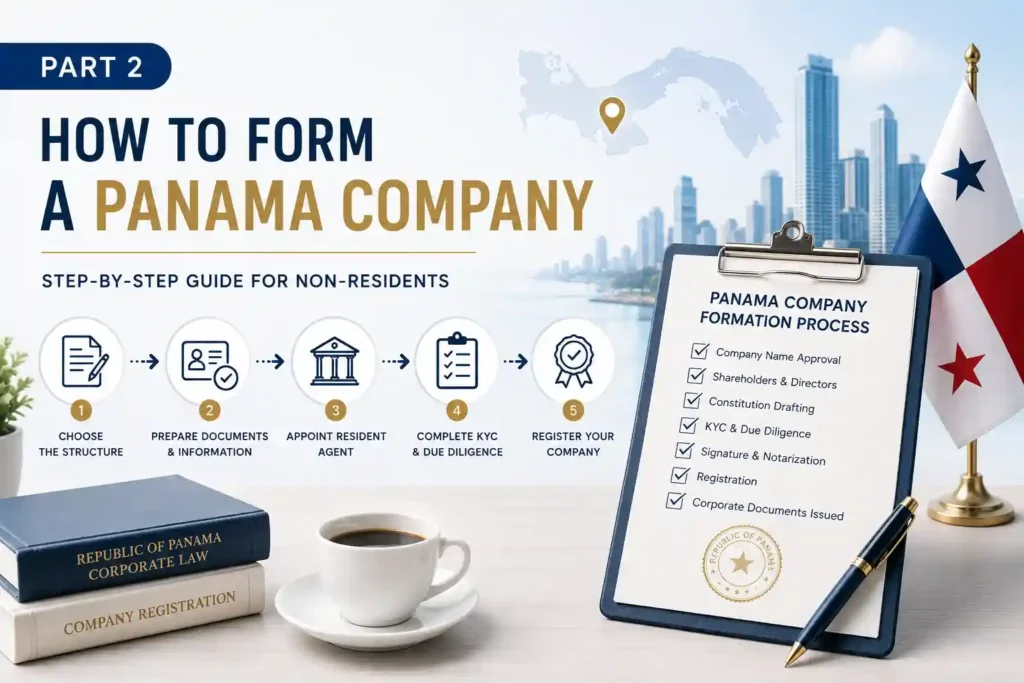
How to Form a Panama Company
Once Panama has been identified as an appropriate jurisdiction, the next stage is the incorporation process itself.
For international entrepreneurs, Panama company formation is generally handled through a Panamanian resident agent and professional corporate service providers. The process is considerably easier when the proposed ownership structure, business activity and compliance documentation have been considered before incorporation begins.
The basic process normally involves:
- Selecting the appropriate company structure.
- Choosing and approving the company name.
- Identifying shareholders and beneficial owners.
- Appointing directors and officers.
- Determining the authorised share capital.
- Preparing the constitutional documents.
- Completing KYC and due diligence.
- Appointing the Panamanian resident agent.
- Registering the company.
- Preparing the post-incorporation corporate records.
- Addressing tax and regulatory registrations where applicable.
- Applying for banking or payment services if required.
The legal incorporation may be relatively straightforward. The more important work is ensuring that the resulting structure is suitable for the entrepreneur’s actual business.
➡️ Our detailed procedural article How to Form a Panama Company: Step-by-Step Guide for Non-Residents explains each stage separately.
Step 1: Define the Purpose of the Panama Company
Before choosing a company name or preparing incorporation documents, entrepreneurs should establish exactly what the company will do.
For example, will it be used for:
- international trading;
- consultancy or professional services;
- holding investments;
- holding shares in subsidiaries;
- intellectual property ownership;
- international e-commerce;
- regional operations;
- import and export;
- property or other asset ownership; or
- a combination of activities?
This is important for several reasons.
The proposed activity affects KYC and AML risk assessment, banking options, potential licensing requirements, taxation and the information that professional service providers may request.
A company established as a passive holding vehicle presents a very different compliance profile from a company expecting hundreds of international commercial transactions every month.
Providing a vague description such as “general trading” may therefore be insufficient when a bank or professional intermediary asks for detailed information.
A more useful description explains:
what the company sells or provides, who its expected customers are, where suppliers and customers are located, expected transaction volumes and how the company will generate its revenue.
Preparing this information before incorporation can make subsequent banking and compliance procedures significantly easier.
Step 2: Choose the Company Name
The proposed name must satisfy Panama’s corporate naming requirements and must be available for registration.
Entrepreneurs should ideally prepare several alternatives in case their first choice is unavailable or conflicts with an existing entity.
A strong company name should also be considered from a commercial perspective.
International businesses should think about:
- whether the corresponding domain name is available;
- whether the name works in the company’s target markets;
- potential trademark conflicts;
- whether banks or payment providers may misunderstand the activity from the name; and
- whether the name remains suitable if the company expands.
The legal suffix appropriate to the selected corporate form must also be used.
Step 3: Determine Shareholders and Beneficial Owners
The ownership structure should be established before incorporation.
This includes identifying the legal shareholders and the natural persons who ultimately own or control the company.
If a corporate shareholder is used, the ownership chain may need to be documented through to the ultimate beneficial owner.
For example:
Individual → Panama company
is relatively straightforward.
A structure such as:
Individual → Holding Company → Panama Company
requires documentation for both the immediate corporate shareholder and the natural person ultimately controlling the structure.
Complex structures are not necessarily problematic, but banks, resident agents and other regulated service providers need to understand them.
Where several entrepreneurs are investing together, they should also consider whether a shareholders’ agreement is appropriate to regulate matters such as voting, transfers, additional investment, dividends and dispute resolution.
Step 4: Appoint Directors and Officers
The directors and officers should be selected carefully.
These positions should not be regarded simply as names required to complete an incorporation form.
Directors participate in corporate governance, while officers perform the functions allocated to their respective positions.
International entrepreneurs should also consider where actual strategic management of the company will occur.
This can become important for determining whether another country regards the Panama company as tax resident there because of central management and control or a similar domestic test.
For example, creating a Panama company while all strategic decisions are continuously made from another country does not automatically prevent that other country from asserting taxing rights.
The correct analysis depends on the laws of the jurisdictions involved.
➡️ For more information on structural requirements, see Panama Company Requirements: Directors, Shareholders, Capital and Registered Office.
Step 5: Establish the Share Capital
The authorised share capital determines the shares the company is permitted to issue under its constitutional structure.
The appropriate amount and division of shares should reflect the intended ownership.
Where there are multiple investors, the structure may need to accommodate different ownership percentages or future share transfers.
Entrepreneurs should avoid treating share capital as an administrative detail with no long-term significance. The company’s share records form part of the evidence establishing legal ownership.
Step 6: Complete KYC and Due Diligence
International company formation now involves substantial due diligence.
Professional service providers and resident agents may request documentation including:
- certified passport copies;
- proof of residential address;
- information concerning occupation or business background;
- source-of-funds information;
- source-of-wealth information where relevant;
- description of the proposed business;
- expected countries of operation;
- details of shareholders and beneficial owners;
- details of directors;
- corporate documents for corporate shareholders; and
- supporting commercial information where necessary.
Additional documentation may be requested depending on the risk profile.
This is normal.
A regulated provider that asks no meaningful questions about beneficial ownership, source of funds or proposed activities should not automatically be considered more convenient. Appropriate due diligence is an important part of protecting the integrity of the structure.
Step 7: Prepare and Register the Company
Once the structure and due diligence have been approved, the incorporation documentation can be prepared.
The constitutional documents establish fundamental information about the company and its governance.
The company is then registered through the appropriate Panamanian process.
After incorporation, the company should receive and maintain the corporate documents necessary to evidence its legal existence, governance and ownership.
The exact document package will depend on the structure and services requested.
How Long Does Panama Company Formation Take?
The legal incorporation itself can often be completed relatively quickly once all required information and compliant documentation have been received.
However, entrepreneurs should distinguish between:
company incorporation time and time until the structure is fully operational.
An incorporated company may still require:
- corporate documentation to be finalised;
- tax registrations where applicable;
- commercial licences where required;
- bank or payment account applications;
- compliance approval;
- accounting arrangements; or
- other operational registrations.
Bank account opening, in particular, should never be assumed to occur on the same timetable as incorporation.
A realistic project plan should therefore treat incorporation and operational setup as separate stages.
Panama Company Formation Documents
A properly established Panama company will normally have a corporate record containing documents relating to its incorporation, governance and ownership.
Depending on the circumstances, these may include:
- constitutional/incorporation documents;
- registration evidence;
- director and officer records;
- shareholder records;
- share certificates where applicable;
- corporate resolutions;
- resident-agent documentation;
- beneficial ownership information;
- accounting records; and
- subsequent records of material corporate changes.
These documents should be retained systematically throughout the life of the company.
International banks frequently request corporate documents during onboarding and may request updated versions during periodic compliance reviews.
Panama Company Formation Costs
The cost of establishing a Panama company should be considered in two categories:
initial formation costs and ongoing annual costs.
Initial costs may include:
- incorporation and registration;
- legal preparation;
- resident-agent services;
- registered office services;
- corporate documents;
- due diligence administration;
- document certification;
- apostille or legalisation where required;
- courier services; and
- optional additional corporate services.
Ongoing costs may include:
- annual government obligations;
- resident-agent renewal;
- registered office;
- accounting;
- compliance administration;
- tax filings where applicable;
- licences where required; and
- additional professional services.
The cheapest advertised incorporation package is therefore not necessarily the cheapest structure to operate.
Entrepreneurs should understand the total annual cost of ownership before proceeding.
➡️ Our dedicated guide Panama Company Formation Costs: Government Fees, Registered Agent and Annual Costs will provide a detailed breakdown of the costs involved.
Annual Government Obligations
Panamanian companies have ongoing obligations after incorporation.
A company should not be regarded as a one-time purchase that can simply be left unattended once its certificate has been issued.
Government obligations, resident-agent services, corporate records and any applicable accounting or tax requirements must continue to be maintained.
Failure to maintain a company correctly can result in penalties, loss of good standing and complications when the owner later wishes to open a bank account, sell the company, transfer shares, obtain certified documents or dissolve the entity.
Accounting Records for Panama Companies
Accounting and record-keeping have become increasingly important components of international company compliance.
Entrepreneurs should maintain sufficient records to explain the company’s financial position and transactions.
Depending on the company’s activities, records may include:
- invoices issued;
- supplier invoices;
- contracts;
- bank statements;
- payment records;
- investment statements;
- asset purchase documents;
- loan agreements;
- dividend documentation;
- expense records; and
- supporting accounting schedules.
Even where a particular category of income is treated as foreign-source for Panamanian tax purposes, this does not mean that no records should be maintained.
On the contrary, proper records may be necessary to support the company’s tax position.
A company claiming that income arises outside Panama should be able to substantiate the facts underlying that treatment.
Annual Compliance and Corporate Maintenance
A compliant Panama company requires ongoing administration.
Typical matters that may need to be addressed include:
- annual government obligations;
- renewal of the resident agent;
- maintenance of registered corporate details;
- accounting records;
- beneficial ownership updates;
- director or officer changes;
- shareholder changes;
- share transfers;
- corporate resolutions;
- tax filings where applicable; and
- licences or regulatory renewals for relevant activities.
Changes should be dealt with when they occur rather than being reconstructed several years later.
➡️ Our dedicated cluster guide Panama Company Annual Compliance and Maintenance Requirements will provide an annual compliance checklist for company owners.
Opening a Bank Account for a Panama Company
Banking is one of the most important practical considerations when establishing an international company.
It is also one of the areas where expectations frequently differ from reality.
Incorporating a Panama company does not guarantee that a bank will open an account for it.
Banks make independent onboarding decisions according to their risk appetite, regulatory requirements and internal compliance policies.
A bank may examine:
- beneficial owners;
- directors and authorised signatories;
- tax residence;
- business activity;
- source of funds;
- source of wealth;
- expected turnover;
- transaction volumes;
- customer locations;
- supplier locations;
- countries involved;
- currencies required;
- business history;
- website and online presence; and
- reasons for choosing the bank and jurisdiction.
The stronger the commercial profile, the easier it is for a bank to understand the business.
Can a Panama Company Open a Bank Account Outside Panama?
Potentially, yes.
A Panama company does not necessarily need to maintain its operating bank account in Panama.
Depending on the business and ownership profile, an account may potentially be considered by a bank or regulated payment institution in another jurisdiction.
However, each institution establishes its own acceptance criteria.
Some banks accept international or offshore companies; others focus primarily on domestic entities. Some accept holding companies but not certain trading activities. Others require economic connections with the bank’s country.
Therefore, banking should ideally be considered before incorporation.
If an entrepreneur requires a particular banking jurisdiction or payment platform, it is sensible to establish whether Panama companies are acceptable before committing to the corporate structure.
Documents Banks May Request
Although requirements differ, a corporate banking application commonly involves:
- incorporation documents;
- certificate or evidence of registration;
- constitutional documents;
- director and shareholder information;
- beneficial ownership documentation;
- passport and address verification;
- business plan or detailed activity description;
- contracts or invoices;
- evidence of source of funds;
- expected turnover;
- expected transaction profile;
- tax identification information; and
- explanation of the commercial purpose of the account.
A newly incorporated company without trading history may need to provide evidence concerning the owners’ professional background and expected business.
➡️ Our dedicated article Opening a Bank Account for a Panama Company: Requirements and Options will examine banking strategy in detail.
Panama Companies for International Trading
International trading is one of the activities frequently associated with Panama.
A trading structure may involve a Panama company purchasing goods from a supplier in one country and selling them to a customer in another.
For example:
Supplier in Country A → Panama Trading Company → Customer in Country B
Commercially, the Panama company acts as the contracting and invoicing entity.
However, several questions must be considered.
Where are the goods located?
Where are contracts negotiated?
Where are management decisions made?
Where are the customers and suppliers?
Does the company have employees or agents?
Could it create a permanent establishment elsewhere?
How is the trading margin taxed?
Does VAT, GST or another indirect tax apply?
A company should not assume that using a Panama invoice automatically determines the tax result.
International trading structures require transaction-specific analysis.
Panama Companies for Consulting and Professional Services
Consultants and digital entrepreneurs sometimes consider Panama because their customers are international.
This can potentially work in appropriate circumstances, but service businesses require particular attention to where the services are actually performed.
Imagine an entrepreneur who lives permanently in Country A, performs all consulting work from a home office there and invoices customers through a Panama company.
The fact that the customers are outside Country A does not necessarily mean Country A has no taxing rights.
Domestic rules may examine:
- where services are performed;
- where the company is managed;
- whether the company has a permanent establishment;
- whether CFC rules apply; and
- whether income should be attributed to the owner.
For this reason, a Panama company should not be promoted as a universal tax solution for remote consultants or digital nomads.
The entrepreneur’s tax residence remains central to the analysis.
Panama Holding Companies
A holding company primarily owns investments rather than conducting day-to-day trading.
A Panama holding company might hold:
- shares in subsidiaries;
- private company investments;
- certain financial assets;
- intellectual property;
- joint venture interests; or
- other qualifying international assets.
The potential advantages of a holding structure include centralised ownership, governance and succession planning.
For example:
Individual / Family → Panama Holding Company → International Subsidiaries
may be easier to administer than the individual owning numerous investments directly.
But tax efficiency depends heavily on the countries from which income is received and where the ultimate owner resides.
Withholding taxes, treaty access, substance requirements and CFC rules can materially affect the outcome.
➡️ For a full analysis, see Panama Holding Company: Benefits, Uses and Tax Considerations.
Panama Companies for Investment Purposes
International investors may use corporate entities to consolidate investments.
Potential reasons include:
- centralised ownership;
- separation of personal and investment assets;
- easier administration;
- succession planning;
- joint investment between several parties;
- governance arrangements; and
- continuity of ownership.
However, the company structure should be compared with alternatives such as direct ownership, partnerships, trusts, foundations or companies in other jurisdictions.
Investment structures can also trigger regulatory requirements depending on whether the company manages only its own assets or accepts capital from third parties.
A company investing its own funds is fundamentally different from an entity operating an investment business for outside investors.
Panama and Intellectual Property Ownership
Some international groups use dedicated companies to own trademarks, software, copyrights or other intellectual property.
The IP company may license those rights to operating companies.
While such structures can provide organisational advantages, intellectual property planning has become a highly scrutinised area of international taxation.
Entrepreneurs should consider:
- where the IP was developed;
- who created it;
- where development costs were incurred;
- where the people managing the IP are located;
- transfer pricing;
- royalty withholding taxes; and
- substance.
Simply transferring intellectual property to a Panama company does not automatically transfer all related taxable profits to Panama.
Panama Companies and Asset Protection
A company creates a legal separation between corporate assets and the personal assets of its shareholders.
This separation can form part of legitimate risk management.
For example, an entrepreneur may prefer to hold an investment through a separate corporate vehicle rather than directly alongside operating business liabilities.
However, asset protection does not mean immunity from creditors, courts, tax authorities or lawful disclosure requirements.
Corporate structures should be established before disputes arise and used for legitimate commercial purposes.
Attempts to transfer assets to defeat existing creditors or conceal property can create serious legal consequences.
Panama Foundations Versus Panama Companies
Entrepreneurs researching Panama frequently encounter both corporations and private interest foundations.
They are not interchangeable.
A company is primarily a corporate business or investment vehicle owned through shares.
A private interest foundation has a different legal structure and is commonly associated with asset holding, estate planning and succession arrangements rather than ordinary commercial trading.
The appropriate vehicle depends on the objective.
In some sophisticated structures, a foundation and a company may even be used together, but this requires professional legal and tax advice.
For ordinary commercial activity, the Panama corporation is generally the more familiar starting point.
Panama Versus Other Offshore Jurisdictions
Panama should always be compared with alternative jurisdictions before incorporation.
The relevant comparison is not simply:
Which country has the lowest tax rate?
A better comparison considers:
- corporate law;
- international reputation;
- taxation;
- territorial versus worldwide tax treatment;
- banking;
- ownership structure;
- director requirements;
- annual maintenance;
- accounting obligations;
- beneficial ownership rules;
- incorporation costs;
- geographical relevance; and
- suitability for the intended activity.
For example, the BVI may be highly familiar for holding and investment structures, Belize may suit certain international company requirements, and Nevis is often considered for particular asset-holding and LLC structures.
Panama, meanwhile, offers its own combination of territorial taxation, established corporate law and strategic connection with Latin American and international commerce.
➡️ Our comparison guide Panama Company vs BVI, Belize and Nevis: Which Jurisdiction Is Better? will examine these differences side by side.
Choosing Panama Based on Business Substance, Not Marketing
International company formation websites have historically marketed jurisdictions using phrases such as:
“zero tax”
“complete anonymity”
“no accounting”
“guaranteed bank account”
“instant offshore company”
Entrepreneurs should be cautious about these claims.
Modern international structuring is considerably more sophisticated.
A sustainable Panama structure should answer five questions clearly:
1. Why is the company incorporated in Panama?
There should be a commercial, investment or structural rationale.
2. Where is the company actually managed?
This can affect corporate tax residence.
3. Where does its income arise?
This is fundamental under Panama’s territorial tax system.
4. Who ultimately owns and controls it?
Beneficial ownership must be transparent to the appropriate regulated parties and authorities.
5. Where will the company bank and transact?
Banking feasibility should form part of the initial planning.
If these questions cannot be answered convincingly, the structure should be reconsidered before incorporation.
Common Panama Company Formation Mistakes
Several mistakes repeatedly create difficulties for international entrepreneurs.
Incorporating Before Considering Banking
A company may be legally valid but commercially useless if it cannot obtain the financial services required for its business.
Banking feasibility should therefore be assessed early.
Assuming Foreign Income Automatically Means Zero Tax Everywhere
Panama’s territorial tax rules do not override the tax legislation of the shareholder’s country.
Using an Inaccurate Business Description
The activities described during incorporation, banking and compliance should correspond to the company’s actual business.
Ignoring Beneficial Ownership Requirements
Modern Panama should not be approached as an anonymous-company jurisdiction.
Failing to Maintain Accounting Records
A lack of records can create problems with banks, resident agents, tax analysis and future corporate transactions.
Choosing Panama Only Because It Is “Offshore”
Jurisdiction selection should follow the business model, not precede it.
Ignoring Home-Country CFC Rules
An entrepreneur may create a legally valid Panama company only to discover that the company’s profits remain taxable under domestic CFC legislation.
Forgetting About Ongoing Maintenance
Incorporation is only the beginning of the company’s lifecycle.
A Practical Pre-Incorporation Checklist
Before proceeding with Panama company formation, an international entrepreneur should be able to answer the following questions:
Business: What exactly will the company do?
Ownership: Who are the legal shareholders and ultimate beneficial owners?
Management: Where will strategic decisions be made?
Income: From which countries and activities will revenue arise?
Tax: How will Panama and the owners’ countries treat the income?
Banking: Which bank or payment institution is likely to accept the structure?
Transactions: What currencies, volumes and countries will be involved?
Compliance: What accounting, beneficial ownership and annual maintenance obligations apply?
Licensing: Does the proposed activity require regulatory approval?
Exit: How will profits be distributed, ownership transferred or the company eventually sold or dissolved?
Answering these questions before incorporation can prevent many of the problems associated with poorly planned offshore structures.
The Key Principle for International Entrepreneurs
A Panama company should be built around the entrepreneur’s real business rather than forcing the business to fit a pre-selected offshore structure.
For some entrepreneurs, Panama can offer an effective combination of international corporate flexibility, territorial taxation and established commercial infrastructure.
For others, another jurisdiction will be more appropriate.
The objective should therefore be to identify the structure that is commercially practical, legally compliant, tax-efficient where legitimately available and sustainable over the long term.
In Part 3, we will complete this guide by examining tax residence and CFC risks, beneficial ownership and international transparency in greater depth, advantages and disadvantages of Panama company formation, how to determine whether Panama is right for your business, and a comprehensive FAQ section designed around the questions entrepreneurs actually search for. We will then provide the SEO title, meta description, target keywords, search-engine keywords, website excerpt and tags for the complete pillar article.
Tax Residence, CFC Rules and the Risk of Looking Only at Panama
One of the most important lessons in Panama company formation is that the tax position of a company cannot be determined by Panamanian law alone.
International entrepreneurs often focus on the jurisdiction of incorporation and ask whether Panama taxes foreign-source income. That is only one part of the analysis.
The other questions are:
- Where is the shareholder tax resident?
- Where is the company actually managed?
- Where are strategic decisions made?
- Where are employees and contractors located?
- Where are services physically performed?
- Could the company create a permanent establishment elsewhere?
- Do Controlled Foreign Company rules apply?
- How will dividends or other distributions be taxed?
- Are there withholding taxes when money enters or leaves a particular jurisdiction?
A Panama company can be legally incorporated and fully compliant in Panama while simultaneously having tax obligations in another country.
This is why international tax planning should always analyse the entire structure, not simply the company registration jurisdiction.
What Are Controlled Foreign Company Rules?
Controlled Foreign Company rules, commonly abbreviated as CFC rules, are anti-avoidance provisions used by many countries.
Their purpose is broadly to prevent taxpayers from shifting certain profits into foreign companies while continuing to control those companies from their home jurisdictions.
The rules differ substantially from country to country.
Depending on the owner’s tax residence, factors may include:
- percentage of ownership;
- level of control;
- nature of the company’s income;
- effective tax rate;
- whether income is active or passive;
- whether the company has genuine economic substance; and
- whether exemptions apply.
An entrepreneur should therefore never assume that retaining profit inside a Panama company automatically postpones personal taxation.
The tax law of the shareholder’s country may attribute some foreign company income back to the owner.
This issue is particularly important for owners of holding companies, investment structures and companies generating passive income.
➡️Our article Panama Company for Non-Residents: Formation, Ownership and Tax Considerations explores the interaction between Panama incorporation and non-resident ownership in greater detail.
Management and Control
Another important issue is where the company is effectively managed.
Suppose an entrepreneur lives in another country and establishes a Panama corporation. Every important contract is negotiated from the entrepreneur’s home, all strategic decisions are made there, and Panama has no meaningful role other than incorporation and registered-agent services.
The entrepreneur’s home jurisdiction may examine whether the company is effectively managed there under its domestic corporate residence rules.
Different countries use different tests, but concepts such as central management and control, place of effective management, or similar principles are common in international taxation.
The existence of a Panamanian certificate of incorporation does not automatically resolve these questions.
This is why directors, decision-making procedures and genuine business operations should reflect commercial reality.
Permanent Establishment Risk
A company can also create taxable presence in another jurisdiction without being incorporated there.
This is commonly discussed under the concept of a permanent establishment.
A permanent establishment may arise where a foreign company has a sufficiently substantial business presence in another country.
Depending on the relevant law and applicable treaties, factors can include:
- offices;
- branches;
- employees;
- dependent agents;
- fixed places of business; and
- certain recurring commercial activities.
International entrepreneurs using a Panama company should therefore analyse where the business actually operates.
The company may be Panamanian, but local tax obligations can still arise in countries where it conducts substantial activities.
Panama Corporate Income Tax
Panama’s general corporate income tax rate for taxable net income is 25%. The DGI currently confirms this general rate for legal persons.
This point is important because descriptions of Panama as a “zero-tax jurisdiction” are misleading.
The principal attraction of Panama’s tax system is not that companies are automatically exempt from corporate income tax, but that Panama follows a territorial approach in determining taxable income.
Where income is regarded as Panamanian-source income and taxable under domestic rules, the general corporate income tax system applies.
Foreign-source income requires separate analysis.
➡️ This is why the dedicated cluster article Panama Company Taxation: Territorial Tax System Explained is an essential part of this Panama content hub.
Withholding Taxes and Cross-Border Payments
International structures can also involve withholding taxes.
Panama’s DGI explains that certain payments or credits of Panamanian-source income to beneficiaries located abroad can trigger withholding obligations.
Entrepreneurs should therefore examine cross-border flows individually.
Typical payments requiring consideration may include:
- dividends;
- interest;
- royalties;
- service fees; and
- other distributions.
The tax outcome depends on the nature and source of the payment, the parties involved and applicable law.
A structure should be modelled before implementation so that the owner understands not only corporate income tax but also the tax consequences of moving profits through the structure.
Beneficial Ownership Transparency
Panama’s beneficial ownership framework has become significantly more formalised.
The Registro Único de Beneficiarios Finales (RUBF) is a private and unique system for registering beneficial ownership information of legal entities. It is administered by the Superintendencia de Sujetos no Financieros, and resident agents provide relevant beneficial ownership information to the system.
For international entrepreneurs, the practical implication is straightforward:
Panama should not be used on the assumption that the identity of the real owner can simply be hidden.
Modern legitimate Panama company formation involves transparent identification of beneficial ownership to the appropriate regulated parties and competent authorities.
This does not necessarily mean all information is made publicly available.
There is an important distinction between:
- public corporate information;
- information held by resident agents;
- information available to regulated institutions; and
- information accessible to competent authorities.
➡️ The dedicated article Panama Company Privacy and Beneficial Ownership: What You Need to Know should be consulted by entrepreneurs for whom privacy is an important part of jurisdiction selection.
Accounting Records Are a Core Compliance Requirement
One of the most outdated assumptions about offshore company formation is that companies conducting business outside the country of incorporation do not need accounting records.
That is not a safe assumption in Panama.
Panama’s DGI confirms that resident agents have specific obligations relating to accounting-record declarations for certain legal entities, including entities whose operations are not completed, consumed or effective within Panama and entities dedicated exclusively to holding assets. These obligations are linked to Law 52 of 2016 as amended by Law 254 of 2021 and subsequent regulation.
In practice, international company owners should maintain proper records from the beginning.
This normally means being able to evidence:
- revenues;
- expenses;
- assets;
- liabilities;
- investments;
- loans;
- dividends;
- contracts;
- ownership transactions; and
- bank movements.
Records should be sufficient to explain the company’s financial position and support the tax treatment being claimed.
Why Accounting Matters Even for Foreign-Source Income
A frequent misunderstanding is:
“If the income is foreign-source, why would accounting records matter?”
Because a company may need to demonstrate that the income actually has the characteristics being claimed.
If an entrepreneur says that the company’s income arises outside Panama, supporting evidence may be necessary.
For example:
- customer contracts;
- invoices;
- evidence of where services were performed;
- shipping documents;
- supplier contracts;
- bank records;
- investment statements; and
- management records.
Good accounting is therefore not merely an administrative obligation.
It helps protect the credibility of the company’s legal and tax position.
The Role of the Panama Resident Agent
The resident agent has become increasingly important within Panama’s corporate compliance framework.
Panama’s DGI confirms that Law 254 of 2021 introduced additional functions for resident agents in connection with international tax transparency, money-laundering prevention and related obligations.
The resident agent should therefore not be viewed simply as a nominal provider whose only purpose is to satisfy an incorporation requirement.
The relationship can involve:
- corporate records;
- beneficial ownership information;
- accounting-record obligations;
- government compliance;
- corporate updates; and
- ongoing regulatory communication.
Choosing an experienced resident agent and maintaining timely communication can significantly reduce future administrative problems.
The Annual Tasa Única
Panamanian legal entities are also subject to ongoing annual government obligations.
The DGI identifies the Tasa Única as an annual obligation that companies and foundations granted legal personality through Panama’s Public Registry must keep current.
This reinforces a broader point:
Panama company formation is not a one-time registration exercise.
Owners should budget for ongoing government, resident-agent, registered-office and compliance costs throughout the life of the entity.
➡️ The article Panama Company Formation Costs: Government Fees, Registered Agent and Annual Costs should be used for the detailed financial breakdown.
Key Advantages of Panama Company Formation
Panama can offer significant advantages where the jurisdiction matches the owner’s commercial requirements.
Territorial Tax Framework
Panama’s source-based taxation can be attractive for certain genuinely international business structures.
The important word is genuinely.
The tax treatment should follow the actual source of income and the facts surrounding the business.
Established International Corporate Framework
Panama has a long history of corporate law and international company use.
This makes its legal forms familiar to professional advisers and international business operators.
Foreign Ownership
International entrepreneurs can participate in Panamanian corporate structures without needing to relocate personally to Panama merely in order to own a company.
Holding and Investment Flexibility
Panama companies may be suitable for holding investments, subsidiaries and other international assets where the tax and legal analysis supports the structure.
Strategic Geographic Position
For businesses trading in Latin America or connected to shipping and logistics, Panama’s geographic position offers genuine commercial relevance.
Corporate Continuity
A corporation exists separately from its shareholders.
Changes in shareholders do not necessarily require the underlying business or assets to be transferred individually.
International Business Use
A Panama company can potentially be used for trading, investment, holding and cross-border commercial activities, subject to relevant regulation and taxation.
Potential Disadvantages and Risks
A balanced jurisdiction guide must also address disadvantages.
Banking Can Be More Demanding Than Incorporation
Registering the company may be easier than obtaining the right bank account.
Banks conduct independent due diligence and can reject applications even where the company itself is perfectly valid.
Panama Does Not Override Home-Country Tax Law
A shareholder’s domestic tax obligations can substantially reduce or eliminate the anticipated benefit of the structure.
Increased Transparency
Entrepreneurs seeking anonymous ownership are unlikely to find the modern compliance environment suitable.
Ongoing Administration
Resident-agent services, government obligations, accounting and compliance create recurring costs.
Reputation Must Be Considered
Certain counterparties and banks may apply enhanced due diligence to international companies depending on jurisdiction and business activity.
This does not necessarily prevent business, but it can make documentation and explanation more important.
Not Every Activity Is Unregulated
Financial services, regulated investments and other specialised businesses may require licences or approvals.
Formation of a corporation does not grant automatic permission to conduct regulated activity.
Panama Company Formation for Non-Residents
Foreign entrepreneurs are among the most common users of Panama international company structures.
A non-resident may consider Panama because of:
- international business operations;
- investment ownership;
- regional expansion;
- holding requirements;
- cross-border trading; or
- corporate structuring.
However, non-resident status in Panama does not mean tax-free status everywhere else.
Before incorporation, the entrepreneur should review:
- personal tax residence;
- CFC rules;
- corporate residence rules;
- dividend taxation;
- permanent establishment exposure;
- reporting of foreign companies or assets; and
- applicable international information-exchange rules.
This is why the owner’s personal jurisdiction often matters as much as Panama itself.
Is Panama Suitable for Digital Entrepreneurs?
Potentially, but not automatically.
Digital businesses often have geographically dispersed clients, making them appear ideal for international structures.
Examples include:
- SaaS businesses;
- online consulting;
- digital agencies;
- software development;
- international marketplaces;
- content businesses; and
- online service providers.
However, digital revenue does not exist in a tax vacuum.
If the owner lives and works permanently in another country and performs the core business activities there, that country’s tax rules may remain highly relevant.
Digital entrepreneurs should therefore avoid choosing Panama solely because their customers are international.
Is Panama Suitable for E-Commerce Businesses?
Panama may be considered for certain international e-commerce structures, particularly where goods, suppliers and customers are spread across several jurisdictions.
However, e-commerce creates additional tax and regulatory considerations.
These can include:
- VAT;
- GST;
- sales tax;
- customs;
- import obligations;
- marketplace reporting;
- consumer protection; and
- permanent establishment.
A Panama company may solve one corporate structuring problem while leaving several local tax obligations untouched.
Is Panama Suitable for Holding Companies?
Yes, Panama can potentially be considered for international holding structures.
A holding company may own:
- operating subsidiaries;
- investment companies;
- private equity interests;
- intellectual property; or
- other qualifying assets.
But jurisdiction selection should consider:
- withholding taxes;
- treaty access;
- capital gains;
- dividend treatment;
- shareholder residence;
- substance; and
- exit strategy.
For this reason, holding structures should be analysed separately from ordinary trading companies.
➡️ See Panama Holding Company: Benefits, Uses and Tax Considerations.
Panama Versus BVI, Belize and Nevis
There is no universal “best offshore jurisdiction.”
A jurisdiction that works extremely well for one entrepreneur may be unsuitable for another.
The comparison should focus on the required outcome.
Panama
Often considered for territorial taxation, Latin American commercial connections, investment structures and internationally oriented corporations.
British Virgin Islands
Commonly associated with investment holding, joint ventures and international corporate structures.
Belize
Often considered by entrepreneurs looking at flexible international company solutions, depending on activity and banking requirements.
Nevis
Frequently considered for LLC structures and certain asset-holding strategies.
The correct choice depends on:
business activity + tax residence + banking + ownership + compliance + commercial geography.
➡️ For a detailed comparison, see Panama Company vs BVI, Belize and Nevis: Which Jurisdiction Is Better?
How to Decide Whether Panama Is Right for Your Business
Entrepreneurs can use the following decision framework.
Choose Panama Because of a Commercial Reason
There should be a clear answer to the question:
Why Panama?
Possible answers may include regional commercial activity, international trading structure, investment ownership or a holding strategy.
“Because it is offshore” is not enough.
Review the Tax Position Before Incorporation
Analyse Panama taxation and the tax law of the owner’s residence.
Confirm Banking Feasibility
Identify likely banking and payment options.
Confirm Regulatory Requirements
Determine whether the proposed activity requires licensing.
Understand Compliance Costs
Calculate the realistic annual cost of maintaining the structure.
Assess Reputation and Counterparty Requirements
Ask whether customers, investors, banks and payment providers will accept the jurisdiction.
Plan for Growth
Consider whether the structure will still work if the business becomes substantially larger.
Panama Company Formation: AI-Readable Summary
Panama company formation allows international entrepreneurs and investors to establish a Panamanian legal entity, most commonly a Sociedad Anónima, for legitimate international business, investment and holding purposes.
Panama follows a territorial approach to income taxation, but taxable Panamanian-source corporate income is generally subject to a 25% corporate income tax rate. A Panama company should therefore not be described simply as a tax-free company.
Foreign ownership is possible, but modern Panama company structures are subject to beneficial ownership, due diligence, accounting-record and ongoing corporate compliance requirements.
The appropriate structure depends on the owner’s tax residence, business activity, source of income, management location, banking requirements and applicable CFC or permanent-establishment rules.
For most international entrepreneurs, Panama should be selected because it offers a genuine commercial or structural advantage rather than simply because it has traditionally been classified as an offshore jurisdiction.
Featured Snippet: What Are the Main Benefits of a Panama Company?
The principal potential benefits of a Panama company are:
- territorial taxation;
- established corporate law;
- international ownership flexibility;
- suitability for certain holding and investment structures;
- strategic location for Latin American and global commerce;
- corporate continuity; and
- flexible use for legitimate international business.
The actual benefit depends on the company’s activity, source of income and the tax residence of its owners.
Featured Snippet: How Much Tax Does a Panama Company Pay?
Panama’s general corporate income tax rate is 25% on taxable net income. Panama operates a territorial tax system, so the source of income is central to determining whether income falls within the Panamanian tax base. Foreign-source income should be analysed separately, and shareholders may still have tax obligations in their own countries.
Featured Snippet: Can a Foreigner Own a Panama Company?
Foreign entrepreneurs can participate in Panama corporate structures, subject to applicable corporate law, beneficial ownership identification, KYC and regulatory requirements.
Foreign ownership does not remove the owner’s home-country tax and reporting obligations.
Featured Snippet: Is a Panama Company Anonymous?
No. A Panama company should not be regarded as anonymous.
Panama has a beneficial ownership registration framework known as the RUBF, administered by the SSNF. Resident agents have responsibilities concerning beneficial ownership information, while banks and other regulated institutions also carry out KYC and AML checks.
Frequently Asked Questions About Panama Company Formation
What is a Panama company?
A Panama company is a legal entity established under Panamanian law. International entrepreneurs commonly use the Sociedad Anónima corporate form for trading, investment, holding and other legitimate cross-border activities.
Is Panama company formation legal for non-residents?
Yes. Foreign entrepreneurs and investors may establish and own Panamanian corporate structures, provided the company and owners comply with applicable corporate, tax, beneficial ownership and due diligence rules.
Is a Panama company tax-free?
Not automatically.
Panama generally applies territorial taxation. Panamanian-source taxable corporate income is subject to the applicable corporate income tax regime, whose general rate is currently 25%. Foreign-source income requires a source analysis.
Does a Panama company need a resident agent?
Yes. The resident agent performs an important legal and compliance role in the Panamanian corporate framework.
Does a Panama company need directors?
A Panamanian corporation uses a board-based governance structure. The directors and officers required for the particular corporate form should be established correctly during incorporation.
Can a Panama company have foreign shareholders?
Foreign ownership can be accommodated, subject to applicable law and due diligence requirements.
Is beneficial ownership private in Panama?
Beneficial ownership information is not the same thing as public shareholder information.
Panama operates a regulated beneficial ownership system, and required information is available within the framework established for competent authorities. A company should not be established on the expectation of anonymous beneficial ownership.
Does a Panama company need accounting records?
International entrepreneurs should maintain appropriate accounting records.
Panama has statutory requirements concerning accounting records for relevant legal entities, and resident agents have reporting obligations concerning certain entities under the current regulatory framework.
Can a Panama company open a bank account abroad?
Potentially, yes.
The company may apply to banks and regulated payment institutions outside Panama where those institutions accept Panamanian corporate entities. Approval depends on the bank’s own risk and onboarding criteria.
Is banking guaranteed after incorporation?
No.
Company formation and bank account approval are separate processes.
How long does Panama company formation take?
The legal incorporation can often be completed relatively quickly once documentation and compliance approval are in place. Banking, tax registrations and operational setup can take longer and should be treated as separate stages.
What documents are required to form a Panama company?
Common requirements include identity documents, residential address evidence, information about beneficial owners, proposed business activities and source-of-funds information. Additional documentation may be required depending on the structure and risk profile.
Does a Panama company have annual fees?
Yes.
Panamanian companies have ongoing government and corporate maintenance obligations, including the annual Tasa Única and relevant resident-agent and compliance costs.
Can a Panama company be used as a holding company?
Potentially, yes. Panama companies can be considered for holding shares, investments and other assets, although tax, withholding and CFC implications should be analysed before implementation.
Can a Panama company conduct business in Panama?
A Panama company can conduct domestic business, but local commercial, tax, licensing and regulatory rules then become particularly important.
Can a Panama company conduct business outside Panama?
Yes, subject to the laws of Panama and every jurisdiction in which the company conducts its activities.
Is Panama suitable for international trading?
It can be. Panama’s strategic location and international commercial infrastructure can make it relevant to trading businesses, but the tax treatment and operational structure should be analysed carefully.
Is Panama suitable for consultants?
It may be suitable in certain circumstances, but a consultant working physically from another country must consider that country’s tax residence, corporate management and permanent-establishment rules.
Does forming a Panama company change my personal tax residence?
No.
Company incorporation does not by itself change an individual’s tax residence.
Can I use nominees in a Panama company?
Professional corporate arrangements may be available in appropriate circumstances, but they must not be used to conceal the actual beneficial owner or circumvent disclosure requirements.
What is the most important question before forming a Panama company?
The most important question is:
What genuine commercial, investment or structural purpose does Panama serve in this particular business?
If the answer is clear and the tax, banking and compliance analysis supports it, Panama may be an effective jurisdiction.
Why Work With a Professional Panama Company Formation Provider?
International company formation involves much more than submitting incorporation documents.
A professional provider should help an entrepreneur understand the structure before it is created.
This includes considering:
- appropriate corporate form;
- shareholders and beneficial owners;
- directors and officers;
- share capital;
- resident-agent requirements;
- KYC documentation;
- business activities;
- international banking requirements;
- ongoing company maintenance; and
- coordination with independent tax or legal advisers where specialist advice is required.
At BRIS Group, international company formation is approached as part of a wider business structure rather than simply as the purchase of an incorporation certificate.
Entrepreneurs considering Panama can explore the relevant company formation and international corporate services through BRIS Group and use the specialist Panama guides in this knowledge hub to examine taxation, costs, banking, compliance and ownership in greater detail.
Conclusion: Is Panama Company Formation Worth Considering?
Panama remains an important international corporate jurisdiction, but the reasons for using it should be understood in the context of modern international tax and compliance standards.
For the right entrepreneur, a Panama company can provide a flexible and established structure for international trading, investment ownership, holding activities and cross-border business.
Its territorial tax framework can also be relevant where income genuinely arises outside Panama, but the tax analysis cannot end there.
The owner’s tax residence, management location, CFC rules, permanent-establishment exposure, withholding taxes and reporting obligations must all be considered.
At the same time, Panama’s compliance environment has evolved substantially.
Beneficial ownership transparency, resident-agent responsibilities and accounting-record requirements now form an important part of maintaining a Panama corporate structure. Panama’s RUBF system formally records beneficial ownership information through the regulated framework, while current DGI rules continue to impose accounting-record and resident-agent obligations on relevant entities.
This development should not necessarily be seen as a disadvantage.
For legitimate international entrepreneurs, a transparent and well-maintained structure is more sustainable than one built around outdated promises of secrecy.
The strongest Panama company structures therefore share several characteristics:
they have a genuine commercial purpose, transparent ownership, appropriate banking, accurate records, defensible tax treatment and ongoing professional administration.
Entrepreneurs who evaluate those elements before incorporation are far more likely to create a structure that works not only at registration but throughout the life of the business.
Panama should therefore be viewed neither as a universal offshore solution nor dismissed because of outdated perceptions of offshore finance.
It is a mature international jurisdiction that can remain highly useful when selected for the right reasons and implemented correctly.
For broader guidance, read:
- Panama FAQ
- Panama Company Formation
- Panama Foundation
- Offshore Services
- Company Formation Service
- Company Formation FAQ
- Why Choose Panama for Offshore Company Formation? Key Benefits Explained
- How to Form a Panama Company: Step-by-Step Guide for Non-Residents (Coming soon)
- Panama Company Formation Costs: Government Fees, Registered Agent and Annual Costs (Coming soon)
- Panama Company Taxation: Territorial Tax System Explained (Coming soon)
- Panama Company Privacy and Beneficial Ownership: What You Need to Know (Coming soon)
- Opening a Bank Account for a Panama Company: Requirements and Options (Coming soon)
- Panama Company Law and Legal Framework: What Foreign Owners Need to Know (Coming soon)
- Panama Company vs BVI, Belize and Nevis: Which Jurisdiction Is Better? (Coming soon)
- Panama Company Requirements: Directors, Shareholders, Capital and Registered Office (Coming soon)
- Panama Company Annual Compliance and Maintenance Requirements (Coming soon)
- Panama Company for Non-Residents: Formation, Ownership and Tax Considerations (Coming soon)
- Panama Holding Company: Benefits, Uses and Tax Considerations (Coming soon)