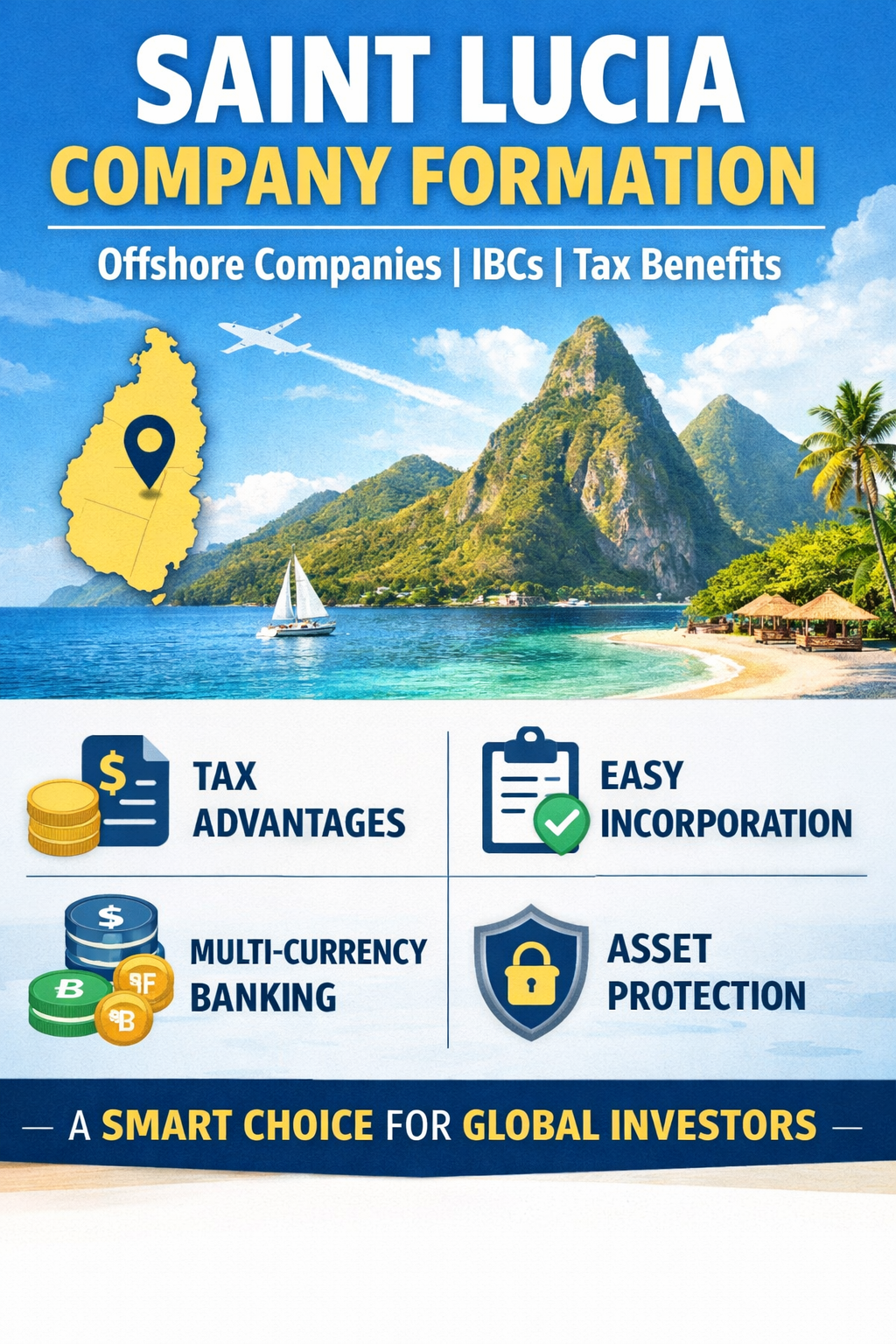
Introduction: Why Saint Lucia is an Attractive Jurisdiction
Saint Lucia is rapidly becoming one of the most attractive jurisdictions for international investors and Introduction: Why Saint Lucia is an Attractive Jurisdiction
Saint Lucia is rapidly emerging as one of the most attractive jurisdictions for international investors and businesses seeking a flexible, tax-efficient, and fully compliant environment. Located in the Eastern Caribbean, Saint Lucia offers political stability, English as an official language, and robust legal frameworks modeled on common law principles, making it highly accessible for foreign investors.
Investors choose Saint Lucia company formation for several key reasons:
- Strategic Location: Excellent connectivity to North America, Europe, and other Caribbean markets, supporting global business operations.
- Political and Economic Stability: Strong governance and a stable economic environment ensure predictable business conditions.
- Flexible Corporate Structures: From International Business Companies (IBCs) to Limited Liability Companies (LLCs), Saint Lucia provides entities suitable for property holdings, investments, and international trading.
- Confidentiality and Asset Protection: Legal structures allow for high levels of privacy, protecting shareholder and director information.
For a complete step-by-step guide on establishing an IBC in Saint Lucia, see our Saint Lucia Company Formation guide.
Types of Companies in Saint Lucia
Saint Lucia offers a variety of corporate structures, each tailored to different business needs, investment goals, and compliance requirements. Choosing the right entity is critical for tax efficiency, asset protection, and operational flexibility. Below is a detailed overview of the main company types available in Saint Lucia:
1. International Business Companies (IBCs)
International Business Companies (IBCs) are the most popular choice for foreign investors due to their tax advantages, confidentiality, and operational flexibility. IBCs are designed primarily for companies whose activities are conducted outside Saint Lucia, including holding investments, trading internationally, or managing intellectual property.
Key Benefits of IBCs:
- No Corporate Tax on Offshore Income: IBCs earning income from foreign sources are exempt from corporate tax in Saint Lucia.
- 100% Foreign Ownership Allowed: Investors do not need local directors or shareholders, making it ideal for global ownership structures.
- Minimal Reporting Requirements: IBCs are not required to file annual accounts or financial statements with the government, although maintaining internal records is recommended.
- Flexibility in Share Capital: IBCs can issue shares in multiple classes, allowing investors to structure ownership and voting rights efficiently.
- Privacy and Confidentiality: Shareholder and director information is not publicly disclosed, providing enhanced privacy for international investors.
Common Uses for IBCs:
- Holding companies for international investments or real estate
- Trading companies conducting cross-border transactions
- Intellectual property holding and licensing structures
- Asset protection and succession planning
IBCs are particularly suitable for entrepreneurs, investors, and multinational groups looking for cost-effective and tax-efficient structures. For a complete step-by-step guide, see our ➡️ Saint Lucia IBC Formation guide.(Coming soon)
2. Limited Liability Companies (LLCs)
Limited Liability Companies (LLCs) in Saint Lucia provide a blend of flexibility, limited liability, and regulatory compliance, making them ideal for businesses that need operational presence in multiple jurisdictions.
Key Advantages of LLCs:
- Limited Liability: Members’ personal assets are protected, and liability is generally limited to the capital invested in the company.
- Flexible Ownership: LLCs can be owned by individuals or corporate entities, including foreign shareholders.
- Operational Flexibility: LLCs can be structured with different classes of membership interests, allowing customized profit-sharing and voting rights.
- Compliance Friendly: While subject to more reporting than IBCs, LLCs provide credibility with banks and potential business partners.
- Suitable for SMEs and Holding Structures: They are ideal for small to medium-sized enterprises, property-holding entities, and family-owned businesses seeking liability protection.
Common Uses for LLCs:
- Operating businesses with physical or commercial presence
- Real estate management and rental companies
- Family-owned or succession planning structures
- Joint ventures and partnerships
For detailed information on forming and managing an LLC, see ➡️ our Saint Lucia LLC Benefits and Requirements guide.(Coming soon)
3. Trusts and Foundations
Trusts and foundations are legal structures primarily used for wealth management, estate planning, and asset protection. These entities can operate independently or in conjunction with IBCs and LLCs to create complex corporate groups or holding structures.
Key Benefits of Trusts and Foundations:
- Advanced Estate Planning: Assets can be transferred or preserved according to the settlor’s wishes, providing continuity across generations.
- Asset Protection: Trusts and foundations can protect wealth from legal claims or creditors, offering an extra layer of security for high-net-worth individuals.
- Flexible Governance: Founders or settlors can appoint directors, trustees, or protectors to manage the entity according to the trust deed or foundation charter.
- Tax Efficiency: While trusts themselves are generally not taxed in Saint Lucia, they can be used in combination with IBCs or LLCs for strategic tax planning.
- Confidentiality: Beneficiaries’ information is kept private, making these structures suitable for high-profile investors.
Common Uses for Trusts and Foundations:
- Family wealth management and succession planning
- Protection of intellectual property or real estate assets
- Structuring charitable or philanthropic activities
- Creating holding structures for IBCs or LLCs with controlled governance
Combining IBCs, LLCs, and trusts/foundations allows investors to design fully optimised corporate and estate structures, balancing tax efficiency, operational needs, and asset protection.
Step-by-Step Saint Lucia Company Formation Process
Forming a company in Saint Lucia involves several structured steps to ensure compliance with local laws and regulatory requirements:
- Name Reservation: Choose a unique company name that complies with Saint Lucia’s regulations and naming conventions. The name must not be identical or too similar to any existing registered company.
- Document Preparation: Prepare all necessary incorporation documents, including the articles of incorporation, shareholder information, and director details. Accurate documentation ensures faster processing and reduces the risk of delays.
- Registered Agent and Office: Appoint a licensed registered agent and maintain a local registered office in Saint Lucia. This is a mandatory requirement for all companies, including IBCs and LLCs.
- Filing and Approval: Submit the incorporation documents to the Financial Services Authority (FSA). The FSA reviews the application to ensure it meets all legal and regulatory requirements.
- Payment of Fees: Pay the required government fees, which vary depending on the type of company and the share capital. Fees typically cover registration, license issuance, and ongoing compliance obligations.
Most IBCs and LLCs are approved within 5–10 business days, provided all documents are complete and accurate. Once approved, companies can legally commence business operations, open bank accounts, and implement their intended corporate structure.
For companies seeking to establish complex holding structures or offshore operations, it is recommended to work with a licensed corporate service provider to ensure all steps, including compliance with economic substance requirements, are properly managed.ments are complete. For more details, see our ➡️ Saint Lucia company registration process guide.(Coming soon)
Legal and Regulatory Framework
Saint Lucia’s corporate environment is designed to provide stability, transparency, and investor protection, making it an attractive jurisdiction for international business. All companies must comply with the local legal and regulatory requirements to operate lawfully and efficiently.
Key components of the regulatory framework include:
- Companies Act: Governs incorporation, corporate governance, shareholder rights, and general company operations. It provides the legal foundation for company formation and ongoing management.
- Financial Services Authority (FSA): The FSA regulates licensing, monitors compliance, and oversees annual reporting requirements. All companies, including IBCs and LLCs, must maintain a licensed registered agent through the FSA.
- AML & KYC Policies: Anti-Money Laundering (AML) and Know Your Customer (KYC) obligations ensure that companies operating in Saint Lucia comply with international financial regulations, safeguarding the jurisdiction against illicit activities.
Companies are also required to maintain proper accounting records and, where applicable, submit financial statements. This is particularly important for entities conducting local business or those subject to economic substance requirements, which mandate demonstrable local management, control, and operations.
For more detailed information on compliance and economic substance requirements, see ➡️ our Saint Lucia Economic Substance Requirements guide. (Coming Soon)
5. Tax Benefits and Financial Incentives
One of the primary reasons investors choose Saint Lucia company formation is the jurisdiction’s favorable tax environment and investor-friendly policies. Saint Lucia has developed a modern regulatory framework that balances international compliance with attractive tax benefits for global businesses.
For entrepreneurs, holding companies, and international investors, the country offers several tax advantages that can help optimize corporate structures and improve operational efficiency.
Key Tax Advantages
1. Competitive Corporate Tax Environment
Saint Lucia offers flexible corporate structures that allow businesses to benefit from favorable tax treatment depending on their activities and operational presence. Companies conducting international business may benefit from tax-efficient structures that reduce the overall tax burden.
2. No Capital Gains Tax
Saint Lucia does not impose capital gains tax on the sale of assets in many offshore structures, making it an attractive jurisdiction for investment holding companies and international asset management.
3. No Inheritance or Wealth Taxes
The jurisdiction does not levy inheritance or wealth taxes, which makes Saint Lucia particularly appealing for estate planning and long-term wealth preservation strategies.
4. Tax Efficiency for Offshore Activities
Companies that operate primarily outside Saint Lucia may benefit from tax-efficient frameworks designed to support international business and investment structures.
5. Attractive Environment for Holding Companies
Saint Lucia companies are frequently used as holding vehicles for international investments, intellectual property ownership, and real estate holdings, thanks to their flexibility and favorable tax treatment.
Additional Financial Incentives
Saint Lucia also provides investment incentives in key sectors to encourage economic development and foreign investment. These incentives may include:
- Tax concessions for tourism and hospitality projects
- Investment incentives for renewable energy initiatives
- Special programs supporting international financial services and technology companies
Such initiatives make Saint Lucia not only a tax-efficient jurisdiction, but also a strategic location for businesses looking to expand internationally. Explore ➡️ our Saint Lucia Tax Benefits for Offshore Companies (coming Soon),
Why Tax Efficiency Matters for International Businesses
For global entrepreneurs and investors, structuring a company in a tax-efficient jurisdiction can provide several benefits:
- Improved profitability through optimized tax structures
- Simplified international investment management
- Greater flexibility for cross-border operations
- Enhanced asset protection and estate planning opportunities
However, businesses must also ensure compliance with international regulations and economic substance requirements when operating offshore structures.
To fully understand how Saint Lucia compares with other offshore jurisdictions, e where we analyse Saint Lucia alongside jurisdictions such as BVI, Cayman Islands, and Belize.
Banking and Corporate Services
Opening a corporate bank account in Saint Lucia is straightforward for offshore companies, making it easy to manage international business operations efficiently.
Banking Options:
- Local and International Banks: Companies can choose from a range of reputable local and international banking institutions.
- Multi-Currency Support: Accounts can handle multiple currencies, including USD, EUR, and GBP, facilitating seamless cross-border transactions.
- Global Connectivity: Banks in Saint Lucia are integrated with international financial networks, allowing smooth international payments and transfers.
Corporate Services:
In addition to banking, companies in Saint Lucia can benefit from a wide range of corporate services to ensure smooth operations and regulatory compliance:
- Accounting and Auditing: Professional accounting services and statutory audits to maintain financial transparency.
- Corporate Secretarial Services: Assistance with statutory filings, company records, and ongoing compliance requirements.
- Registered Office Services: Maintenance of a local registered office, which is a mandatory requirement for all Saint Lucia companies.
For more detailed guidance, see ➡️ our Saint Lucia Corporate Banking Guide (Coming Soon)
Economic Substance and Compliance Considerations
To align with OECD and international standards, Saint Lucia requires companies conducting certain activities to demonstrate economic substance within the jurisdiction. Compliance ensures that the company is recognized as a legitimate operating entity under international regulations.
Key Requirements:
- Local Management and Control: Companies must demonstrate that strategic decisions are made and controlled locally in Saint Lucia.
- Annual Economic Substance Reports: Companies engaged in relevant activities are required to submit detailed reports to the Financial Services Authority (FSA) documenting their compliance.
- Adequate Staff, Office Space, and Operational Expenditures: Companies must maintain sufficient employees, office facilities, and operational expenses in Saint Lucia to substantiate their business activities.
Failure to meet these requirements can result in penalties, suspension, or even loss of licensing, which could affect the company’s ability to operate internationally.
For more detailed guidance, including which activities require economic substance and how to comply, see ➡️ our Saint Lucia Economic Substance Requirements guide (Coming Soon).
8. Why Choose Saint Lucia Over Other Caribbean Jurisdictions
The Caribbean region offers several well-known offshore jurisdictions such as the British Virgin Islands, Cayman Islands, and Belize. However, Saint Lucia company formation has become increasingly popular among international entrepreneurs, investors, and holding companies due to its cost efficiency, regulatory transparency, and flexible corporate structures.
While many offshore jurisdictions provide similar tax advantages, Saint Lucia distinguishes itself through a combination of competitive incorporation costs, modern legislation, and streamlined company formation procedures.
Key Advantages of Saint Lucia
Lower Incorporation and Annual Fees
Compared with some Caribbean jurisdictions, the cost of incorporating and maintaining a company in Saint Lucia is generally more affordable. This makes the jurisdiction particularly attractive for startups, investment holding companies, and international entrepreneurs looking for a cost-efficient corporate structure.
Fast and Efficient Company Formation
Saint Lucia offers a relatively quick incorporation process, with most companies approved within approximately 5–10 business days, provided all documentation is complete. This efficiency allows businesses to begin operations and establish banking relationships quickly.
Flexible Corporate Structures
Saint Lucia provides a range of corporate entities designed for different business purposes, including:
- International Business Companies (IBCs)
- Limited Liability Companies (LLCs)
- Trusts and Foundations
These structures allow investors to create holding companies, investment vehicles, asset protection structures, and international trading companies tailored to their specific needs.
Strong Legal and Regulatory Framework
The country operates under a legal system influenced by common law principles, providing a familiar and transparent framework for international investors. Regulatory oversight by the Financial Services Authority ensures compliance with global financial standards while maintaining an efficient business environment.
Growing Reputation as an International Business Hub
Saint Lucia continues to strengthen its reputation as a reliable jurisdiction for international finance, offering a balanced approach between regulatory compliance and business-friendly policies.
Strategic Alternative to Traditional Offshore Jurisdictions
For many investors, Saint Lucia represents a strategic alternative to more established offshore jurisdictions. It combines the benefits of a modern offshore center with competitive costs and a supportive regulatory environment.
Businesses seeking a flexible jurisdiction for international investment, asset protection, and cross-border operationsincreasingly view Saint Lucia as a compelling option.
For a more detailed analysis of how Saint Lucia compares with other Caribbean offshore centers, see ➡️ our Caribbean Offshore Company Comparison Guide (Coming soon), where we examine the differences between Saint Lucia, the British Virgin Islands, Cayman Islands, and Belize.
Saint Lucia vs Other Caribbean Jurisdictions
Saint Lucia offers several advantages over other popular Caribbean jurisdictions, making it a highly competitive choice for international investors and businesses. When compared to jurisdictions like the British Virgin Islands (BVI), Cayman Islands, or Belize, Saint Lucia stands out in several key areas:
- Lower Incorporation and Annual Fees: The cost of forming and maintaining a company in Saint Lucia is generally lower than in many neighboring offshore jurisdictions.
- Faster Processing Times: Company registration in Saint Lucia is typically completed within 5–10 business days, which is often faster than comparable jurisdictions.
- Flexible Corporate Structures: Saint Lucia provides a wide range of corporate structures, including IBCs, LLCs, and trusts/foundations, suitable for holding companies, investment vehicles, and complex international operations.
These advantages make Saint Lucia an attractive option for investors seeking a cost-effective, efficient, and compliant offshore jurisdiction.
For a detailed, side-by-side analysis of Saint Lucia and other Caribbean jurisdictions, see ➡️ our Caribbean Offshore Company Comparison Guide (Coming soon).
Common Challenges and How to Avoid Them
While Saint Lucia offers a flexible and tax-efficient environment for international investors, companies may encounter certain challenges during incorporation and ongoing operations. Understanding these potential issues and their solutions is essential to ensure smooth business operations.
Common Challenges:
- Banking Delays: Opening a corporate bank account may take longer due to global compliance checks and enhanced due diligence processes.
- Misunderstanding Economic Substance Requirements: Companies may not fully understand their obligations for demonstrating local management, control, and operational presence.
- Confusion Over Corporate Governance Rules: Differences in reporting, record-keeping, and regulatory obligations can create compliance risks for international investors.
Solutions:
- Work with Licensed Registered Agents: Using a licensed local agent ensures proper guidance through incorporation and compliance processes.
- Maintain Proper Records and Documentation: Accurate and up-to-date accounting and corporate records minimize delays and regulatory issues.
- Engage Local Corporate Service Providers for Ongoing Support: Professional advisors can assist with banking, compliance, and annual filings, ensuring continuous adherence to local and international requirements.
By proactively addressing these challenges, investors can maximize the benefits of Saint Lucia company formation while minimising operational risks.
Frequently Asked Questions (FAQ)
Q: What types of companies can I form in Saint Lucia?
A: You can form International Business Companies (IBCs), Limited Liability Companies (LLCs), trusts, and foundations.
Q: How long does it take to register a company in Saint Lucia?
A: Registration usually takes 5–10 business days, depending on document completeness.
Q: Are there tax benefits for Saint Lucia offshore companies?
A: Yes, IBCs benefit from no corporate tax, no capital gains tax, and no inheritance tax.
Q: Do I need a local director or shareholder?
A: No, 100% foreign ownership is allowed, and local directors or shareholders are not required for offshore companies.