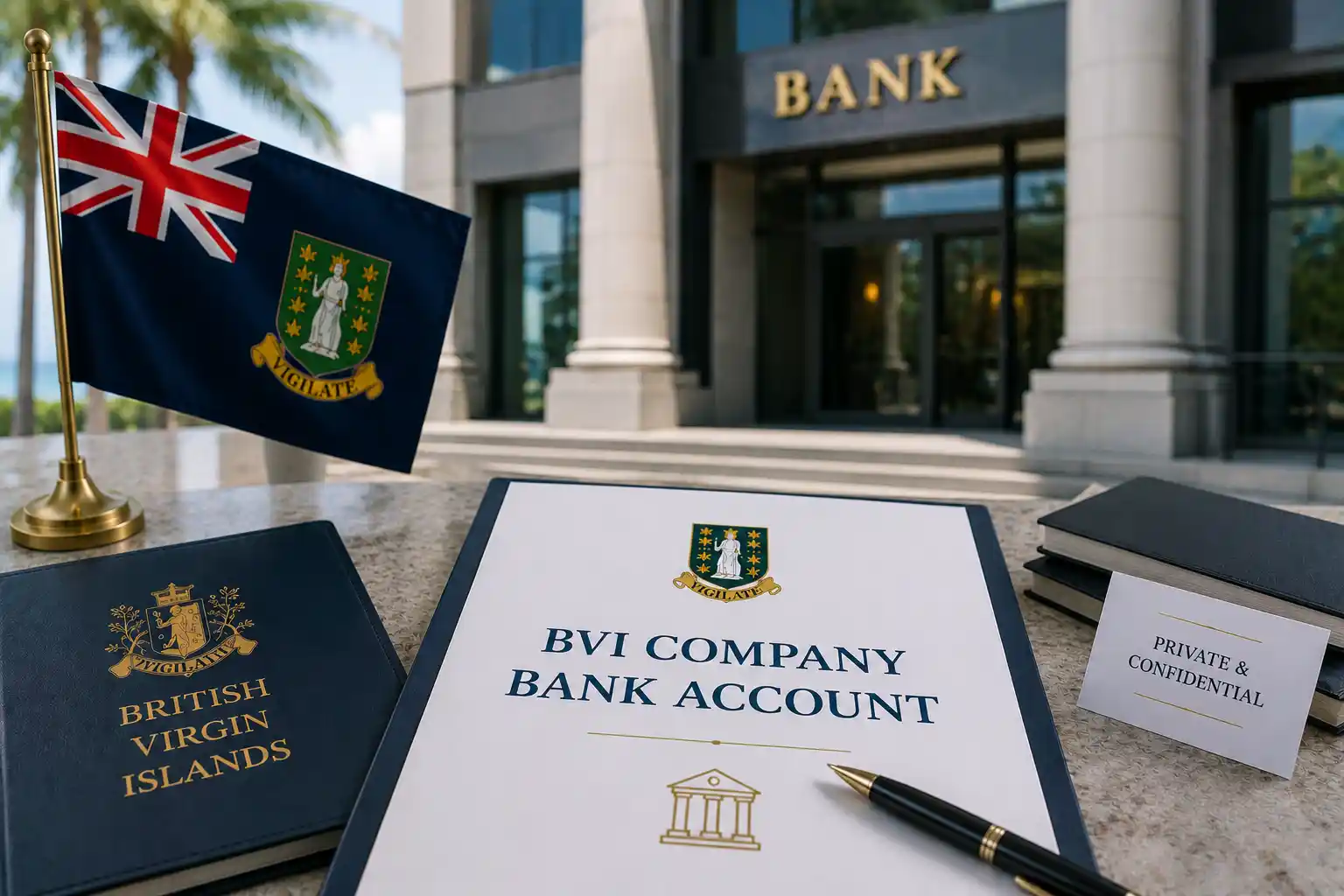
Offshore Banking for BVI Companies
Opening a bank account is often one of the most important practical steps after incorporating a British Virgin Islands company.
A BVI Business Company can generally hold bank accounts outside the British Virgin Islands and use international banking facilities for legitimate commercial, investment and holding activities.
However, company incorporation and bank account opening are two completely separate processes.
A BVI Certificate of Incorporation does not guarantee that a bank will accept the company.
Banks, payment institutions and other financial institutions conduct their own compliance review and can approve or reject an application according to their internal policies, risk appetite, the company’s business activity, ownership, countries of operation, expected transactions and source of funds.
For this reason, banking should ideally be considered before the BVI company is incorporated rather than after the structure has already been established.
A well-structured BVI company with transparent ownership, a clear commercial purpose, documented source of funds and realistic banking requirements can potentially access international banking services.
A company with no credible business rationale, unclear ownership or unexplained transactions can face considerable difficulties.
This guide explains offshore banking for BVI companies in 2026, including account-opening requirements, KYC, beneficial ownership, source of funds, source of wealth, banking jurisdictions, holding-company accounts, trading-company accounts, fintech and payment alternatives, common reasons for rejection and how to prepare a stronger banking application.
➡️ For the complete jurisdiction overview:
BVI Company Formation: The Complete Guide to Registering a Company in the British Virgin Islands (2026)
Can a BVI Company Open a Bank Account?
Yes.
A properly incorporated BVI Business Company can generally apply for a corporate bank account.
The account does not necessarily have to be opened in the British Virgin Islands.
Depending on the company’s ownership, activity and commercial requirements, banking may potentially be sought in:
- the British Virgin Islands;
- other Caribbean jurisdictions;
- the United Kingdom;
- Europe;
- Switzerland;
- Asia;
- the Middle East;
- other international financial centres; or
- another jurisdiction where an institution is prepared to accept the structure.
The fact that a company is incorporated in the BVI does not itself dictate where its bank account must be maintained.
Does a BVI Company Need a Bank Account?
A bank account is not normally required simply to complete the incorporation of an ordinary BVI Business Company.
The company can therefore be legally incorporated before a bank account is opened.
However, a bank or other financial account will usually be necessary if the company needs to:
- receive customer payments;
- pay suppliers;
- receive dividends;
- make investments;
- hold cash;
- pay expenses;
- fund subsidiaries;
- receive sale proceeds;
- conduct international trading;
- pay professional fees; or
- distribute funds to shareholders.
For a passive SPV, a conventional operating account may not always be required immediately.
Is a BVI Bank Account Opened Automatically With the Company?
No.
This is an important distinction.
Company incorporation
and
bank account opening
are separate procedures.
The BVI registered agent handles or facilitates the corporate incorporation process.
A bank independently conducts its own:
- KYC;
- AML screening;
- sanctions screening;
- beneficial ownership verification;
- source-of-funds review;
- source-of-wealth review;
- business assessment; and
- risk evaluation.
A company can therefore be successfully incorporated but subsequently rejected by a particular bank.
Is Bank Account Approval Guaranteed?
No.
No legitimate corporate service provider should guarantee that a bank account will be opened.
The final decision always belongs to the financial institution.
Even a fully compliant BVI company can be rejected because:
- the bank does not accept BVI companies;
- the business activity falls outside its risk appetite;
- the beneficial owner’s country is restricted;
- the expected turnover is too small;
- the expected turnover is too large for the selected banking product;
- the company has no connection with the bank’s jurisdiction;
- the source of funds is insufficiently documented;
- the ownership structure is too complex;
- the business is considered high risk;
- the bank does not understand the commercial rationale; or
- internal bank policy changes during the application.
Banking should therefore be treated as an application, not an entitlement.
Can a BVI Company Bank Outside the BVI?
Yes.
International banking outside the place of incorporation is common for BVI companies.
For example:
BVI Holding Company
↓
Bank account in another jurisdiction
↓
Receives dividends from foreign subsidiaries
or:
BVI Trading Company
↓
International corporate account
↓
Receives customer payments and pays suppliers
There is no general principle requiring the bank and the company to be located in the same jurisdiction.
The selected bank must nevertheless be willing to accept the corporate and geographic profile.
Are There Banks in the British Virgin Islands?
Yes.
The British Virgin Islands has licensed banking institutions supervised by the BVI Financial Services Commission.
However, the existence of local banks does not mean that every international BVI Business Company will automatically qualify for a local account.
Each institution maintains its own:
- customer eligibility criteria;
- minimum balance requirements;
- business restrictions;
- geographic restrictions;
- documentation standards; and
- risk policies.
A BVI company should therefore compare both local and international banking possibilities.
What Is Offshore Banking for a BVI Company?
“Offshore banking” generally means that the company maintains a financial account outside the jurisdiction where its owners live or where its principal business takes place.
For a BVI company, this could mean:
BVI Company
↓
Bank in Switzerland
or:
BVI Company
↓
Bank in the UAE
or:
BVI Company
↓
Bank in another accepted international financial centre
The expression does not imply secrecy or tax evasion.
Modern international banking operates within extensive:
- KYC;
- AML;
- beneficial ownership;
- tax information exchange;
- sanctions; and
- financial reporting frameworks.
What Is the Best Bank for a BVI Company?
There is no single “best bank” for every BVI company.
The appropriate banking solution depends on:
- business activity;
- beneficial owner’s residence;
- nationality;
- expected annual turnover;
- transaction size;
- currencies required;
- countries of customers;
- countries of suppliers;
- investment activity;
- minimum balance;
- need for cards;
- online banking requirements;
- payment volumes;
- whether SWIFT payments are required;
- whether SEPA is required;
- whether the company is active or passive; and
- the overall risk profile.
A bank suitable for a US$20 million investment holding company may be unsuitable for an e-commerce business processing hundreds of daily transactions.
Banking Should Be Considered Before Incorporation
One of the most common mistakes in international company formation is:
Step 1: incorporate company.
Step 2: decide what the company will do.
Step 3: start looking for a bank.
A better sequence is:
Step 1: define the business.
Step 2: identify ownership and countries of operation.
Step 3: determine realistic banking requirements.
Step 4: assess whether banks are likely to accept the structure.
Step 5: select the corporate jurisdiction.
Step 6: incorporate.
Step 7: submit the banking application.
This reduces the risk of creating a company that cannot obtain the financial services it needs.
What Documents Are Required to Open a BVI Company Bank Account?
Requirements differ between institutions, but a corporate bank will commonly request company documents and personal KYC for the individuals behind the structure.
Corporate documents may include:
- Certificate of Incorporation;
- Memorandum and Articles of Association;
- register of directors;
- register of members;
- share certificates where relevant;
- director resolutions;
- bank account opening resolution;
- Certificate of Good Standing where requested;
- Certificate of Incumbency or equivalent corporate confirmation where available;
- ownership structure chart;
- business licence where applicable;
- regulatory licence where applicable; and
- certified copies of corporate documents.
Additional documentation can be requested depending on the company and bank.
Certificate of Incorporation
The Certificate of Incorporation confirms that the company was legally incorporated in the British Virgin Islands.
It normally shows basic information such as:
- company name;
- company number; and
- incorporation status/date information.
This is one of the core corporate documents required by banks.
Memorandum and Articles of Association
The Memorandum and Articles establish the company’s constitutional framework.
Banks may review these documents to understand:
- the company’s legal powers;
- share structure;
- governance;
- director authority; and
- any restrictions affecting the company.
A standard BVI Business Company generally has broad corporate capacity.
Register of Directors
Banks generally need to know who legally manages the company.
The register of directors identifies the company’s directors.
Banks may separately verify each director through personal KYC documentation.
A director may also be required to sign the bank’s account-opening forms or resolutions.
Register of Members
The register of members provides information about the company’s legal shareholders.
Where a shareholder is another company, trust or other legal structure, the bank will normally look beyond the immediate shareholder to determine the ultimate beneficial owners.
Beneficial Ownership Information
Banks must understand who ultimately owns and controls the company.
For a simple structure:
Individual
↓
100%
↓
BVI Company
the analysis is straightforward.
For a layered structure:
Individual
↓
Foreign Holding Company
↓
Trust / Corporate Layer
↓
BVI Company
the bank may require documentation for every relevant level of ownership.
Complexity is not automatically prohibited, but the commercial reason for the structure must be clear.
Who Is the Ultimate Beneficial Owner?
The ultimate beneficial owner, or UBO, is generally the natural person who ultimately owns or controls the corporate structure under the applicable legal and compliance tests.
Banks do not normally stop their analysis at a nominee shareholder or intermediate holding company.
They look through the ownership chain to identify the individuals behind it.
This is why a BVI company should not be presented as an anonymous banking structure.
Personal KYC for Shareholders and Directors
Banks commonly request personal documents for:
- beneficial owners;
- directors;
- authorised signatories;
- shareholders;
- controlling persons; and
- other relevant individuals.
Documents may include:
- valid passport;
- national identity card where applicable;
- recent proof of residential address;
- tax identification number;
- tax residence information;
- professional or business background;
- CV;
- source-of-funds evidence;
- source-of-wealth evidence; and
- bank references where required.
Certification requirements vary between institutions.
Proof of Residential Address
Common forms of address evidence can include:
- utility bill;
- bank statement;
- government correspondence;
- tax authority correspondence; or
- another document accepted by the institution.
The document normally needs to be recent.
The exact acceptable period and certification requirements depend on the bank.
What Is Source of Funds?
Source of funds explains where the specific money entering the account comes from.
For example, the source of funds may be:
- business revenue;
- proceeds from sale of property;
- proceeds from sale of a company;
- salary savings;
- investment proceeds;
- dividends;
- inheritance;
- shareholder capital contribution; or
- loan proceeds.
A statement such as “personal savings” may not always be sufficient without supporting evidence.
Evidence of Source of Funds
Depending on the circumstances, evidence may include:
- bank statements;
- property sale agreement;
- company sale agreement;
- dividend vouchers;
- investment statements;
- employment records;
- audited accounts;
- loan agreement;
- inheritance documents;
- tax returns; or
- other documentary evidence.
The bank needs to understand how the funds were generated and whether the explanation is credible.
What Is Source of Wealth?
Source of wealth is broader than source of funds.
It explains how the beneficial owner accumulated their overall wealth.
For example:
A business owner may have accumulated wealth through:
- 20 years of operating a manufacturing business;
- dividends from that business;
- sale of investments; and
- property ownership.
The source of funds for the BVI company’s new bank account might then be:
US$500,000 proceeds from the sale of a particular property.
Source of wealth and source of funds are therefore related but different.
Why Do Banks Ask for Source of Wealth?
Banks are required to understand the financial background of their customers, particularly where:
- account balances are substantial;
- transactions are large;
- ownership is complex;
- jurisdictions present elevated risk;
- the beneficial owner is a politically exposed person;
- private investment structures are involved; or
- the business otherwise requires enhanced due diligence.
A credible and documented source-of-wealth explanation can materially strengthen an application.
Business Description
One of the most important parts of a banking application is the description of the company’s activity.
Weak description:
“Consulting.”
Better description:
“The company provides strategic market-entry consulting to privately owned European technology businesses expanding into Southeast Asian markets.”
The bank should understand:
- what the company sells;
- who pays it;
- why customers need the service;
- where the work takes place;
- how the company earns money; and
- why a BVI company is being used.
Business Plan
Banks may request a business plan, particularly for a newly incorporated company.
A useful banking business plan may explain:
- company activity;
- ownership;
- management;
- target markets;
- customers;
- suppliers;
- projected turnover;
- expected transaction volumes;
- currencies;
- source of initial capital;
- commercial rationale;
- website;
- staffing;
- offices; and
- future strategy.
The document should reflect the actual business rather than generic incorporation wording.
Contracts and Invoices
A bank may request evidence that the proposed business is genuine.
Examples include:
- signed customer contracts;
- supplier agreements;
- purchase orders;
- invoices;
- letters of intent;
- distribution agreements;
- consulting agreements;
- investment agreements;
- shareholder agreements; or
- acquisition documents.
For a newly formed company, draft contracts or existing contracts being transferred to the new entity may sometimes support the application.
Company Website
A professional website can help demonstrate the commercial reality of an operating business.
The bank may review:
- services offered;
- contact details;
- management;
- terms and conditions;
- jurisdictions served;
- products;
- regulatory disclosures; and
- consistency with the banking application.
Information on the website should not contradict information supplied to the bank.
Expected Annual Turnover
Banks commonly ask for projected annual turnover.
For example:
Expected annual turnover: US$1.5 million
The applicant may then need to explain how that estimate was calculated.
The expected turnover should be consistent with:
- business plan;
- contracts;
- existing business history;
- customer base;
- owner’s experience; and
- transaction profile.
Unrealistically high or unexplained forecasts can create additional questions.
Expected Number of Transactions
Banks may ask:
- number of incoming payments per month;
- number of outgoing payments;
- average transaction value;
- maximum transaction value;
- expected cash balance; and
- countries involved.
A holding company receiving four dividends per year has a very different profile from an e-commerce company receiving thousands of customer payments.
Countries of Customers and Suppliers
Banks assess geographic risk.
The application may therefore need to identify:
- principal customer countries;
- supplier countries;
- investment countries;
- subsidiary jurisdictions;
- source of incoming funds; and
- destination of outgoing payments.
A vague answer such as “worldwide” is often less useful than a realistic list of principal markets.
Why Does the Bank Ask Why the Company Is in the BVI?
Banks increasingly expect a commercial explanation for offshore structures.
Possible legitimate reasons can include:
- international holding structure;
- neutral joint venture jurisdiction;
- acquisition SPV;
- investment vehicle;
- established corporate law;
- cross-border ownership;
- international group structure; or
- holding subsidiaries in several jurisdictions.
The explanation should match the company’s real purpose.
Simply stating:
“because there is no tax”
is unlikely to be the strongest banking rationale.
BVI Holding Company Bank Account
A BVI holding company may need an account primarily to:
- receive dividends;
- make acquisitions;
- receive disposal proceeds;
- fund subsidiaries;
- receive shareholder capital;
- pay professional expenses; and
- distribute dividends.
This can sometimes be a relatively understandable banking profile because transactions are fewer and larger.
The bank will normally want evidence of the underlying investments.
For example:
- subsidiary incorporation documents;
- share certificates;
- acquisition agreements;
- dividend records;
- investment statements; and
- group structure chart.
➡️ Read our blog: BVI Holding Company: Benefits, Uses and Tax Considerations
Bank Account for a BVI Trading Company
An international trading company generally requires more extensive transactional banking.
The bank may want to understand:
- products traded;
- suppliers;
- customers;
- shipping routes;
- countries involved;
- invoice values;
- logistics;
- customs;
- warehouses;
- trade finance requirements; and
- expected payment volumes.
A detailed business description is particularly important.
BVI Consulting Company Bank Account
Consulting companies may need to provide:
- consulting agreements;
- client information;
- invoices;
- director CV;
- professional qualifications;
- company website;
- explanation of services; and
- expected payment flows.
Banks may also examine where the services are actually performed and why the company is incorporated in the BVI.
BVI Investment Company Bank Account
An investment company may require:
- bank account;
- brokerage account;
- custody account; or
- combination of these.
The institution may request evidence concerning:
- investment strategy;
- source of investment capital;
- beneficial owner’s investment history;
- expected portfolio;
- securities markets;
- investment manager where applicable; and
- whether the company invests only its own money.
Own-Money Investment vs Third-Party Investment Business
This distinction is important.
A BVI company investing its own corporate funds is fundamentally different from a company:
- accepting money from unrelated investors;
- managing portfolios for clients;
- operating an investment fund; or
- providing investment services.
Third-party investment activity can trigger regulatory requirements.
The company should therefore determine whether its proposed activity requires BVI or foreign regulatory authorisation.
BVI E-Commerce Company Banking
E-commerce companies can be more complicated because they often require:
- operating bank account;
- merchant account;
- payment gateway;
- card processing;
- marketplace account; and
- multiple currency facilities.
A conventional bank account alone may not provide the complete payment infrastructure.
The company should therefore consider banking and payment processing together.
Merchant Accounts for BVI Companies
A merchant account allows a business to accept card payments.
Merchant providers assess risks including:
- product type;
- chargeback rate;
- refund policy;
- customer countries;
- transaction value;
- website quality;
- terms and conditions;
- regulatory status; and
- company jurisdiction.
Some merchant providers do not accept BVI companies.
Others may accept them depending on the business.
Payment Institutions and EMIs
A BVI company may sometimes use an Electronic Money Institution or other regulated payment institution instead of, or alongside, a conventional bank.
Depending on the provider, services can include:
- multi-currency accounts;
- local payment details;
- international transfers;
- payment cards;
- foreign exchange;
- SEPA payments; and
- SWIFT payments.
However, an EMI account is not necessarily equivalent to a traditional bank account.
Bank vs EMI
A traditional bank may offer:
- deposit accounts;
- lending;
- trade finance;
- investment services;
- credit facilities; and
- broader banking products.
An EMI or payment institution may focus on:
- payments;
- currency exchange;
- virtual/local account details; and
- transactional services.
Client money protection arrangements can also differ from conventional bank deposit protection.
The legal status of the institution should therefore be checked before funds are transferred.
Can a BVI Company Use Fintech Banking?
Potentially.
Some regulated fintech providers accept international corporate customers.
However, eligibility can change quickly.
A provider that accepts BVI companies today may change its policy later.
Therefore, corporate structuring should not depend entirely on one fintech provider without considering alternatives.
Multi-Currency Accounts
A BVI company conducting international business may benefit from accounts supporting:
USD
EUR
GBP
and potentially other currencies.
This can reduce unnecessary currency conversions where the company receives and pays funds in different currencies.
SWIFT Banking
Companies making international wire transfers may require SWIFT access.
The applicant should confirm:
- whether the institution supports SWIFT;
- incoming currencies;
- outgoing currencies;
- correspondent bank arrangements;
- transaction limits; and
- payment-country restrictions.
SEPA Accounts
A BVI company doing business with European counterparties may want EUR payment facilities.
Some institutions can provide SEPA-capable accounts to non-European companies.
However, acceptance depends on the provider and company profile.
The company should not assume that BVI incorporation automatically qualifies it for European payment infrastructure.
IBAN for a BVI Company
A BVI company may potentially obtain an account with an IBAN through a bank or eligible payment institution in a jurisdiction using or supporting IBAN-based payments.
The IBAN jurisdiction does not need to match the company’s place of incorporation.
For example, a BVI company may potentially hold an account with European banking details if accepted by the relevant provider.
Does a BVI Company Need a Local BVI Bank Account?
No general rule requires an ordinary BVI Business Company to maintain its bank account in the BVI simply because it is incorporated there.
International banking is therefore possible.
However, regulatory, economic substance and tax considerations should be assessed separately.
Does a Foreign Bank Account Change the Company’s BVI Status?
No.
Opening a bank account in another jurisdiction does not change the fact that the company is incorporated in the British Virgin Islands.
However, a foreign bank account may become relevant to:
- tax reporting;
- economic substance;
- foreign tax residence;
- accounting;
- CRS;
- FATCA; and
- other regulatory obligations.
Does the Bank Account Determine Tax Residence?
Not by itself.
The location of a company’s bank account is only one factual element.
Tax residence may depend on factors such as:
- incorporation;
- central management and control;
- place of effective management;
- directors;
- decision-making; and
- domestic legislation.
A Swiss bank account does not automatically make a BVI company Swiss tax resident.
Similarly, a BVI bank account does not automatically determine all aspects of BVI or foreign tax residence.
BVI Company Banking and Economic Substance
Banking and economic substance are related in some cases but are not the same issue.
The BVI Economic Substance framework focuses on whether an entity carries on specified relevant activities and, where applicable, whether required substance is maintained.
A bank account outside the BVI does not by itself mean that the company fails economic substance.
Likewise, merely opening a BVI bank account does not automatically satisfy substance requirements.
The company’s actual activity must be analysed.
➡️ Read our blog: BVI Economic Substance Rules Explained
Pure Equity Holding Company Banking
A qualifying pure equity holding entity may have relatively simple banking needs.
For example:
BVI Holding Company
↓
owns foreign subsidiaries
↓
receives dividends twice annually
↓
holds funds before reinvestment
Its account profile may involve:
- few incoming payments;
- high-value dividends;
- occasional acquisitions;
- professional expenses; and
- occasional distributions.
This is different from an active trading account.
The bank should be told the true expected transaction pattern.
BVI Company Banking and Beneficial Ownership
Modern banking does not permit the beneficial owner to disappear behind the BVI company.
Financial institutions identify and verify beneficial ownership according to applicable AML rules.
The BVI itself also operates a beneficial ownership filing regime.
Therefore, bank confidentiality should not be confused with anonymous ownership.
➡️ Read our blog: BVI Beneficial Ownership, Privacy and Confidentiality Requirements
CRS and BVI Company Bank Accounts
The Common Reporting Standard is an international automatic exchange-of-information framework.
Where applicable, a financial institution may collect information concerning:
- entity tax residence;
- entity classification;
- controlling persons;
- beneficial owners;
- account balance; and
- certain financial income.
The institution may then report relevant information to its local tax authority for exchange with participating jurisdictions.
A BVI company account should therefore not be viewed as a secret account outside international tax reporting.
FATCA
FATCA is particularly relevant where US persons or US tax connections are involved.
Financial institutions may request:
- FATCA classification;
- US tax forms;
- GIIN where applicable;
- controlling-person information; and
- US tax residence declarations.
US beneficial owners should obtain specialist US tax advice concerning foreign company and foreign account reporting.
Tax Identification Numbers
Banks frequently request tax identification numbers for:
- beneficial owners;
- controlling persons;
- directors in some cases; and
- the company where applicable.
The purpose is generally connected with tax compliance and information reporting.
Tax Residence Self-Certification
A bank may ask the company and its controlling persons to complete tax residence self-certifications.
These declarations should be completed accurately.
The company’s place of incorporation and tax residence should not automatically be treated as identical without considering applicable law.
Can a BVI Company Have More Than One Bank Account?
Yes.
A company can potentially maintain several accounts if accepted by the institutions.
For example:
Operating account
for customer and supplier transactions.
Investment account
for portfolio assets.
Currency account
for EUR transactions.
Reserve account
for retained corporate funds.
Multiple accounts can improve operational flexibility but increase compliance and accounting requirements.
Can a BVI Company Have Accounts in Different Countries?
Potentially yes.
For example:
BVI Company
↓
USD account in one jurisdiction
↓
EUR account in another jurisdiction
↓
Brokerage account elsewhere
There is no universal corporate-law prohibition against this for an ordinary BVI company.
Each institution must independently approve the company.
Can a BVI Company Hold USD?
Yes.
USD is commonly used in international BVI corporate structures.
Whether a particular institution offers USD accounts depends on its banking products and correspondent arrangements.
Can a BVI Company Hold GBP and EUR?
Potentially yes.
Multi-currency banking can include GBP, EUR and other major currencies where supported by the financial institution.
Minimum Balance Requirements
Some international banks require minimum balances.
These can range from relatively modest amounts to substantial private or corporate banking thresholds.
Minimum balance requirements are commercial bank policies and should not be confused with BVI statutory company capital requirements.
A company does not need to deposit US$50,000 merely because it has 50,000 authorised shares.
Bank Opening Fees
Banks and payment providers may charge:
- application fees;
- account-opening fees;
- due diligence fees;
- monthly fees;
- minimum balance fees;
- transaction fees;
- SWIFT fees;
- foreign exchange margins; and
- account maintenance charges.
These are institution-specific and can change.
They should therefore be confirmed directly for the selected banking solution rather than stated as universal BVI costs.
How Long Does It Take to Open a BVI Company Bank Account?
There is no universal timeframe.
A straightforward application may progress relatively quickly, while a complex structure can take significantly longer.
Timing depends on:
- bank;
- ownership;
- KYC quality;
- source of wealth;
- source of funds;
- business activity;
- jurisdictions;
- account purpose;
- compliance questions; and
- how quickly the applicant responds.
Company incorporation can therefore be much faster than bank account opening.
Can Banking Be Opened Remotely?
Potentially.
Many institutions permit at least part of the application process to be completed remotely.
However, some banks may require:
- video identification;
- certified documents;
- notarised documents;
- apostilles;
- original documents;
- branch visit;
- meeting with a relationship manager; or
- physical presence of directors or beneficial owners.
Requirements depend entirely on the institution.
Video Identification
Remote banking applications may use video identification to verify directors, shareholders or beneficial owners.
Applicants should have:
- original passport;
- stable internet connection;
- suitable camera;
- clear lighting; and
- any requested supporting documents.
The provider determines whether video verification is acceptable.
Certified Corporate Documents
A bank may request certified copies of BVI corporate documents.
Certification may need to be performed by:
- registered agent;
- lawyer;
- notary;
- accountant;
- other accepted professional; or
- another person accepted by the bank.
The bank’s certification wording should ideally be confirmed before documents are certified.
Apostille and Legalisation
Some banks or foreign authorities may require BVI corporate documents to be apostilled or otherwise legalised.
This can include:
- Certificate of Incorporation;
- Certificate of Good Standing;
- Memorandum and Articles; or
- other corporate records.
Whether apostille is required depends on the destination and purpose.
Certificate of Good Standing
A bank may request a current Certificate of Good Standing, particularly where the company is not newly incorporated.
This provides official confirmation concerning the company’s status according to the applicable Registry criteria.
Older companies should expect banks to request more current corporate evidence than companies incorporated only days earlier.
Corporate Search
A financial institution may independently verify the BVI company through available Registry information.
The BVI FSC provides a public search function through which specified information and corporate products can be obtained.
Applicants should therefore ensure that their corporate records and filings are current.
Why Are BVI Bank Accounts Sometimes Difficult to Open?
The difficulty usually arises from the combination of:
- offshore jurisdiction;
- cross-border ownership;
- international payments;
- AML requirements;
- tax transparency;
- sanctions screening; and
- bank-specific risk policies.
This does not mean that BVI companies cannot obtain banking.
It means that banks expect a stronger explanation of the structure than they may require from a simple domestic company.
Common Reasons for Bank Rejection
1. No Clear Commercial Rationale
The applicant cannot explain why a BVI company is required.
2. Weak Business Description
The activity is described only as “consulting”, “trading” or “investment”.
3. Unclear Source of Funds
The applicant cannot document where the money comes from.
4. Unclear Source of Wealth
The beneficial owner’s financial background does not support the proposed transactions.
5. High-Risk Countries
Customers, suppliers, owners or transactions involve jurisdictions outside the bank’s risk appetite.
6. Sanctions Exposure
The structure creates sanctions concerns.
7. High-Risk Industry
The bank does not accept the proposed sector.
8. Complex Ownership
Multiple layers exist without a convincing commercial explanation.
9. No Evidence of Business
There are no contracts, customers, suppliers, website or investment documents.
10. Inconsistent Information
The application, website, corporate documents and explanations contradict one another.
11. Unrealistic Turnover
The projected volume cannot be supported.
12. No Connection to the Banking Jurisdiction
Some banks require a genuine business or personal connection with the country where the account is requested.
High-Risk Business Activities
Banks may apply enhanced scrutiny or decline sectors such as:
- cryptocurrency;
- virtual asset services;
- gambling;
- adult services;
- arms or defence-related business;
- high-risk financial services;
- money transmission;
- payment processing;
- unlicensed investment activity;
- certain commodities;
- high-risk international trade; or
- other sectors outside their policy.
A BVI company should verify banking feasibility before entering such activities.
Crypto and Virtual Asset Companies
A BVI company involved with digital assets may face significantly enhanced banking scrutiny.
Banks may distinguish between:
company investing its own funds in digital assets
and
company providing virtual asset services to customers.
The second category can trigger regulatory requirements and considerably more demanding banking due diligence.
The company’s BVI regulatory status should be established before approaching a bank.
Sanctions Screening
Banks screen:
- company;
- directors;
- shareholders;
- beneficial owners;
- authorised signatories;
- customers;
- counterparties; and
- transaction countries
against applicable sanctions regimes.
A company that is legally incorporated can still be unacceptable to a bank because of sanctions risk.
Politically Exposed Persons
Being a politically exposed person does not automatically mean an account cannot be opened.
However, PEP relationships commonly require enhanced due diligence.
This may involve:
- more detailed source-of-wealth evidence;
- source-of-funds verification;
- senior management approval;
- enhanced transaction monitoring; and
- periodic reviews.
Enhanced Due Diligence
Banks can apply enhanced due diligence where a relationship presents elevated risk.
This can include additional investigation of:
- business background;
- wealth;
- funds;
- ownership;
- transactions;
- counterparties;
- geographic exposure; and
- corporate purpose.
The applicant should therefore be prepared to answer detailed questions rather than treating them as unusual.
Why a Professional Application Matters
Banking applications should be consistent and well organised.
A strong application normally presents a coherent picture:
Who owns the company?
What does it do?
Why is it incorporated in the BVI?
Where does the money come from?
Who are the customers?
Who are the suppliers?
Which countries are involved?
How much money will move through the account?
Why is this particular bank appropriate?
If these questions can be answered clearly and supported by documents, the application is generally easier for a compliance team to assess.
Banking Profile Example: Holding Company
Company: BVI Business Company
Activity: holding shares in three operating subsidiaries
Beneficial owner: entrepreneur resident in Country A
Incoming payments: dividends from subsidiaries
Outgoing payments: acquisitions, professional fees and shareholder distributions
Annual incoming volume: US$2 million
Transactions: approximately 10–20 per year
Source of wealth: proceeds and accumulated profits from established operating businesses
Source of funds: dividends from identified subsidiaries
This is a relatively coherent banking profile.
Banking Profile Example: Trading Company
Company: BVI Business Company
Activity: wholesale electronic components
Customers: distributors in Europe and Asia
Suppliers: manufacturers in Asia
Annual turnover: US$5 million
Currencies: USD and EUR
Incoming transactions: approximately 50 monthly
Outgoing transactions: approximately 30 monthly
Source of funds: customer payments under commercial invoices
Required banking: SWIFT, multi-currency account and online corporate banking
The bank can understand how the account is expected to operate.
Weak Banking Profile Example
Activity: international business.
Customers: worldwide.
Turnover: US$20 million.
Source of funds: savings.
Reason for BVI: tax.
Website: none.
Contracts: none.
Business history: none.
Requested services: unlimited international payments.
This type of application is likely to generate substantial compliance questions.
Should the BVI Company Be Formed Before Pre-Assessing Banking?
Where possible, the banking profile should be assessed first.
A preliminary assessment can consider:
- ownership;
- residence;
- nationality;
- activity;
- expected turnover;
- jurisdictions;
- currencies;
- source of wealth;
- source of funds; and
- required services.
This cannot guarantee approval, but it can help avoid clearly unsuitable banking strategies.
Can a Newly Incorporated BVI Company Open an Account?
Yes, potentially.
A new company naturally has no corporate banking history.
The bank may therefore rely more heavily on:
- beneficial owner’s history;
- existing business;
- contracts;
- business plan;
- professional background;
- source of capital; and
- supporting documentation.
A new company is not automatically a weak applicant if its commercial rationale is clear.
Can a Dormant BVI Company Open a Bank Account?
Potentially, but the bank may ask why an inactive company requires an account.
If the company is becoming active, the applicant should explain the change in purpose and provide updated business information.
Older corporate documents and KYC may also need to be refreshed.
Can an Existing BVI Company Change Banks?
Yes.
A company may apply to another institution if:
- existing bank closes the account;
- service is inadequate;
- currencies are unavailable;
- fees are too high;
- business activity changes;
- company enters new markets; or
- additional banking redundancy is desired.
The new bank will conduct its own due diligence.
Previous banking approval does not guarantee approval by another institution.
Bank Account Closure Risk
Banks periodically review customers.
An account can potentially be closed even after years of operation if:
- bank risk appetite changes;
- transactions differ from declared activity;
- KYC becomes outdated;
- requested information is not provided;
- sanctions rules change;
- business becomes higher risk; or
- the bank exits a customer segment.
Maintaining accurate and current information is therefore essential.
Ongoing Bank Compliance
After the account is opened, the company may periodically be asked for:
- updated passport;
- updated address evidence;
- new Certificate of Good Standing;
- financial statements;
- management accounts;
- tax returns;
- source-of-funds documents;
- contracts;
- ownership updates;
- explanation of transactions; or
- tax residence self-certification.
Opening the account is therefore not the end of compliance.
Tell the Bank About Corporate Changes
Material changes should be reported where required.
Examples include:
- new shareholder;
- new beneficial owner;
- director change;
- address change;
- new business activity;
- significant increase in turnover;
- entry into new countries;
- new subsidiary; or
- change in tax residence.
Failure to update information can create account restrictions.
BVI Annual Compliance and Banking
A bank may request evidence that the BVI company remains in good standing.
The company should therefore maintain:
- annual government fees;
- registered agent;
- registered office;
- statutory filings;
- beneficial ownership information;
- register information;
- accounting records;
- annual financial return where applicable; and
- economic substance reporting where applicable.
A company with overdue corporate compliance can encounter banking difficulties.
➡️ Read our blog: BVI Company Accounting, Annual Returns and Ongoing Compliance Requirements
Accounting Records for Bank Transactions
Every bank transaction should be reflected in the company’s accounting records.
For example:
Dividend received
↓
record dividend income.
Share purchase
↓
record investment acquisition.
Director expense
↓
record expense or director balance correctly.
Shareholder loan
↓
record liability or receivable.
Bank transfer between own accounts
↓
record inter-account movement.
Good accounting records support both statutory compliance and future bank reviews.
Does 0% BVI Corporate Tax Make Banking Easier?
Not necessarily.
The BVI’s effectively 0% general corporate income tax environment is a feature of the jurisdiction.
Banks, however, are primarily concerned with:
- legitimacy;
- tax compliance;
- commercial purpose;
- transparency;
- ownership;
- source of funds; and
- transaction risk.
A company should be able to explain where it is tax resident and what foreign tax obligations apply.
➡️ Read our blog: BVI Company Taxation: Corporate Tax, Capital Gains and Withholding Tax Explained
Can a BVI Company Be Tax Resident Elsewhere?
Potentially yes.
A company incorporated in the BVI can potentially be considered tax resident elsewhere under foreign domestic law depending on factors such as management and control.
Banks may therefore ask:
Where is the company tax resident?
The answer should be determined by the relevant legal facts rather than automatically stating “BVI” simply because the company is incorporated there.
Banking for Non-Resident BVI Company Owners
Non-resident ownership is normal for BVI Business Companies.
The bank will typically focus on:
- owner’s country of residence;
- nationality;
- tax residence;
- professional background;
- source of wealth;
- company purpose;
- countries of business; and
- expected account activity.
➡️ For the broader ownership analysis:
BVI Company Formation for Non-Residents: Ownership, Uses and Tax Considerations
Banking for UK Owners
A UK resident can potentially own a BVI company and apply for international corporate banking.
However, the bank may want to understand:
- why a BVI company is being used;
- whether business is actually conducted from the UK;
- company tax residence;
- expected customers;
- source of funds; and
- the owner’s UK business background.
UK tax considerations should be addressed separately.
Banking for EU Owners
EU-resident beneficial owners can potentially obtain banking for BVI companies, but acceptance varies considerably between institutions.
European banks and payment providers may examine:
- connection with Europe;
- EU customer base;
- VAT obligations;
- tax residence;
- business substance; and
- purpose of the offshore company.
Banking for UAE-Based Owners
A UAE-based entrepreneur may potentially seek banking in the UAE or another international financial centre.
However, UAE banks generally conduct substantial KYC and may require evidence of:
- UAE residence;
- local business connection;
- office;
- existing company;
- investments; or
- other economic relationship.
A BVI company alone does not guarantee access to UAE banking.
Banking for US Persons
US beneficial owners can face additional FATCA and tax documentation requirements.
A bank may request US tax forms and information concerning:
- US citizenship;
- US residence;
- tax identification number;
- foreign company classification; and
- controlling-person status.
US tax advice is strongly recommended.
Can a BVI Company Open a Private Bank Account?
A BVI company may potentially qualify for corporate or investment services from private banks where the assets meet the institution’s requirements.
Private banking is more likely to be relevant to:
- substantial investment holding companies;
- family investment vehicles;
- wealth structures;
- portfolio companies; and
- high-value SPVs.
Minimum investable asset requirements can be significant.
Private Banking vs Commercial Banking
Private banking typically focuses on:
- investments;
- wealth management;
- custody;
- portfolio management; and
- high-value clients.
Commercial banking focuses more on:
- customer payments;
- supplier payments;
- payroll;
- trade;
- working capital; and
- daily business operations.
A BVI holding company may fit private banking better than a high-volume trading company.
Can a BVI Company Obtain Credit?
Potentially, but lending is a separate credit decision.
A bank may require:
- financial statements;
- collateral;
- guarantees;
- investment portfolio;
- operating history;
- cash flow;
- business plan; and
- shareholder support.
New offshore companies without assets or operating history may find unsecured borrowing difficult.
Can a BVI Company Get a Corporate Card?
Potentially.
Some banks and payment institutions offer:
- debit cards;
- corporate cards;
- employee cards; or
- virtual cards.
Availability depends on the institution, beneficial owner residence and company activity.
Choosing a Banking Jurisdiction
The company should consider:
Currency
Where will payments be received?
Customers
Where are they located?
Suppliers
Where will payments be sent?
Owner
Where does the beneficial owner live?
Business
Where is the activity actually conducted?
Reputation
Will customers accept the banking jurisdiction?
Regulation
Is the financial institution properly licensed?
Protection
How are customer funds or deposits protected?
Tax Reporting
What CRS/FATCA reporting applies?
Practicality
Does the account provide the required payment infrastructure?
The answer should be based on the business rather than on the word “offshore”.
Traditional Bank or Fintech?
For many BVI companies, the strongest approach may be to consider both.
A traditional bank may be preferable for:
- substantial balances;
- investments;
- financing;
- long-term relationship banking;
- trade finance; and
- complex corporate transactions.
A regulated payment institution may be useful for:
- daily payments;
- multiple currencies;
- foreign exchange;
- payment cards; and
- operational transactions.
Where appropriate, a company may maintain more than one financial relationship rather than relying on a single provider.
Banking Diversification
Depending on scale, maintaining more than one banking or payment relationship can reduce operational dependence on one institution.
For example:
Primary bank
for reserves and significant transactions.
Payment account
for operating transactions.
Brokerage/custody account
for investments.
This is particularly relevant to international companies that cannot afford lengthy disruption if one provider changes its risk policy.
How to Improve the Chances of Opening a BVI Company Account
The strongest applications generally have five characteristics:
1. Transparent Ownership
The beneficial owners are clearly identified.
2. Clear Business
The company has a specific, understandable commercial purpose.
3. Documented Money
Source of funds and source of wealth can be demonstrated.
4. Logical Banking Jurisdiction
There is a credible reason for approaching the particular institution.
5. Consistent Information
Corporate documents, website, contracts and application forms tell the same story.
No adviser can guarantee approval, but careful preparation can substantially improve the quality of the application.
Documents Checklist for BVI Company Banking
A banking file may commonly contain:
Corporate
Certificate of Incorporation
Memorandum and Articles
Register of Directors
Register of Members
Share Certificate where relevant
Certificate of Good Standing where requested
Corporate resolution
Ownership chart
Personal
Passport
Proof of address
Tax identification information
CV/business profile
Financial
Source-of-funds evidence
Source-of-wealth evidence
Existing bank statements
Financial statements where applicable
Commercial
Business plan
Contracts
Invoices
Website
Supplier information
Customer information
Expected transaction profile
Compliance
Tax residence declarations
FATCA/CRS forms
Regulatory licence where applicable
Additional documentation requested by the institution
Common Banking Mistakes
Applying to Banks Randomly
Not every bank accepts BVI companies.
Incorporating Before Considering Banking
The chosen structure may not fit the desired bank.
Using Generic Business Descriptions
Banks need specific information.
Hiding Ownership Complexity
Banks will normally discover the ownership chain during KYC.
Providing Inconsistent Turnover Figures
Different numbers across forms create compliance concerns.
Ignoring Source of Wealth
Large balances require credible wealth evidence.
Assuming an EMI Is a Bank
The regulatory and protection framework may differ.
Assuming BVI Means Anonymous
Modern banking requires beneficial owner identification.
Ignoring Tax Residence
Banks increasingly request entity tax classifications and self-certifications.
Expecting Instant Approval
Corporate banking can require multiple rounds of compliance questions.
Offshore Banking and Tax Evasion Are Not the Same Thing
Holding an international bank account through a BVI company can be entirely lawful.
What matters is that the company and its owners comply with applicable:
- tax law;
- corporate law;
- AML requirements;
- beneficial ownership rules;
- sanctions;
- CRS;
- FATCA; and
- reporting obligations.
Offshore banking should therefore be understood as cross-border financial infrastructure, not as a mechanism for concealing assets.
Offshore Banking for BVI Companies Through BRIS Group
BRIS Group assists clients with BVI company formation and can coordinate banking assistance where suitable banking options are available for the proposed corporate profile.
Before a banking application is submitted, the structure can be reviewed from a practical corporate and banking perspective, including:
- company activity;
- ownership;
- directors;
- beneficial owners;
- owner residence;
- expected turnover;
- customer jurisdictions;
- supplier jurisdictions;
- currencies;
- source of funds;
- source of wealth;
- required payment facilities; and
- proposed banking purpose.
Depending on the case, assistance may include:
- preparation of corporate banking documentation;
- KYC coordination;
- corporate document certification;
- Certificate of Good Standing arrangements;
- apostille/legalisation coordination where required;
- ownership structure chart;
- business activity description;
- banking application coordination;
- introduction to potentially suitable banking or payment providers where available; and
- responses to follow-up compliance requests.
BRIS Group cannot guarantee bank account approval.
The final decision always remains with the relevant bank, payment institution or financial institution.
Banking fees, minimum balances, transaction fees and other financial institution charges should be confirmed for the particular institution and are not included as universal BVI company costs.
Frequently Asked Questions About Banking for BVI Companies
Can a BVI company open a bank account?
Yes. A BVI Business Company can generally apply for corporate banking subject to the institution’s acceptance criteria.
Does the account have to be in the BVI?
No. A BVI company may potentially maintain an account in another jurisdiction.
Is a bank account required to incorporate a BVI company?
No. A conventional corporate bank account is not normally required merely to complete incorporation.
Is banking included automatically with BVI company formation?
No. Incorporation and bank account opening are separate processes.
Is bank approval guaranteed?
No. The bank independently decides whether to accept the company.
Can a BVI company open an account remotely?
Potentially. Some institutions permit remote onboarding, while others require physical presence or additional verification.
What documents does the bank need?
Typically the Certificate of Incorporation, Memorandum and Articles, registers, ownership information, director and UBO KYC, business information and financial evidence.
Does the bank need to know the beneficial owner?
Yes.
Can a nominee hide the beneficial owner from the bank?
No. Banks identify the natural persons ultimately owning or controlling the company under applicable KYC rules.
What is source of funds?
It explains where the specific money entering the account originated.
What is source of wealth?
It explains how the beneficial owner accumulated their overall wealth.
Will the bank ask for both?
Potentially yes, particularly for international corporate relationships or higher-value accounts.
Can a new BVI company open an account without trading history?
Potentially yes. The bank may rely more heavily on the owner’s history, contracts, business plan and source of capital.
Does a BVI company need a website?
Not universally, but a professional website can strengthen an operating company’s commercial profile.
Does it need contracts?
Banks frequently request contracts, invoices or other evidence of expected business.
Can a BVI holding company open an account?
Yes, subject to bank approval.
Can a BVI holding company receive dividends?
Yes. Banks may request evidence of the subsidiaries and expected dividend flows.
Can a BVI company have a brokerage account?
Potentially yes, subject to the brokerage or custodian’s eligibility requirements.
Can a BVI company have a multi-currency account?
Potentially yes.
Can it have USD, EUR and GBP accounts?
Potentially, where supported by the selected institution.
Can a BVI company obtain an IBAN?
Potentially through a bank or payment institution offering eligible IBAN-based accounts.
Can a BVI company use SEPA?
Potentially where the account provider supports SEPA payments for the company.
Can it use SWIFT?
Yes, where the selected institution provides SWIFT facilities.
Can a BVI company use an EMI?
Potentially, subject to the EMI’s customer acceptance policy.
Is an EMI the same as a bank?
No. The regulatory framework, products and customer-fund protection can differ.
Can a BVI company use fintech banking?
Potentially, but acceptance policies can change and should be confirmed before relying on a particular provider.
Can a BVI company have more than one account?
Yes, subject to each institution independently accepting the company.
Can accounts be in different countries?
Potentially yes.
Does a foreign bank account change the company’s BVI incorporation?
No.
Does a foreign bank account make the company tax resident there?
Not automatically.
Does a BVI bank account prove BVI tax residence?
Not by itself.
Does a BVI company pay tax because it has a bank account?
The location of the bank account alone does not determine the company’s overall tax liability.
Does BVI 0% corporate tax guarantee the bank will accept the company?
No.
Will banks accept BVI trading companies?
Some do, depending on activity, countries, turnover and compliance profile.
Will banks accept BVI consulting companies?
Potentially, where the activity and commercial rationale are clear.
Will banks accept BVI investment companies?
Potentially. Investment activity and whether third-party funds are involved must be explained.
Can a BVI company accept investor money?
This requires regulatory analysis. Accepting or managing third-party investment money can constitute regulated activity.
Can a BVI crypto company open a bank account?
Potentially, but crypto-related companies commonly face enhanced due diligence and more limited banking options.
Can a BVI company get a merchant account?
Potentially, depending on business activity, website, chargeback risk and provider policy.
Can a BVI company get corporate cards?
Potentially, where the bank or payment institution provides them.
Can a BVI company obtain a loan?
Potentially, but lending depends on creditworthiness, collateral, financial history and bank policy.
Can UK residents open banking for a BVI company?
Potentially yes, subject to the institution’s criteria and applicable UK tax and reporting obligations.
Can EU residents bank a BVI company?
Potentially yes. Acceptance varies significantly by institution and jurisdiction.
Can UAE residents open an account for a BVI company?
Potentially yes, although banks may require a meaningful UAE or regional connection.
Can US persons own and bank a BVI company?
Potentially, but FATCA and extensive US tax reporting considerations can apply.
Are BVI company bank accounts secret?
No. Modern banking operates within KYC, AML, CRS, FATCA and other information-reporting frameworks.
How long does banking take?
There is no universal timeframe. It depends on the institution and complexity of the application.
Why would a bank reject a BVI company?
Common reasons include unclear business purpose, unsupported source of funds, complex ownership, high-risk countries, restricted activities or lack of connection to the bank’s jurisdiction.
Should banking be considered before incorporation?
Yes. This is generally advisable where the business depends on particular banking facilities.
Offshore Banking for BVI Companies in 2026: Key Takeaways
A BVI Business Company can generally apply for corporate banking both inside and outside the British Virgin Islands.
The bank account does not have to be located in the BVI.
Depending on the company’s profile, potential banking solutions may include:
traditional corporate banks;
international banks;
private banks;
investment and custody institutions;
regulated payment institutions;
and
multi-currency payment platforms.
However, incorporation does not guarantee banking.
The financial institution independently assesses:
beneficial ownership;
directors;
business activity;
source of funds;
source of wealth;
tax residence;
countries of operation;
customers and suppliers;
expected turnover;
transaction profile;
and
commercial rationale.
The strongest BVI banking applications are therefore not those that attempt to emphasise secrecy.
They are those that provide maximum clarity.
A bank should be able to understand:
who owns the company;
what the company does;
where its money comes from;
where its money goes;
why the BVI structure exists;
and
why the requested banking relationship makes commercial sense.
BVI companies remain useful international corporate vehicles, but modern offshore banking is built around transparency, documented wealth and demonstrable legitimate business activity.
For this reason, banking feasibility should ideally be considered before incorporation, particularly for trading, consulting, e-commerce, virtual asset and other active businesses.
Related BVI Company Guides
- BVI Company Formation: The Complete Guide to Registering a Company in the British Virgin Islands (2026)
- How to Register a Company in the British Virgin Islands: Step-by-Step Guide
- BVI Company Formation Costs Explained: Government Fees, Annual Fees and Other Expenses
- Advantages of BVI Company Formation for International Business
- BVI Company Taxation: Corporate Tax, Capital Gains and Withholding Tax Explained
- Types of Companies in the British Virgin Islands: BVI Business Company Structures Explained
- BVI Company Requirements: Directors, Shareholders, Share Capital and Registered Office
- BVI Company Formation for Non-Residents: Ownership, Uses and Tax Considerations
- BVI Holding Company: Benefits, Uses and Tax Considerations
- BVI Economic Substance Rules Explained
- BVI Beneficial Ownership, Privacy and Confidentiality Requirements
- BVI Company Accounting, Annual Returns and Ongoing Compliance Requirements
Important Notice
This guide provides general information about banking for BVI companies and does not constitute banking, financial, legal, tax, investment or regulatory advice.
Bank and payment-provider policies change frequently.
A financial institution may change:
- accepted jurisdictions;
- business restrictions;
- minimum balances;
- onboarding requirements;
- pricing;
- country restrictions; and
- risk appetite
at any time.
No company formation or professional service provider can guarantee that a bank, EMI, payment institution, brokerage or custodian will approve an application.
The final account-opening decision remains solely with the relevant financial institution.
The tax and regulatory consequences of maintaining an account in another jurisdiction should also be reviewed separately.