Marshall Islands LLC vs Corporation: Which Structure Should You Choose?
Introduction
Choosing between a Marshall Islands LLC vs Corporation is one of the most important decisions for entrepreneurs, investors, and international business owners considering offshore incorporation in 2026. The decision impacts everything from liability protection and tax efficiency to operational flexibility, banking eligibility, compliance obligations, and long-term wealth structuring.
The Marshall Islands has become a leading offshore jurisdiction for global businesses due to its flexible corporate legislation, internationally recognized legal framework, and business-friendly incorporation process. However, while incorporation is relatively straightforward, selecting the correct legal structure is critical for ensuring your company aligns with your commercial goals.
In most cases, business owners choosing Marshall Islands company formation will evaluate two primary options:
- Marshall Islands Limited Liability Company (LLC)
- Marshall Islands Corporation (often used as an International Business Company or IBC)
Each structure offers distinct advantages depending on the nature of the business, ownership model, tax considerations, asset protection goals, and operational requirements.
This guide provides a deep comparison of both structures and helps you determine which is best for your specific situation.
➡️ For foundational understanding, see:
Marshall Islands Company Formation: The Complete 2026 Guide to Offshore Incorporation
Understanding Marshall Islands Corporate Structures
Before comparing LLCs and corporations, it is important to understand how the Marshall Islands structures its offshore business entities.
The jurisdiction offers two dominant offshore frameworks:
1. Marshall Islands Corporation
A corporation is a separate legal entity owned by shareholders and managed by directors. It is the most widely used structure for international business, holding companies, trading operations, and shipping activities.
2. Marshall Islands LLC
A Limited Liability Company (LLC) is a hybrid structure that combines features of partnerships and corporations, offering greater internal flexibility in ownership and management arrangements.
Both structures provide limited liability protection, but they differ significantly in governance, taxation treatment (depending on jurisdiction of owners), and operational flexibility.
Why This Decision Matters in 2026
Global regulatory environments have evolved significantly. Today, offshore structures must serve real business purposes, not just administrative or theoretical advantages.
The structure you choose affects:
- Banking approval success
- Compliance obligations
- Tax treatment in your home country
- Asset protection effectiveness
- Investor confidence
- Business scalability
- Operational flexibility
This makes the Marshall Islands LLC vs Corporation comparison essential for modern entrepreneurs.
Marshall Islands Corporation Overview
A Marshall Islands corporation is the traditional offshore structure used by international businesses for decades.
Key Characteristics
- Separate legal entity from owners
- Owned by shareholders
- Managed by directors
- Perpetual existence
- Flexible share structure
- Recognized globally in corporate law
This structure is commonly used for:
- International trading companies
- Holding companies
- Shipping businesses
- Investment entities
- Intellectual property structures
➡️ For industry-specific applications, see:
Marshall Islands Shipping Company Formation Guide (Coming Soon)
Advantages of a Marshall Islands Corporation
1. Strong International Recognition
Corporations are globally recognized legal structures. This makes them easier to understand for:
- Banks
- Investors
- Counterparties
- Regulators
This recognition improves credibility in international transactions.
2. Flexible Ownership Structure
A corporation can issue:
- Multiple classes of shares
- Voting and non-voting shares
- Preferred equity structures
This makes it ideal for investment structuring and fundraising.
3. Ideal for Holding Companies
Corporations are widely used as holding entities for:
- Subsidiaries
- Intellectual property
- Investment portfolios
- Maritime assets
➡️ For deeper analysis:
Marshall Islands Holding Company Structure Explained (Coming soon)
4. Easier Banking Compatibility
Banks are generally more familiar with corporate structures than LLCs, especially in cross-border contexts.
This often results in:
- Smoother onboarding
- Better acceptance rates
- Clearer compliance classification
5. Perpetual Existence
Corporations continue regardless of ownership changes, making them suitable for long-term planning.
Disadvantages of a Corporation
Despite its strengths, the corporation structure also has limitations:
1. More Formal Governance
Corporations require:
- Shareholder resolutions
- Director resolutions
- Structured governance procedures
This can reduce operational flexibility.
2. Less Internal Flexibility
Compared to LLCs, corporations have stricter internal rules regarding ownership and management structure.
3. Potentially More Administrative Complexity
Depending on the service provider, corporations may require more structured documentation and reporting.
Marshall Islands LLC Overview
A Marshall Islands LLC is a more modern and flexible offshore structure designed for entrepreneurs who want operational simplicity and customizable governance.
Key Characteristics
- Hybrid legal structure
- Flexible ownership arrangements
- Contract-based internal governance
- Limited liability protection
- Less rigid corporate formalities
The LLC is often preferred by:
- Digital entrepreneurs
- Consultants
- Private investors
- Small international businesses
Advantages of a Marshall Islands LLC
1. Maximum Flexibility
The LLC allows members to define:
- Internal governance rules
- Profit distribution methods
- Management structure
- Decision-making processes
This flexibility is one of its strongest advantages.
2. Simplified Management Structure
Unlike corporations, LLCs do not require rigid structures like:
- Boards of directors
- Formal shareholder meetings
This makes them easier to operate for small teams or solo entrepreneurs.
3. Strong Asset Protection Features
LLCs still provide limited liability protection, separating personal and business assets.
This is especially useful for:
- Freelancers
- Consultants
- Digital entrepreneurs
➡️ For deeper insights:
Asset Protection with a Marshall Islands Offshore Company (Coming soon)
4. Ideal for Private Investment Structures
LLCs are often used for:
- Private investment vehicles
- Family wealth structures
- Joint ventures
Their contractual flexibility makes them highly adaptable.
5. Better Operational Privacy in Practice
While not anonymous, LLC structures can provide more internal flexibility in ownership arrangements depending on configuration.
Disadvantages of an LLC
1. Less Familiar to International Banks
Some banks are more accustomed to corporations, which can sometimes make onboarding more complex.
2. Fewer Standardized Rules
While flexibility is an advantage, it can also lead to:
- Uncertainty in governance
- Poorly structured agreements
- Internal disputes if not properly drafted
3. Not Always Ideal for Complex Groups
Large multinational structures may prefer corporations for clarity and scalability.
LLC vs Corporation: Key Structural Differences
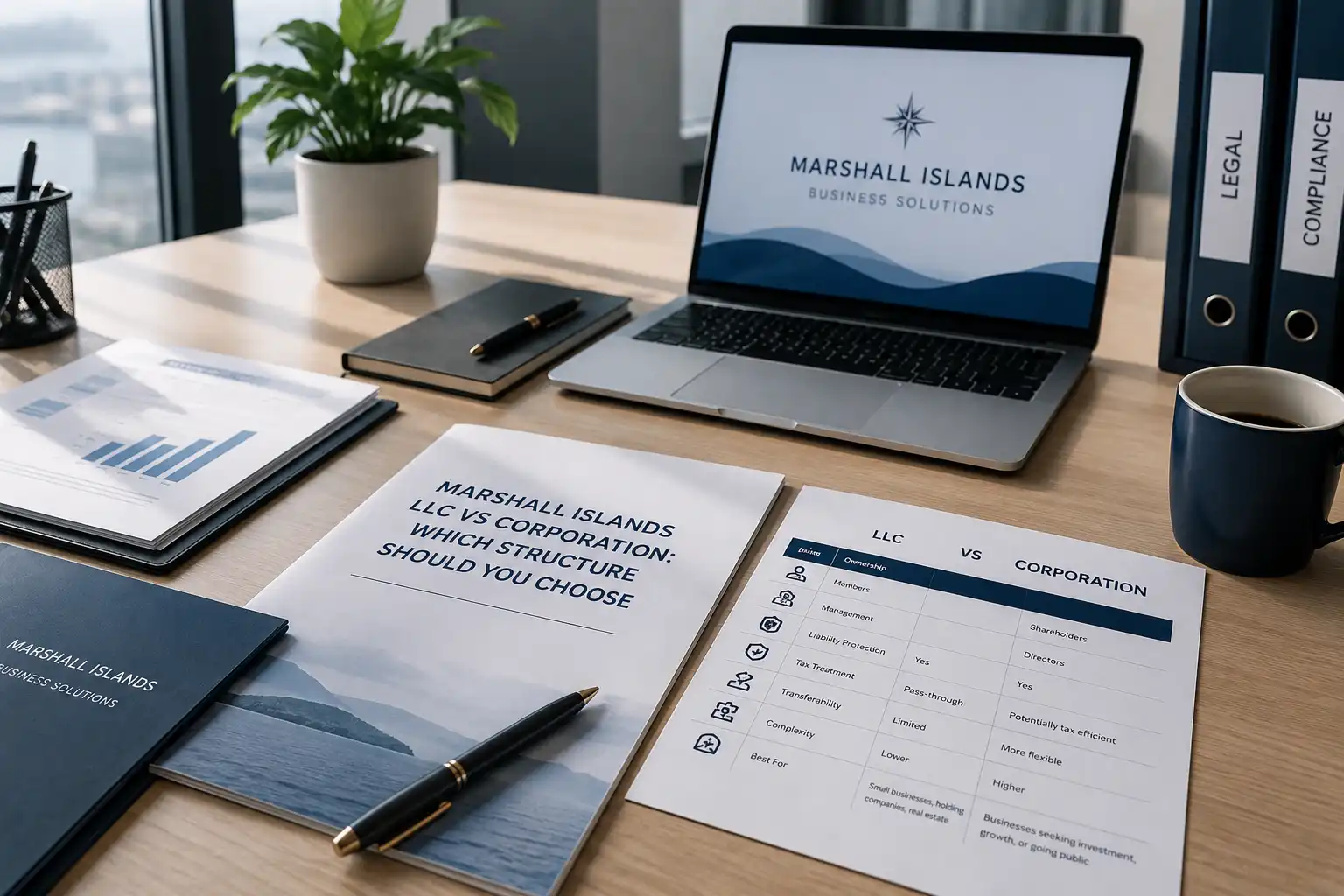
To understand the choice clearly, it is important to compare them across key business dimensions:
1. Ownership Structure
Corporation:
- Shareholders own shares
- Formal equity structure
LLC:
- Members own interests
- Contract-based ownership
2. Management
Corporation:
- Board of directors
- Officers
LLC:
- Member-managed or manager-managed
3. Governance
Corporation:
- Formal and regulated
- Document-heavy
LLC:
- Flexible
- Contract-driven
4. Asset Protection
Both offer limited liability, but:
- Corporations are more structured
- LLCs offer more contractual flexibility
5. Banking Compatibility
Corporations generally have stronger global banking acceptance.
6. Use Cases
Corporation:
- Holding companies
- Shipping
- Investment groups
- International trade
LLC:
- Consultants
- Digital businesses
- Private investors
- Small teams
Which Structure Should You Choose?
Choosing between a Marshall Islands LLC and Corporation depends on your specific goals.
Choose a Corporation if you:
- Need international credibility
- Plan to open corporate bank accounts
- Operate a trading or shipping business
- Require structured governance
- Plan to scale internationally
- Want a holding company structure
Choose an LLC if you:
- Want maximum flexibility
- Operate a digital or consulting business
- Prefer simplified governance
- Manage private investments
- Run a small international operation
- Want contract-based control
Strategic Consideration: Hybrid Structures
In some cases, businesses combine both structures:
Example:
- Corporation as holding company
- LLC as operating entity
This allows:
- Strong governance at the top level
- Flexibility at operational level
- Improved asset separation
This is a common structure among international entrepreneurs building scalable offshore frameworks.
Link to Broader Offshore Strategy
Your choice of structure should always align with your wider offshore planning strategy, including:
- Tax residency planning
- Banking strategy
- Compliance obligations
- Asset protection goals
- Business model structure
➡️ For full context, see:
- Marshall Islands Company Formation: The Complete 2026 Guide to Offshore Incorporation
- Compliance, Substance and Reporting Requirements in the Marshall Islands
- Offshore Banking for Marshall Islands Companies: What You Need to Know (Coming soon)
- Marshall Islands Tax Benefits for Offshore Companies
Legal, Tax, Banking and Compliance Deep Comparison
In Part 1, we explored the structural differences between a Marshall Islands LLC and a Corporation, including ownership models, governance frameworks, flexibility, and typical use cases. In Part 2, we go deeper into real-world decision-making factors that matter most in 2026: legal treatment, tax implications, banking acceptance, compliance expectations, asset protection effectiveness, and long-term strategic suitability.
This section is designed for entrepreneurs, investors, and international business owners who want to build a serious offshore structure rather than a theoretical one.
➡️ For foundational context, see:
Marshall Islands Company Formation: The Complete 2026 Guide to Offshore Incorporation
Legal Treatment: LLC vs Corporation in Practice
Although both structures exist under Marshall Islands law and provide limited liability protection, they operate differently in legal interpretation and international recognition.
Marshall Islands Corporation (Legal View)
A corporation is universally understood as:
- A separate legal person
- Owned by shareholders
- Governed by directors
- Operating under formal statutes
This clarity makes corporations easier to interpret in cross-border legal and financial environments.
Corporations tend to be preferred when dealing with:
- International contracts
- Institutional banking
- Corporate investors
- Regulatory scrutiny
They offer a predictable legal framework that aligns with global corporate standards.
Marshall Islands LLC (Legal View)
An LLC is more contractual in nature:
- Governed by internal operating agreements
- Flexible management structure
- Less rigid statutory framework
This flexibility is beneficial but can create interpretational complexity in certain international contexts.
LLCs are often best suited for:
- Private investment structures
- Small international teams
- Contract-based businesses
- Flexible ownership arrangements
However, in cross-border disputes or institutional environments, corporations may be more straightforward to assess legally.
Tax Treatment Considerations (Global Perspective)
It is important to clarify a critical point:
The Marshall Islands does not operate as a traditional onshore taxing jurisdiction for offshore entities in most cases, but taxation depends heavily on:
- Owner tax residency
- Place of management
- Source of income
- Controlled foreign corporation (CFC) rules
- Local tax obligations in the owner’s country
Therefore, the structure itself (LLC vs Corporation) is less important than how it is treated in the owner’s home jurisdiction.
Corporation Tax Considerations
Corporations are often easier to classify for tax reporting purposes because:
- Shareholding is clearly defined
- Dividend flows are standardised
- Corporate income structures are widely recognized
This reduces ambiguity in tax reporting in many jurisdictions.
LLC Tax Considerations
LLCs may be treated differently depending on jurisdiction:
- As disregarded entities
- As partnerships
- As corporations (in some cases)
This flexibility can be advantageous, but it also introduces complexity.
For example:
- Some tax systems prefer corporations for clarity
- Others may scrutinize LLC classification more heavily
Key Insight
From a tax perspective:
- Corporation = predictable classification
- LLC = flexible but variable classification
This is why corporations are often preferred for structured international holding setups.
Banking Perspective: LLC vs Corporation
Banking is one of the most important practical considerations in offshore structuring.
Even the best legal structure is ineffective without banking access.
Corporation Banking Advantage
Banks typically prefer corporations because:
- They are globally standardized
- Ownership structures are easy to verify
- Governance is formal and documented
- Risk classification is well established
As a result, corporations generally experience:
- Easier onboarding
- Faster compliance approval
- Wider acceptance across jurisdictions
This is especially important for:
- Trading companies
- Investment structures
- Shipping businesses
- Holding companies
➡️ For more context, see:
Offshore Banking for Marshall Islands Companies: What You Need to Know (Coming Soon)
LLC Banking Considerations
LLCs can still obtain banking relationships, but:
- Some banks require additional documentation
- Internal governance clarity must be stronger
- Operating agreements are heavily reviewed
Banks may request:
- Detailed operating agreements
- Explanation of profit distribution
- Clarification of management authority
This does not make LLCs weaker, but it does make onboarding more documentation-intensive.
Key Banking Insight
- Corporation = smoother global banking compatibility
- LLC = flexible but more documentation scrutiny
Compliance and Reporting Differences
Compliance expectations apply to both structures, but implementation differs.
Corporation Compliance Profile
Corporations typically follow:
- Structured governance procedures
- Formal resolution documentation
- Clear director/shareholder separation
- Standardized reporting systems
This makes compliance easier to standardize across international operations.
LLC Compliance Profile
LLCs rely more heavily on:
- Operating agreements
- Internal contractual rules
- Member-defined governance
While this increases flexibility, it also requires:
- Strong documentation discipline
- Clear internal rules
- Proper record keeping
Which Is Easier to Maintain?
In practice:
- Corporations are easier for standardized compliance
- LLCs require more customized compliance design
Asset Protection Comparison
Asset protection is one of the main reasons entrepreneurs consider Marshall Islands structures.
However, effectiveness depends on structure type and implementation quality.
Corporation Asset Protection Strengths
Corporations provide:
- Strong separation between shareholders and company liabilities
- Clear legal ownership boundaries
- Predictable enforcement structure
This makes them suitable for:
- High-risk trading businesses
- International contracts
- Shipping operations
- Investment holding structures
➡️ For deeper analysis:
Asset Protection with a Marshall Islands Offshore Company (Coming Soon)
LLC Asset Protection Strengths
LLCs provide:
- Strong liability separation
- Flexible internal protection mechanisms
- Contract-based structuring options
They are especially effective for:
- Private wealth structures
- Family-owned investments
- Joint venture arrangements
Key Difference
- Corporation = structurally rigid but predictable protection
- LLC = flexible protection but depends heavily on operating agreement quality
Operational Use Case Comparison
Different business models benefit from different structures.
Best Use Cases for a Corporation
A Marshall Islands corporation is typically best for:
- International trading companies
- Shipping and maritime businesses
- Investment holding companies
- Multi-entity corporate groups
- Businesses requiring external investors
Best Use Cases for an LLC
A Marshall Islands LLC is typically best for:
- Digital entrepreneurs
- SaaS businesses
- Consultants and freelancers
- Private investment vehicles
- Small partnerships
Real-World Example
Corporation structure:
Parent Corporation (Marshall Islands)
→ Trading Subsidiary
→ Investment Portfolio
→ Intellectual Property Holdings
LLC structure:
Single LLC
→ Multiple members
→ Flexible profit distribution
→ Contract-based operations
Common Mistakes When Choosing Structure
Many offshore structures fail not because of jurisdiction, but because of incorrect structure selection.
Mistake 1: Choosing Based on Trends
Some entrepreneurs choose structures based on what others use rather than business needs.
Mistake 2: Ignoring Banking Requirements
A structure that is legally valid may still struggle in banking if poorly aligned.
Mistake 3: Overusing LLC Flexibility
Too much flexibility without clear governance can create internal disputes or documentation gaps.
Mistake 4: Over-Structuring Small Businesses
Some small businesses choose complex corporate structures they do not need.
Mistake 5: Not Aligning with Tax Residency
The structure must align with personal or corporate tax obligations in the owner’s country.
Decision Framework: LLC vs Corporation
A simplified decision model:
Step 1: Business Type
- Trading / shipping / investment group → Corporation
- Digital / consulting / small operation → LLC
Step 2: Banking Priority
- High banking acceptance needed → Corporation
- Flexible/private operations → LLC
Step 3: Ownership Structure
- Multiple investors → Corporation
- Single or small group → LLC
Step 4: Growth Plans
- Scaling internationally → Corporation
- Stable private operation → LLC
Future Trends (2026 and Beyond)
Offshore structuring is evolving rapidly.
Expected trends include:
1. Increased Compliance Standardization
Both LLCs and corporations will face stronger compliance expectations globally.
2. Banking Preference for Structure Clarity
Corporations may continue to be preferred by institutional banks.
3. Greater Documentation Requirements for LLCs
LLCs may require more detailed operating agreements in cross-border contexts.
4. AI-Driven Compliance Systems
Automated compliance verification will increasingly analyze:
- Ownership structure
- Transaction behavior
- Business legitimacy
Final Conclusion: Which Should You Choose?
There is no universal answer to the Marshall Islands LLC vs Corporation decision.
However, clear patterns exist:
Choose a Corporation if you want:
- Strong international recognition
- Easier banking relationships
- Structured governance
- Investment or trading operations
- Scalable business framework
Choose an LLC if you want:
- Maximum flexibility
- Private investment structuring
- Small team operations
- Contract-based governance
- Entrepreneurial simplicity
Strategic Final Insight
The best offshore structure is not the most flexible or the most formal—it is the one that aligns with:
- Your business model
- Your banking requirements
- Your tax residency
- Your long-term strategy
- Your compliance capacity
This is why professional structuring is essential for serious offshore planning.
Related Articles
To build a complete understanding of Marshall Islands offshore structuring, continue reading:
- Marshall Islands FAQ
- Marshall Islands Company Formation
- Offshore Services
- Offshore Banks
- Marshall Islands Company Formation: The Complete 2026 Guide to Offshore Incorporation
- Marshall Islands IBC: Features, Advantages and Legal Structure Explained
- How to Open a Marshall Islands Offshore Company Step by Step
- Benefits of Marshall Islands Company Formation for International Businesses
- Marshall Islands Tax Benefits for Offshore Companies
- Compliance, Economic Substance and Reporting Requirements in the Marshall Islands