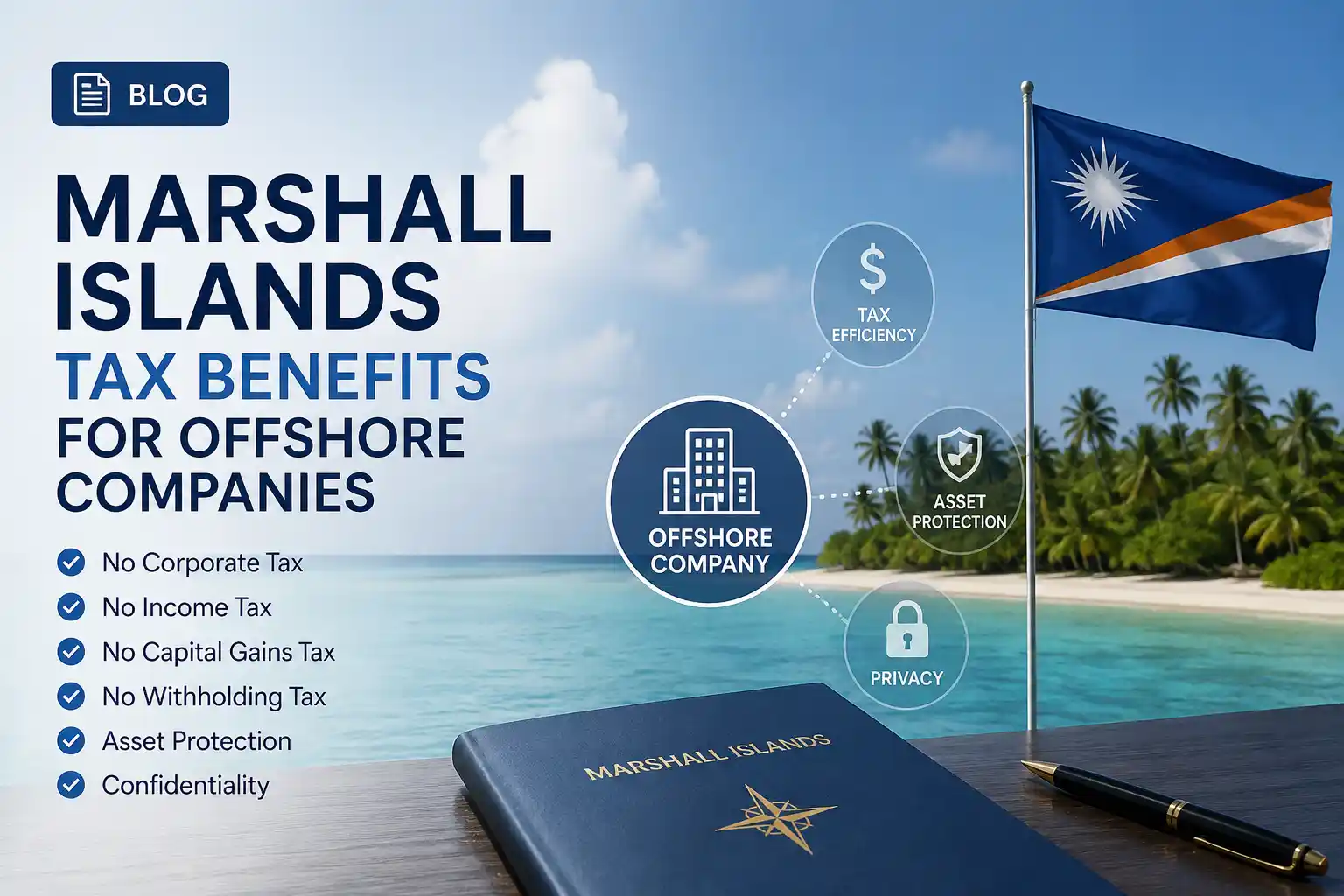
Marshall Islands Tax Benefits for Offshore Companies
Introduction
Tax efficiency remains one of the most important considerations for entrepreneurs, investors, multinational groups, family offices, and international business owners when selecting an offshore jurisdiction.
For decades, the Marshall Islands has been recognized as one of the world’s leading offshore incorporation destinations, offering a business-friendly legal framework, flexible corporate structures, international credibility, and attractive tax treatment for qualifying offshore activities.
However, offshore taxation in 2026 is very different from what it was twenty years ago.
Modern offshore planning is no longer about simply incorporating a company in a low-tax jurisdiction. International entrepreneurs must also consider:
- Tax residency rules
- Economic substance requirements
- Beneficial ownership regulations
- Controlled Foreign Corporation (CFC) rules
- International reporting obligations
- Banking compliance requirements
As a result, understanding the tax benefits of a Marshall Islands company requires a broader perspective than simply looking at local corporate tax rates.
This guide explains the key tax advantages, planning opportunities, limitations, and compliance considerations associated with Marshall Islands offshore companies in 2026.
👉 For a complete overview of incorporation and offshore structures, see our pillar guide:
Marshall Islands Company Formation: The Complete 2026 Guide to Offshore Incorporation
Why Tax Efficiency Matters for International Businesses
As businesses expand internationally, taxation becomes increasingly complex.
Entrepreneurs often operate across multiple jurisdictions simultaneously.
For example:
- Owners may reside in one country.
- Customers may be located in another.
- Suppliers may operate elsewhere.
- Corporate entities may be incorporated offshore.
Without proper structuring, businesses may face:
- Double taxation
- Excessive administrative burdens
- Compliance challenges
- Reduced profitability
This is one reason offshore jurisdictions remain attractive.
A properly structured offshore company can help improve efficiency while supporting international growth.
Understanding the Marshall Islands Tax System
The Marshall Islands has developed a corporate framework specifically designed to support international business.
Many offshore entrepreneurs are attracted to the jurisdiction because qualifying non-resident companies may benefit from a tax-neutral environment for offshore activities.
This does not mean businesses automatically avoid taxation.
Rather, it means that the Marshall Islands generally does not impose certain local taxes on qualifying international activities conducted outside the jurisdiction.
The distinction is important.
Tax obligations may still arise elsewhere depending on:
- Tax residency
- Business operations
- Ownership structure
- Applicable international tax rules
Professional tax advice should always be obtained before implementing any offshore structure.
What Is a Tax-Neutral Jurisdiction?
The term “tax-neutral” is frequently used when discussing offshore company formation.
A tax-neutral jurisdiction generally seeks not to impose additional layers of local taxation on qualifying offshore activities.
This differs from high-tax jurisdictions where businesses may face:
- Corporate income tax
- Capital gains tax
- Withholding taxes
- Dividend taxes
- Other local levies
Tax neutrality allows international businesses to structure activities more efficiently while remaining compliant with applicable tax laws in relevant jurisdictions.
The Marshall Islands is often categorized as a tax-neutral offshore jurisdiction for qualifying offshore entities.
Key Tax Benefits of Marshall Islands Offshore Companies
Benefit 1: No Local Corporate Income Tax on Qualifying Offshore Activities
One of the primary reasons international entrepreneurs choose Marshall Islands companies is the absence of local corporate income taxation on qualifying offshore activities.
For many international businesses, this creates significant flexibility.
Common examples include:
- Holding companies
- Investment structures
- International trading companies
- Intellectual property holding entities
This feature has made the Marshall Islands attractive to global investors and multinational business owners.
However, business owners must remember that foreign tax obligations may still apply.
The absence of local Marshall Islands taxation does not eliminate tax liabilities in other jurisdictions.
Benefit 2: No Capital Gains Tax
Capital gains taxation can significantly impact investment returns.
In many countries, gains realized from the sale of investments may be subject to taxation.
Marshall Islands offshore structures are frequently used by investors because qualifying offshore entities generally operate within a tax-neutral environment regarding capital gains.
This can be attractive for:
- Investment holding companies
- Venture capital structures
- Family offices
- Portfolio investors
Long-term investment planning often benefits from jurisdictions that avoid imposing additional layers of taxation on capital appreciation.
Benefit 3: No Local Dividend Tax
Dividend taxation is another important consideration for international investors.
In some jurisdictions, dividends distributed by companies may trigger additional tax obligations.
Marshall Islands structures may offer advantages because qualifying offshore entities generally operate without local dividend taxation.
This can improve flexibility when designing international holding structures.
However, shareholders must still consider taxation in their country of residence.
Benefit 4: No Withholding Taxes on Certain Offshore Transactions
Withholding taxes can reduce the efficiency of cross-border transactions.
Many countries impose withholding obligations on:
- Dividends
- Interest payments
- Royalties
Marshall Islands offshore companies are often used because the jurisdiction generally does not impose local withholding taxes on qualifying offshore activities.
This may improve operational efficiency for international structures.
Benefit 5: No Local Estate or Inheritance Tax
Long-term wealth planning frequently involves succession considerations.
Entrepreneurs and family offices often seek structures that support efficient intergenerational planning.
The Marshall Islands has historically been attractive in this regard because qualifying offshore structures generally avoid local estate and inheritance taxation.
This feature may support:
- Family office structures
- Wealth preservation strategies
- Long-term asset ownership planning
Why Holding Companies Benefit from Marshall Islands Structures
Holding companies remain one of the most common uses of Marshall Islands entities.
A holding company generally owns:
- Subsidiaries
- Investments
- Intellectual property
- International assets
Rather than conducting day-to-day operations, the company serves as an ownership vehicle.
Tax Advantages of Holding Companies
Holding companies may benefit from:
- Centralized ownership
- Simplified administration
- Tax efficiency
- Asset protection opportunities
Many multinational groups use offshore holding companies to consolidate ownership of international assets.
👉 For more information, see:
Benefits of Marshall Islands Company Formation for International Businesses
Tax Benefits for Investment Structures
Investors often require corporate structures capable of supporting long-term portfolio growth.
Marshall Islands entities are frequently used for:
- Private investments
- Venture capital participation
- Family investment vehicles
- International asset ownership
Because the jurisdiction generally does not impose local taxation on qualifying offshore investment activities, it can serve as an efficient holding platform.
Investment structures should always be designed with consideration for international tax obligations.
Tax Benefits for International Trading Companies
International trading remains another popular use of Marshall Islands companies.
Trading businesses may operate across multiple countries while maintaining centralized ownership through an offshore entity.
Examples include:
- Import-export businesses
- Commodity traders
- Distribution companies
- Wholesale operations
The jurisdiction’s tax-neutral environment can improve efficiency when properly integrated into a compliant international business structure.
Tax Benefits for Intellectual Property Ownership
Intellectual property has become one of the most valuable corporate assets in the modern economy.
Businesses increasingly derive value from:
- Software
- Patents
- Trademarks
- Copyrights
- Digital products
Marshall Islands entities are often used to hold intellectual property rights.
Potential benefits include:
- Centralized ownership
- Asset protection
- International licensing flexibility
However, intellectual property structures face increasing scrutiny under international tax rules.
Substance requirements are especially important in this area.
Tax Efficiency for Family Offices
Family offices frequently seek long-term structures that support:
- Wealth preservation
- Asset protection
- Succession planning
- International diversification
Marshall Islands companies may be incorporated as part of broader family office strategies.
Benefits may include:
- Flexible ownership arrangements
- Corporate continuity
- Efficient asset management
The suitability of any structure depends on the family’s specific objectives and jurisdictional exposure.
Tax Planning vs Tax Evasion
One of the most important distinctions in international business is the difference between tax planning and tax evasion.
Legitimate Tax Planning
Legitimate tax planning involves:
- Following applicable laws
- Utilizing legal structures
- Managing international operations efficiently
- Complying with reporting obligations
Illegal Tax Evasion
Tax evasion involves:
- Concealing income
- Misrepresenting ownership
- Failing to report taxable activities
- Violating tax laws
Modern offshore planning must be based on transparency, compliance, and legitimate commercial objectives.
The Marshall Islands remains a respected international jurisdiction precisely because it operates within recognized legal and regulatory frameworks.
Common Misconceptions About Offshore Taxation
Myth: Offshore Companies Pay No Tax Anywhere
This is one of the most common misunderstandings.
Tax obligations may still arise based on:
- Tax residency
- Business operations
- Ownership arrangements
- International reporting rules
Myth: Offshore Structures Are Anonymous
Beneficial ownership transparency has become a major global standard.
Businesses should expect compliance obligations.
Myth: Incorporation Alone Creates Tax Savings
Effective tax planning depends on:
- Structure design
- Operational reality
- Substance requirements
- Professional advice
A company alone does not automatically generate tax benefits.
Controlled Foreign Corporation (CFC) Rules and Offshore Tax Planning
One of the most important developments in international taxation over the past two decades has been the introduction of Controlled Foreign Corporation (CFC) rules.
Many countries have implemented CFC legislation to prevent residents from accumulating profits in foreign companies without reporting them for tax purposes.
Entrepreneurs using Marshall Islands companies should understand that incorporation alone does not determine tax outcomes.
Tax authorities may consider:
- Ownership percentages
- Management control
- Source of income
- Nature of business activities
- Tax residency of shareholders
If a Marshall Islands company is controlled by residents of a country with CFC regulations, reporting obligations may apply.
This does not make offshore structures ineffective. It simply means offshore companies must be integrated into a compliant international tax strategy.
Proper planning remains essential.
Economic Substance and Tax Compliance
In 2026, economic substance has become one of the most important concepts in offshore business planning.
Historically, many offshore companies existed primarily as passive ownership vehicles. Today, regulators increasingly expect companies to demonstrate legitimate commercial purpose.
What Is Economic Substance?
Economic substance generally refers to the degree of genuine business activity associated with a company.
Indicators may include:
- Corporate decision-making
- Management activities
- Business operations
- Commercial rationale
- Documentation and governance
The objective is to ensure that offshore structures support real business activities rather than purely artificial arrangements.
Why Substance Matters
Substance requirements affect:
- Tax planning
- Banking applications
- Investor due diligence
- Regulatory compliance
Businesses with clear commercial purposes are generally better positioned for long-term success.
👉 For more information, see:
How to Open a Marshall Islands Offshore Company Step by Step
Tax Residency Considerations
One of the most misunderstood aspects of offshore company planning is tax residency.
Many entrepreneurs assume that a company is automatically taxed only where it is incorporated.
In reality, tax residency may be influenced by several factors.
Place of Management
Some countries assess where strategic decisions are made.
Relevant questions may include:
- Where do directors operate?
- Where are meetings held?
- Where are major decisions approved?
Operational Presence
Authorities may also consider:
- Employees
- Offices
- Operational activities
Ownership and Control
In some situations, shareholder control may influence tax treatment.
As a result, business owners should always evaluate tax residency issues alongside incorporation planning.
Double Taxation and International Structuring
International businesses often operate across multiple jurisdictions simultaneously.
Without proper planning, income may be exposed to taxation more than once.
Common Double Taxation Scenarios
Examples include:
- Corporate profits taxed in one jurisdiction and again when distributed.
- Cross-border investment income.
- International licensing arrangements.
How Offshore Structures Help
Marshall Islands companies are frequently used within international structures designed to:
- Centralize ownership
- Improve administrative efficiency
- Reduce unnecessary tax friction
- Simplify cross-border operations
The goal is not tax avoidance but efficient and compliant international business management.
Banking and Tax Transparency
Banking and taxation are increasingly interconnected.
Financial institutions now conduct extensive due diligence on offshore companies.
Banks typically request information regarding:
- Beneficial ownership
- Business activities
- Source of wealth
- Source of funds
- Tax compliance
Businesses that maintain strong documentation and governance procedures generally experience smoother banking relationships.
👉 For more information, see:
Offshore Banking Solutions for International Companies
OECD Standards and Global Transparency
The international tax environment has changed significantly.
Organizations such as the Organisation for Economic Co-operation and Development (OECD) have influenced global transparency standards.
Key initiatives include:
- Base Erosion and Profit Shifting (BEPS)
- Common Reporting Standard (CRS)
- Beneficial ownership transparency
- Information exchange agreements
These developments have reshaped offshore planning worldwide.
What This Means for Marshall Islands Companies
Marshall Islands entities remain useful and legitimate business structures.
However, successful implementation now requires:
- Transparency
- Compliance
- Commercial substance
- Professional planning
Businesses should embrace these principles rather than resist them.
Marshall Islands vs BVI: Tax Benefits Comparison
The Marshall Islands and British Virgin Islands are frequently compared by international entrepreneurs.
Similarities
Both jurisdictions offer:
- Tax-neutral corporate environments
- Flexible ownership structures
- Offshore company frameworks
- International business focus
Marshall Islands Advantages
The Marshall Islands may appeal to businesses seeking:
- Delaware-inspired corporate law
- Maritime industry credibility
- Cost efficiency
- Strong holding company structures
BVI Advantages
The BVI may appeal to businesses seeking:
- Extensive investor familiarity
- Strong banking recognition
- Broad international usage
From a taxation perspective, both jurisdictions remain highly competitive.
👉 For a detailed comparison, see:
Marshall Islands vs BVI: Which Offshore Jurisdiction Is Better in 2026?
Tax Benefits for Holding Companies
Holding companies remain one of the strongest use cases for Marshall Islands structures.
A holding company may own:
- Subsidiaries
- Investments
- Intellectual property
- Real estate interests
Why Entrepreneurs Use Offshore Holding Companies
Benefits may include:
- Centralized ownership
- Corporate continuity
- Simplified administration
- Asset separation
The tax-neutral environment often complements these structural advantages.
Holding companies continue to represent one of the most common applications of Marshall Islands entities.
Tax Benefits for Maritime Businesses
The Marshall Islands enjoys a unique position within the international maritime industry.
Its ship registry is among the largest and most respected globally.
As a result, maritime operators often choose Marshall Islands companies for:
- Vessel ownership
- Fleet management
- Shipping investments
- Maritime financing
The combination of legal certainty, industry reputation, and tax efficiency creates a compelling proposition for shipping businesses.
Tax Benefits for Family Offices
Family offices frequently prioritize:
- Wealth preservation
- Succession planning
- Asset protection
- International diversification
Marshall Islands structures can support these objectives through:
- Flexible ownership arrangements
- Long-term corporate continuity
- Efficient asset management
Many family offices integrate offshore companies into broader international wealth planning strategies.
Common Tax Planning Mistakes
Focusing Only on Tax Rates
Many entrepreneurs evaluate offshore jurisdictions solely based on tax rates.
This approach overlooks other critical factors:
- Banking
- Compliance
- Reputation
- Investor perception
Long-term success depends on balancing all of these considerations.
Ignoring Substance Requirements
Substance has become a core element of international tax planning.
Businesses that fail to establish legitimate commercial foundations may face challenges.
Poor Documentation
Documentation supports:
- Banking applications
- Tax compliance
- Regulatory reviews
Accurate records are essential.
Using Generic Structures
Every business is different.
Effective planning should reflect:
- Industry
- Ownership structure
- Geographic footprint
- Growth objectives
Customized solutions typically outperform generic offshore structures.
Who Benefits Most from Marshall Islands Tax Structures?
Marshall Islands companies are commonly used by:
International Entrepreneurs
Business owners operating across multiple jurisdictions.
Investors
Individuals and groups managing international portfolios.
Holding Companies
Structures owning subsidiaries and investments.
Family Offices
Organizations managing long-term wealth.
Maritime Operators
Shipping and vessel ownership businesses.
Intellectual Property Owners
Businesses holding trademarks, patents, and software assets.
International Traders
Companies engaged in cross-border commerce.
The flexibility of the jurisdiction allows it to support a broad range of commercial activities.
Featured Snippet: What Are the Tax Benefits of a Marshall Islands Offshore Company?
Marshall Islands offshore companies may benefit from a tax-neutral environment for qualifying offshore activities, including the absence of local corporate income tax, capital gains tax, dividend tax, and withholding taxes in certain circumstances. These benefits make the jurisdiction attractive for holding companies, investment structures, international trading businesses, and maritime operations.
Featured Snippet: Are Marshall Islands Companies Tax-Free?
Marshall Islands companies are often described as tax-neutral for qualifying offshore activities. However, business owners may still have tax obligations in their country of residence or other jurisdictions where business activities occur. Professional tax advice is essential.
Summary
Marshall Islands offshore companies remain attractive in 2026 because they offer:
- Tax-neutral treatment for qualifying offshore activities
- No local corporate income tax
- No local capital gains tax
- No local dividend tax
- No withholding taxes on certain offshore transactions
- Flexible holding company structures
- International credibility
- Maritime industry advantages
Business owners must also consider:
- CFC rules
- Tax residency
- Economic substance
- Banking compliance
- International reporting obligations
Successful offshore planning combines tax efficiency with transparency and regulatory compliance.
Frequently Asked Questions
Do Marshall Islands companies pay corporate income tax?
Qualifying offshore activities generally benefit from a tax-neutral environment within the Marshall Islands.
Are capital gains taxed in the Marshall Islands?
Qualifying offshore companies generally do not face local capital gains taxation.
Can Marshall Islands companies be used as holding companies?
Yes. Holding structures are among the most common uses of Marshall Islands entities.
Do Marshall Islands companies help with international tax planning?
They can form part of broader international tax strategies when properly structured and managed.
Are offshore companies still legal in 2026?
Yes. Offshore companies remain legal and widely used when operated in compliance with applicable laws and regulations.
Is professional tax advice necessary?
Absolutely. International tax planning should always involve qualified legal and tax professionals.
Final Thoughts
The Marshall Islands remains one of the world’s most respected offshore jurisdictions for international business, investment holding, asset protection, and maritime activities. Its tax-neutral framework continues to attract entrepreneurs seeking efficient global structures.
However, modern offshore planning is no longer solely about minimizing taxes. Successful international businesses must balance tax efficiency with substance, compliance, transparency, governance, and long-term strategic planning.
When implemented correctly, a Marshall Islands company can serve as a powerful component of a compliant international business structure, supporting growth, investment, wealth preservation, and cross-border expansion.
For broader guidance, read:
- Marshall Islands FAQ
- Marshall Islands Company Formation
- Offshore Services
- Offshore Banks
- Marshall Islands Company Formation: The Complete 2026 Guide to Offshore Incorporation
- Marshall Islands IBC: Features, Advantages and Legal Structure Explained
- How to Open a Marshall Islands Offshore Company Step by Step
- Benefits of Marshall Islands Company Formation for International Businesses
- Compliance, Economic Substance and Reporting Requirements in the Marshall Islands
- Offshore Banking for Marshall Islands Companies
- Marshall Islands LLC vs Corporation: Which Structure Should You Choose?
- Marshall Islands Holding Company Structure Explained
- Asset Protection with a Marshall Islands Offshore Company
- Marshall Islands Shipping Company Formation Guide
- Marshall Islands Nominee Directors and Shareholders Explained
- Marshall Islands vs BVI: Which Offshore Jurisdiction Is Better in 2026?