
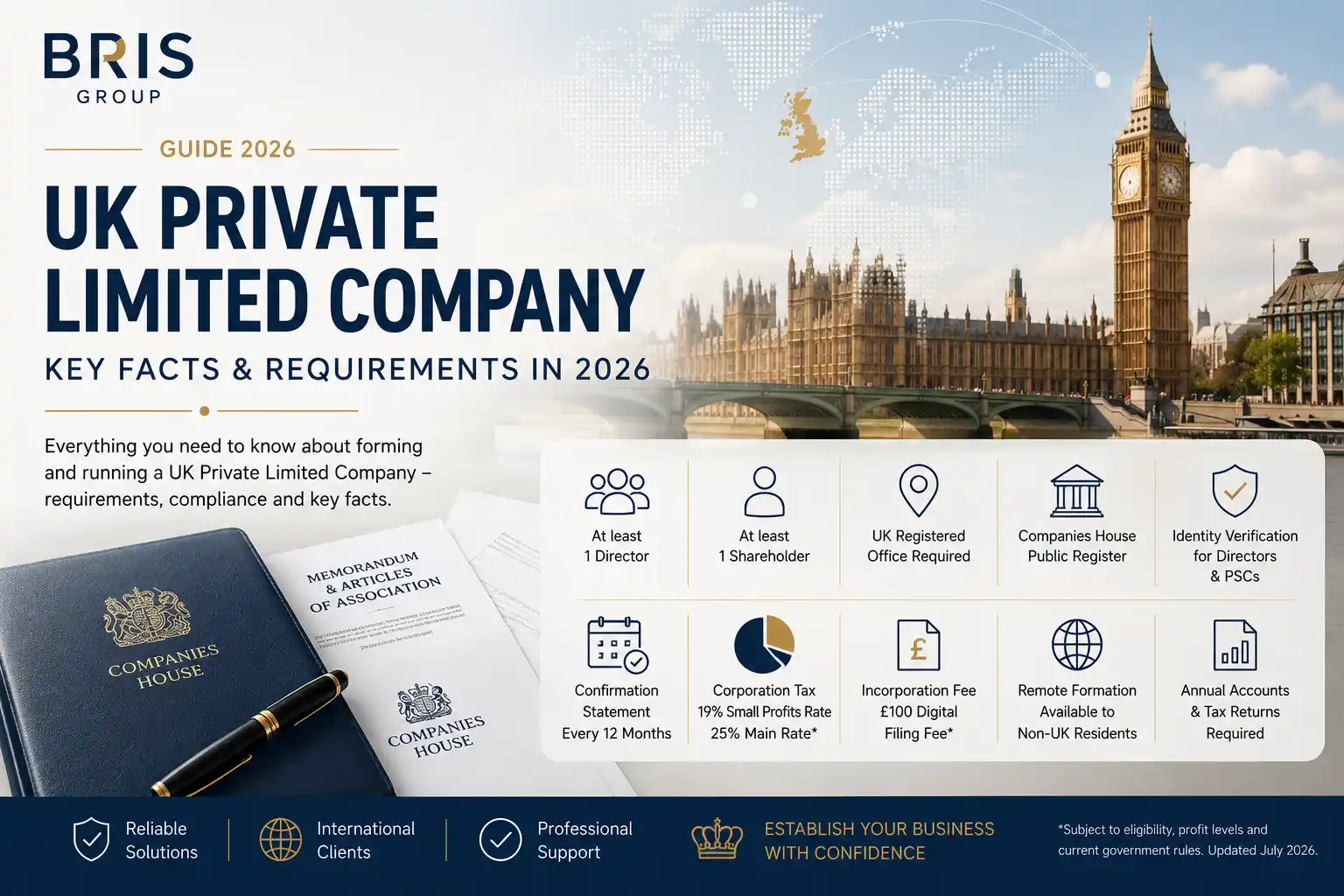
UK Private Limited Company: Key Facts & Requirements in 2026
A UK Private Limited Company (LTD) is one of the most widely used business structures in the United Kingdom. It can be established by UK residents and international entrepreneurs and provides a separate legal structure through which a business can trade, enter into contracts, employ staff and conduct commercial activities.
However, incorporation is only the beginning. Directors and shareholders should understand the basic structure of a UK LTD, its filing obligations and the information required to keep the company compliant.
This guide provides an overview of the key facts and requirements for operating a UK Private Limited Company in 2026.
Planning to establish a company in the UK?
Explore our → UK Private Limited Company Formation service for incorporation packages and professional support.
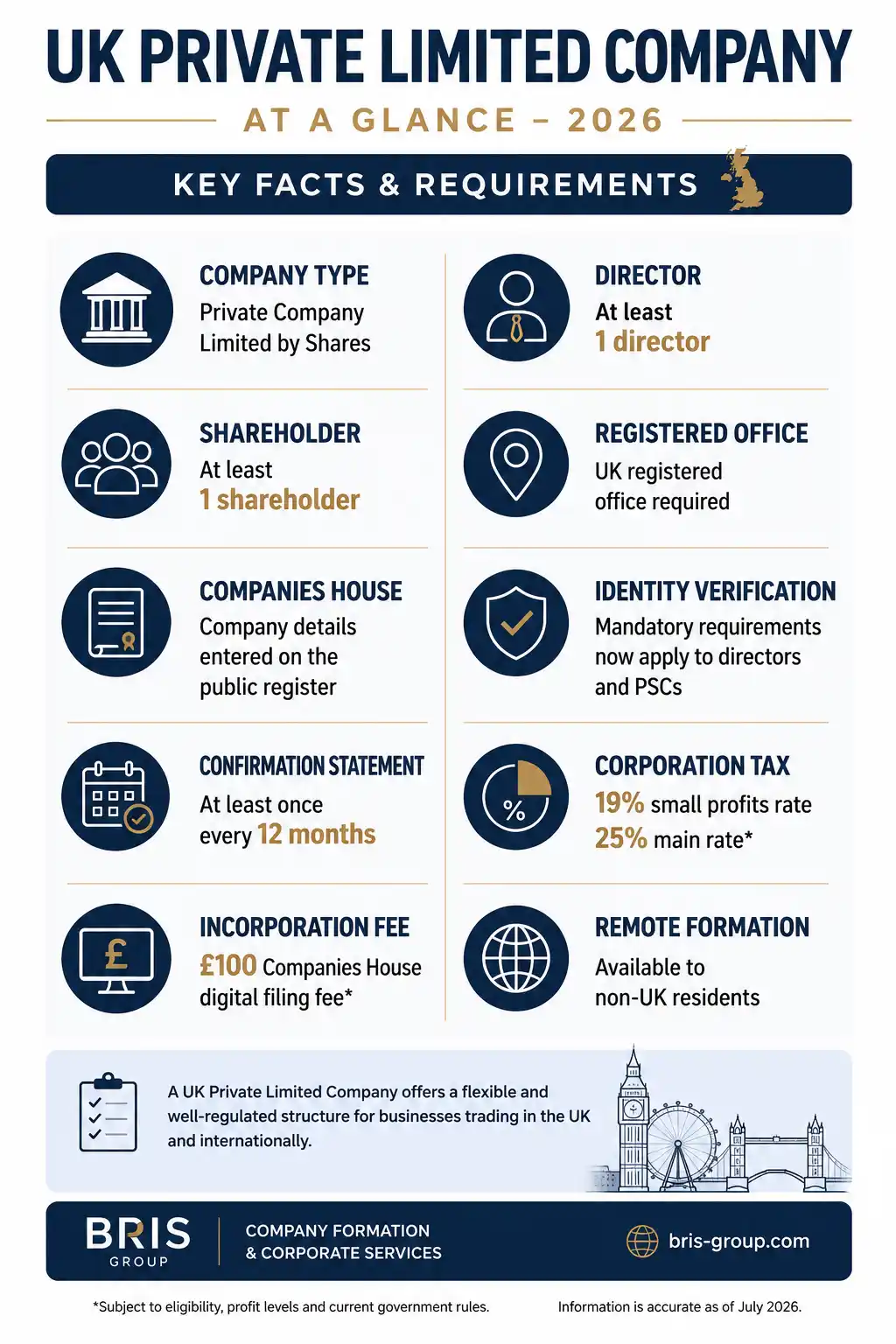
UK Private Limited Company at a Glance
Who Can Form a UK Private Limited Company?
A UK Private Limited Company can be established by both UK residents and non-residents. There is no general requirement for a shareholder or director to live in the United Kingdom simply in order to incorporate an LTD.
This makes the UK attractive to international entrepreneurs who want to establish a business within a well-established corporate and legal environment.
A company must, however, satisfy UK incorporation requirements and continue to meet its statutory obligations after registration.
Directors and Shareholders
A private company limited by shares must have at least one director. Directors are legally responsible for managing the company and ensuring that its statutory obligations are met.
A company limited by shares must also have at least one shareholder. The same individual can generally act as both director and shareholder, making the structure suitable for single-owner businesses as well as companies with multiple shareholders.
Ownership and control should also be considered in relation to the UK’s People with Significant Control (PSC) requirements.
Companies House Identity Verification
This deserves its own section in the 2026 article, because it is a major change compared with older guides still circulating online.
Identity verification became a legal requirement from 18 November 2025. New directors need to verify their identity when incorporating or being appointed, while existing directors are being brought into the system through a transitional process linked to confirmation statements. PSCs are also subject to identity-verification requirements.
After verification, an individual receives a Companies House personal code that is used to connect the verified identity with company roles.
Registered Office Address
Every UK company must maintain a registered office address in the appropriate UK jurisdiction.
The registered office is the company’s official address for statutory correspondence and forms part of the public Companies House record.
International entrepreneurs who do not maintain their own suitable UK premises can use a professional registered office service, provided the address meets the applicable requirements. Explore our → Registered Office Service.
Annual Compliance Requirements
Registering a company creates ongoing responsibilities.
A UK LTD will normally need to maintain appropriate company records, prepare annual accounts, meet applicable tax obligations and keep the information held by Companies House up to date.
Companies must also file a confirmation statement at least once every 12 months confirming that the information held by Companies House is correct.
This is why company formation should be considered as the beginning of the company’s compliance lifecycle rather than a one-time registration exercise.
Corporation Tax
UK companies may be subject to Corporation Tax on taxable profits.
For the financial year beginning 1 April 2026, the main Corporation Tax rate is 25%, while the small profits rate is 19% for companies with profits of £50,000 or less. Marginal Relief may apply between £50,000 and £250,000. These thresholds can be reduced where associated companies are involved or for short accounting periods.
The actual tax position depends on the company’s activities and circumstances, so incorporation in the UK should not be treated as determining the tax treatment of every business or owner.
Can a UK LTD Be Formed Remotely?
Yes. International entrepreneurs can establish a UK Private Limited Company without relocating to the UK simply for incorporation.
However, forming the company and subsequently obtaining banking, payment processing, VAT registration or other services are separate matters and may involve their own eligibility, documentation and compliance requirements.
For a detailed explanation, read: UK Company Formation for Non-Residents
Is a UK Private Limited Company Right for Your Business?
A UK LTD can provide a flexible structure for entrepreneurs operating domestically or internationally, but the appropriate company structure depends on the business model, ownership, tax circumstances and planned activities.
Before incorporation, it is therefore useful to consider not only how to register the company, but also how it will operate after formation.
If you are ready to establish your business, BRIS Group can assist with incorporation, registered office services and ongoing corporate support.
→ View UK Private Limited Company Formation Packages
Related Pages:
- UK PLC FAQ
- UK LLP FAQ
- UK Company Formation Packages
- UK Double Taxation treaties
- UK Private Limited Company Formation
- UK Company Structure Explained – Directors, Shareholders & PSCs
- UK Company Formation for Non-Residents: Register a UK Company from Anywhere in the World
- UK Company Annual Filing Requirements Explained – 2026 Guide
- How to start a company in the UK?