
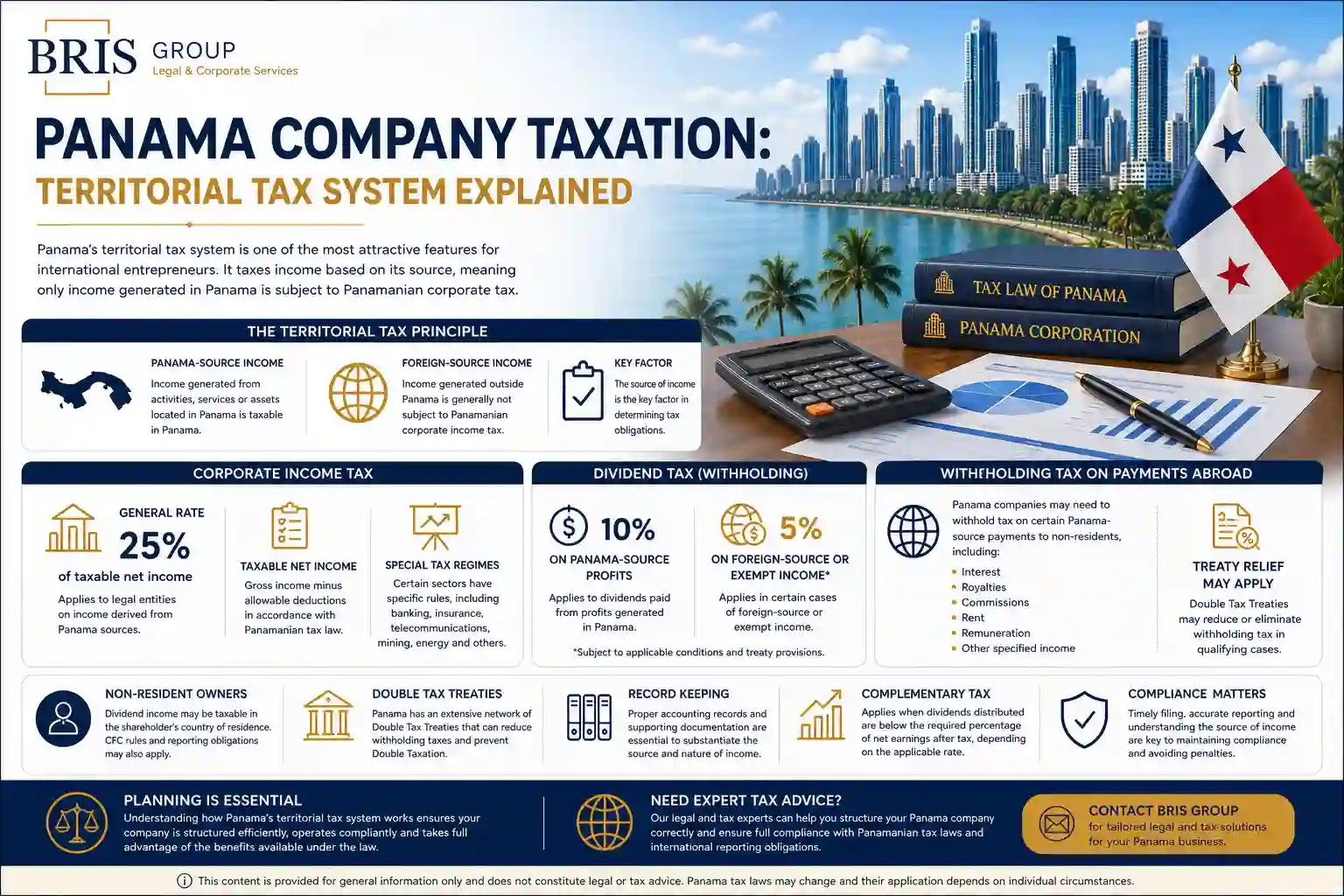
Panama Company Taxation
Panama’s territorial tax system is one of the main reasons international entrepreneurs consider incorporating a company in the jurisdiction. However, it is also one of the most misunderstood features of Panama company taxation.
The phrase “territorial taxation” is sometimes incorrectly interpreted to mean that every Panama offshore company pays no corporate tax.
That is not how the system works.
Panama generally taxes income according to its source. Income considered to arise from Panamanian sources can fall within the Panamanian tax system, while genuinely foreign-source income is treated differently.
For companies with taxable Panamanian-source income, Panama’s general corporate income tax rate is currently 25% of taxable net income. (dgi.mef.gob.pa)
For international entrepreneurs, the key question is therefore not simply:
“Is my company incorporated in Panama?”
The more important question is:
“Where does my company’s income legally arise?”
This distinction is essential for trading companies, consultants, holding companies, digital businesses, investment structures and non-resident shareholders.
This guide explains Panama’s territorial tax system in practical terms, including corporate income tax, foreign-source income, dividends, withholding taxes, international remittances, double-tax treaties, tax residence and the tax considerations that foreign entrepreneurs should analyse before forming a company.
➡️ For the complete corporate overview, see Panama Company Formation: Complete Guide for International Entrepreneurs and Investors.
➡️ For the incorporation procedure, see How to Form a Panama Company: Step-by-Step Guide for Non-Residents.
Quick Answer: How Are Panama Companies Taxed?
Panama generally operates a territorial income tax system.
This means the source of income is fundamental to determining whether corporate profits are taxable in Panama.
In broad terms:
Panama-source taxable income can be subject to Panamanian corporate income tax.
Foreign-source income is generally outside the ordinary territorial corporate income tax base, subject to the precise facts and applicable law.
The general corporate income tax rate on taxable net income is currently 25%.
However, company taxation can also involve:
- dividend withholding tax;
- complementary tax;
- withholding on Panama-source payments remitted abroad;
- ITBMS where applicable;
- annual tax and corporate filings;
- special industry rules;
- treaty provisions; and
- taxes imposed by the owner’s country of residence.
A Panama company should therefore never be marketed simply as a “zero-tax company.”
Summary: Panama Territorial Taxation
Panama uses a territorial tax system, meaning that the source of income determines whether corporate profits are taxable in Panama.
The general corporate income tax rate for legal entities is 25% of taxable net income.
Income genuinely arising outside Panama may receive different treatment under the territorial system, but determining whether income is foreign-source depends on the facts and the nature of the activity.
Panama companies can also face dividend withholding taxes. Current DGI guidance states that dividends distributed from Panama-source profits are generally subject to 10% withholding, while certain dividends from foreign-source or exempt income can be subject to 5%, depending on the circumstances.
Payments of certain Panama-source income to non-residents can also create withholding obligations.
For non-resident owners, Panama taxation must always be considered together with the tax rules of the shareholder’s home country.
What Is a Territorial Tax System?
A territorial tax system generally focuses taxation on income connected with the jurisdiction.
This differs conceptually from a worldwide tax system, where resident taxpayers may potentially be taxed on income arising anywhere in the world, subject to exemptions, credits and treaty rules.
Panama’s system is commonly described as territorial because the source of income is central to determining whether it falls within the country’s income-tax base.
That concept is relatively simple.
Applying it to a real business can be considerably more complicated.
Territorial Taxation Does Not Mean Zero Tax
This point is essential.
If a Panama company earns taxable income from activities carried out in Panama, the company can be subject to corporate income tax.
Current DGI guidance confirms that legal entities generally pay 25% on taxable net income.
Therefore:
Panama company ≠ zero corporate tax
A more accurate statement is:
Panama applies territorial taxation, so the source and nature of the company’s income determine the Panamanian tax treatment.
Why Panama’s Territorial System Appeals to International Entrepreneurs
The territorial system can be relevant to genuinely international businesses because their commercial activities may occur across several jurisdictions.
For example, an international company might:
- purchase goods in Asia;
- sell them to customers in South America;
- hold investments outside Panama;
- receive income from foreign subsidiaries;
- operate international services; or
- own assets situated outside Panama.
In such cases, analysing where income arises becomes especially important.
The potential tax advantage exists only where the relevant income actually qualifies for the treatment being claimed.
What Is Panama-Source Income?
There is no safe universal shortcut for determining source.
The nature of the income matters.
The analysis may differ for:
- trading profits;
- professional services;
- royalties;
- interest;
- rental income;
- dividends;
- capital gains;
- commissions; and
- investment income.
A company’s customer being located outside Panama does not, by itself, automatically answer the source question.
Why the Location of the Customer Is Not Enough
Consider a consultant living and working physically in Panama but serving customers in Europe.
The fact that the customers are in Europe does not necessarily mean all income should automatically be treated as foreign-source.
Now consider a company whose international commercial operations genuinely occur outside Panama.
That creates a different factual analysis.
Tax source therefore depends on how the income is produced, not simply where the invoice recipient lives.
Panama Corporate Income Tax Rate
The general corporate income tax rate applicable to legal entities is currently:
25% of taxable net income
according to Panama’s Dirección General de Ingresos.
The tax is therefore not simply calculated on gross revenue.
Taxable net income generally involves determining taxable revenue and allowable deductions under Panamanian tax law.
Gross Revenue Versus Taxable Net Income
Suppose a business has:
Revenue: B/.1,000,000
This does not automatically mean the company pays 25% of B/.1,000,000.
The tax system examines taxable net income according to applicable rules.
The business may have legitimate deductible expenses associated with producing taxable income.
Examples might include certain:
- operating expenses;
- salaries;
- professional services;
- business premises;
- commercial expenses; and
- other allowable costs.
Whether a specific expense is deductible must be determined under Panamanian tax law.
Special Corporate Tax Rules
Certain industries can be subject to specific tax provisions.
The DGI’s current corporate rate guidance identifies particular sectors such as banking, telecommunications, insurance, reinsurance, certain financial companies, cement manufacturing, gambling, mining and electricity generation/distribution as having historically operated under specific rate schedules, with the current listed rate reaching 25% for those sectors after the relevant transition periods.
Companies in regulated or specialised sectors should therefore obtain industry-specific tax and regulatory advice.
Foreign-Source Income
Foreign-source income is central to Panama’s attractiveness for international entrepreneurs.
However, “foreign-source” should be treated as a tax classification, not marketing language.
A company’s records should support the basis on which income is treated as arising outside Panama.
Depending on the business, this may involve evidence such as:
- contracts;
- invoices;
- shipping documents;
- customer locations;
- supplier locations;
- evidence of services performed;
- investment documentation;
- banking records; and
- management records.
The stronger the records, the more defensible the tax treatment.
Example: International Trading Company
Consider a Panama company that purchases products from a manufacturer in Asia and sells them to customers in Europe.
The goods do not enter Panama.
At first glance, this may appear to be a straightforward foreign-source trading structure.
However, the complete analysis should consider:
- where contracts are concluded;
- where goods are situated;
- where sales activity occurs;
- where management is performed;
- whether the company has operations in Panama; and
- where value is generated.
This is why professional tax analysis is preferable to relying on generic statements such as “international sales are tax-free.”
Example: Panama Domestic Trading Company
Now consider a company with:
- an office in Panama;
- employees in Panama;
- customers in Panama;
- goods sold locally; and
- commercial operations conducted inside Panama.
That business has a clear Panamanian economic connection.
Its income-tax position can therefore be fundamentally different from a company conducting genuine foreign activity.
Example: International Consultant
Suppose a non-resident owner establishes a Panama company and provides consulting services to customers worldwide.
The owner lives permanently in another country and performs all services from that country.
From Panama’s perspective, the source analysis is one issue.
But the owner’s country may independently consider:
- the company tax resident there;
- the owner personally taxable there;
- the company to have a permanent establishment there;
- CFC rules applicable; or
- service income taxable locally.
This illustrates why Panama’s territorial system cannot be analysed in isolation.
Panama Taxation for Non-Residents
Non-resident shareholders are a major part of the international Panama company market.
However, non-resident ownership does not automatically create tax exemption.
A non-resident should consider two separate layers:
Layer 1: Panama taxation
How is the company’s income treated under Panama’s territorial system?
Layer 2: Home-country taxation
How does the owner’s country tax foreign companies, dividends and controlled foreign entities?
Both layers matter.
➡️ For a detailed analysis, see Panama Company for Non-Residents: Formation, Ownership and Tax Considerations.
Controlled Foreign Company Rules
Many countries have Controlled Foreign Company (CFC) rules.
These rules can potentially attribute certain income of a foreign company back to a resident shareholder.
The precise rules vary widely.
They may consider:
- ownership percentage;
- control;
- passive versus active income;
- effective foreign tax rate;
- economic substance;
- business activity; and
- anti-avoidance tests.
A Panama company may therefore pay little or no Panama tax on certain genuinely foreign-source income while the owner remains taxable elsewhere.
This is one of the most important reasons international tax advice should be obtained before incorporation.
Corporate Residence Outside Panama
Another country may also treat the company itself as tax resident there.
For example, some countries examine where central management and control takes place.
Others use concepts such as place of effective management.
If all major decisions are made outside Panama, another jurisdiction may assert corporate taxing rights.
This risk is especially relevant for owner-managed companies.
Management and Control Example
Imagine a shareholder residing permanently in Country A.
The shareholder:
- is the real decision-maker;
- signs all major contracts;
- controls the company bank account;
- manages every customer;
- hires all staff; and
- conducts all strategic planning from Country A.
The company is incorporated in Panama.
Country A may still have strong grounds under its own laws to examine the company for tax purposes.
Panama incorporation alone does not prevent that.
Permanent Establishment
Even if another country does not treat the Panama company as resident there, the company may create a permanent establishment.
A permanent establishment can arise where a company has sufficient business presence in another country.
Possible indicators can include:
- office;
- branch;
- employees;
- fixed business premises;
- dependent agents; and
- recurring commercial operations.
The rules depend on domestic legislation and applicable treaties.
Panama Dividend Tax
Corporate tax is only one level of taxation.
When a company distributes profits to shareholders, dividend tax can become relevant.
Panama’s DGI currently explains that companies required to withhold dividend tax generally apply:
10% on distributions from Panama-source profits
and
5% on certain distributions of foreign-source or exempt income, depending on the applicable circumstances. (dgi.mef.gob.pa)
This is important because an entrepreneur should not assume that foreign-source income can always be distributed to shareholders with no Panamanian tax consequence.
Dividend Tax on Panama-Source Profits
Where applicable, the DGI describes a 10% withholding rate on dividends distributed from profits of Panamanian source.
The company acts as withholding agent and remits the tax under the relevant procedure.
Dividend Tax on Foreign-Source or Exempt Income
DGI guidance also provides for a 5% dividend withholding rate in certain distributions involving foreign-source and/or qualifying exempt income.
The exact application depends on the company’s circumstances, and entrepreneurs should not simply assume that the 5% rate applies to every Panama company earning income abroad.
Dividend Tax and Double Tax Treaties
Panama has concluded double-tax treaties with various jurisdictions.
DGI guidance expressly states that where a valid treaty applies, the treaty regime may prevail for dividend taxation.
This means treaty analysis can become important where shareholders are located in treaty jurisdictions.
Panama-UK Double Tax Treaty Example
Panama has a double-tax convention with the United Kingdom.
The treaty contains provisions covering dividends and other categories of income and can affect the maximum source-state taxation in qualifying circumstances.
However, treaty entitlement depends on the specific taxpayer and facts.
A Panama company should not be incorporated solely on the assumption that treaty benefits will automatically apply.
Treaty Shopping Risks
International treaties are not designed to allow entrepreneurs to insert a company into a structure solely to obtain an artificial tax benefit.
Modern treaty frameworks increasingly include:
- beneficial ownership concepts;
- anti-abuse rules;
- substance considerations; and
- principal-purpose tests.
Treaty planning therefore requires professional analysis.
Complementary Tax
Panama also has rules addressing situations where companies do not distribute a sufficient portion of profits.
DGI’s current dividend guidance explains a complementary tax mechanism where dividend distributions fall below specified percentages of net earnings after tax.
The rules differ depending on whether the underlying dividend tax rate is 10% or 5%.
This is another reason the statement “I will simply leave all profits inside the company and pay nothing” can be inaccurate.
Why Complementary Tax Exists
The concept is intended to prevent companies from indefinitely avoiding dividend-tax collection simply by never distributing profits.
The precise calculation depends on the applicable corporate tax and dividend regime.
Entrepreneurs should obtain proper accounting advice before making distributions or retaining substantial profits.
Loans to Shareholders
Panama’s DGI also states that certain loans or credits made by a company to its shareholders can trigger dividend-tax consequences.
This is an important anti-avoidance provision.
An owner should not assume:
“Instead of paying myself a dividend, I will simply borrow the money from my company.”
Tax law may specifically address that type of arrangement.
Withholding Tax on Payments Abroad
A Panama company can also have withholding obligations when making certain payments to non-residents.
The DGI states that where a person or company remits certain Panama-source income abroad, including remuneration, interest, commissions, rent, royalties and other qualifying income, withholding obligations can arise.
This matters for international groups paying:
- foreign consultants;
- overseas licensors;
- lenders;
- landlords;
- agents; or
- related companies.
Panama-Source Remittances Abroad
The tax treatment depends on whether the payment represents income produced in Panama and on the nature of the payment.
DGI’s Form 05 guidance states that withholding can apply where payments to non-residents concern Panama-source income and meet the conditions specified under Panamanian tax law.
Therefore, cross-border payments should be analysed before they are made.
Treaty Relief on Remittances
Where the recipient is located in a country with which Panama has a tax treaty, treaty provisions may potentially modify the normal withholding result.
Panama’s DGI provides a specific Form 929 procedure for applying treaty benefits to certain Panama-source remittances abroad. (dgi.mef.gob.pa)
Treaty eligibility should be established before applying a reduced rate.
Panama ITBMS
Panama also has an indirect tax known as ITBMS, broadly comparable to VAT in many jurisdictions.
Whether ITBMS applies depends on the company’s activities and transactions.
A Panama company doing business domestically may therefore face indirect tax obligations in addition to corporate income tax.
International entrepreneurs should not focus solely on corporate income tax when assessing the total tax burden.
VAT and Sales Tax Outside Panama
A Panama company selling internationally may also create indirect-tax obligations outside Panama.
For example, e-commerce or digital businesses may face:
- VAT;
- GST;
- sales tax;
- marketplace collection rules; and
- digital-service taxes
in customer jurisdictions.
Panama’s territorial income tax system does not override those foreign indirect taxes.
Taxation of Panama Holding Companies
Holding companies require a different analysis from ordinary trading companies.
A Panama holding company may receive:
- dividends;
- capital gains;
- interest;
- royalties; or
- proceeds from investment disposals.
The tax result depends on the origin and character of each category of income.
Foreign Dividends Received by a Panama Holding Company
Where a Panama company receives dividends from a foreign subsidiary, the treatment must be considered from both jurisdictions.
The subsidiary’s country may impose withholding tax when the dividend leaves that country.
Panama’s territorial rules then need to be considered separately.
This means the tax efficiency of a holding structure can depend heavily on:
- subsidiary jurisdictions;
- withholding rates;
- treaty access;
- owner residence; and
- distribution strategy.
➡️ For a detailed holding analysis, see Panama Holding Company: Benefits, Uses and Tax Considerations.
Capital Gains
Capital gains taxation depends on the type and location of the asset and the nature of the transaction.
An entrepreneur should therefore not assume that all gains realised through a Panama company are automatically outside taxation.
For example, gains involving Panamanian property, shares or other locally connected assets can have specific rules.
International investment structures require asset-specific analysis.
Panama Taxation for International Trading Companies
Trading businesses need to consider several layers of taxation.
These can include:
- source of trading profit;
- import duties;
- customs;
- VAT/ITBMS;
- permanent establishment;
- withholding taxes;
- transfer pricing; and
- taxes in customer or supplier jurisdictions.
The company’s Panama registration addresses only part of that picture.
Transfer Pricing
Where a Panama company transacts with related companies, transfer pricing can become relevant.
For example:
Panama Company → related subsidiary
or
Foreign Parent → Panama Company
Transactions between related parties should reflect appropriate commercial pricing under applicable rules.
International tax authorities increasingly examine whether profits are allocated according to where economic value is actually created.
Transfer Pricing Example
Suppose a Panama company charges a large management fee to a related operating company in another country.
If the Panama company has no employees, no management function and no evidence of providing the services, the fee may be challenged.
The existence of an invoice alone does not prove economic activity.
International structures therefore need commercial substance.
Panama Tax Treaties
Panama has developed a network of agreements addressing double taxation and international tax cooperation.
Treaties can help determine:
- taxing rights;
- withholding tax limits;
- permanent establishment;
- residence;
- dividends;
- interest;
- royalties; and
- double-tax relief.
However, treaty availability should never be assumed.
Each country relationship should be checked individually.
Why Double Tax Treaties Matter
Without a treaty, a cross-border payment can potentially face taxation in more than one jurisdiction.
A treaty can allocate taxing rights and provide mechanisms for relief.
This is particularly important for:
- international holding companies;
- financing structures;
- royalty payments;
- cross-border services; and
- investors receiving distributions.
Panama Tax Transparency
Panama’s tax system should also be viewed in the context of international tax transparency.
The jurisdiction participates in international information-exchange frameworks and has substantially strengthened beneficial ownership and financial transparency rules.
For legitimate entrepreneurs, the practical message is:
Do not design a Panama company around the assumption that income or bank accounts will remain invisible to home-country tax authorities.
Tax compliance should be planned from the beginning.
Accounting Records and Taxation
A territorial system still requires records.
A company claiming that income is foreign-source should maintain documentation supporting that treatment.
Appropriate records can include:
- contracts;
- invoices;
- bank statements;
- supplier documents;
- shipping records;
- expense records;
- management documents;
- investment statements; and
- accounting ledgers.
Good accounting is therefore part of tax planning.
Annual Tax Compliance
The precise tax filings required depend on the company’s circumstances.
A company conducting taxable business in Panama may have substantially more tax compliance than a passive foreign-asset holding entity.
Corporate owners should confirm annually:
- whether an income tax return is required;
- whether ITBMS applies;
- whether dividend tax applies;
- whether withholding returns are required;
- whether treaty filings apply;
- whether accounting declarations are required; and
- whether other sector taxes apply.
Panama RUC
Panamanian legal entities should also consider registration with the tax authority through the Registro Único de Contribuyentes (RUC).
This is part of bringing the company’s tax and corporate identity into Panama’s administrative framework.
An international company should not assume that having little or no Panama-source income means it can ignore tax administration entirely.
Tax Planning Versus Tax Evasion
Panama company taxation should always be discussed within this distinction.
Tax planning means arranging legitimate commercial affairs while applying available legal rules.
Tax evasion can involve hiding income, falsifying transactions, concealing ownership or deliberately failing to meet reporting obligations.
Panama’s territorial tax system can form part of legitimate international tax planning.
It should not be used as a justification for failing to report income where another jurisdiction requires disclosure.
Example: Legitimate International Structure
An entrepreneur operates an international trading business.
The company:
- has genuine commercial contracts;
- maintains accounting records;
- correctly identifies its beneficial owner;
- determines the source of income under applicable law;
- files required returns;
- reports foreign ownership in the owner’s home country where necessary; and
- pays applicable taxes.
That is fundamentally different from establishing a company to hide undeclared personal income.
The Importance of the Owner’s Tax Residence
The owner’s personal tax residence is often more important than expected.
A Panama company can distribute dividends to its shareholder, but the shareholder’s home jurisdiction may tax those dividends.
The owner may also have:
- foreign-company reporting;
- CFC reporting;
- wealth reporting;
- foreign-account reporting; or
- capital-gains obligations.
Therefore, changing the company jurisdiction does not automatically change the owner’s tax residence.
Featured Snippet: What Is the Corporate Tax Rate in Panama?
Panama’s general corporate income tax rate is currently 25% of taxable net income. Panama operates a territorial tax system, so the source of income is fundamental in determining whether corporate profits fall within the Panamanian tax base.
Featured Snippet: Does Panama Tax Foreign-Source Income?
Panama generally follows territorial taxation, meaning that genuinely foreign-source income is treated differently from Panama-source taxable income. The source must be determined according to the facts and applicable Panamanian law; simply having foreign customers does not automatically settle the tax treatment.
Featured Snippet: Is a Panama Offshore Company Tax-Free?
No. A Panama company is not automatically tax-free.
Panama-source taxable corporate income is generally subject to the 25% corporate income tax regime, while foreign-source income requires a territorial source analysis.
Dividend and withholding taxes may also apply.
Featured Snippet: What Is Panama’s Dividend Tax?
Current DGI guidance generally provides for 10% dividend withholding on Panama-source profits and 5% in certain cases involving foreign-source or exempt income, subject to applicable rules and treaty provisions.
Featured Snippet: Does Panama Withhold Tax on Payments Abroad?
Certain payments of Panama-source income to non-residents can trigger withholding obligations, including qualifying interest, commissions, rent, royalties, remuneration and other income. Treaty provisions may modify the outcome in eligible cases. (dgi.mef.gob.pa)
Frequently Asked Questions
What is Panama’s territorial tax system?
Panama’s territorial system generally focuses income taxation on income arising from Panamanian sources. The legal source of income is therefore central to determining tax liability.
What is the corporate income tax rate in Panama?
The general rate is currently 25% on taxable net income.
Is foreign-source income taxed in Panama?
Foreign-source income is generally treated differently under Panama’s territorial tax system. The precise result depends on the source and character of the income.
Is an offshore Panama company automatically tax-exempt?
No.
Does having customers outside Panama make income foreign-source?
Not automatically. The nature of the activity and how the income is produced must be examined.
Do non-resident shareholders pay Panama tax?
The company may have Panamanian tax obligations, and dividends may be subject to withholding depending on the source of profits and applicable rules. The shareholder may also owe tax in the country of residence.
What is the Panama dividend tax rate?
DGI guidance generally identifies a 10% rate for distributions from Panama-source profits and 5% for certain foreign-source or exempt distributions.
Does Panama have complementary tax?
Yes. DGI guidance contains complementary-tax rules where qualifying companies distribute less than specified portions of profits.
Can I avoid dividend tax by taking a shareholder loan?
Not necessarily. Panama’s DGI specifically addresses certain loans or credits to shareholders as potentially subject to dividend-tax treatment.
Does Panama impose withholding tax on royalties paid abroad?
Panama-source royalties remitted to non-residents can fall within the withholding framework, subject to applicable law and treaty provisions.
Does Panama have double tax treaties?
Yes. Panama has entered into tax treaties with various jurisdictions. Eligibility and rates depend on the relevant treaty and taxpayer circumstances.
Does Panama have a tax treaty with the UK?
Yes. Panama and the United Kingdom have a double taxation convention covering income and capital gains.
Can a Panama company be taxed in another country?
Yes. Another jurisdiction may tax the company because of management, permanent establishment or other domestic rules.
Can the shareholder be taxed on Panama company profits?
Potentially. CFC rules and other domestic tax laws may attribute or tax income depending on the shareholder’s country.
Is Panama suitable for tax planning?
Panama can form part of legitimate international tax planning where there is a genuine commercial structure and the relevant laws are followed.
Is Panama suitable for a holding company?
Potentially. The treatment of foreign dividends, withholding taxes, capital gains, treaty access and the owner’s tax residence must be analysed.
Does a Panama company need accounting records if income is foreign-source?
Proper accounting records should still be maintained. Tax treatment and record-keeping obligations are separate issues.
Does Panama charge VAT?
Panama has an indirect tax known as ITBMS. Whether it applies depends on the transaction and business activity.
Do international e-commerce companies avoid VAT by using Panama?
No. VAT, GST or sales-tax obligations can arise in customer jurisdictions regardless of Panama incorporation.
Does Panama tax capital gains?
Capital-gains treatment depends on the asset and transaction. Panamanian assets and securities can have specific tax rules.
What is the biggest tax mistake when forming a Panama company?
The biggest mistake is assuming that Panama’s territorial system automatically removes taxation in both Panama and the shareholder’s home jurisdiction.
Tax Checklist
Before establishing a Panama company, entrepreneurs should answer:
Income source: Where is the company’s income legally generated?
Panama tax: Is any income Panamanian-source?
Corporate rate: Does the general 25% corporate rate apply?
Dividends: What happens when profits are distributed?
Withholding: Will the company make Panama-source payments abroad?
Treaties: Is an applicable double-tax treaty available?
Shareholder residence: Where is the ultimate owner tax resident?
CFC: Does the owner’s country apply Controlled Foreign Company rules?
Management: Where will strategic decisions be made?
Permanent establishment: Will the company operate physically in another country?
Indirect taxes: Are VAT, GST, ITBMS or sales taxes relevant?
Accounting: Can the source and treatment of income be evidenced?
If these questions cannot be answered before incorporation, professional tax advice should be obtained.
Final Summary: How Panama Company Taxation Really Works
Panama’s territorial tax system can make the jurisdiction attractive for legitimate international business, but it should not be reduced to the claim that Panama offshore companies pay no tax.
The core principle is:
the source of income matters.
Panama-source taxable corporate income is generally subject to a 25% corporate income tax rate on taxable net income.
Genuinely foreign-source income is treated differently under the territorial framework, but that classification must be supported by the actual facts.
The company may also face:
- dividend withholding;
- complementary tax;
- withholding on certain remittances abroad;
- ITBMS;
- treaty procedures;
- accounting and reporting obligations; and
- taxation outside Panama.
Current DGI guidance generally identifies 10% dividend withholding on Panama-source profits and 5% in certain cases involving foreign-source or exempt income.
For non-resident entrepreneurs, the Panama analysis is only half of the picture.
The owner’s country may impose:
- CFC taxation;
- personal dividend taxation;
- foreign-company reporting;
- corporate tax residence;
- permanent establishment rules; or
- other anti-avoidance measures.
The correct question is therefore not:
“Can I form a tax-free Panama company?”
It is:
“How will this specific business be taxed in Panama and in every other jurisdiction connected with its income, management and ownership?”
That approach produces a much stronger and more sustainable international structure.
➡️ For the main Panama company guide, read Panama Company Formation: Complete Guide for International Entrepreneurs and Investors
➡️ For formation procedures, read How to Form a Panama Company: Step-by-Step Guide for Non-Residents.
➡️ For costs, read Panama Company Formation Costs: Government Fees, Registered Agent and Annual Costs.
➡️ For the advantages of the jurisdiction, read Why Choose Panama for Offshore Company Formation? Key Benefits Explained.
For broader guidance, read:
- Panama FAQ
- Panama Company Formation
- Panama Foundation
- Offshore Services
- Company Formation Service
- Company Formation FAQ
- Panama Company Formation: Complete Guide for International Entrepreneurs and Investors
- Why Choose Panama for Offshore Company Formation? Key Benefits Explained
- How to Form a Panama Company: Step-by-Step Guide for Non-Residents
- Panama Company Formation Costs: Government Fees, Registered Agent and Annual Costs (Coming soon)
- Panama Company Taxation: Territorial Tax System Explained (Coming soon)
- Panama Company Privacy and Beneficial Ownership: What You Need to Know (Coming soon)
- Opening a Bank Account for a Panama Company: Requirements and Options (Coming soon)
- Panama Company Law and Legal Framework: What Foreign Owners Need to Know (Coming soon)
- Panama Company vs BVI, Belize and Nevis: Which Jurisdiction Is Better? (Coming soon)
- Panama Company Requirements: Directors, Shareholders, Capital and Registered Office (Coming soon)
- Panama Company Annual Compliance and Maintenance Requirements (Coming soon)
- Panama Company for Non-Residents: Formation, Ownership and Tax Considerations (Coming soon)
- Panama Holding Company: Benefits, Uses and Tax Considerations (Coming soon)