

Nominee Director Services in Australia
Foreign companies expanding into Australia often encounter a legal requirement: appointing at least one resident director for their Australian subsidiary or branch. For many non-resident investors, a practical solution is hiring a nominee director. While nominee directors provide convenience and satisfy statutory requirements, they also introduce unique risks, costs, and legal considerations.
This guide provides a detailed overview of nominee director services in Australia, exploring benefits, risks, compliance obligations, and best practices.
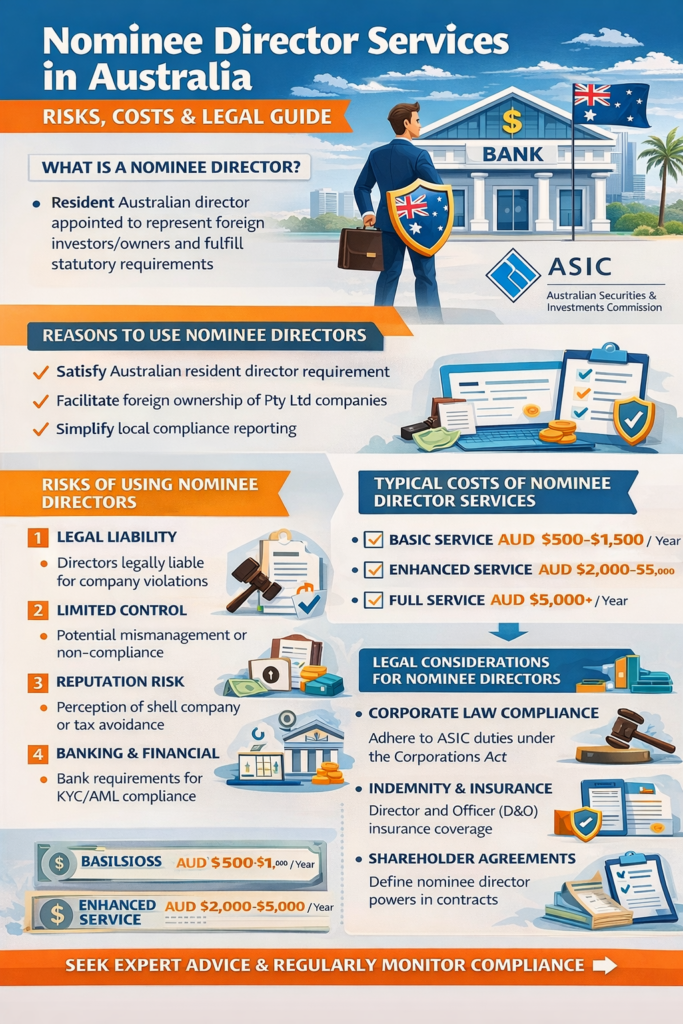
What Is a Nominee Director?
A nominee director is an individual appointed to serve on the board of an Australian company on behalf of shareholders or foreign owners. Nominee directors are often provided by corporate service providers and can fulfill resident director requirements under the Corporations Act 2001.
Key features of nominee directors:
- Legal appointment: They are officially registered with ASIC as company directors.
- Resident status: Must ordinarily reside in Australia.
- Agency role: Act on behalf of the company’s shareholders or owners, but responsibilities may vary based on agreement.
👉 Nominee directors are commonly used in foreign-owned Pty Ltd subsidiaries, as discussed in Pty Ltd vs Branch Office in Australia: Which Structure Is Best for Foreign Companies?
Why Companies Use Nominee Directors
1. Compliance with Australian Law
Australian law requires at least one resident director for proprietary companies (Pty Ltd). A nominee director satisfies this legal requirement, allowing the company to operate without a local shareholder or director.
2. Facilitate Offshore Ownership
Foreign investors can retain full ownership while meeting local statutory obligations. This is particularly useful for holding companies, investment vehicles, or non-operating entities.
3. Simplify Administrative Burden
Nominee directors can manage routine statutory filings and communications with ASIC, such as:
- Annual statements
- Director updates
- Registered office correspondence
4. Speed Up Incorporation
Using a nominee director allows foreign companies to incorporate quickly, especially when local directors are unavailable.
Risks of Using Nominee Directors
While nominee directors offer benefits, they also carry several risks:
1. Legal Liability
- Nominee directors are legally responsible under the Corporations Act for the company’s actions.
- They can be held liable for breaches, including insolvent trading, unpaid taxes, or regulatory violations.
- Directors must act in the best interest of the company, regardless of the shareholder agreement.
2. Limited Control
- Foreign owners must ensure the nominee director acts according to instructions.
- Poor selection can result in non-compliance or mismanagement.
3. Reputation Risk
- Using nominee directors may raise concerns with banks, investors, or regulators if perceived as a shell company or tax avoidance vehicle.
4. Banking and Financial Operations
- Some banks may require all directors to be identified for account opening and international transfers.
- Nominee directors must cooperate to meet KYC and AML requirements, otherwise account opening may be delayed.
👉 For guidance on banking requirements for foreign companies, see How to Open a Business Bank Account in Australia as a Non-Resident
Costs of Hiring a Nominee Director
Nominee director services are typically charged as a monthly or annual fee, depending on the provider and service level.
Typical Cost Structure
- Basic Service: AUD 500–1,500 per year, covering registration and minimal statutory duties.
- Enhanced Service: AUD 2,000–5,000 per year, including compliance management, registered office, and document handling.
- Full Service: AUD 5,000+ per year, including bookkeeping oversight, tax filing assistance, and acting as company secretary.
Costs vary based on:
- Company size and complexity
- Number of directors required
- Level of statutory compliance support
- Corporate service provider reputation and risk management policies
Legal Considerations for Nominee Directors
1. Compliance with the Corporations Act 2001
Nominee directors must adhere to all statutory obligations of directors under the Corporations Act, including:
- Duty of care and diligence
- Duty to act in the best interest of the company
- Duty to prevent insolvent trading
- Duty to maintain accurate financial records
Non-compliance can lead to civil penalties or criminal liability.
2. Shareholder Agreements
A well-drafted shareholder agreement should clearly outline:
- Nominee director powers and limitations
- Reporting obligations
- Liability indemnification
- Termination clauses
This ensures alignment between foreign owners and nominee directors, mitigating risks.
3. Indemnity and Insurance
- Companies may provide director and officer (D&O) insurance to protect nominee directors against claims.
- Indemnity clauses in agreements can further reduce personal exposure, but must comply with Australian law.
4. Conflict of Interest Management
Nominee directors must avoid conflicts of interest. For example, a provider offering nominee directors to multiple clients must have policies to prevent competing interests.
Practical Tips for Selecting a Nominee Director
1. Choose Reputable Providers
- Engage professional corporate service firms with experience and strong references.
- Check for ASIC registration, compliance history, and client testimonials.
2. Conduct Due Diligence
- Verify qualifications, residency, and track record of directors.
- Review prior compliance performance to minimize risk.
3. Clearly Define Duties
- Specify statutory duties versus operational responsibilities in a written agreement.
- Include reporting and communication obligations to ensure transparency.
4. Use Contracts to Limit Liability
- Indemnity agreements and D&O insurance are essential.
- Ensure the nominee director’s obligations are balanced with protection from undue risk.
5. Regular Monitoring
- Conduct periodic reviews of nominee director performance.
- Maintain communication to prevent gaps in compliance or record keeping.
👉 For a detailed overview of ongoing corporate compliance, see Annual Compliance Checklist for Australian Companies (ASIC & ATO Guide)
Banking and Financial Considerations
Nominee directors play a critical role in opening and maintaining business bank accounts:
- Some banks require nominee directors’ signatures on accounts
- Directors must comply with KYC/AML verification
- Banks may request access to company resolutions or shareholder agreements
Foreign investors should coordinate nominee director arrangements with banking setup to avoid delays or account restrictions.
Alternatives to Nominee Directors
While nominee directors are common, alternatives include:
- Resident Director from Shareholders: Appoint a director who is a local shareholder or employee.
- Corporate Service Providers with Resident Agents: Some firms offer registered agent services, combined with director support.
- Branch Offices: In certain cases, foreign companies can operate via a branch without a resident director, subject to restrictions.
Each option carries trade-offs in terms of cost, control, and liability.
Scenario Examples
Scenario 1: Small Foreign-Owned Pty Ltd
A non-resident investor wants to incorporate a holding company in Australia:
- Appoints a nominee director to meet residency requirements
- Uses a registered office service provided by the corporate firm
- Maintains full ownership and strategic control of the company
Scenario 2: Multi-National Expansion
A global company establishes a subsidiary to explore the Australian market:
- Appoints nominee directors initially
- Replaces with local employees as operations scale
- Ensures compliance with ASIC, ATO, and banking obligations
Risks Mitigation and Best Practices
- Insurance: Obtain D&O insurance to protect nominee directors.
- Contractual Clarity: Define obligations, powers, and termination clauses.
- Compliance Oversight: Regularly review filings, financial records, and statutory obligations.
- Professional Advisory: Engage lawyers and accountants familiar with non-resident corporate structures.
Key Takeaways
- Nominee directors satisfy legal residency requirements for Australian companies.
- They reduce administrative burden but carry legal and operational risks.
- Costs range from a few hundred to several thousand AUD per year, depending on services.
- Indemnity agreements, D&O insurance, and clear contracts are critical.
- Foreign investors should integrate nominee director arrangements with banking, accounting, and compliance operations.
👉 For more details on Australian corporate structures, see Pty Ltd vs Branch Office in Australia: Which Structure Is Best for Foreign Companies?
********
If you wish to register a company in Australia our team will be happy to help you there and provide you with more detailed information, you can contact us

Related Pages:
- Australia Company Formation
- Australia FAQ
- Frequently Asked Questions (FAQ)
- Ocenia & Polinesia jurisdictions
- Company Formation FAQ
- Company Formation Service
- Australia Public Company Formation
- Setting Up an Offshore Company in Australia: The Complete Guide for Foreign Investors
- Australian Corporate Tax Residency Rules Explained for Foreign Owners
- Pty Ltd vs Branch Office in Australia: Which Structure Is Best for Foreign Companies?
- Annual Compliance Checklist for Australian Companies (ASIC & ATO Guide)
- How to Open a Business Bank Account in Australia as a Non-Resident
- Regulated Industries in Australia: Licensing Guide for Foreign Investors