

Business Bank Account in Australia
For foreign investors and business owners, establishing a legal and functional presence in Australia requires more than just company registration. One critical step is opening a business bank account, which allows your company to manage revenue, pay employees, and maintain compliance with Australian financial and tax regulations.
This guide explains how non-residents can open an Australian business bank account, the documentation required, the steps involved, practical tips for smooth onboarding, and common challenges.
👉 You also can read related page Australia Company Formation, providing a complete resource for foreign investors.
Why a Business Bank Account Is Essential
Opening a business bank account in Australia is not just a convenience — it’s a legal and operational requirement for most companies:
- Legal separation: Keeps company funds separate from personal finances, maintaining the limited liability structure of a Pty Ltd or branch.
- Tax compliance: Facilitates accurate accounting and tax reporting to the Australian Taxation Office (ATO).
- Banking and payments: Allows electronic payments, international transfers, and local payroll.
- Business credibility: Enhances your reputation with suppliers, clients, and investors.
👉 For a full overview of company setup and structures, see Setting Up an Offshore Company in Australia: The Complete Guide for Foreign Investors,.
Eligibility Requirements for Non-Residents
Australian banks have specific criteria for non-residents, which generally include:
- A registered Australian company or branch office (Pty Ltd or foreign company)
- An Australian Business Number (ABN) and Australian Company Number (ACN)
- A physical or registered office address in Australia
- A valid passport and proof of identity of directors and signatories
- Sometimes, a resident director or local agent to facilitate banking
Banks may also require background checks, proof of business activity, and supporting documents to verify the company’s legitimacy.
👉 For guidance on company structures, refer to Pty Ltd vs Branch Office in Australia: Which Structure Is Best for Foreign Companies?
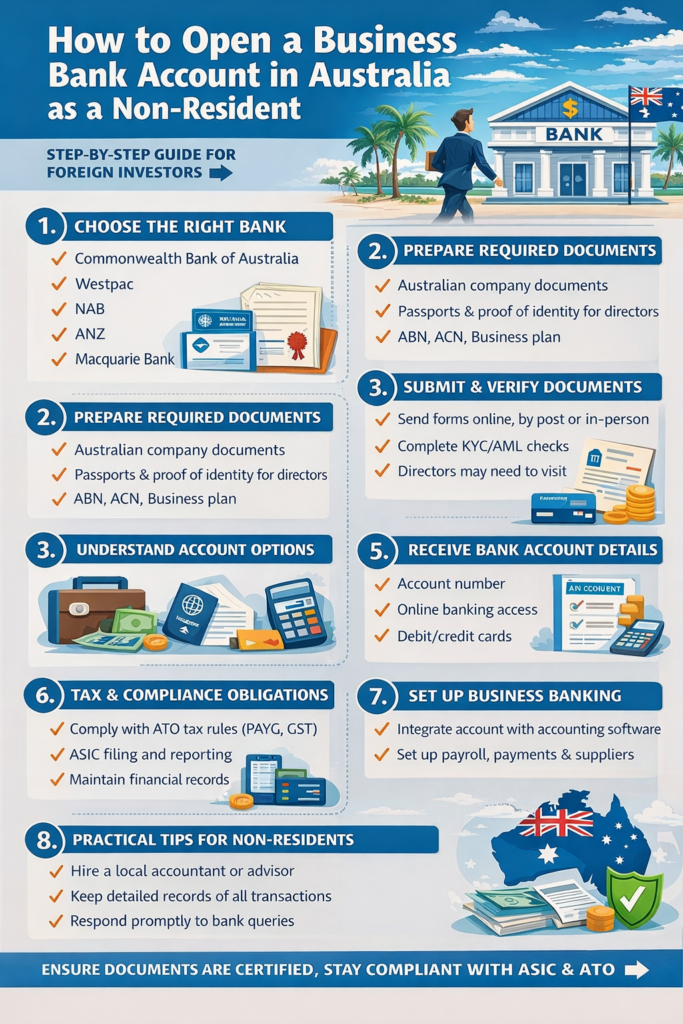
Step 1: Choose the Right Bank
Australia has a competitive banking sector with options for international business clients. Major banks include:
- Commonwealth Bank of Australia (CBA)
- Westpac Banking Corporation
- National Australia Bank (NAB)
- ANZ Bank
- Macquarie Bank
When selecting a bank, consider:
- International transfer fees
- Account maintenance costs
- Ease of remote account opening
- Multi-currency support
- Integration with accounting software
Some banks offer specialized services for non-residents and foreign-owned companies.
Step 2: Prepare Required Documentation
Non-resident business account applications require specific documentation. Banks usually request:
Company Documents
- Certificate of Incorporation
- Constitution or company rules
- Australian Business Number (ABN)
- Australian Company Number (ACN)
- ASIC registration documents
Director and Shareholder Documents
- Valid passports or national IDs
- Proof of residential address (can be overseas)
- Director consent forms
- Shareholder identification and ownership documentation
Additional Documentation
- Business plan or overview
- Company financial statements (if available)
- Signed resolutions authorizing account opening
- Contact information for directors and key personnel
Ensuring documents are certified, notarized, or translated into English (if required) can significantly speed up the application process.
Step 3: Understand Australian Bank Account Options
1. Transaction Accounts
- Basic operating account for daily business transactions
- Supports electronic payments, payroll, and deposits
2. Savings Accounts
- Optional for businesses to accrue interest on surplus funds
- May have restrictions on withdrawals
3. Multi-Currency Accounts
- Useful for companies with international operations
- Allows management of foreign currencies and reduces conversion fees
4. Merchant Accounts
- Required if the business accepts credit card payments
- Often integrated with point-of-sale systems
5. Online Banking & Business Tools
- Most major banks offer online banking portals and business management tools
- Integration with accounting platforms like Xero or MYOB is common
Step 4: Opening the Account
Non-residents can often open an account before arriving in Australia, but in some cases, a physical visit may be required. The process typically involves:
- Contacting the bank to discuss eligibility and required documents
- Submitting documentation via email, post, or in-person
- Completing Know Your Customer (KYC) and anti-money laundering (AML) checks
- Signing account agreements
- Receiving account details, debit/credit cards, and online banking credentials
Some banks may require directors to appear in person at a branch, while others offer remote account opening with notarized documents.
Step 5: Tax and Compliance Considerations
Once the account is open, compliance with Australian laws is essential:
- Australian Tax Office (ATO) obligations, including PAYG withholding and GST
- Maintaining accurate accounting records for audits and reporting
- Ensuring separation of personal and business funds
- Using the account for legitimate company transactions to maintain corporate integrity
👉 For detailed tax guidance, see Australian Corporate Tax Residency Rules Explained for Foreign Owners
Step 6: Practical Tips for Smooth Account Opening
1. Engage a Local Accountant or Corporate Service Provider
- Helps prepare documents and ensure all legal requirements are met
2. Provide Clear and Complete Documentation
- Certified copies, translations, and notarizations reduce delays
3. Maintain Transparency
- Clearly explain the business model, expected transactions, and directors’ roles
4. Choose a Bank Experienced with Non-Residents
- Some banks specialize in offshore clients and foreign-owned entities
5. Keep Communication Lines Open
- Respond promptly to bank requests and queries to avoid delays
Step 7: Common Challenges Non-Residents Face
- Banks requiring in-person verification
- Strict AML and KYC procedures
- Delays in account activation due to incomplete documentation
- Understanding local banking terminology and regulations
- Differences in bank fees, transaction limits, and foreign currency options
Many foreign investors address these challenges by using professional corporate service providers familiar with Australian banking regulations.
Step 8: Integrating the Bank Account with Company Operations
Once opened, integrate the bank account with:
- Accounting software (Xero, QuickBooks, MYOB)
- Payment systems for clients and suppliers
- Payroll management for employees
- Regular financial reporting to directors and shareholders
Proper integration ensures smooth operations, reduces compliance risk, and helps maintain financial transparency.
Step 9: Alternative Options
If opening a bank account in Australia is difficult, foreign companies may consider:
- International banking solutions (multi-currency accounts, fintech providers)
- Banking through a corporate service provider or nominee director arrangement
- Partnering with local businesses for payments and operations
While alternatives can be useful temporarily, a full Australian business bank account is recommended for long-term operations.
Step 10: Key Takeaways
- Non-residents can open Australian business bank accounts but must meet eligibility criteria
- Pty Ltd subsidiaries generally have smoother banking access than branch offices
- Accurate documentation and KYC compliance are critical
- Engage professional advisors for faster and compliant account setup
- Link banking to company compliance obligations with ASIC and ATO
********
If you wish to register a company in Australia our team will be happy to help you there and provide you with more detailed information, you can contact us

Related Pages:
- Australia Company Formation
- Australia FAQ
- Frequently Asked Questions (FAQ)
- Ocenia & Polinesia jurisdictions
- Company Formation FAQ
- Company Formation Service
- Australia Public Company Formation
- Setting Up an Offshore Company in Australia: The Complete Guide for Foreign Investors
- Australian Corporate Tax Residency Rules Explained for Foreign Owners
- Pty Ltd vs Branch Office in Australia: Which Structure Is Best for Foreign Companies?
- Annual Compliance Checklist for Australian Companies (ASIC & ATO Guide)
- Nominee Director Services in Australia: Risks, Costs & Legal Considerations
- Regulated Industries in Australia: Licensing Guide for Foreign Investors