Marshall Islands Holding Company Structure Explained
Introduction
A Marshall Islands holding company structure is one of the most widely used offshore frameworks for international entrepreneurs, investors, and corporate groups seeking efficient asset ownership, liability separation, and global investment structuring in 2026.
As global business becomes increasingly cross-border, companies are no longer limited to operating in a single jurisdiction. Instead, modern corporate groups often rely on holding structures to centralize ownership, manage subsidiaries, protect assets, and optimize operational efficiency.
The Marshall Islands has become a preferred jurisdiction for holding company formation due to its flexible corporate laws, internationally recognized legal framework, and suitability for offshore structuring.
A holding company in the Marshall Islands is not typically used for day-to-day trading operations. Instead, it functions as a central ownership entity that holds shares in other companies, manages investments, and controls intellectual property or strategic assets.
This guide explains in detail how the structure works, why it is used, who it is suitable for, and how it integrates into global offshore planning strategies.
➡️ For foundational context, see:
Marshall Islands Company Formation: The Complete 2026 Guide to Offshore Incorporation
What Is a Marshall Islands Holding Company?
A holding company is a legal entity whose primary purpose is to own and control other assets or companies.
In the Marshall Islands context, a holding company is typically formed as a:
- Corporation
- International Business Company (IBC)
It does not usually engage in active commercial trading. Instead, it acts as a parent company in a corporate structure.
Core Functions of a Holding Company
A Marshall Islands holding company may:
- Own shares in subsidiary companies
- Hold intellectual property assets
- Manage investment portfolios
- Control group-level strategy
- Centralize ownership structures
- Provide asset protection layers
This structure is widely used by international business groups and high-net-worth individuals.
Why Use a Marshall Islands Holding Company?
The primary reason for using a holding company is structural efficiency and risk separation.
Instead of holding assets directly in operating companies, businesses place them in a parent entity.
This creates:
- Legal separation between assets and operations
- Centralized ownership control
- Reduced exposure to operational risks
- Simplified group management
Key Benefits of a Marshall Islands Holding Structure
1. Asset Protection Layering
One of the most important benefits is liability separation.
In a properly structured group:
- Operating companies handle business risks
- Holding company owns valuable assets
This reduces exposure of key assets to operational liabilities.
➡️ For deeper analysis:
Asset Protection with a Marshall Islands Offshore Company
2. Centralized Ownership
A holding company allows consolidation of ownership into one entity.
Instead of multiple individual ownership structures, investors can:
- Centralize control
- Simplify governance
- Improve transparency within the group
3. Investment Efficiency
Holding companies are widely used for investment structures such as:
- Equity portfolios
- Venture capital investments
- Real estate holdings
- Private equity structures
This enables efficient capital allocation across multiple assets.
4. International Expansion Support
Global businesses often use holding companies to manage subsidiaries across jurisdictions.
Example structure:
Marshall Islands Holding Company
→ UK Subsidiary
→ UAE Subsidiary
→ Singapore Trading Entity
This provides a unified ownership framework.
5. Succession and Estate Planning
Holding structures are commonly used for long-term wealth planning.
They support:
- Generational wealth transfer
- Estate planning
- Ownership continuity
- Family office structuring
How a Marshall Islands Holding Company Works
A holding company operates at the top of a corporate structure.
It does not typically engage in active trading.
Instead, it performs strategic functions such as:
- Holding shares in subsidiaries
- Managing dividends
- Controlling intellectual property
- Allocating capital
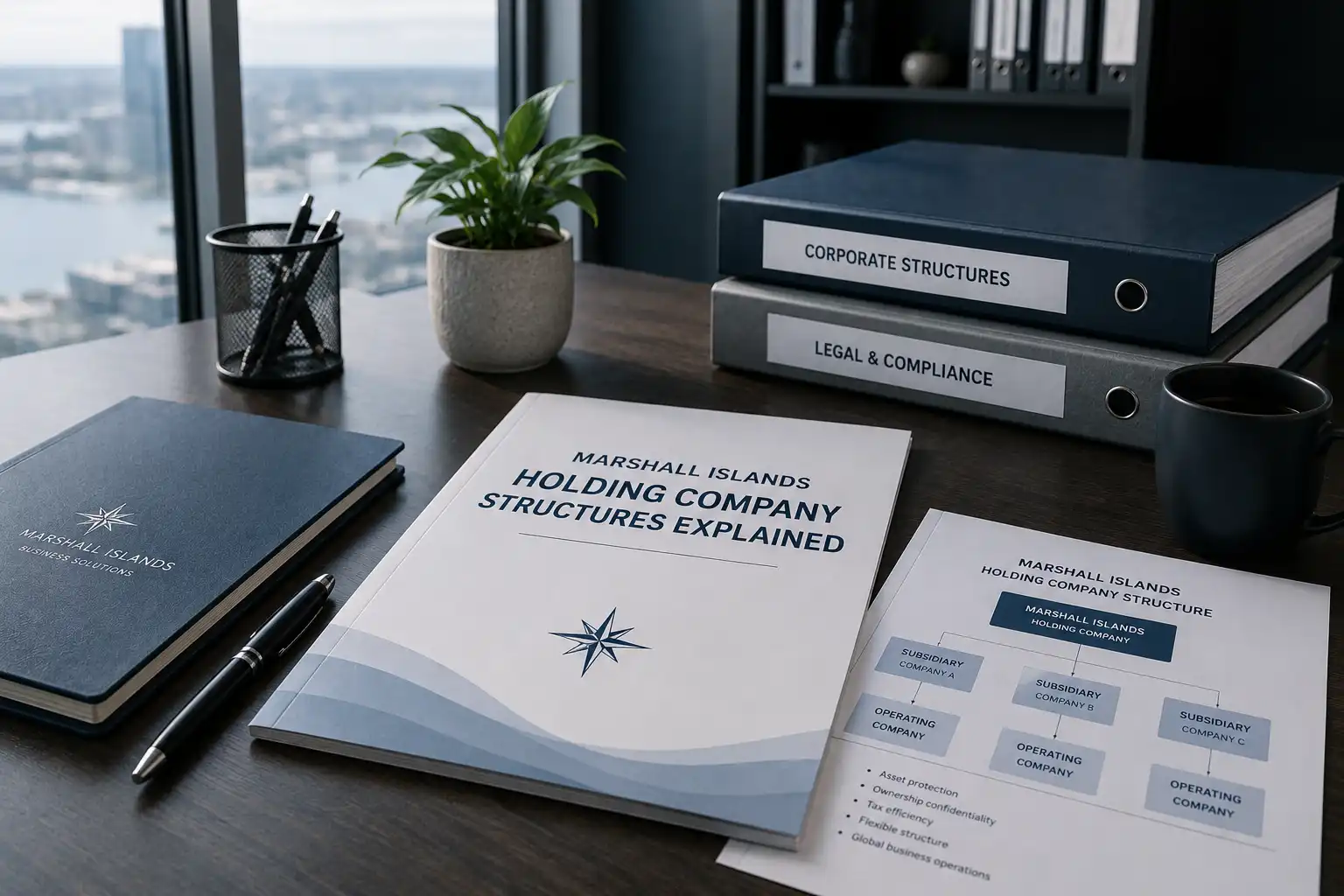
Basic Structure Example
Individual Investor
↓
Marshall Islands Holding Company
↓
Operating Company A (Trading)
Operating Company B (Services)
Investment Portfolio Entity
Flow of Value
- Operating companies generate revenue
- Profits are distributed upward
- Holding company consolidates value
- Capital is reinvested or distributed
Types of Assets Held in a Marshall Islands Holding Company
Holding companies are highly versatile and can own multiple asset classes.
1. Equity in Subsidiaries
The most common use case is ownership of other companies.
2. Intellectual Property
Holding companies often own:
- Trademarks
- Copyrights
- Patents
- Software assets
- Brand systems
3. Investment Assets
Including:
- Stocks
- Bonds
- Funds
- Private investments
4. Real Estate Holdings (Indirect)
Real estate is often held through subsidiary structures.
5. Maritime Assets
The Marshall Islands is globally recognized in shipping structures.
➡️ For industry-specific context:
Marshall Islands Shipping Company Formation Guide
Marshall Islands Holding Company vs Operating Company
Understanding the difference is critical.
Holding Company
- Owns assets
- Does not trade
- Controls subsidiaries
- Manages investments
Operating Company
- Conducts business activity
- Generates revenue
- Bears operational risk
- Handles customers and suppliers
Strategic Importance of Separation
Separating holding and operating functions provides:
- Risk isolation
- Financial clarity
- Legal protection
- Organizational structure
This separation is a core principle of international corporate structuring.
Why Marshall Islands Is Used for Holding Structures
The jurisdiction is widely used because it offers:
1. Flexible Corporate Law
Supports multi-layer ownership structures.
2. International Recognition
Accepted in global corporate and banking environments.
3. Efficient Incorporation Process
Fast setup enables quick structuring of global groups.
4. Strong Offshore Framework
Designed for international business activity.
Common Use Cases for Marshall Islands Holding Companies
1. International Business Groups
Companies operating across multiple countries.
2. Investment Firms
Managing diversified portfolios.
3. Family Offices
Long-term wealth structuring and estate planning.
4. Digital Business Groups
SaaS, e-commerce, and online platforms.
5. Maritime and Shipping Groups
Fleet ownership and charter structures.
Link to Broader Offshore Strategy
Holding companies do not operate in isolation.
They are part of a broader offshore ecosystem that includes:
- Corporate formation
- Banking structure
- Tax residency planning
- Compliance systems
- Asset protection frameworks
👉 For more context, see:
- Marshall Islands Company Formation: The Complete 2026 Guide to Offshore Incorporation
- Offshore Banking for Marshall Islands Companies: What You Need to Know
- Compliance, Substance and Reporting Requirements in the Marshall Islands
- Marshall Islands LLC vs Corporation: Which Structure Should You Choose?
Advanced Structuring, Tax Considerations, Banking, Compliance and Real-World Applications
In Part 1, we covered the foundations of a Marshall Islands holding company structure, including how it works, what it holds, and why it is used in international corporate planning. In Part 2, we move into more advanced territory: structuring models, tax implications (global perspective), banking behavior, compliance requirements, substance expectations, real-world use cases, and common mistakes.
This section is designed for entrepreneurs, investors, and international groups building scalable offshore structures rather than simple standalone companies.
➡️ For foundational reading, see:
Marshall Islands Company Formation: The Complete 2026 Guide to Offshore Incorporation
Advanced Marshall Islands Holding Company Structures
A holding company rarely exists in isolation. In practice, it is usually part of a multi-layer corporate architecture.
Below are the most common advanced structures used in 2026.
1. Basic Two-Tier Structure
This is the simplest holding model:
Marshall Islands Holding Company
↓
Operating Company
Use case:
- Small international businesses
- Digital entrepreneurs
- Early-stage investment structures
Advantages:
- Simple
- Low maintenance
- Easy banking explanation
2. Multi-Subsidiary Structure
Marshall Islands Holding Company
↓
Operating Company A (EU)
Operating Company B (Asia)
Operating Company C (Middle East)
Use case:
- International trading groups
- Regional expansion strategies
- Multi-market businesses
Advantages:
- Risk diversification
- Geographic segmentation
- Operational clarity
3. IP Holding Structure
Marshall Islands IP Holding Company
↓
Operating Companies License IP
Use case:
- SaaS companies
- Software developers
- Digital brands
Advantages:
- Centralized intellectual property ownership
- Licensing income streams
- Asset separation from operational risk
➡️ For related context:
Marshall Islands LLC vs Corporation: Which Structure Should You Choose?
4. Investment Holding Structure
Marshall Islands Investment Holding Company
↓
Portfolio Assets (Stocks, Funds, Private Equity)
Use case:
- Private investors
- Family offices
- Wealth management structures
Advantages:
- Centralized portfolio management
- Efficient reinvestment
- Simplified reporting structure
5. Hybrid Corporate Group Structure
Marshall Islands Holding Company
↓
Operating Companies (multiple jurisdictions)
↓
Investment Entities / SPVs
Use case:
- Large international groups
- Venture-backed businesses
- Private equity-style structures
Advantages:
- Maximum flexibility
- Strong asset protection layering
- Institutional-level structuring
Tax Considerations (Global Perspective)
It is essential to clarify that Marshall Islands holding companies are not inherently tax solutions. Tax outcomes depend on:
- Beneficial owner tax residency
- Source of income
- Controlled Foreign Corporation (CFC) rules
- Permanent establishment rules
- Local tax regulations
Holding Company Tax Characteristics
A holding company typically:
- Does not generate active trading income
- Receives dividends, interest, or capital gains
- Acts as a central ownership entity
This can influence tax treatment depending on jurisdiction.
Common Global Tax Treatment Scenarios
Different countries may treat holding structures differently:
- Some treat them as passive investment entities
- Some apply CFC rules
- Some require disclosure of foreign ownership
- Some tax dividends upon distribution
Key Insight
The holding company itself does not determine tax outcomes.
Instead:
Tax residency and substance determine taxation more than jurisdiction alone.
➡️ For broader tax context:
Marshall Islands Tax Benefits for Offshore Companies
Banking Implications of Holding Companies
Banking is one of the most critical operational factors in offshore structuring.
Even a legally sound structure is ineffective without financial infrastructure.
Why Banks Like Holding Companies
Holding companies are often viewed positively because they:
- Centralize ownership
- Reduce transactional complexity
- Provide clear asset ownership structure
- Support group-level financial transparency
This makes them easier to classify in compliance systems.
Banking Requirements for Holding Companies
Banks typically request:
- Corporate structure chart
- Source of wealth documentation
- Source of funds explanation
- Details of underlying subsidiaries
- Investment rationale
Common Banking Challenges
Holding companies may face issues if:
- Structure is overly complex without explanation
- Subsidiaries operate in high-risk sectors
- Ownership is unclear or poorly documented
- Financial flows are inconsistent
Best Practice for Banking Approval
To improve banking success:
- Keep structure logically simple
- Document all subsidiaries clearly
- Provide clear investment rationale
- Maintain consistent financial reporting
👉 For deeper banking guidance:
Offshore Banking for Marshall Islands Companies: What You Need to Know
Compliance and Reporting Requirements
Holding companies are subject to ongoing compliance obligations.
These include:
1. Beneficial Ownership Disclosure
Companies must maintain accurate records of ultimate ownership.
2. Corporate Record Keeping
This includes:
- Shareholder registers
- Board resolutions
- Ownership documents
- Investment records
3. Due Diligence Updates
Service providers may request:
- Updated identity documents
- Business activity updates
- Source of funds confirmation
4. Financial Documentation
Holding companies should maintain:
- Investment records
- Dividend flows
- Asset valuations
- Portfolio statements
Key Insight
Even passive holding companies are not “maintenance-free”.
Compliance is ongoing.
👉 For full regulatory context:
Compliance, Substance and Reporting Requirements in the Marshall Island
Economic Substance and Holding Companies
Economic substance requirements have become a key global regulatory focus
Do Holding Companies Need Substance?
In many cases, yes—but at a reduced level compared to operating companies.
Substance may include:
- Documented ownership decisions
- Board-level governance
- Investment oversight activities
- Strategic management functions
Substance Risk Factors
Holding companies may face scrutiny if:
- They exist only on paper
- There is no governance activity
- They lack documentation
- They have unclear ownership purpose
Low-Risk Holding Structures
A well-structured holding company should:
- Maintain clear decision records
- Document investments
- Demonstrate ownership control
- Align with real business activity
Real-World Use Cases
1. Global Trading Group
Holding Company (Marshall Islands)
↓
Regional trading subsidiaries
Purpose:
- Risk isolation
- Centralized ownership
- Financial consolidation
2. SaaS Company Group
Holding Company
↓
IP Company
↓
SaaS Operating Entities
Purpose:
- Protect software assets
- Centralize licensing
- Scale globally
3. Private Investment Group
Holding Company
↓
Portfolio of global assets
Purpose:
- Wealth preservation
- Central reporting
- Estate planning
4. Shipping and Maritime Structure
Holding Company
↓
Vessel ownership entities
Purpose:
- Liability separation
- Asset protection
- Operational efficiency
➡️ For maritime context:
Marshall Islands Shipping Company Formation Guide
Common Mistakes in Holding Company Structuring
Mistake 1: Overcomplication
Too many layers without purpose can:
- Increase banking scrutiny
- Create compliance burden
- Reduce transparency
Mistake 2: No Clear Business Purpose
Holding companies must have:
- Investment rationale
- Ownership logic
- Strategic function
Mistake 3: Poor Documentation
Missing:
- Ownership records
- Board resolutions
- Investment documentation
can create compliance risk.
Mistake 4: Mixing Personal and Corporate Assets
This undermines:
- Asset protection
- Banking credibility
- Legal separation
Mistake 5: Ignoring Tax Residency Rules
Holding companies must align with:
- Personal tax residency
- Corporate tax obligations
- CFC regulations
Decision Framework: Is a Holding Company Right for You?
Step 1: Do you own multiple assets or companies?
- Yes → Holding company recommended
- No → Not necessary
Step 2: Do you need asset separation?
- Yes → Strong use case
- No → Simple structure may suffice
Step 3: Do you operate internationally?
- Yes → Holding company adds value
- No → May be unnecessary
Step 4: Do you require investment structuring?
- Yes → Holding company is ideal
- No → Simpler structure may work
Future Trends (2026–2030)
1. Increased Transparency Requirements
Global regulators will continue enhancing visibility into ownership structure
2. AI-Based Compliance Monitoring
Banks will increasingly use AI systems to analyze:
- Ownership networks
- Transaction behavior
- Risk classification
3. Preference for Clean Structures
Simple, well-documented holding structures will outperform complex opaque ones.
4. Greater Substance Expectations
Holding companies will increasingly need:
- Documented decision-making
- Real governance activity
- Economic justification
Final Conclusion
A Marshall Islands holding company structure is one of the most powerful tools for international business organization, asset protection, and investment management when used correctly.
However, its effectiveness depends not on jurisdiction alone, but on:
- Structure design
- Compliance discipline
- Banking readiness
- Tax residency alignment
- Documentation quality
The most successful offshore structures are not the most complex—they are the most strategically aligned.
Related Cluster Articles
To build a complete offshore framework, explore:
- Marshall Islands FAQ
- Marshall Islands Company Formation
- Offshore Services
- Offshore Banks
- Marshall Islands Company Formation: The Complete 2026 Guide to Offshore Incorporation
- Marshall Islands IBC: Features, Advantages and Legal Structure Explained
- How to Open a Marshall Islands Offshore Company Step by Step
- Benefits of Marshall Islands Company Formation for International Businesses
- Marshall Islands Tax Benefits for Offshore Companies
- Compliance, Economic Substance and Reporting Requirements in the Marshall Islands
- Offshore Banking for Marshall Islands Companies
- Marshall Islands LLC vs Corporation: Which Structure Should You Choose?
- Asset Protection with a Marshall Islands Offshore Company
- Marshall Islands Shipping Company Formation Guide
- Marshall Islands Nominee Directors and Shareholders Explained
- Marshall Islands vs BVI: Which Offshore Jurisdiction Is Better in 2026?