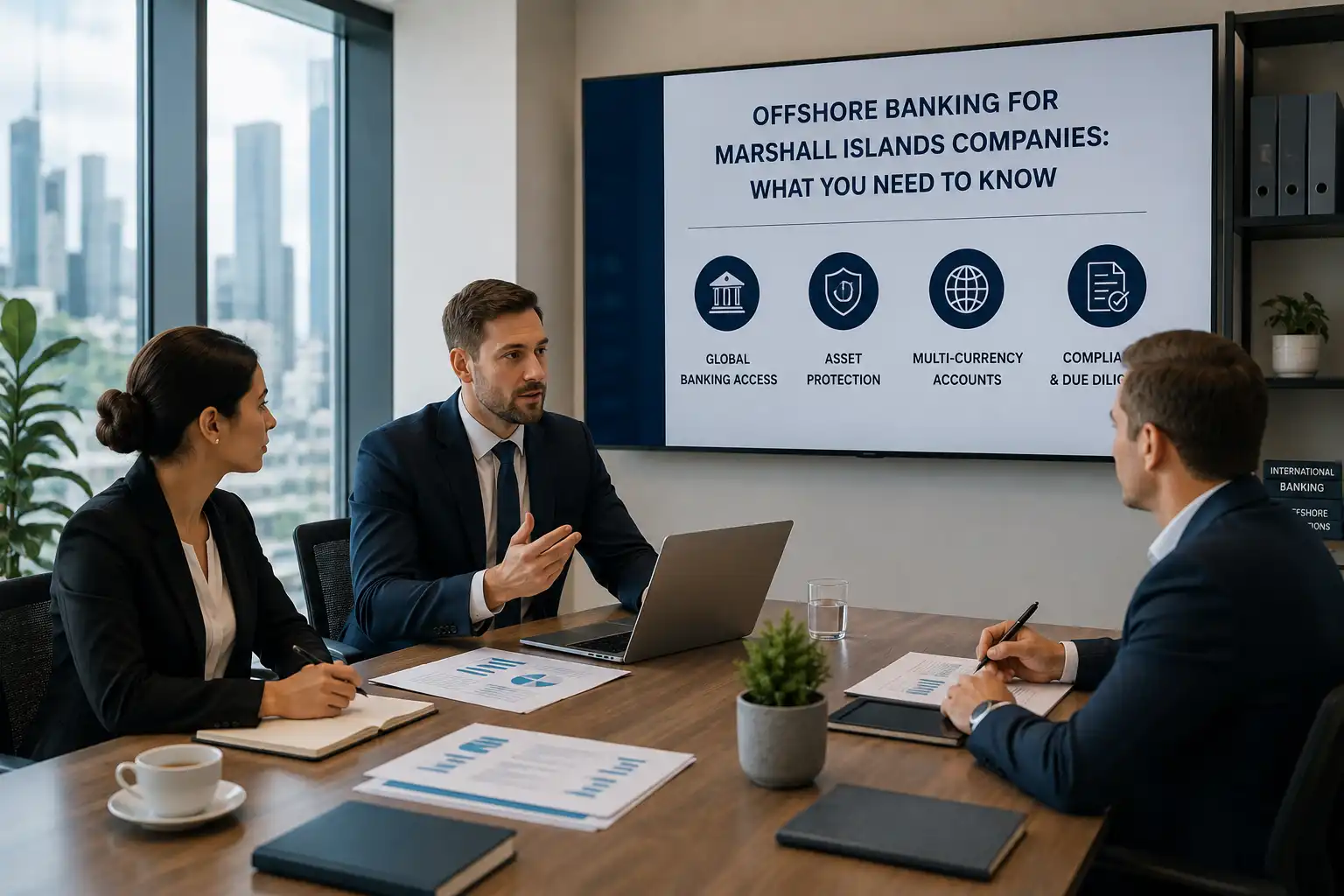
Offshore Banking for Marshall Islands Companies: What You Need to Know
Introduction
Opening a Marshall Islands company is often the easiest part of establishing an offshore business structure. The real challenge for many entrepreneurs begins after incorporation, when they need to secure reliable banking services.
In today’s international financial environment, offshore banking is no longer simply about opening an account and transferring funds across borders. Banks and financial institutions operate under strict compliance requirements, extensive due diligence procedures, anti-money laundering regulations, and global transparency standards.
As a result, business owners planning to incorporate a Marshall Islands company should understand that banking preparation is just as important as company formation itself.
The good news is that Marshall Islands companies continue to be accepted by many international banks, electronic money institutions (EMIs), payment service providers (PSPs), fintech platforms, and corporate banking providers. When structured correctly and supported by strong documentation, Marshall Islands companies can successfully establish banking relationships across multiple jurisdictions.
This guide explains everything entrepreneurs need to know about offshore banking for Marshall Islands companies in 2026, including account opening procedures, compliance requirements, common challenges, banking alternatives, and strategies for improving approval rates.
👉 For a broader overview of company formation, see:
Marshall Islands Company Formation: The Complete 2026 Guide to Offshore Incorporation
Why Banking Matters More Than Incorporation
Many first-time offshore entrepreneurs focus almost exclusively on incorporation.
They compare:
- Registration costs
- Annual maintenance fees
- Corporate structures
- Tax benefits
However, a company without access to banking services has limited practical value.
Most businesses require the ability to:
- Receive payments
- Pay suppliers
- Manage operating expenses
- Hold reserves
- Process international transactions
- Access online banking services
For this reason, successful offshore planning begins with banking considerations rather than ending with them.
Are Marshall Islands Companies Accepted by Banks?
One of the most common questions entrepreneurs ask is whether banks accept Marshall Islands companies.
The answer is yes.
Marshall Islands companies are legitimate legal entities incorporated under internationally recognized corporate legislation.
Many banks and financial institutions are familiar with the jurisdiction because Marshall Islands entities are commonly used for:
- Holding companies
- International trading
- Investment structures
- Maritime businesses
- Asset ownership structures
- Family office arrangements
However, acceptance depends on much more than the jurisdiction itself.
Banks increasingly evaluate:
- Business activities
- Ownership structure
- Geographic exposure
- Compliance readiness
- Source of funds
- Source of wealth
The quality of the business often matters more than the country of incorporation.
Why Banks Scrutinize Offshore Companies
The global banking industry has changed dramatically over the past twenty years.
Following international regulatory reforms, banks now apply enhanced due diligence to many offshore structures.
Their primary concerns include:
- Money laundering risks
- Sanctions exposure
- Tax evasion concerns
- Fraud prevention
- Reputational risk
As a result, offshore companies must demonstrate transparency and legitimacy.
A properly documented Marshall Islands company can satisfy these requirements, but preparation is essential.
Types of Financial Institutions Available
When entrepreneurs think about offshore banking, they often imagine traditional international banks.
In reality, today’s financial ecosystem offers several options.
Traditional International Banks
Traditional banks continue to provide:
- Corporate accounts
- International wire transfers
- Foreign exchange services
- Treasury solutions
- Investment products
Advantages include:
- Strong reputation
- Established infrastructure
- Broad service offerings
Challenges may include:
- Longer onboarding procedures
- Higher compliance requirements
- More documentation
Electronic Money Institutions (EMIs)
EMIs have become increasingly popular among international businesses.
They often provide:
- Multi-currency accounts
- Payment collection
- Online banking platforms
- International transfers
Benefits include:
- Faster onboarding
- Modern technology
- Global accessibility
Many startups and digital businesses begin with EMI solutions before expanding into traditional banking relationships.
Payment Service Providers (PSPs)
Payment service providers can support:
- Online transactions
- Merchant processing
- Customer payments
- E-commerce operations
These providers play a critical role for:
- Online businesses
- SaaS companies
- Digital service providers
Fintech Platforms
Fintech providers continue to reshape international banking.
Services may include:
- Multi-currency wallets
- Business accounts
- Global payment infrastructure
- Currency exchange
Many international businesses combine fintech solutions with traditional banking relationships.
Choosing the Right Banking Solution
Not every banking provider is appropriate for every business.
The ideal solution depends on:
Business Activity
Banks assess what the company actually does.
Examples include:
- Trading
- Consulting
- Investment management
- Shipping
- Software development
- E-commerce
Different activities present different risk profiles.
Geographic Exposure
Financial institutions evaluate:
- Customer locations
- Supplier locations
- Operational jurisdictions
Businesses operating in high-risk regions may face additional scrutiny.
Transaction Volumes
Expected transaction volumes influence account selection.
Banks often request estimates regarding:
- Monthly transfers
- Average transaction size
- Annual turnover
Growth Plans
A startup may require different banking services than a multinational enterprise.
Entrepreneurs should consider long-term scalability when selecting providers.
Documentation Required for Offshore Banking
Documentation remains one of the most important aspects of account opening.
Incomplete applications are among the leading causes of rejection.
Corporate Documents
Banks typically request:
- Certificate of Incorporation
- Articles of Incorporation
- Corporate resolutions
- Shareholder registers
- Director registers
These documents establish the company’s legal existence.
Identification Documents
Financial institutions generally require:
- Passport copies
- Government-issued identification
for all beneficial owners and key decision-makers.
Proof of Address
Examples include:
- Utility bills
- Bank statements
- Government correspondence
Business Description
A clear explanation of:
- Products
- Services
- Revenue model
- Customer profile
is often required.
Source of Funds Documentation
Banks want to understand where business capital originates.
Examples may include:
- Business earnings
- Investment proceeds
- Employment income
- Asset sales
Business Plan
Some institutions request:
- Financial projections
- Operational plans
- Growth forecasts
especially for newly incorporated companies.
Understanding Beneficial Ownership
Beneficial ownership transparency is now a central component of offshore banking.
Banks must identify the individuals who ultimately own or control the company.
Who Is a Beneficial Owner?
Generally, a beneficial owner is a person who:
- Owns shares
- Exercises control
- Benefits economically from the company
Banks cannot simply rely on nominee arrangements or intermediary entities.
Transparency is expected throughout the ownership chain.
Why Beneficial Ownership Matters
Financial institutions use beneficial ownership information to:
- Assess risk
- Prevent illicit activity
- Comply with regulations
Clear ownership structures improve approval prospects.
Know Your Customer (KYC) Requirements
Every reputable financial institution operates under KYC obligations.
KYC procedures help banks understand:
- Who the customer is
- What the business does
- Where funds originate
- How the account will be used
Strong KYC documentation demonstrates professionalism and compliance readiness.
Businesses that proactively prepare KYC materials often experience faster onboarding.
Anti-Money Laundering (AML) Compliance
AML regulations influence nearly every aspect of offshore banking.
Banks evaluate:
- Ownership structure
- Business model
- Geographic exposure
- Transaction patterns
Companies should establish internal AML procedures that reflect the nature of their activities.
Good compliance supports long-term banking relationships.
Why Some Offshore Banking Applications Are Rejected
Even legitimate businesses occasionally encounter account-opening difficulties.
Common reasons include:
Incomplete Documentation
Missing information is one of the most frequent causes of rejection.
Unclear Business Activities
Banks need to understand exactly how the company generates revenue.
Complex Ownership Structures
Overly complicated structures may trigger additional scrutiny.
High-Risk Industries
Certain sectors are viewed as higher risk.
Geographic Concerns
Some jurisdictions face increased regulatory attention.
Most rejections can be avoided through proper preparation and transparent communication.
Banking Preparation Before Incorporation
One of the most effective strategies is planning for banking before forming the company.
Questions to consider include:
- Which banking providers are most suitable?
- What documentation will be required?
- What transaction volumes are expected?
- How will compliance be managed?
Entrepreneurs who address these questions early often achieve better results.
Internal Resources
👉 For a deeper understanding of Marshall Islands structures, see:
- Marshall Islands IBC: Features, Advantages and Legal Structure Explained
- How to Open a Marshall Islands Offshore Company Step by Step
- Marshall Islands Tax Benefits for Offshore Companies
- Benefits of Marshall Islands Company Formation for International Businesses
Featured Snippet: Can a Marshall Islands Company Open a Bank Account?
Yes. Marshall Islands companies can open corporate bank accounts with many international banks, electronic money institutions, fintech providers, and payment service providers. Approval depends on business activities, ownership transparency, compliance readiness, and documentation quality rather than incorporation alone.
Summary
Marshall Islands companies remain widely accepted by international financial institutions in 2026.
Successful banking applications typically require:
- Corporate documents
- KYC information
- Beneficial ownership disclosure
- Source of funds evidence
- Business plans
- Compliance procedures
Banking success depends on preparation, transparency, and professional documentation rather than simply choosing an offshore jurisdiction.
Best Banking Jurisdictions for Marshall Islands Companies
One of the most common questions entrepreneurs ask after incorporating a Marshall Islands company is where they should open a corporate bank account.
There is no universal answer because the best banking jurisdiction depends on:
- Business activities
- Customer locations
- Transaction volumes
- Compliance profile
- Banking requirements
In 2026, businesses increasingly diversify their banking relationships rather than relying on a single institution.
European Banking Solutions
European financial institutions continue to attract international businesses because they offer:
- Strong regulatory frameworks
- Multi-currency accounts
- SEPA payment capabilities
- International transfer services
European banking solutions are particularly popular among:
- Holding companies
- Consulting firms
- E-commerce businesses
- Investment structures
Asian Banking Solutions
Asia remains an important financial center for international trade and investment.
Many businesses operating across global markets seek banking providers with strong Asian connections.
These institutions may offer:
- International trade support
- Multi-currency capabilities
- Cross-border payment infrastructure
Offshore Financial Centers
Certain offshore financial centers continue to provide specialized banking services for international businesses.
These providers often understand offshore corporate structures and international ownership arrangements.
However, modern offshore banking still requires full compliance with international standards.
Multi-Currency Banking Solutions
International businesses rarely operate in a single currency.
Customers, suppliers, and partners may use:
- US dollars
- Euros
- British pounds
- Swiss francs
- Other major currencies
Multi-currency banking solutions help businesses manage these transactions efficiently.
Benefits of Multi-Currency Accounts
Advantages may include:
- Reduced currency conversion costs
- Simplified international payments
- Better treasury management
- Improved operational flexibility
Many fintech providers and electronic money institutions now offer sophisticated multi-currency solutions that rival traditional banks.
Merchant Accounts and Payment Processing
For online businesses, banking alone is often insufficient.
Many companies also require merchant services to accept customer payments.
Businesses That Need Merchant Accounts
Examples include:
- E-commerce stores
- SaaS businesses
- Online service providers
- Subscription platforms
Merchant providers evaluate many of the same factors as banks, including:
- Ownership structure
- Business activities
- Compliance procedures
- Geographic exposure
Payment Gateway Integration
Modern businesses increasingly rely on integrated payment ecosystems.
Common requirements include:
- Credit card acceptance
- International payments
- Recurring billing
- Digital wallet compatibility
Selecting payment providers early can simplify operational planning.
Banking for Holding Companies
Holding companies remain one of the most common uses of Marshall Islands structures.
Unlike operating businesses, holding companies often generate revenue through:
- Dividends
- Investments
- Capital appreciation
- Asset ownership
What Banks Expect from Holding Companies
Financial institutions generally request:
- Corporate ownership diagrams
- Investment strategy descriptions
- Asset information
- Beneficial ownership documentation
Because holding companies typically have fewer transactions, banks often focus heavily on ownership transparency.
👉 For more information, see:
Marshall Islands Tax Benefits for Offshore Companies
Banking for International Trading Companies
Trading companies frequently require more sophisticated banking arrangements.
Their operations often involve:
- International suppliers
- Global customers
- Multiple currencies
- Frequent transfers
Additional Banking Considerations
Banks may request:
- Contracts
- Supplier agreements
- Customer invoices
- Shipping documentation
The objective is to understand the commercial activity behind expected transactions.
Well-documented trading businesses generally achieve stronger banking outcomes.
Banking for Investment Structures
Investment companies often require specialized banking solutions.
Typical activities may include:
- Portfolio management
- Venture investments
- Asset ownership
- Family office operations
Investment-Focused Banking Requirements
Banks frequently assess:
- Investment strategy
- Source of wealth
- Asset portfolio composition
- Expected transaction profile
Transparency remains critical.
Clear documentation improves onboarding efficiency.
Banking for Maritime Businesses
The Marshall Islands enjoys a unique reputation within the global shipping industry.
Many maritime operators use Marshall Islands entities for:
- Vessel ownership
- Fleet management
- Maritime investments
Maritime Banking Considerations
Financial institutions serving the maritime sector may request:
- Vessel documentation
- Ownership records
- Charter agreements
- Operational information
The jurisdiction’s strong maritime reputation can be advantageous in these situations.
Banking for Digital Businesses
Digital entrepreneurship continues to expand globally.
Marshall Islands companies are increasingly used by:
- Software developers
- SaaS providers
- Consultants
- Digital agencies
- Online educators
Digital Business Banking Needs
Many digital businesses prioritize:
- Fast onboarding
- Multi-currency capabilities
- Online account management
- International payment infrastructure
Fintech providers have become particularly popular among technology-focused businesses.
Banking for Crypto and Blockchain Businesses
The crypto sector presents unique banking challenges.
While many financial institutions have become more comfortable with digital assets, onboarding standards remain strict.
What Banks Evaluate
Crypto-related businesses may need to demonstrate:
- Licensing status
- Compliance programs
- AML procedures
- Transaction monitoring systems
Banks typically conduct enhanced due diligence when reviewing crypto-related applications.
Businesses with strong governance and compliance frameworks often achieve better outcomes.
Corporate Debit Cards and Treasury Solutions
Modern banking involves more than maintaining a current account.
Many businesses seek:
- Corporate debit cards
- Expense management tools
- Treasury services
- Currency exchange solutions
These services improve operational efficiency and support international expansion.
Treasury Management
Larger businesses often require:
- Cash management
- Foreign exchange support
- Liquidity planning
Professional treasury services become increasingly valuable as companies scale internationally.
Common Offshore Banking Fees
Entrepreneurs should understand the potential costs associated with offshore banking.
Account Opening Fees
Some institutions charge onboarding fees.
Monthly Maintenance Fees
Corporate accounts often include recurring maintenance costs.
International Transfer Fees
Wire transfers may involve:
- Sending fees
- Receiving fees
- Correspondent bank charges
Foreign Exchange Costs
Currency conversion spreads can significantly affect international businesses.
Businesses should compare providers carefully rather than focusing solely on account availability.
Risk Management for Offshore Companies
Strong risk management improves both banking relationships and overall business stability.
Documentation Management
Maintain organized records including:
- Contracts
- Invoices
- Ownership documents
- Compliance records
Transaction Monitoring
Businesses should understand:
- Transaction patterns
- Payment flows
- Geographic exposure
Unexpected activity can trigger banking reviews.
Compliance Reviews
Periodic internal reviews help identify potential issues before they become problems.
Common Banking Mistakes to Avoid
Waiting Until After Incorporation
Many entrepreneurs form companies before considering banking requirements.
A better approach is to evaluate banking options during the planning stage.
Poor Documentation
Weak documentation remains one of the most common reasons for delays.
Choosing Banks Based Only on Reputation
The most famous bank is not always the best fit.
Businesses should focus on suitability rather than brand recognition alone.
Ignoring Compliance
Compliance expectations continue to increase.
Companies that embrace transparency typically enjoy stronger banking relationships.
Underestimating Onboarding Timelines
Corporate banking applications often take longer than expected.
Proper planning helps avoid operational disruptions.
Maintaining a Corporate Bank Account
Opening an account is only the beginning.
Long-term account maintenance requires ongoing attention.
Keep Information Updated
Banks should be informed about:
- Ownership changes
- Director changes
- Business model changes
Maintain Accurate Records
Documentation supports:
- Periodic reviews
- Compliance requests
- Banking renewals
Monitor Transaction Activity
Transactions should remain consistent with the company’s stated business profile.
Unexpected activity may trigger additional inquiries.
Offshore Banking Trends in 2026
The offshore banking landscape continues to evolve.
Several trends are shaping the market.
Increased Digitalization
Banks and fintech providers continue investing in:
- Online onboarding
- Digital verification
- Automated compliance systems
Greater Transparency
Regulators increasingly expect:
- Beneficial ownership disclosure
- Transaction visibility
- Compliance reporting
Growth of Alternative Banking Providers
EMIs and fintech institutions continue gaining market share.
These providers often offer:
- Faster onboarding
- Better technology
- Greater flexibility
Stronger Risk-Based Compliance
Banks increasingly tailor due diligence requirements based on risk assessments.
Businesses with transparent operations often benefit from more efficient onboarding.
Internal Resources
👉 For additional guidance, explore:
- Marshall Islands Company Formation: The Complete 2026 Guide to Offshore Incorporation
- How to Open a Marshall Islands Offshore Company Step by Step
- Marshall Islands IBC: Features, Advantages and Legal Structure Explained
- Marshall Islands Tax Benefits for Offshore Companies
- Marshall Islands vs BVI: Which Offshore Jurisdiction Is Better in 2026?
Featured Snippet: What Is the Best Bank for a Marshall Islands Company?
There is no single best bank for every Marshall Islands company. The ideal banking solution depends on business activities, transaction volumes, geographic exposure, compliance profile, and operational requirements. Many businesses use a combination of traditional banks, electronic money institutions, and fintech providers.
Featured Snippet: Can a Marshall Islands Company Open a Multi-Currency Account?
Yes. Many banks, EMIs, and fintech providers offer multi-currency accounts to Marshall Islands companies, allowing businesses to hold and transact in multiple currencies while supporting international operations.
Summary
Successful offshore banking for Marshall Islands companies requires:
- Strong corporate documentation
- Beneficial ownership transparency
- Clear business activities
- Compliance readiness
- Appropriate banking provider selection
Businesses may choose from:
- Traditional banks
- Electronic money institutions
- Fintech platforms
- Payment service providers
Key considerations include:
- Multi-currency capabilities
- Merchant services
- International transfers
- Banking fees
- Risk management
- Long-term compliance
The strongest banking outcomes typically result from careful preparation, transparent operations, and professional documentation.
Frequently Asked Questions
Can Marshall Islands companies open bank accounts internationally?
Yes. Many international financial institutions accept Marshall Islands companies subject to compliance review and onboarding approval.
Are multi-currency accounts available?
Yes. Numerous banks and fintech providers offer multi-currency solutions.
Is offshore banking difficult in 2026?
Banking is more regulated than in the past, but properly structured companies with strong documentation can still access excellent banking solutions.
Can holding companies obtain banking services?
Yes. Holding companies regularly open accounts when ownership and business purpose are clearly documented.
Do banks require beneficial ownership information?
Yes. Beneficial ownership disclosure is now a standard banking requirement worldwide.
Can fintech providers replace traditional banks?
In some situations, yes. Many businesses use fintech solutions for daily operations while maintaining traditional banking relationships for additional services.
Advanced Banking Strategies for Marshall Islands Companies
As international banking becomes more sophisticated, many successful offshore businesses no longer rely on a single banking provider. Instead, they develop diversified banking strategies that improve operational flexibility, reduce risk, and support long-term growth.
For Marshall Islands companies, this approach is often particularly valuable because international operations frequently involve multiple currencies, jurisdictions, and business partners.
Multi-Bank Structures
Many established international businesses maintain relationships with several financial institutions simultaneously.
For example:
- One bank may be used for operational expenses.
- Another may handle international transfers.
- A fintech provider may support multi-currency transactions.
- An investment institution may hold reserves and investment assets.
This diversification reduces dependency on a single institution and provides operational continuity if banking policies change.
Segregation of Business Activities
Larger businesses often separate banking functions based on operational needs.
Examples include:
- Trading activities
- Investment activities
- Intellectual property licensing
- Maritime operations
This approach improves transparency and can simplify accounting and compliance procedures.
Currency Diversification
Businesses operating internationally may benefit from holding funds in multiple currencies.
Advantages include:
- Reduced exchange rate exposure
- Improved payment efficiency
- Better treasury management
- Greater flexibility during market volatility
Currency diversification has become increasingly important in a rapidly changing global economy.
Banking for Family Offices and Wealth Structures
Family offices frequently use Marshall Islands companies as part of broader wealth management and succession planning structures.
Banking requirements for family offices differ significantly from those of operating businesses.
Typical Banking Needs
Family offices may require:
- Investment accounts
- Wealth management services
- Multi-currency capabilities
- International transfer support
- Asset custody solutions
Enhanced Due Diligence
Banks generally conduct detailed reviews of:
- Source of wealth
- Investment history
- Corporate ownership structures
- Beneficial ownership information
Comprehensive documentation is particularly important for high-value accounts.
Banking for Investment Companies
Investment-focused Marshall Islands entities often require specialized banking arrangements.
Examples include:
- Private investment companies
- Venture capital vehicles
- Family investment structures
- Asset holding entities
What Banks Review
Financial institutions commonly evaluate:
- Investment strategy
- Asset composition
- Transaction expectations
- Ownership transparency
Investment structures with clear governance and documentation generally experience smoother onboarding.
Banking for International Groups
Many multinational groups use Marshall Islands companies within broader international corporate structures.
These organizations often require:
- Centralized treasury management
- International payment systems
- Foreign exchange solutions
- Global liquidity planning
Corporate Banking Relationships
Larger corporate groups frequently develop long-term banking relationships based on:
- Consistent compliance
- Financial stability
- Operational transparency
Strong banking partnerships can become a significant competitive advantage.
How to Improve Corporate Banking Approval Rates
Although every institution has its own onboarding standards, several best practices consistently improve approval prospects.
Prepare a Clear Business Profile
Banks want to understand:
- What the company does
- How revenue is generated
- Who the customers are
- Where transactions occur
A concise and professional business description is extremely valuable.
Maintain Complete Documentation
Incomplete applications frequently cause delays.
Prepare:
- Corporate documents
- Ownership information
- Source of funds evidence
- Business plans
- Contracts where applicable
Demonstrate Commercial Purpose
Businesses with clear commercial objectives generally achieve better outcomes than entities with vague or poorly defined activities.
Be Transparent
Transparency is one of the most important factors in modern offshore banking.
Banks value:
- Accurate disclosures
- Consistent information
- Responsive communication
Work with Experienced Professionals
Professional advisors can often identify potential banking challenges before applications are submitted.
This proactive approach improves efficiency and reduces the risk of rejection.
Offshore Banking and Regulatory Change
The offshore banking environment continues to evolve.
Entrepreneurs should expect ongoing developments in:
- Compliance standards
- Reporting requirements
- Beneficial ownership transparency
- Anti-money laundering regulations
Businesses that adapt proactively are generally best positioned for long-term success.
The Future of Offshore Banking
Several trends are expected to continue shaping the industry:
- Increased automation
- Digital onboarding
- Real-time compliance monitoring
- Expansion of fintech services
- Greater international transparency
These changes do not eliminate offshore opportunities. Instead, they favor businesses that operate professionally and transparently.
Why Marshall Islands Companies Remain Bankable
Despite increasing global regulation, Marshall Islands companies continue to maintain strong international recognition.
Several factors contribute to this:
Established Corporate Framework
The jurisdiction’s corporate legislation provides legal certainty and international familiarity.
Maritime Reputation
The Marshall Islands remains one of the world’s most respected maritime jurisdictions.
International Business Focus
The jurisdiction has decades of experience supporting international business structures.
Corporate Flexibility
Marshall Islands companies can be adapted to a wide range of commercial and investment activities.
These characteristics help support banking relationships when combined with proper compliance procedures.
Key Takeaways
Successful offshore banking for Marshall Islands companies depends on much more than choosing a bank.
Business owners should focus on:
- Proper corporate structuring
- Comprehensive documentation
- Ownership transparency
- Compliance readiness
- Long-term planning
The strongest banking relationships are typically built on professionalism, consistency, and regulatory compliance.
When approached strategically, Marshall Islands companies can access a broad range of banking, payment, and financial services that support international business growth.
Final Thoughts
Offshore banking remains one of the most important aspects of operating a Marshall Islands company in 2026. While regulatory requirements have become more demanding, opportunities remain abundant for businesses that prioritize transparency, compliance, and professional governance.
Marshall Islands companies continue to be used successfully by:
- International entrepreneurs
- Holding companies
- Investors
- Family offices
- Trading businesses
- Maritime operators
- Digital businesses
The key to banking success lies not in finding a “secret” offshore bank but in presenting a legitimate, well-documented, and commercially viable business.
With proper preparation, the right banking strategy, and ongoing compliance management, a Marshall Islands company can establish stable banking relationships that support long-term international growth.
For broader guidance, read:
- For broader guidance, read:
- Marshall Islands FAQ
- Marshall Islands Company Formation
- Offshore Services
- Offshore Banks
- Marshall Islands Company Formation: The Complete 2026 Guide to Offshore Incorporation
- Marshall Islands IBC: Features, Advantages and Legal Structure Explained
- How to Open a Marshall Islands Offshore Company Step by Step
- Benefits of Marshall Islands Company Formation for International Businesses
- Marshall Islands Tax Benefits for Offshore Companies
- Compliance, Economic Substance and Reporting Requirements in the Marshall Islands
- Marshall Islands LLC vs Corporation: Which Structure Should You Choose?
- Marshall Islands Holding Company Structure Explained
- Asset Protection with a Marshall Islands Offshore Company
- Marshall Islands Shipping Company Formation Guide
- Marshall Islands Nominee Directors and Shareholders Explained
- Marshall Islands vs BVI: Which Offshore Jurisdiction Is Better in 2026?