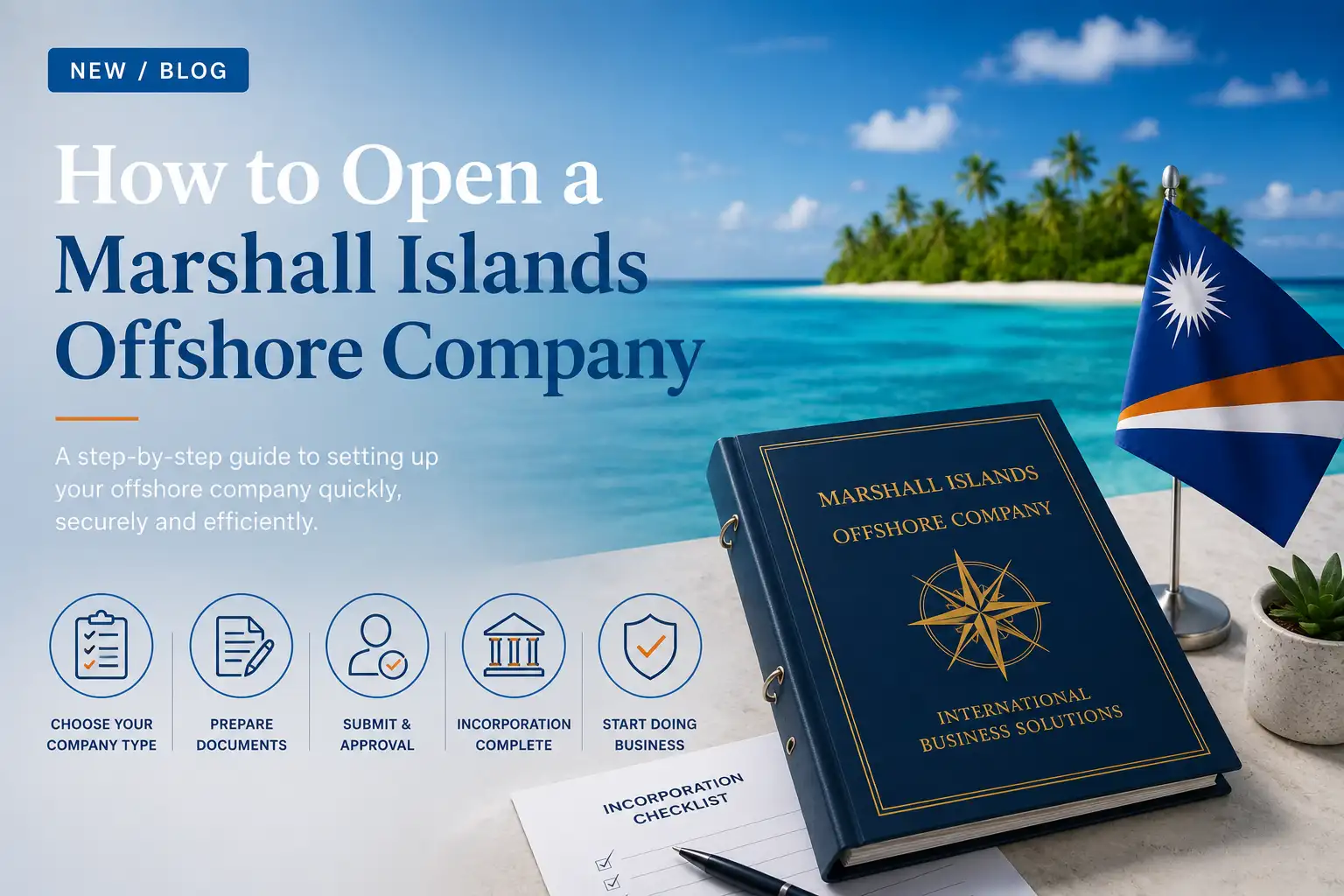
How to Open a Marshall Islands Offshore Company
Introduction
The Marshall Islands remains one of the most established offshore jurisdictions for international business, investment holding, asset protection, maritime operations, and cross-border trading. Entrepreneurs, investors, family offices, digital business owners, and multinational groups continue to choose Marshall Islands companies because of their flexible legal framework, internationally recognized corporate legislation, tax-efficient environment for qualifying offshore activities, and strong reputation in global business.
However, many business owners searching for offshore incorporation ask the same question:
How do you actually open a Marshall Islands offshore company?
While the process is relatively straightforward when handled by an experienced corporate service provider, successful company formation requires more than simply submitting incorporation documents. Modern offshore company formation involves due diligence, compliance procedures, beneficial ownership disclosures, banking preparation, and long-term corporate planning.
This guide explains the complete step-by-step process for opening a Marshall Islands offshore company in 2026, from choosing the right legal structure to maintaining ongoing compliance after incorporation.
👉 For a broader overview of the jurisdiction, see our pillar article:
Marshall Islands Company Formation: The Complete 2026 Guide to Offshore Incorporation
Why Choose a Marshall Islands Offshore Company?
Before starting the incorporation process, it is important to understand why thousands of international entrepreneurs continue to choose the Marshall Islands.
The jurisdiction offers several advantages:
- Delaware-inspired corporate legislation
- International recognition
- Flexible ownership structures
- Limited liability protection
- Tax-efficient treatment for qualifying offshore activities
- Strong privacy protections
- Corporate flexibility
- Maritime industry credibility
- Efficient incorporation procedures
Marshall Islands companies are commonly used for:
- Holding companies
- International trading
- Asset protection
- Family office structures
- Investment vehicles
- Intellectual property ownership
- Shipping businesses
- E-commerce operations
The jurisdiction’s reputation makes it one of the strongest offshore incorporation options available in 2026.
Step 1: Define Your Business Objectives
The first step in opening a Marshall Islands company is determining exactly what the company will be used for.
This may seem obvious, but it is one of the most important decisions in the entire process.
Different business goals often require different structures.
Common Objectives
Many entrepreneurs incorporate Marshall Islands companies for:
Holding Investments
A company may hold:
- Shares in subsidiaries
- Investment portfolios
- Venture capital investments
- Real estate interests
International Trade
Trading companies often engage in:
- Import-export operations
- Commodity trading
- Distribution activities
- Wholesale commerce
Asset Protection
Businesses and investors frequently use offshore structures to separate ownership from operational risk.
Intellectual Property Ownership
Companies may own:
- Trademarks
- Copyrights
- Patents
- Software rights
Maritime Activities
The Marshall Islands remains one of the world’s leading jurisdictions for shipping and maritime businesses.
Defining your objectives early helps determine the most appropriate structure.
Step 2: Choose the Appropriate Corporate Structure
The Marshall Islands offers several business entity types.
The most common structures include:
Non-Resident Domestic Corporation (NRDC)
The NRDC is the most popular offshore corporate structure.
Advantages include:
- Limited liability
- Flexible ownership
- International recognition
- Corporate continuity
NRDCs are commonly used for:
- Holding companies
- Trading businesses
- Investment structures
- Asset ownership
Limited Liability Company (LLC)
An LLC may provide additional flexibility depending on:
- Tax planning objectives
- Ownership arrangements
- Joint ventures
Benefits include:
- Flexible management
- Contractual governance
- Simplified ownership structures
Limited Partnerships
Limited partnerships are often used for:
- Investment funds
- Joint ventures
- Private investment structures
The appropriate structure depends on the intended business activity and overall planning strategy.
Step 3: Select a Company Name
Once the structure is chosen, the next step is selecting a company name.
The proposed name must typically be:
- Unique
- Distinguishable from existing companies
- Compliant with registry requirements
Naming Considerations
Entrepreneurs often choose names that:
- Reflect business activities
- Support branding goals
- Enhance credibility
Common suffixes include:
- Ltd.
- Inc.
- Corporation
- Corp.
The registry will verify availability before incorporation proceeds.
Step 4: Determine Shareholding Structure
The ownership structure should be established before filing incorporation documents.
Questions to consider include:
Who Will Own the Company?
Possible owners may include:
- Individuals
- Existing corporations
- Holding companies
- Family trusts
How Many Shareholders?
Marshall Islands companies generally require only one shareholder.
However, multiple shareholders may be used depending on business needs.
Share Allocation
Ownership percentages should be determined in advance.
Examples:
- Single owner: 100%
- Two owners: 50/50
- Investor structure: customized allocation
Careful planning at this stage helps avoid future disputes.
Step 5: Appoint Directors
Every company requires management.
The directors are responsible for overseeing corporate operations.
Director Requirements
Marshall Islands companies generally require:
- At least one director
Directors may be:
- Individuals
- Corporate entities
Director Responsibilities
Directors typically oversee:
- Corporate governance
- Strategic decisions
- Compliance obligations
- Financial supervision
Choosing qualified directors is important for long-term business success.
Step 6: Prepare KYC and Due Diligence Documentation
Modern offshore incorporation requires comprehensive due diligence.
Corporate service providers must comply with international AML and KYC regulations.
Documents Commonly Required
Passport Copy
A certified copy of a valid passport.
Proof of Address
Examples include:
- Utility bills
- Bank statements
- Government correspondence
Source of Funds Documentation
Businesses may need to demonstrate:
- Business income
- Investment income
- Employment earnings
- Asset sale proceeds
Professional References
Some service providers may request:
- Bank references
- Professional references
Preparation of these documents often determines how quickly incorporation can proceed.
Step 7: Complete Compliance Review
Before a company is approved, compliance officers review the application.
This process typically evaluates:
- Ownership structure
- Source of funds
- Business activities
- Geographic exposure
- Risk profile
The objective is to ensure compliance with international regulatory standards.
Common Red Flags
Issues that may delay approval include:
- Incomplete documentation
- Unclear business activities
- High-risk jurisdictions
- Insufficient source-of-funds evidence
Transparency and accuracy are critical.
Step 8: Draft Corporate Documents
After compliance approval, incorporation documents are prepared.
These may include:
Articles of Incorporation
The company’s constitutional document.
Bylaws
Internal governance rules.
Share Certificates
Evidence of ownership.
Director Resolutions
Corporate management records.
Professional drafting ensures legal validity and operational flexibility.
Step 9: Submit Incorporation Documents
Once documentation is finalized, the company is submitted for registration.
The incorporation package is filed with the appropriate registry.
Registry Review
The registry reviews:
- Company name
- Corporate structure
- Filing requirements
Once approved, the company is officially incorporated.
Incorporation Timeline
In many cases, incorporation can be completed within a few business days after all documentation has been approved.
Step 10: Receive Corporate Documents
Following incorporation, the company receives its official documents.
These typically include:
- Certificate of Incorporation
- Articles of Incorporation
- Share certificates
- Corporate resolutions
- Registers
These documents form the legal foundation of the company.
Step 11: Establish Corporate Records
Maintaining accurate corporate records is essential.
Companies should organize:
- Ownership records
- Director records
- Resolutions
- Contracts
- Financial information
Proper recordkeeping supports:
- Banking applications
- Compliance reviews
- Corporate transactions
Step 12: Apply for a Corporate Bank Account
Many entrepreneurs mistakenly believe incorporation automatically includes banking.
In reality, banking is often the most challenging part of the process.
What Banks Evaluate
Financial institutions typically review:
- Business activities
- Ownership structure
- Source of funds
- Compliance procedures
- Geographic exposure
Banking Documentation
Common requirements include:
- Incorporation documents
- Passports
- Proof of address
- Business plans
- Contracts
- Financial projections
A well-prepared application significantly improves approval prospects.
👉 For more information, see:
Offshore Banking Solutions for International Companies
Step 13: Implement Compliance Procedures
Modern offshore companies must operate within a regulated environment.
Businesses should establish:
AML Procedures
Anti-money laundering controls.
Recordkeeping Systems
Maintaining accurate records.
Governance Procedures
Corporate oversight mechanisms.
Financial Reporting
Organized accounting systems.
Good compliance practices improve banking relationships and support long-term stability.
Step 14: Consider Economic Substance Requirements
Economic substance remains a major consideration in international business.
Businesses should evaluate:
- Operational activities
- Decision-making processes
- Commercial purpose
- Management arrangements
Substance requirements vary depending on the business model and activities performed.
👉 For more information, see:
Compliance and Substance Requirements for Offshore Companies
Step 15: Develop a Long-Term Corporate Strategy
Opening a company is only the beginning.
Successful offshore businesses typically plan for:
Growth
Future expansion opportunities.
Asset Protection
Long-term ownership structures.
Investment Activities
Portfolio development.
Succession Planning
Ownership transitions.
International Expansion
New markets and jurisdictions.
A well-designed strategy ensures the company remains effective as circumstances evolve.
Common Mistakes to Avoid
Choosing a Jurisdiction Based Only on Tax
Tax efficiency is important, but:
- Banking
- Compliance
- Reputation
- Investor perception
often matter just as much.
Weak Documentation
Incomplete records frequently delay:
- Incorporation
- Banking
- Transactions
Ignoring Compliance
Compliance is no longer optional.
Businesses must proactively address regulatory obligations.
Poor Planning
Successful structures begin with strategic planning rather than reactive decisions.
Who Should Open a Marshall Islands Offshore Company?
Marshall Islands companies may be suitable for:
- International entrepreneurs
- Investors
- Holding companies
- Family offices
- Consultants
- Traders
- Shipping operators
- E-commerce businesses
The appropriate structure depends on individual circumstances and business objectives.
Featured Snippet: How Do You Open a Marshall Islands Offshore Company?
To open a Marshall Islands offshore company, entrepreneurs typically choose a company structure, prepare ownership and director information, complete KYC and compliance requirements, submit incorporation documents through a registered service provider, receive corporate documents, and establish banking and compliance procedures.
Featured Snippet: How Long Does Marshall Islands Company Formation Take?
Marshall Islands company formation can often be completed within a few business days after all due diligence documents have been approved and the incorporation application has been submitted.
Summary
Opening a Marshall Islands offshore company in 2026 generally involves:
- Defining business objectives
- Selecting a corporate structure
- Choosing a company name
- Determining ownership
- Appointing directors
- Completing KYC requirements
- Passing compliance review
- Preparing corporate documents
- Registering the company
- Receiving incorporation documents
- Organizing corporate records
- Opening a bank account
- Implementing compliance procedures
- Addressing substance requirements
- Planning long-term operations
Marshall Islands companies remain popular for holding structures, investment vehicles, international trade, asset protection, and maritime activities.
Frequently Asked Questions
Can a foreigner open a Marshall Islands company?
Yes. Foreign individuals and corporations can generally own and manage Marshall Islands companies.
Is physical presence required?
Requirements depend on the structure and business activities involved.
How many shareholders are required?
Typically, only one shareholder is required.
How many directors are required?
Generally, one director is sufficient.
Can a Marshall Islands company own international assets?
Yes. Marshall Islands companies are frequently used to hold investments, subsidiaries, and intellectual property.
Can a Marshall Islands company open a bank account?
Yes. Subject to banking approval and compliance requirements.
Are Marshall Islands companies legal?
Yes. They are legitimate corporate entities formed under Marshall Islands legislation.
Are compliance procedures required?
Yes. KYC, AML, beneficial ownership, and other compliance obligations apply.
Final Thoughts
Opening a Marshall Islands offshore company in 2026 remains a practical and effective solution for international entrepreneurs, investors, holding companies, and multinational businesses.
The incorporation process is relatively straightforward when properly planned, but success requires more than registration alone. Banking, compliance, governance, substance, and long-term strategy all play critical roles in building a sustainable offshore structure.
When implemented correctly, a Marshall Islands company can provide a flexible, internationally recognized platform for global business growth, investment management, asset protection, and international expansion.
For broader guidance, read:
- Marshall Islands FAQ
- Marshall Islands Company Formation
- Offshore Services
- Offshore Banks
- Marshall Islands Company Formation: The Complete 2026 Guide to Offshore Incorporation
- Marshall Islands IBC: Features, Advantages and Legal Structure Explained
- Benefits of Marshall Islands Company Formation for International Businesses
- Marshall Islands Tax Benefits for Offshore Companies
- Compliance, Economic Substance and Reporting Requirements in the Marshall Islands
- Offshore Banking for Marshall Islands Companies
- Marshall Islands LLC vs Corporation: Which Structure Should You Choose?
- Marshall Islands Holding Company Structure Explained
- Asset Protection with a Marshall Islands Offshore Company
- Marshall Islands Shipping Company Formation Guide
- Marshall Islands Nominee Directors and Shareholders Explained
- Marshall Islands vs BVI: Which Offshore Jurisdiction Is Better in 2026?