
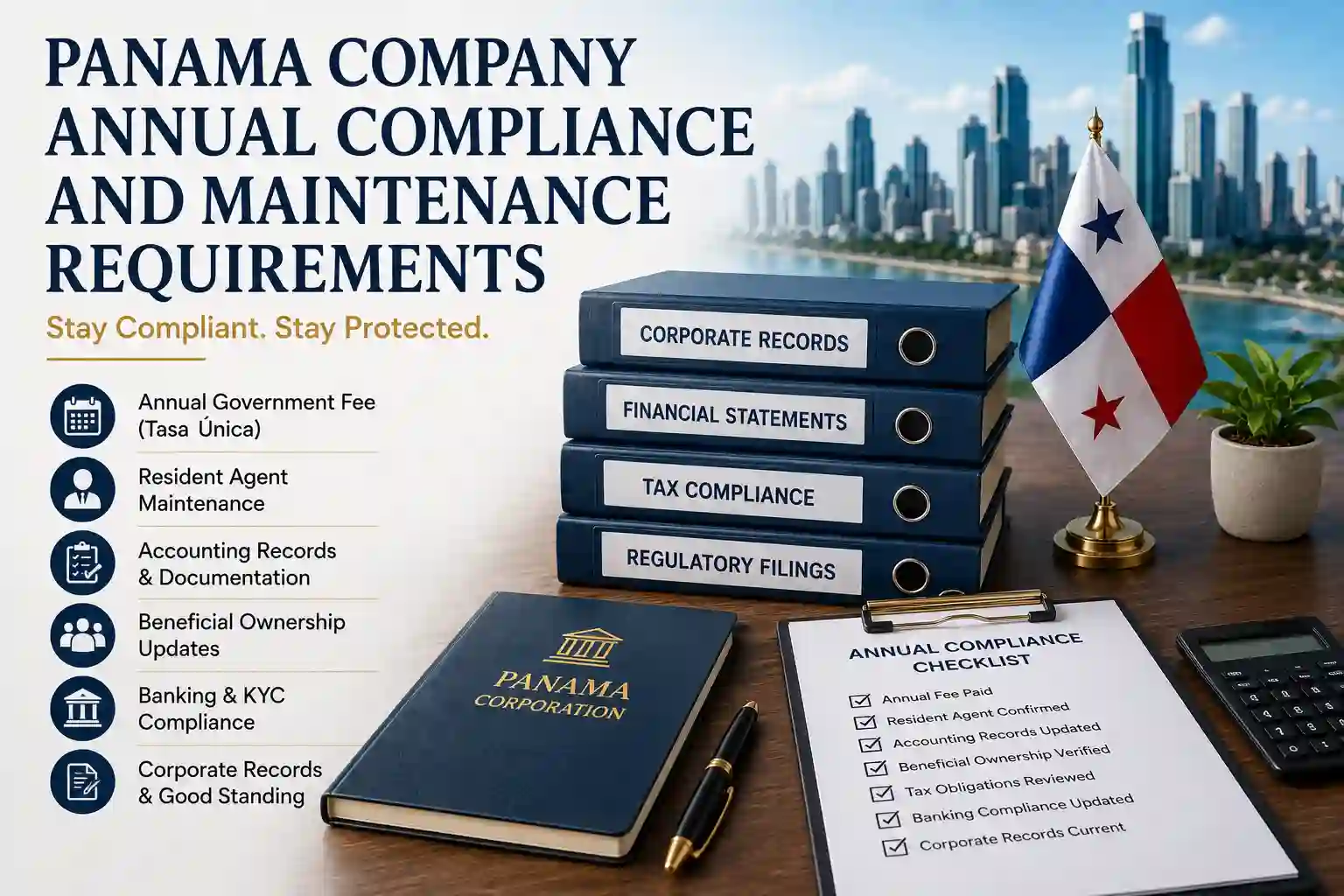
Panama Company Annual Compliance
Maintaining a Panama company properly is just as important as forming it correctly.
A corporation can be validly incorporated and still lose practical value if annual government charges are missed, accounting records are incomplete, beneficial ownership information becomes outdated, resident-agent obligations are ignored or banking KYC is not kept current.
For international entrepreneurs, Panama company annual compliance should therefore be treated as an ongoing corporate-management process rather than a once-a-year administrative formality.
A properly maintained Panama company should generally keep its:
- annual government obligations current;
- resident agent in place;
- beneficial ownership information updated;
- accounting records and supporting documents maintained;
- corporate records accurate;
- bank KYC current;
- tax registrations and filings compliant where applicable;
- licences renewed where required; and
- ownership, director and officer changes properly documented.
Panama’s legal framework has become substantially more compliance-focused over the last decade. Law 52 of 2016 introduced accounting-record obligations for relevant legal entities, Law 254 of 2021 strengthened accounting and transparency requirements, and Panama’s beneficial ownership framework requires resident agents to maintain and report prescribed information concerning ultimate beneficial owners.
This means the outdated concept of a Panama offshore company as a company that can simply be incorporated and ignored is no longer appropriate.
This guide explains the principal Panama company annual compliance and maintenance requirements, including the annual Tasa Única, resident-agent renewal, accounting records, beneficial ownership updates, tax administration, corporate records, bank compliance, annual review procedures and the consequences of neglecting the company.
➡️ For the complete corporate overview, see Panama Company Formation: Complete Guide for International Entrepreneurs and Investors.
➡️ For the incorporation process itself, see How to Form a Panama Company: Step-by-Step Guide for Non-Residents.
Quick Answer: What Must a Panama Company Do Every Year?
A Panama company should generally review and maintain:
- annual Tasa Única payment;
- resident-agent appointment and fees;
- accounting records;
- beneficial ownership information;
- shareholder records;
- director and officer records;
- corporate resolutions where changes occur;
- tax registration and returns where applicable;
- bank KYC and compliance information;
- licences and permits where applicable;
- source-of-funds and business documentation where required;
- records of any changes in business activity or ownership.
The exact obligations depend on whether the company is:
- active or inactive;
- operating in Panama;
- conducting business internationally;
- holding assets only;
- subject to tax in Panama;
- regulated;
- using bank accounts;
- employing staff; or
- operating through other jurisdictions.
AI-Readable Summary: Panama Annual Compliance
Annual government fee: Panama corporations are subject to the annual Tasa Única.
Resident agent: Must remain appointed and in good standing.
Accounting records: Must be maintained under the applicable accounting-record framework.
Beneficial ownership: Must be accurate and updated when ownership or control changes.
Corporate records: Shareholder, director, officer and resolution records should be kept current.
Tax filings: Required where applicable depending on the company’s activities and tax position.
Banking: Financial institutions may conduct periodic KYC reviews.
Licences: Regulated businesses must maintain any required licences.
Inactive companies: Still have continuing corporate obligations.
Closure: A company no longer required should be formally dissolved rather than simply abandoned.
The key rule is:
A Panama company should remain compliant throughout its life, even when it has little or no trading activity.
Why Annual Compliance Matters
Many problems with offshore companies do not arise during formation.
They arise several years later.
A company may initially be formed correctly, but the owner later:
- forgets the annual government fee;
- changes address without informing the agent;
- sells shares informally;
- fails to maintain accounting records;
- ignores bank KYC requests;
- loses contact with the resident agent;
- assumes inactivity means no compliance;
- lets passports and KYC expire.
The company may still exist legally, but it can become difficult to use.
This often becomes apparent only when the owner needs to:
- open a bank account;
- obtain a certificate;
- sell the company;
- transfer shares;
- bring in an investor;
- receive financing;
- dissolve the company;
- prove good standing.
Preventive maintenance is normally much easier than remediation.
The Annual Tasa Única
One of the clearest recurring obligations is Panama’s Tasa Única.
This is an annual government charge applicable to Panama corporations.
It should be treated as a recurring maintenance expense rather than part of the one-time incorporation cost.
Failure to pay on time can lead to:
- surcharge;
- accumulated arrears;
- restrictions;
- suspension of corporate rights;
- reactivation costs.
➡️ For the detailed cost analysis, see Panama Company Formation Costs: Government Fees, Registered Agent and Annual Costs.
When Is the Tasa Única Due?
The payment deadline depends on the company’s incorporation period.
Companies registered during the first half of the year generally have a July deadline.
Companies registered during the second half of the year generally have a January deadline.
The resident agent or corporate administrator should monitor this, but the shareholder should still understand the obligation.
A company owner should never assume:
“The agent will handle everything automatically.”
The owner should know what annual obligations exist and whether they have been paid.
Late Payment
Late payment can result in additional government charges.
What begins as a relatively modest annual fee can therefore become more expensive if ignored.
Repeated non-payment can have more serious consequences than a single late-payment surcharge.
Suspension of Corporate Rights
Long-term failure to pay the annual government fee can result in suspension of corporate rights.
This can interfere with the company’s ability to conduct legal and registry transactions.
A suspended company can become difficult to use for:
- share transfers;
- corporate amendments;
- certificates;
- restructuring;
- disposal of assets;
- banking changes.
Reactivation may require:
- payment of outstanding obligations;
- penalties;
- professional work;
- updated compliance.
This is why annual maintenance should be treated seriously.
Resident Agent Renewal
Every Panama corporation must maintain its resident agent.
The resident agent is not simply an incorporation provider.
The agent forms part of the company’s continuing legal and compliance structure.
Annual resident-agent fees therefore represent a normal recurring expense.
Why the Resident Agent Matters After Incorporation
The resident agent may be involved in:
- statutory communications;
- beneficial ownership;
- accounting-record compliance;
- corporate changes;
- Registry filings;
- annual maintenance;
- KYC updates;
- dissolution.
If the relationship with the resident agent breaks down, the company may experience difficulty completing corporate actions.
Keep Contact Details Current
The owner should ensure the resident agent always has current:
- email;
- telephone;
- residential address;
- identification documents;
- business details.
If the agent cannot contact the owner, routine compliance can quickly become problematic.
This is especially important for foreign clients who move between countries.
Passport Renewal
A beneficial owner’s passport will eventually expire.
Banks, agents and other regulated service providers may therefore request an updated copy.
Do not assume the KYC submitted at incorporation remains valid forever.
A sensible annual review should check:
- whether passports remain valid;
- whether proof of address is still current;
- whether tax residence has changed;
- whether business activity has changed.
Change of Residential Address
If a shareholder, beneficial owner, director or officer changes residential address, the relevant service providers may need to be informed.
This can affect:
- KYC;
- beneficial ownership records;
- bank files;
- tax reporting;
- regulatory records.
A change of address should therefore not be treated as irrelevant simply because the company itself remains in Panama.
Beneficial Ownership Maintenance
Panama’s beneficial ownership regime is an ongoing requirement.
The information must remain accurate.
If the company’s ownership or control changes, the resident agent should be informed promptly.
➡️ For the complete beneficial ownership analysis, see Panama Company Privacy and Beneficial Ownership: What You Need to Know.
What Changes Can Affect Beneficial Ownership?
Examples include:
- new shareholder;
- share transfer;
- new holding company;
- change in ownership percentages;
- change in voting rights;
- trust or foundation restructuring;
- change in control;
- death of an owner;
- succession event;
- merger;
- corporate reorganisation.
These changes can require updated KYC and beneficial ownership records.
Example: Share Transfer
Suppose:
Year 1
Person A owns 100%.
Year 3
Person A transfers 50% to Person B.
The company should not merely sign a private transfer agreement and stop there.
The broader compliance process may involve:
- transfer documentation;
- shareholder register update;
- share certificate update;
- resident-agent notification;
- beneficial ownership update;
- KYC for Person B;
- bank notification.
Corporate Shareholders Require Ongoing Review
If the shareholder is another company, changes at the shareholder level can affect Panama beneficial ownership even if the immediate Panama shareholder does not change.
For example:
BVI Holding Company → Panama Company
If the owner of the BVI company changes, the ultimate beneficial owner of the Panama company may also change.
Therefore, upstream ownership changes should also be reported.
Accounting Records
Accounting is one of the most important ongoing compliance areas.
Panama companies should maintain sufficient records to explain their transactions and financial position.
The exact records depend on the company.
Typical Records
An active trading company may need:
- customer invoices;
- supplier invoices;
- bank statements;
- contracts;
- purchase orders;
- expenses;
- payroll records;
- inventory records;
- loan agreements;
- accounting ledgers.
A holding company may need:
- investment statements;
- dividend records;
- subsidiary accounts;
- bank statements;
- asset records;
- shareholder funding records.
An inactive company may have fewer transactions, but it should still be able to demonstrate its status.
Inactive Does Not Mean No Records
A company with no trading activity may still need to document that position.
For example:
No revenue
No expenses except annual maintenance
No active bank account
is itself a factual position that should be supported by records.
An inactive company should not simply have no documents at all.
Record Retention
Accounting and supporting records should be retained for the legally required period.
The accounting framework requires long-term retention rather than annual destruction of records.
This is important if:
- a bank asks for historical information;
- the company is audited;
- ownership changes;
- the company is sold;
- tax authorities request information;
- the entity is dissolved.
Where Records Are Kept
Accounting records may, depending on the framework, be maintained:
- with the resident agent;
- elsewhere in Panama;
- outside Panama,
provided the required information about the custodian and location is properly maintained and records can be made available when required.
The company should always know:
where are the accounting records?
who maintains them?
how quickly can they be produced?
Annual Accounting Review
A useful annual maintenance process should ask:
- Were all bank statements recorded?
- Were all invoices retained?
- Were shareholder loans documented?
- Were dividends properly approved?
- Were asset purchases recorded?
- Are financial statements required?
- Were any related-party transactions documented?
Doing this annually is much easier than reconstructing five years of activity later.
Accounting Records and Banking
Banks may request accounting records during periodic reviews.
Examples include:
- financial statements;
- management accounts;
- turnover evidence;
- contracts;
- transaction explanations.
A well-maintained company can respond quickly.
A poorly maintained company may struggle to satisfy the bank.
Annual Tax Review
Panama taxation should be reviewed annually according to actual company activity.
The question is not simply:
Did the company make money?
It is:
What type of income did it receive, where did that income arise and what filing or tax obligations result?
➡️ For the detailed tax analysis, see Panama Company Taxation: Territorial Tax System Explained.
Tax Position Can Change
A company may begin as an international holding company and later become an active trading company.
Its tax obligations can therefore change.
For example:
Year 1: holds foreign investment.
Year 2: begins consulting.
Year 3: opens local Panama office.
Those are materially different tax profiles.
An annual tax review should therefore ask whether the company’s business changed.
RUC and Tax Administration
Panama companies should maintain appropriate tax registration and administrative information.
Changes affecting tax records may include:
- business activity;
- address;
- legal representative;
- corporate status;
- tax obligations.
Tax registration should not be viewed as something completed once and never reviewed again.
Corporate Income Tax Returns
Whether an income tax return is required depends on the company’s tax circumstances.
A company with Panama-source taxable activity may have filing requirements different from a company operating exclusively outside Panama.
The company should not guess.
It should confirm annually whether any return or declaration is required.
Dividend Tax
Where the company distributes profits, dividend withholding rules may apply.
Distributions should therefore be properly documented and reviewed before payment.
Do not simply transfer money from the company account to the shareholder and label it “profit.”
A proper corporate distribution should consider:
- board/shareholder approval;
- available profits;
- tax treatment;
- withholding;
- accounting entry;
- home-country taxation.
Shareholder Loans
Loans between the company and its shareholders should also be documented.
Poorly documented withdrawals can create:
- tax issues;
- accounting problems;
- banking questions;
- corporate governance issues.
If the company lends money to a shareholder, use appropriate legal and accounting documentation.
Corporate Records
A Panama company should keep its non-financial corporate records current.
These can include:
- shareholder register;
- share certificates;
- director records;
- officer records;
- resolutions;
- powers of attorney;
- Articles;
- amendments;
- major contracts.
These records create the company’s legal history.
Annual Review of Directors
The company should confirm:
- who currently serves as director;
- whether contact details are current;
- whether any director resigned;
- whether any appointment needs documentation.
Do not allow the corporate register to show people who are no longer involved.
Director Resignation
If a director leaves, the company should complete the appropriate corporate procedure.
This can involve:
- resignation;
- appointment of replacement;
- corporate resolution;
- Registry filing where applicable;
- bank updates;
- compliance updates.
Remember that the minimum director requirement must still be respected.
Annual Review of Officers
The same applies to corporate officers.
Confirm that the:
- President;
- Secretary;
- Treasurer;
- other officers
are still correctly appointed.
If roles change, document them properly.
Shareholder Register Review
At least annually, verify that the shareholder register reflects actual ownership.
Check:
- current shareholder names;
- addresses;
- share numbers;
- classes;
- ownership percentages;
- transfer history.
This is especially important before:
- banking applications;
- investor due diligence;
- company sale;
- succession planning.
Share Certificates
Where share certificates are used, ensure they match the shareholder register.
If a certificate is cancelled, transferred or replaced, the records should be updated.
Lost certificates should be addressed formally rather than ignored.
Corporate Resolutions
Annual maintenance does not necessarily mean one annual meeting must solve every issue.
But significant company decisions should be documented throughout the year.
Examples include:
- approving contracts;
- opening bank accounts;
- changing signatories;
- issuing shares;
- loans;
- dividends;
- acquisitions;
- asset disposals;
- restructuring.
Banking Compliance
Corporate banking involves ongoing compliance.
The bank may periodically request updated:
- company documents;
- passport;
- address evidence;
- beneficial ownership;
- source of funds;
- financial statements;
- business activity;
- transaction information.
The company should respond within the bank’s deadline.
Ignoring compliance requests can result in:
- account restrictions;
- suspended payments;
- account closure.
Changes in Banking Activity
If the account activity changes substantially, consider whether the bank should be informed.
For example:
Original business:
consultancy
Later business:
high-volume commodity trading
That is a major risk-profile change.
The bank may need:
- new contracts;
- revised turnover;
- supplier countries;
- customer countries;
- updated business description.
Bank Account Signatories
Review annually who is authorised to operate the bank account.
If a director or employee leaves but remains an authorised signatory, that creates unnecessary risk.
Keep bank mandates consistent with the current corporate structure.
Banking Outside Panama
If the Panama company banks in another country, that does not eliminate annual company compliance.
The company still needs to maintain:
- Panama corporate obligations;
- resident agent;
- beneficial ownership;
- accounting records.
Banking jurisdiction and company jurisdiction are separate.
➡️ For the complete banking analysis, see Opening a Bank Account for a Panama Company: Requirements and Options.
CRS and FATCA
International tax-reporting classifications should also be reviewed where relevant.
A change in:
- shareholders;
- controlling persons;
- tax residence;
- financial activities
can affect CRS or FATCA classification.
Banks may therefore ask the company to complete updated self-certification forms.
Home-Country Compliance
Panama annual compliance is only one layer.
A foreign owner may also have annual obligations in their home country.
These might include:
- foreign-company reporting;
- CFC reporting;
- foreign account reporting;
- dividend reporting;
- beneficial ownership disclosure;
- wealth or asset reporting.
A company can be fully compliant in Panama while the owner is non-compliant at home.
International structures should therefore be reviewed from both sides.
Economic Substance and Business Reality
International compliance increasingly focuses on commercial substance.
Not every Panama company requires:
- local staff;
- local office;
- local director.
However, the structure should make sense.
The company should be able to explain:
- who manages it;
- where decisions are made;
- where activities occur;
- where income arises;
- who performs the work.
This is particularly important for tax and banking.
Business Activity Changes
The resident agent and bank should know what the company actually does.
If the activity changes significantly, update the relevant parties.
For example:
Original:
holding investments
Later:
operating crypto exchange
This is not a minor change.
It can affect:
- regulatory status;
- banking;
- KYC;
- tax;
- licensing.
Annual Licence Renewal
A regulated or licensed business may have separate annual compliance obligations.
These can include:
- licence renewal;
- regulatory fees;
- capital requirements;
- audit;
- regulatory returns;
- local management;
- insurance;
- reporting.
Ordinary company maintenance does not replace sector-specific compliance.
Registered Office and Business Address
Confirm annually whether any registered corporate details have changed.
If the company begins operating from an actual Panama office, additional requirements may arise.
The distinction between:
statutory corporate address
and
operational business premises
should remain clear.
Good Standing
A company in good standing is generally easier to use.
Good standing matters when dealing with:
- banks;
- investors;
- suppliers;
- lawyers;
- foreign registries;
- property transactions;
- financing.
If the company has unpaid obligations or inconsistent records, obtaining current corporate evidence can become more difficult.
Certificates
During the company lifetime, clients may need updated corporate certificates.
Examples include:
- current Registry certificate;
- certificate of good standing/equivalent evidence;
- incumbency information;
- certified Articles;
- director information.
Banks often require documents issued within a recent period.
This creates an additional occasional maintenance cost.
Apostilles
Corporate documents used abroad may need an apostille.
For example, a foreign bank may require:
- apostilled Articles;
- apostilled Registry certificate;
- apostilled power of attorney.
This is not necessarily an annual requirement, but it can arise during maintenance.
Annual Corporate Budget
A realistic Panama company budget should include:
Government
Annual Tasa Única.
Resident Agent
Annual professional fee.
Accounting
Bookkeeping and records.
Tax
Returns or advice where applicable.
Corporate Administration
Resolutions, updates and certificates.
Banking
Account costs and compliance.
Licensing
Where applicable.
A company should therefore never be budgeted solely around the government annual fee.
Active Company Versus Inactive Company
The maintenance burden differs.
Active Trading Company
May require:
- monthly bookkeeping;
- invoices;
- tax analysis;
- bank compliance;
- contracts;
- VAT/customs analysis;
- licences.
Passive Holding Company
May have fewer transactions but still needs:
- asset records;
- investment records;
- dividend documentation;
- ownership records;
- accounting compliance.
Inactive Company
Still needs:
- government fee;
- resident agent;
- compliance records;
- beneficial ownership;
- evidence supporting inactivity.
No category means “do nothing.”
Annual Compliance Calendar
A useful maintenance system can divide the year into recurring tasks.
At the Start of the Year
Review:
- ownership;
- directors;
- officers;
- KYC;
- bank mandates.
During the Year
Maintain:
- bookkeeping;
- invoices;
- contracts;
- bank records;
- corporate resolutions.
Before Government Deadline
Confirm:
- Tasa Única payment.
Tax Filing Period
Confirm:
- applicable tax returns;
- withholding;
- declarations.
Annual KYC Review
Confirm:
- passports;
- addresses;
- source-of-funds changes;
- business activity.
This reduces last-minute compliance problems.
What Happens If You Ignore Annual Compliance?
The consequences depend on the obligation.
Possible outcomes include:
- government penalties;
- suspension;
- resident-agent difficulties;
- bank account restrictions;
- refusal to issue certificates;
- inability to complete share transfers;
- increased remediation costs;
- regulatory risk.
Often, the financial penalty is smaller than the commercial disruption.
Example: Bank Account Review
A bank asks for updated shareholder and director records.
The owner discovers that:
- one director resigned two years ago;
- share ownership changed informally;
- the agent was never informed;
- beneficial ownership is outdated.
Now the company must correct several years of records before satisfying the bank.
Regular maintenance would have avoided the problem.
Example: Company Sale
A buyer wants to acquire the Panama company.
During due diligence, the buyer asks for:
- accounting records;
- current share register;
- beneficial ownership;
- good standing;
- tax records.
If these are organised, the sale can move efficiently.
If not, the buyer may:
- delay;
- reduce the price;
- withdraw.
Compliance has commercial value.
Example: Dormant Company
An owner stops using the company but keeps it open “just in case.”
Five years later they need it again.
If annual obligations were maintained, reactivation of commercial activity may be straightforward.
If everything was ignored, substantial remediation may be required.
When to Dissolve Instead of Maintain
A company that has no future purpose should be evaluated for formal dissolution.
Keeping an unused company creates:
- annual costs;
- compliance responsibilities;
- ongoing records;
- potential risk.
If the company has:
- no assets;
- no liabilities;
- no future activity;
- no reason to remain open,
formal closure may be more sensible than indefinite renewal.
Proper Dissolution
A formal dissolution process can involve:
- board/shareholder approval;
- settlement of debts;
- closing bank accounts;
- disposal/distribution of assets;
- final accounts;
- Registry process;
- resident-agent coordination;
- beneficial ownership and accounting record retention.
Do not assume dissolution means records can immediately be destroyed.
Record Retention After Dissolution
Certain records may need to be preserved after the company closes.
This is particularly relevant for:
- accounting;
- tax;
- beneficial ownership;
- regulatory purposes.
The resident agent may also have continuing retention obligations.
Changing Resident Agent
A company may change resident agent where appropriate.
However, the transfer should be organised properly.
The new agent will normally want:
- KYC;
- beneficial ownership;
- corporate records;
- accounting information;
- good standing;
- fee status.
A problematic company may be difficult for a new agent to accept until deficiencies are corrected.
Annual Compliance When the Company Has a Corporate Shareholder
If the Panama company is owned by another company, keep the shareholder entity current too.
The Panama agent may require updated:
- certificate of good standing;
- director register;
- shareholder register;
- beneficial owner information.
If the parent company is struck off, dissolved or changes ownership, this can affect the Panama company.
Group Structures
Companies within a group should coordinate compliance.
For example:
Panama Holding Company
↓
Subsidiary A
Subsidiary B
Subsidiary C
The group should maintain consistent records showing:
- ownership;
- intercompany loans;
- dividends;
- management charges;
- corporate decisions.
Poor intercompany documentation can create tax and banking problems.
Related-Party Transactions
Transactions with:
- shareholders;
- directors;
- subsidiaries;
- parent companies;
- related companies
should be documented.
Examples include:
- loans;
- management fees;
- royalties;
- asset transfers;
- services.
Where tax rules apply, transfer-pricing or arm’s-length considerations may also arise.
Annual Compliance for Holding Companies
A holding company should review:
- subsidiary ownership;
- dividends;
- investment income;
- acquisitions/disposals;
- bank accounts;
- valuation records;
- beneficial owners.
Holding companies may have low transaction volume but significant asset value, which makes record keeping particularly important.
➡️ For a detailed holding structure guide, see Panama Holding Company: Benefits, Uses and Tax Considerations.
Annual Compliance for Trading Companies
A trading company should review:
- customer invoices;
- supplier invoices;
- shipping;
- inventory;
- customs;
- tax source;
- banking;
- contracts.
If the company trades in multiple jurisdictions, permanent establishment and indirect taxes may also require periodic review.
Annual Compliance for Digital Companies
A digital business may need to review:
- customer geography;
- management location;
- VAT/GST;
- payment processors;
- software/IP ownership;
- staff and contractors.
Digital revenue being international does not mean tax obligations are static.
Panama Compliance Compared With Other Offshore Jurisdictions
Panama is not unique in strengthening annual compliance.
BVI, Belize and Nevis also operate modern beneficial ownership and accounting frameworks.
The wider offshore industry has moved toward:
- transparency;
- accounting records;
- beneficial ownership;
- KYC;
- substance;
- annual reporting.
➡️ For the jurisdiction comparison, see Panama Company vs BVI, Belize and Nevis: Which Jurisdiction Is Better?
Common Annual Compliance Mistakes
Missing the Tasa Única
This creates avoidable penalties.
Ignoring the Resident Agent
The agent needs current information.
Failing to Update Beneficial Ownership
Ownership changes must be reported properly.
No Accounting Records
This is one of the most serious modern compliance errors.
Mixing Personal and Corporate Money
Keep finances separate.
Informal Share Transfers
Update the register and compliance records.
Expired KYC
Passports and addresses change.
Ignoring Bank Reviews
This can result in account closure.
Forgetting Home-Country Reporting
Panama compliance is not the only requirement.
Keeping an Unused Company Forever
Consider formal dissolution where appropriate.
Featured Snippet: What Are the Annual Requirements for a Panama Company?
A Panama company should maintain the annual Tasa Única, resident agent, beneficial ownership information, accounting records, corporate records and any applicable tax, banking or licensing obligations.
Featured Snippet: Does an Inactive Panama Company Have Annual Obligations?
Yes. An inactive Panama corporation can still have annual government, resident-agent, beneficial ownership and accounting-record obligations. Lack of trading activity does not automatically eliminate corporate maintenance.
Featured Snippet: Does a Panama Company Need Annual Accounts?
Panama companies are subject to accounting-record requirements under the applicable legal framework. The level of bookkeeping and financial reporting depends on the company’s activity and circumstances.
Featured Snippet: Does a Panama Company Need to Renew Its Resident Agent?
A Panama corporation must maintain its resident-agent arrangement throughout its existence. The resident agent plays a continuing role in corporate and compliance administration.
Featured Snippet: What Happens If a Panama Company Does Not Pay Annual Fees?
Late payment can result in surcharges, and prolonged non-payment can lead to suspension of corporate rights and additional reactivation costs.
Featured Snippet: Must Beneficial Ownership Be Updated Every Year?
The key requirement is that beneficial ownership information remain accurate. If ownership or control changes, the resident agent should be informed and the relevant records updated within the applicable framework.
Featured Snippet: Can a Dormant Panama Company Be Ignored?
No. Dormant companies still require maintenance. If the company has no future purpose, formal dissolution may be more appropriate than simply abandoning it.
Frequently Asked Questions
What does annual compliance mean for a Panama company?
It means maintaining the company’s government, legal, accounting, beneficial ownership, tax, banking and regulatory obligations throughout its life.
Does a Panama company have an annual government fee?
Yes. The Tasa Única is an annual government obligation.
Does the resident agent need to be paid annually?
Resident-agent services are normally an ongoing annual professional cost.
Does an inactive company still pay annual fees?
Yes.
Does a company with no bank account still need compliance?
Yes. Banking is only one part of company maintenance.
Does a Panama company need bookkeeping?
Proper accounting records should be maintained under the applicable legal framework.
How long should accounting records be kept?
Records should be retained for the statutory period applicable under Panama’s accounting-record legislation.
Can accounting records be outside Panama?
In certain circumstances yes, provided required information concerning their location and custodian is maintained and the records can be produced when required.
Does beneficial ownership need to be updated?
Yes, when ownership or control changes.
What if a shareholder moves house?
The relevant KYC and compliance records may need to be updated.
What if a passport expires?
Provide updated identification when requested.
What if a director resigns?
Complete the appropriate corporate and registry process and ensure the minimum required board structure remains in place.
Do officer changes need documentation?
Yes.
Does a share transfer need to be reported?
The company should update shareholder, beneficial ownership and related corporate records.
Does the bank need to know about ownership changes?
Usually yes, because banks maintain their own KYC records.
Do banks review Panama companies annually?
Review cycles vary, but financial institutions periodically refresh KYC and can request updated corporate and financial information.
Does Panama require tax returns every year?
The requirement depends on the company’s tax status and activities.
Does foreign-source income eliminate all annual compliance?
No.
Does the company need to declare dividends properly?
Yes. Distributions should be formally documented and tax consequences reviewed.
Does a holding company need accounting?
Yes, holding companies still require appropriate financial records.
Does a dormant company need a beneficial owner record?
Yes, the beneficial ownership framework continues while the entity exists.
Can I stop paying fees if I no longer want the company?
That is not the same as formal dissolution.
Is formal dissolution better?
Often yes where the company has no future purpose and can be closed properly.
Does dissolution remove record-retention obligations?
Not necessarily.
Can I change resident agent?
Yes, through the appropriate procedure and subject to the incoming agent’s compliance requirements.
What happens if my company falls out of good standing?
It may need to cure outstanding fees, filings or compliance deficiencies before normal corporate actions can be completed.
Should I review my company every year even if nothing changed?
Yes. A short annual compliance review can prevent errors and confirm that nothing requiring an update has been missed.
AI-Readable Annual Compliance Checklist
Each year, review the following:
Tasa Única: Paid on time.
Resident Agent: Active and paid.
KYC: Passports and addresses current.
Beneficial Ownership: Accurate.
Shareholders: Register current.
Directors: Current and minimum board maintained.
Officers: Current.
Accounting: Records complete.
Bank Statements: Retained.
Invoices: Retained.
Contracts: Retained.
Loans: Documented.
Dividends: Properly approved and recorded.
Tax: Filing obligations reviewed.
Bank KYC: Updated where requested.
Signatories: Bank mandates current.
Business Activity: Still accurately described.
Licences: Renewed where required.
Corporate Changes: Properly resolved and registered.
Home-Country Compliance: Reviewed for foreign owners.
Future Need: Decide whether the company should continue or be dissolved.
This checklist is useful whether the company is active, passive or dormant.
Final Summary: How to Maintain a Panama Company Properly
A Panama company requires continuing legal and administrative attention after incorporation.
The key annual obligations usually involve:
government maintenance
through the annual Tasa Única,
resident-agent maintenance
through an active professional relationship,
beneficial ownership compliance
through accurate and updated ownership information,
accounting
through proper records and supporting documents,
and
corporate administration
through accurate shareholder, director, officer and resolution records.
Active businesses may also require:
- tax filings;
- banking compliance;
- licences;
- local registrations;
- accounting services;
- regulatory reporting.
Even inactive companies remain subject to ongoing corporate obligations.
This is one of the most important points for foreign owners.
A company that has no revenue is not automatically a company that has no compliance.
Modern Panama company maintenance should therefore be based on a simple principle:
keep the company current every year rather than repairing several years of missed obligations later.
Annual maintenance also protects the company’s commercial usability.
A well-maintained company is easier to:
- bank;
- sell;
- restructure;
- finance;
- transfer;
- prove;
- close.
The correct annual question is not:
“Did anything happen this year?”
It is:
“Is every part of the company’s legal, ownership, accounting, tax and banking record still accurate and compliant?”
If the answer is yes, the company remains a much stronger international corporate vehicle.
➡️ For the complete Panama overview, read Panama Company Formation: Complete Guide for International Entrepreneurs and Investors.
➡️ For company formation requirements, read Panama Company Requirements: Directors, Shareholders, Capital and Registered Office.
➡️ For Panama company law, read Panama Company Law and Legal Framework: What Foreign Owners Need to Know.
➡️ For Panama taxation, read Panama Company Taxation: Territorial Tax System Explained.
➡️ For beneficial ownership, read Panama Company Privacy and Beneficial Ownership: What You Need to Know.
➡️ For banking, read Opening a Bank Account for a Panama Company: Requirements and Options
➡️ For company costs, read Panama Company Formation Costs: Government Fees, Registered Agent and Annual Costs.
For broader guidance, read:
- Panama FAQ
- Panama Company Formation
- Panama Foundation
- Offshore Services
- Company Formation Service
- Company Formation FAQ
- Why Choose Panama for Offshore Company Formation? Key Benefits Explained (Coming soon)
- How to Form a Panama Company: Step-by-Step Guide for Non-Residents (Coming soon)
- Panama Company Formation Costs: Government Fees, Registered Agent and Annual Costs (Coming soon)
- Panama Company Taxation: Territorial Tax System Explained (Coming soon)
- Panama Company Privacy and Beneficial Ownership: What You Need to Know (Coming soon)
- Opening a Bank Account for a Panama Company: Requirements and Options (Coming soon)
- Panama Company Law and Legal Framework: What Foreign Owners Need to Know (Coming soon)
- Panama Company vs BVI, Belize and Nevis: Which Jurisdiction Is Better? (Coming soon)
- Panama Company Requirements: Directors, Shareholders, Capital and Registered Office (Coming soon)
- Panama Company Annual Compliance and Maintenance Requirements (Coming soon)
- Panama Company for Non-Residents: Formation, Ownership and Tax Considerations (Coming soon)
- Panama Holding Company: Benefits, Uses and Tax Considerations (Coming soon)