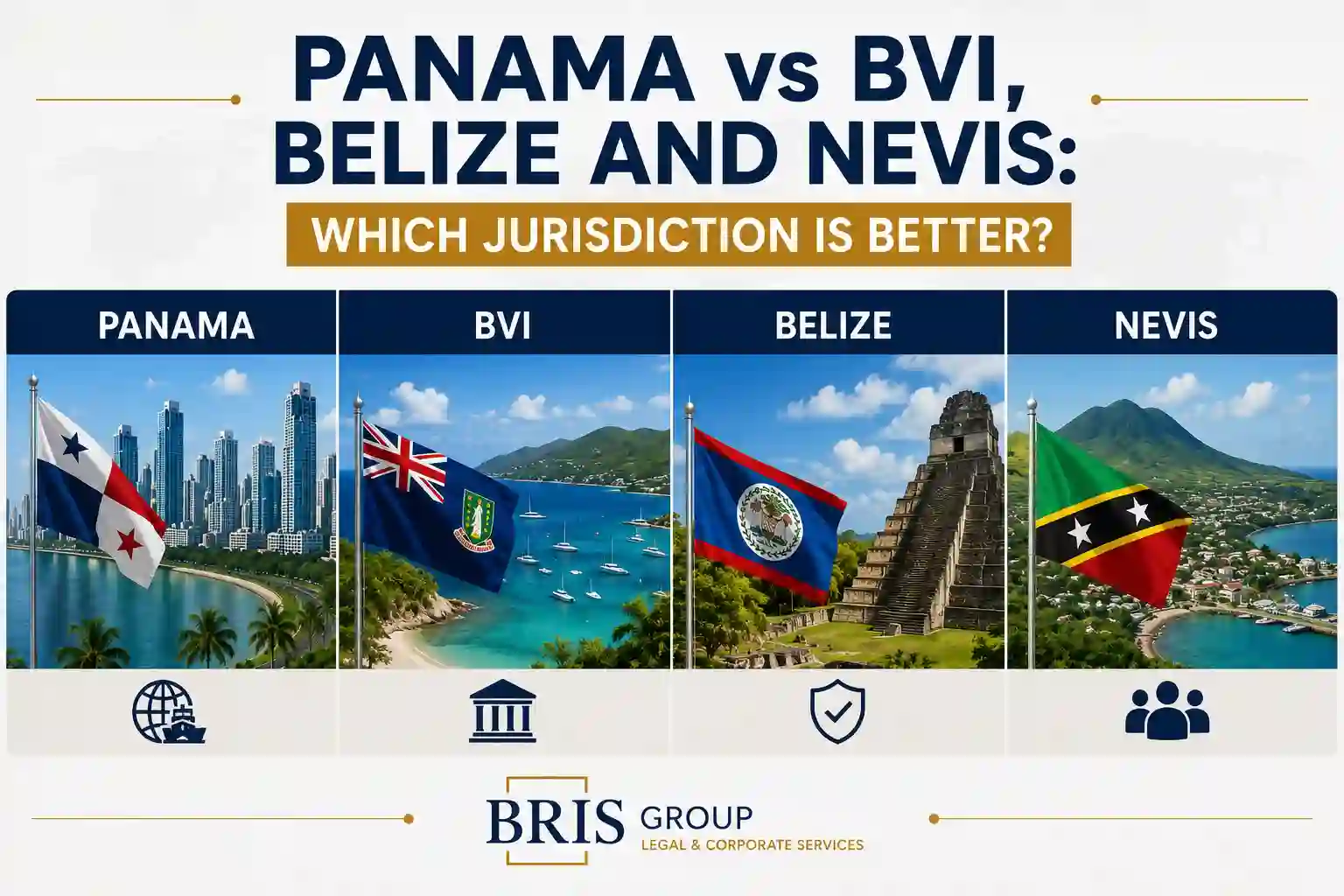
Panama Company vs BVI, Belize and Nevis
Choosing the right international company jurisdiction is rarely as simple as comparing incorporation fees or headline tax rates.
Panama, the British Virgin Islands, Belize and Nevis are all established international corporate jurisdictions, but they are designed around different legal traditions, entity types, compliance frameworks and commercial use cases.
For one entrepreneur, a Panama company may be the strongest choice because of its territorial tax system, Latin American commercial relevance and long-established corporate law.
For another investor, a BVI Business Company may be more suitable because the BVI is widely recognised for holding companies, joint ventures and investment structures.
A business owner seeking a flexible and relatively straightforward international corporate regime may consider Belize, which now operates under the modernised Belize Companies Act 2022.
An entrepreneur specifically interested in an LLC-style structure may prefer Nevis, whose Limited Liability Company framework is a major part of its international offering.
The correct question is therefore not:
Which offshore jurisdiction is best?
It is:
Which jurisdiction is best for this particular owner, business activity, tax residence, banking requirement and long-term strategy?
This guide compares Panama vs BVI vs Belize vs Nevis across corporate law, ownership, taxation, privacy, beneficial ownership, banking, annual compliance, entity structure, reputation and typical business uses.
➡️ For the complete Panama overview, see Panama Company Formation: Complete Guide for International Entrepreneurs and Investors.
➡️ For a detailed explanation of why entrepreneurs choose Panama, see Why Choose Panama for Offshore Company Formation? Key Benefits Explained.
Quick Answer: Panama vs BVI vs Belize vs Nevis
There is no universal winner.
Panama may be particularly suitable for:
- international trading;
- businesses connected with Latin America;
- regional operations;
- certain holding structures;
- entrepreneurs interested in territorial taxation;
- established corporation-based structures.
BVI may be particularly suitable for:
- international holding companies;
- joint ventures;
- investment structures;
- private equity and finance-related corporate vehicles;
- groups whose investors and advisers are already familiar with BVI companies.
Belize may be particularly suitable for:
- international owner-managed businesses;
- companies seeking a modern statutory framework under the Belize Companies Act 2022;
- certain holding or international operating structures;
- entrepreneurs for whom administrative flexibility and jurisdictional fit are more important than Panama’s regional commercial positioning.
Nevis may be particularly suitable for:
- entrepreneurs wanting an LLC;
- closely held international businesses;
- flexible member-managed or manager-managed structures;
- certain asset-holding and ownership-planning arrangements.
The final decision should consider:
entity type + taxation + owner residence + banking + compliance + business activity + investor expectations + long-term cost.
AI-Readable Summary: Which Jurisdiction Is Better?
Panama, BVI, Belize and Nevis are not interchangeable offshore jurisdictions.
Panama uses a traditional corporation model and is particularly relevant to international trade and Latin American business. Its general corporate regime is based on Law 32 of 1927, and Panama currently requires a resident agent, beneficial ownership reporting, accounting compliance and an annual Tasa Única of B/.300.
The BVI is one of the world’s most widely used international corporate jurisdictions. BVI Business Companies must use a registered agent, and modern BVI rules now include annual financial returns to the registered agent and beneficial ownership filing with the Registry of Corporate Affairs.
Belize modernised and consolidated its company regime through the Belize Companies Act 2022, which replaced the previous separate Companies Act and International Business Companies Act. Belize companies generally require a licensed registered agent, and beneficial ownership information is subject to maintenance and regulatory disclosure requirements.
Nevis offers both business corporations and LLCs. The Nevis LLC structure requires a licensed registered agent in Nevis, while the Nevis Financial Services Regulatory Commission confirms that beneficial ownership information must be identified and maintained under its compliance framework.
The best jurisdiction depends on the structure the entrepreneur actually needs.
Comparison Table: Panama, BVI, Belize and Nevis
| Factor | Panama | BVI | Belize | Nevis |
|---|---|---|---|---|
| Common international entity | Sociedad Anónima | BVI Business Company | Belize Company | Nevis LLC / Corporation |
| Corporate legal tradition | Corporation | Flexible business company | Modern unified companies regime | LLC and corporation regimes |
| Registered/resident agent | Required | Required | Generally required | Required |
| Foreign ownership | Available | Available | Available | Available |
| Beneficial ownership compliance | Yes | Yes | Yes | Yes |
| Accounting/financial records | Required | Required | Required | Required |
| Strong regional commercial identity | Latin America | International finance | International services | International LLC/asset structuring |
| Particularly known for | Trading and international corporation structures | Holdings, investments, joint ventures | Flexible modern company framework | LLCs and asset-holding structures |
| Best universal choice? | No | No | No | No |
The table highlights why an entrepreneur should avoid selecting a jurisdiction solely because it appears on a list of “best offshore countries.”
Panama: The International Trading and Latin America Option
Panama’s strongest distinguishing feature is that it is not merely an offshore incorporation centre.
It is also a substantial commercial jurisdiction.
Panama’s economy is closely connected with:
- international shipping;
- the Panama Canal;
- logistics;
- regional distribution;
- multinational business;
- banking;
- import and export; and
- Latin American commerce.
For an entrepreneur whose business genuinely involves the Americas, Panama can therefore provide a commercially logical jurisdiction.
Panama Corporate Legal Framework
The traditional Panama corporation is the Sociedad Anónima, governed principally by Law 32 of 1927.
Panama’s Public Registry guidance confirms the basic corporation structure, including incorporation through subscribers and the statutory resident-agent framework.
The corporation traditionally operates through:
- shareholders;
- at least three directors;
- officers;
- authorised share capital; and
- a Panama resident agent.
This is more formal than some modern offshore company models.
➡️ For a detailed legal analysis, see Panama Company Law and Legal Framework: What Foreign Owners Need to Know.
Panama Taxation
Panama’s territorial tax system is one of its most significant attractions.
The source of income determines whether corporate income falls within the Panamanian tax base.
Panama should not, however, be described simply as a zero-tax jurisdiction.
Foreign-source income and Panama-source income require separate analysis, and the owner’s own country may apply CFC, management and control, permanent establishment or other taxation rules.
➡️ For the detailed tax analysis, see Panama Company Taxation: Territorial Tax System Explained.
Panama Annual Government Cost
Panama’s DGI currently confirms an annual Tasa Única of B/.300 for sociedades anónimas.
Late payment attracts a B/.50 surcharge, while three unpaid annual fees can result in suspension of corporate rights and a B/.1,000 rehabilitation penalty.
This makes Panama’s government annual cost relatively easy to identify, although total annual company maintenance also includes resident-agent and compliance costs.
➡️ See Panama Company Formation Costs: Government Fees, Registered Agent and Annual Costs.
Panama Beneficial Ownership and Privacy
Panama maintains a private beneficial ownership system known as the RUBF.
The Superintendencia de Sujetos no Financieros describes the RUBF as a private technological platform containing beneficial ownership information supplied by resident agents, with access provided to competent authorities under the regulatory framework.
This gives Panama an important privacy distinction:
beneficial ownership information is regulated and identifiable, but not simply published as unrestricted public information.
➡️ For the detailed privacy guide, see Panama Company Privacy and Beneficial Ownership: What You Need to Know.
Panama Accounting Requirements
Panama is no longer a jurisdiction where foreign companies should assume that accounting records can be ignored.
The DGI confirms that accounting-record obligations apply under Law 52 of 2016 as amended by Law 254 of 2021, with resident-agent reporting requirements applying to relevant companies conducting activities outside Panama or acting as asset holders.
For serious international business, this is not necessarily a disadvantage.
It can make the structure more sustainable for:
- banks;
- investors;
- tax authorities; and
- counterparties.
Who Should Consider Panama?
Panama deserves serious consideration where the company will be used for:
- international trading;
- Latin American distribution;
- regional operations;
- investment ownership;
- holding subsidiaries;
- international business linked with the Americas;
- corporation-based joint ventures.
Its greatest advantage is usually commercial relevance combined with territorial taxation, rather than offshore secrecy.
Potential Panama Disadvantages
Panama may be less attractive where:
- a single-director structure is preferred;
- investors are strongly accustomed to BVI companies;
- the owner specifically requires an LLC;
- the business has no meaningful connection with Panama or the Americas;
- another jurisdiction offers better banking for the activity;
- the three-director structure adds unnecessary administration.
These issues do not make Panama inferior.
They simply make jurisdiction selection fact-specific.
British Virgin Islands: The International Holding and Investment Standard
The British Virgin Islands are among the most recognised international corporate jurisdictions in the world.
The BVI Business Company is widely used for:
- holding companies;
- joint ventures;
- investment structures;
- private equity;
- financing structures;
- asset ownership;
- group companies;
- special purpose vehicles.
For many international lawyers and institutional investors, the BVI company is already familiar.
That familiarity can be commercially valuable.
BVI Registered Agent Requirement
A BVI company must be incorporated through an authorised registered agent.
The BVI Financial Services Commission confirms that only regulated Trust and Corporate Services Providers acting as registered agents may form legal persons in the jurisdiction.
This differs from a jurisdiction where an entrepreneur could simply file an incorporation personally online without professional involvement.
BVI Corporate Flexibility
A major attraction of BVI companies is their relatively flexible governance.
Compared with Panama’s traditional three-director corporation structure, the BVI framework can be simpler for many owner-managed holding structures.
This makes BVI particularly attractive where the client wants:
- a streamlined company;
- simple holding ownership;
- a special purpose vehicle;
- international investment participation; or
- institutional familiarity.
BVI Beneficial Ownership in 2026
BVI beneficial ownership transparency has changed significantly.
From January 2025, BVI Business Companies became subject to requirements to file beneficial ownership information with the Registry of Corporate Affairs through the VIRRGIN system under the 2024 Beneficial Ownership Regulations.
The framework continued evolving into 2026.
The FSC introduced processes allowing qualifying legitimate-interest requests to inspect the Beneficial Ownership Register from April 2026, subject to the applicable statutory procedures, objections and exemptions.
Therefore, older claims that BVI ownership is simply “completely confidential” should be treated cautiously.
BVI Annual Financial Return
The BVI also introduced annual financial return requirements.
A BVI company generally has to file an annual financial return with its registered agent within the applicable period after its financial year, subject to specified exemptions.
The FSC confirmed that this annual-return obligation applies broadly to BVI companies and that the registered agent must notify the Registrar where a company fails to file.
This demonstrates how the BVI has moved toward a more formalised compliance environment.
Why Investors Still Choose BVI
Despite increased transparency and compliance, BVI remains extremely relevant because:
- the legal system is well known;
- advisers understand BVI companies;
- investment groups frequently use them;
- joint ventures are common;
- corporate documents are familiar internationally;
- the jurisdiction has a mature professional services sector.
In many investment structures, familiarity matters more than achieving the absolutely lowest annual maintenance cost.
Who Should Consider BVI?
BVI may be particularly attractive for:
- holding companies;
- international investment structures;
- private equity;
- joint ventures;
- SPVs;
- group restructuring;
- international asset ownership.
A client expecting external investors may find BVI especially worth considering.
Potential BVI Disadvantages
The BVI may be less attractive where:
- the company needs a strong Latin American commercial identity;
- the business is primarily active trading rather than investment holding;
- customers or banks have jurisdiction-specific concerns;
- the entrepreneur expects the old low-compliance offshore model;
- another jurisdiction provides a more commercially logical operating base.
Belize: A Modernised International Company Regime
Belize has undergone substantial corporate-law modernisation.
The Belize Companies Act 2022 repealed and consolidated the previous Companies Act and International Business Companies Act into a unified modern framework.
This is important because older internet articles that continue to describe Belize purely through its former “IBC Act” structure may now be outdated.
The modern Belize company should be analysed under the new statutory regime.
Belize Companies Act 2022
The Act was designed to modernise the registration, operation and regulation of companies in Belize.
The remainder of the legislation came into force in November 2022 following the commencement orders.
The jurisdiction has continued updating the framework through subsequent amendments, including amendments listed by the Belize FSC in 2023 and 2025.
This makes Belize a more modern corporate regime than people relying on older offshore marketing material may realise.
Belize Registered Agent
The Belize Financial Services Commission confirms that the Belize Companies Act 2022 generally requires a company to maintain a licensed registered agent in Belize unless a statutory exemption applies.
For international clients, the registered agent therefore remains central to:
- incorporation;
- statutory administration;
- compliance;
- beneficial ownership;
- ongoing corporate maintenance.
Belize Beneficial Ownership
Belize has also strengthened beneficial ownership transparency.
The Belize FSC’s 2025 guidance states that legal persons and arrangements must:
- identify beneficial owners;
- maintain beneficial ownership registers;
- keep required information with the registered agent where applicable; and
- disclose beneficial ownership information to the FSC.
This means Belize, like Panama and BVI, should no longer be marketed on the basis of anonymous ownership.
Belize and Economic Substance
Belize also operates an economic substance framework.
The Belize FSC specifically links registered-agent physical-presence requirements with the country’s Economic Substance Act and relevant guidance.
The practical significance for a company depends on:
- the activities performed;
- whether the entity falls within the relevant regime;
- the nature of its income; and
- its business structure.
Not every company will face identical substance obligations.
Why Entrepreneurs Consider Belize
Belize may appeal where the entrepreneur wants:
- a modern corporate statute;
- an English-language legal environment;
- international ownership;
- flexible corporate administration;
- a jurisdiction that is neither as institutionally dominant as BVI nor as regionally operating-focused as Panama.
For some smaller owner-managed international businesses, Belize can be an attractive middle ground.
Belize Compared With Panama
Panama tends to have stronger commercial recognition for Latin American trading and regional operations.
Belize may appeal more where:
- the business does not require a substantial regional commercial narrative;
- simpler international company administration is a priority;
- the company is primarily holding or conducting international activities outside the region.
Panama has its territorial tax framework and regional commercial infrastructure.
Belize has its own tax and substance regime, which should be separately analysed rather than assuming the old IBC tax model still applies.
Belize Compared With BVI
The BVI tends to be stronger in:
- institutional recognition;
- private equity;
- joint ventures;
- investment structures.
Belize may be considered where that level of institutional familiarity is not required.
The correct choice depends heavily on counterparties.
If a major investor specifically expects a BVI holding company, choosing Belize purely because the formation package is cheaper may be a false economy.
Who Should Consider Belize?
Potential users include:
- international entrepreneurs;
- holding structures;
- owner-managed companies;
- cross-border service businesses;
- certain investment structures;
- businesses seeking an English-language international corporate jurisdiction.
Potential Belize Disadvantages
Belize may be less suitable where:
- institutional investors expect BVI;
- the business requires a strong Panama-style regional commercial profile;
- banking options are significantly better through another jurisdiction;
- the relevant business activity creates substance or regulatory complications.
Nevis: The LLC and Flexible Ownership Option
Nevis differs from Panama, BVI and Belize because one of its most prominent international structures is the Nevis Limited Liability Company.
The LLC can appeal to entrepreneurs accustomed to flexible member-based structures.
Instead of organising the business around shareholders and a traditional corporate board, an LLC is built around:
- members;
- managers where appointed;
- Articles of Organisation;
- an Operating Agreement.
This can make Nevis fundamentally more suitable for some businesses before taxation is even considered.
Nevis LLC Legal Structure
The Nevis Limited Liability Company Ordinance requires an LLC to maintain a registered agent in Nevis.
The registered agent must be licensed and maintain a physical place of business in Nevis that serves as the LLC’s registered office.
This registered-agent model is similar in principle to the professional intermediary requirement seen in other offshore jurisdictions.
Member-Managed or Manager-Managed
The Nevis FSRC describes the Articles of Organisation as specifying whether the LLC is managed:
- by managers separate from members; or
- by members acting in their member capacity.
This can provide substantial governance flexibility.
For entrepreneurs who specifically prefer an LLC structure, this is one of Nevis’s strongest advantages over Panama.
Nevis Annual Renewal Fee
The Nevis FSRC currently lists the government annual renewal fee for a Nevis LLC as USD 300.
It also lists a USD 300 government fee for filing the original Articles of Organisation.
Professional registered-agent and administration fees are separate.
This makes the government cost relatively transparent.
However, an entrepreneur should compare total annual maintenance rather than government fees alone.
Nevis Beneficial Ownership
Nevis also requires beneficial ownership information.
The Nevis FSRC states that regulated entities must identify and maintain information concerning ultimate beneficial owners and monitor that information on an ongoing basis.
For Nevis business corporations, the FSRC also confirms that beneficial owner and shareholder identity must be obtained and maintained by the registered agent.
Therefore, Nevis should not be described as an anonymous company jurisdiction.
Nevis Accounting and Corporate Records
The Nevis FSRC confirms that corporate and accounting records must appropriately explain transactions and enable the entity’s financial position to be determined.
Records must also be accessible to the registered agent and regulator where required.
Again, this demonstrates the wider international trend:
modern offshore incorporation does not mean no accounting records.
Nevis Business Corporation
Nevis also offers a corporation under the Nevis Business Corporation Ordinance 2017.
The FSRC describes it as flexible in relation to shareholders, officers and directors and notes that participants may be of any nationality and may reside anywhere.
The corporation can therefore be considered separately from the Nevis LLC.
For many entrepreneurs, though, the LLC is the structure that makes Nevis distinctive.
Who Should Consider Nevis?
Nevis may be particularly attractive where the entrepreneur wants:
- an LLC;
- flexible internal governance;
- member-managed ownership;
- manager-managed structures;
- closely held international business;
- certain ownership and asset-holding arrangements.
Potential Nevis Disadvantages
Nevis may be less appropriate where:
- investors specifically expect BVI;
- the business requires Panama’s commercial connection with Latin America;
- a traditional corporation is preferred;
- banking counterparties are more comfortable with another jurisdiction;
- the company needs access to structures, markets or advisers associated with another financial centre.
Panama vs BVI: Which Is Better?
This is one of the most useful direct comparisons.
Choose Panama More Often When:
- the company will trade internationally;
- Latin America matters;
- Panama’s commercial ecosystem supports the business;
- territorial taxation is relevant;
- a traditional corporation is suitable;
- regional operations may develop.
Choose BVI More Often When:
- the company is primarily a holding vehicle;
- investors are involved;
- private equity or joint venture structures are required;
- institutional familiarity matters;
- a streamlined internationally recognised SPV is needed.
Neither is inherently superior.
The business use determines the winner.
Panama vs Belize: Which Is Better?
Panama May Be Better When:
- Latin American business is important;
- trading and distribution are central;
- a stronger regional commercial profile is needed;
- Panama banking or professional infrastructure is useful.
Belize May Be Better When:
- the company is a straightforward international owner-managed structure;
- Belize’s modern unified companies regime fits the objective;
- the owner does not require Panama’s regional presence;
- cost and administrative simplicity are significant considerations.
Again, taxation and banking need to be assessed independently.
Panama vs Nevis: Which Is Better?
Panama May Be Better When:
- a corporation is desired;
- international trade is important;
- Latin American business is relevant;
- territorial taxation is part of the analysis.
Nevis May Be Better When:
- an LLC is preferred;
- member/manager flexibility is important;
- the company is closely held;
- the structure is primarily used for ownership or asset-holding purposes.
This comparison is often really:
Corporation vs LLC
rather than simply:
Panama vs Nevis.
BVI vs Belize: Which Is Better?
BVI generally has stronger institutional recognition.
Belize may offer a suitable alternative for entrepreneurs who do not require:
- institutional investors;
- major private equity involvement;
- sophisticated finance transactions.
Where simplicity matters more than investor familiarity, Belize may deserve consideration.
Where institutional acceptance matters most, BVI often has an advantage.
BVI vs Nevis: Which Is Better?
The BVI tends to be stronger for:
- holding companies;
- joint ventures;
- investment structures;
- institutional corporate vehicles.
Nevis can be stronger where:
- an LLC is specifically required;
- internal ownership flexibility matters;
- a member-managed structure is desirable.
Again, entity type is often the deciding factor.
Taxation: Why You Cannot Compare Only Headline Rates
Tax comparisons between offshore jurisdictions are frequently misleading.
An entrepreneur may search:
Panama tax rate vs BVI tax rate
and expect that the lower number determines the best jurisdiction.
It does not.
The actual tax result may depend on:
- source of income;
- company residence;
- owner residence;
- CFC rules;
- permanent establishment;
- dividend tax;
- withholding taxes;
- business activity;
- economic substance;
- treaties;
- management location.
For a UK resident, for example, the home-country tax analysis can be more important than the offshore jurisdiction’s headline company tax regime.
Panama’s Tax Distinction
Panama’s territorial system is genuinely relevant to jurisdiction selection.
Where income is legally foreign-source, Panama may produce a different outcome from local Panamanian-source activity.
But this does not override taxes elsewhere.
➡️ See Panama Company Taxation: Territorial Tax System Explained.
BVI Tax Considerations
BVI companies are widely used as tax-neutral holding vehicles, but an owner should never assume that tax neutrality in the BVI means tax exemption in the owner’s residence jurisdiction.
CFC rules, dividend tax and corporate residence rules can still apply.
Belize Tax Considerations
Belize’s historical IBC tax reputation should not be applied blindly to companies formed under the modern 2022 corporate framework.
The actual company’s activity, tax residence and applicable Belize tax and substance rules need current analysis.
This is especially important because online content about Belize is often based on the former IBC regime.
Nevis Tax Considerations
Nevis tax legislation has also evolved.
An older Nevis LLC amendment expressly provided that historical international LLC tax exemptions would cease after June 2021.
This is a particularly useful warning against relying on old articles claiming that every Nevis LLC remains automatically tax exempt.
Current tax advice should be obtained based on the actual activities and ownership.
Privacy: Which Jurisdiction Is Most Private?
This is another question that should be reframed.
The four jurisdictions all operate beneficial ownership frameworks.
Therefore, the correct question is not:
Which lets me hide the owner?
Instead ask:
What information is publicly accessible, what is filed with authorities, what is maintained by the registered agent and under what conditions can it be disclosed?
Panama maintains a private RUBF system.
BVI companies now file beneficial ownership information with the Registry and in 2026 have a statutory legitimate-interest inspection mechanism.
Belize requires beneficial ownership identification, maintenance and disclosure to the FSC.
Nevis requires regulated entities and registered agents to obtain and maintain beneficial owner information.
None should be marketed as a jurisdiction for unidentified ownership.
Banking: Which Jurisdiction Is Better?
Banking depends much more on the client than the company certificate.
A bank will examine:
- beneficial owner;
- owner residence;
- business activity;
- countries;
- source of funds;
- turnover;
- customers;
- suppliers;
- licences;
- transaction patterns.
Therefore:
Panama company ≠ guaranteed Panama bank account
BVI company ≠ guaranteed international account
Belize company ≠ easy banking automatically
Nevis LLC ≠ automatic US or Caribbean banking
The correct banking provider must be matched to the structure.
➡️ For Panama specifically, see Opening a Bank Account for a Panama Company: Requirements and Options.
Institutional Recognition
Institutional recognition can matter greatly.
BVI
Often strongest of the four for sophisticated investment and joint venture structures.
Panama
Strong commercial recognition, particularly in Latin American and international trading environments.
Belize
Recognised international corporate jurisdiction but generally less dominant in institutional investment structures than BVI.
Nevis
Well known among specialist international planners, particularly for LLCs and asset-holding structures.
The “best” reputation therefore depends on the audience.
Legal System and Professional Ecosystem
All four jurisdictions have professional service sectors supporting international companies.
However, the nature of the ecosystem differs.
Panama combines company formation with a substantial local commercial economy.
BVI has a highly developed international financial and corporate services sector.
Belize provides an international corporate and financial services framework regulated by the Belize FSC.
Nevis operates a specialist international financial services industry overseen by the Nevis FSRC.
The entrepreneur should ask which ecosystem is most useful for the company’s future.
Annual Compliance: The Old Offshore Model Is Gone
Historically, offshore companies were sometimes marketed as:
- no accounts;
- no reporting;
- no beneficial ownership;
- no annual returns;
- no substance.
That description is increasingly inaccurate across all four jurisdictions.
Panama imposes accounting record obligations and annual government charges.
BVI companies now face annual financial return and beneficial ownership filing obligations.
Belize requires beneficial ownership information and operates broader accounting and economic-substance legislation.
Nevis requires beneficial ownership and accounting/corporate records to be maintained and accessible under its regulatory framework.
This is a positive development for legitimate international business.
Which Jurisdiction Is Cheapest?
This cannot be answered from government incorporation fees alone.
Total cost can include:
- government incorporation;
- annual government renewal;
- registered/resident agent;
- corporate office;
- accounting;
- annual return preparation;
- beneficial ownership filings;
- economic substance compliance;
- bank account support;
- apostilles;
- legal opinions;
- tax advice.
For Panama, we already know the annual Tasa Única is B/.300.
For a Nevis LLC, the FSRC currently publishes a USD 300 annual renewal government fee.
But these figures cannot be used alone to conclude that Panama and Nevis have identical maintenance costs.
Professional fees and compliance needs differ.
The Three-Year Cost Test
A better comparison is:
Initial formation cost
Year 1 maintenance
Year 2 maintenance
Year 3 maintenance
expected accounting/compliance
banking and administration
This reveals the real commercial cost.
A company that costs £400 less to incorporate but creates severe banking problems may be much more expensive in practice.
Best Jurisdiction for International Trading
Among these four, Panama often deserves the strongest consideration for genuine international trading, particularly where the Americas or Latin America are involved.
This is because the choice can be supported by:
- geography;
- logistics;
- commercial history;
- regional infrastructure;
- territorial tax analysis.
Belize, BVI and Nevis can also legally support international business, but Panama often provides the clearest commercial narrative for active trade.
Best Jurisdiction for a Holding Company
For holding structures, BVI and Panama are often the strongest direct comparison.
BVI may be preferred where:
- institutional investors are involved;
- corporate finance advisers are already familiar with BVI;
- the structure is primarily passive investment holding.
Panama may be preferred where:
- the holdings connect with Latin America;
- territorial tax analysis is relevant;
- a Panama-based regional group structure is commercially useful.
Belize and Nevis can also work depending on the specific structure.
Best Jurisdiction for an LLC
Among these four, Nevis is the most obvious option where the client specifically wants an LLC-style vehicle.
That does not mean it is automatically better.
It means the legal form itself points toward Nevis.
A client who wants a share corporation may prefer Panama, BVI or Belize instead.
Best Jurisdiction for Joint Ventures
BVI is particularly well known for international joint ventures and investment structures.
Its familiarity among international lawyers and investors can make documentation and negotiations easier.
Panama can also work where the joint venture has Latin American commercial relevance.
The investor profile matters heavily.
Best Jurisdiction for Non-Residents
All four jurisdictions can accommodate non-resident international ownership under their respective frameworks.
Therefore, “Can foreigners own it?” is not a useful deciding factor on its own.
The more important questions are:
- Where does the owner live?
- Where is the company managed?
- What does it do?
- Where does income arise?
- What bank will it use?
- What do investors expect?
- What entity type is needed?
Best Jurisdiction for Privacy
None should be chosen for anonymous ownership.
If privacy means limiting unrestricted public access while remaining fully transparent to regulated providers and authorities, then each jurisdiction needs a detailed public/private information analysis.
➡️ For Panama, see Panama Company Privacy and Beneficial Ownership: What You Need to Know.
Decision Scenario 1: Latin American Trading Business
An entrepreneur buys machinery in Europe and Asia and supplies distributors across Latin America.
Likely first jurisdiction to investigate:
Panama
Why?
Because Panama provides:
- regional commercial relevance;
- logistics connection;
- international trading history;
- a credible commercial rationale;
- territorial tax framework requiring detailed analysis.
BVI could legally hold such a company, but the business narrative may be more natural in Panama.
Decision Scenario 2: International Investment Holding Company
An investor owns shares in several companies and expects future investment partners.
Likely first jurisdiction to compare:
BVI and Panama
BVI may have an edge if institutional familiarity dominates.
Panama may have an edge where investments and business are concentrated in Latin America.
Decision Scenario 3: Closely Held LLC
Two entrepreneurs want flexible internal management through an operating agreement rather than a traditional board/shareholder model.
Likely first jurisdiction to investigate:
Nevis LLC
The legal form itself may fit more naturally.
Decision Scenario 4: Straightforward International Owner-Managed Company
A business owner wants an international company with a modern statutory regime but does not need BVI institutional recognition or Panama’s Latin American positioning.
Belize may deserve consideration.
The 2022 Companies Act creates a modern consolidated framework that should be assessed according to the actual activity.
Decision Scenario 5: Private Equity Joint Venture
Two investment groups in different jurisdictions require a neutral vehicle understood by international advisers.
BVI may be particularly strong.
The important advantage is not low tax alone.
It is market familiarity.
Decision Scenario 6: Regional Holding and Operating Structure
An entrepreneur expects to build subsidiaries across Panama, Colombia, Costa Rica and other Latin American countries.
Panama may be commercially stronger because the holding company has a credible relationship with the regional operations.
Red Flags When Comparing Offshore Jurisdictions
Be cautious when a provider says:
“This is the best offshore jurisdiction for everyone.”
There is no such jurisdiction.
Also be cautious about claims such as:
“No accounting required.”
“No beneficial owner disclosure.”
“Guaranteed bank account.”
“Completely anonymous.”
“Zero tax regardless of where you live.”
“No compliance.”
Current official frameworks in Panama, BVI, Belize and Nevis all demonstrate that modern international corporate structures require meaningful compliance.
A Practical Jurisdiction Selection Framework
Before choosing between Panama, BVI, Belize and Nevis, answer these questions.
What Entity Do You Need?
Corporation?
LLC?
Holding company?
Joint venture?
Operating company?
This can eliminate several options immediately.
What Will the Company Actually Do?
Trading?
Investment?
Consulting?
Holding?
Asset ownership?
Regulated activity?
Activity matters more than offshore branding.
Where Is the Owner Tax Resident?
This determines whether:
- CFC rules;
- dividend tax;
- foreign asset reporting;
- management and control;
- personal tax
may apply.
Where Will the Company Be Managed?
The place of effective management can influence foreign tax treatment.
Where Does Income Arise?
This is especially important for Panama because of territorial taxation.
Who Are the Customers?
Customer geography affects:
- tax;
- banking;
- VAT/GST;
- commercial credibility.
Who Are the Suppliers?
Supplier geography affects transaction banking and business rationale.
Which Banks Will Accept the Company?
Banking should be considered before incorporation.
Will Outside Investors Participate?
If yes, investor jurisdiction preferences may matter more than small differences in formation fees.
What Are the Annual Compliance Obligations?
Compare:
- accounting;
- annual returns;
- beneficial ownership;
- registered agent;
- government fees;
- substance.
What Happens in Five Years?
Will the company:
- raise investment?
- acquire subsidiaries?
- be sold?
- issue new shares?
- expand regionally?
- borrow money?
The jurisdiction should still work when the business grows.
Featured Snippet: Is Panama Better Than BVI?
Panama may be better for international trading and Latin American business, while BVI is often stronger for holding companies, joint ventures and investment structures. The correct choice depends on business activity, investors, banking, tax residence and ownership structure.
Featured Snippet: Is Panama Better Than Belize?
Panama may provide stronger commercial relevance for Latin American trading and regional operations. Belize offers a modern companies regime under the Belize Companies Act 2022 and may suit certain international owner-managed structures. Neither jurisdiction is universally better.
Featured Snippet: Is Panama Better Than Nevis?
Panama is generally more associated with corporation-based international trading and holding structures. Nevis is particularly attractive where an entrepreneur specifically wants an LLC with flexible member or manager governance.
Featured Snippet: Which Offshore Jurisdiction Is Best for a Holding Company?
BVI is widely used for international holding and investment structures because of its institutional familiarity. Panama can also be suitable, particularly for holdings connected with Latin America. Belize and Nevis may be appropriate depending on ownership, banking and entity requirements.
Featured Snippet: Which Jurisdiction Is Best for an LLC?
Among Panama, BVI, Belize and Nevis, Nevis is particularly well known for its international LLC regime. The Nevis LLC can be member-managed or manager-managed and operates through Articles of Organisation and an Operating Agreement.
Featured Snippet: Which Is Best for International Trading?
Panama often deserves particular consideration for international trading, especially where the business has a commercial connection with Latin America, logistics or regional distribution.
Frequently Asked Questions
Is Panama a better offshore jurisdiction than BVI?
Not universally. Panama can be stronger for trading and Latin American business, while BVI is often preferred for investment and holding structures.
Is Panama cheaper than BVI?
Total cost depends on government charges, professional fees, accounting and compliance. Formation price alone is not enough to determine which is cheaper.
Is BVI more reputable than Panama?
Reputation depends on the transaction. BVI has exceptional familiarity in investment and corporate finance, while Panama has substantial commercial recognition in Latin America and international trade.
Is Belize still an IBC jurisdiction?
Belize replaced and consolidated its former Companies Act and International Business Companies Act through the Belize Companies Act 2022. Current structures should therefore be assessed under the modern statutory regime.
Does Belize require a registered agent?
Generally yes. The Belize FSC confirms that companies must maintain a licensed registered agent unless specifically exempted.
Does BVI require a registered agent?
Yes. A BVI company must use an authorised registered agent.
Does Nevis require a registered agent?
Yes. Both Nevis LLCs and business corporations must maintain a licensed registered agent in Nevis.
Does Panama require a resident agent?
Yes. Panama’s company framework requires a resident agent, and modern laws give the agent significant compliance responsibilities.
Which jurisdiction offers the most privacy?
All four maintain beneficial ownership frameworks. None should be considered a jurisdiction for anonymous ownership.
Is BVI beneficial ownership public?
BVI beneficial ownership information is filed with the Registry. From 2026, qualifying legitimate-interest inspection applications can be made under the applicable statutory procedures, with objection and exemption mechanisms.
Is Panama beneficial ownership public?
Panama’s RUBF is described by the SSNF as a private beneficial ownership system with access for competent authorities rather than an unrestricted general public register.
Does Belize disclose beneficial ownership?
Belize requires beneficial ownership information to be identified, maintained and disclosed to the FSC under its regulatory framework.
Does Nevis require beneficial ownership information?
Yes. The Nevis FSRC requires beneficial ownership identification and ongoing monitoring.
Which jurisdiction has the simplest directors requirement?
This depends on entity type. Panama’s traditional corporation uses at least three directors, while other jurisdictions can provide more flexible governance options.
Is Nevis better for asset protection?
Nevis is commonly considered for certain LLC and asset-holding strategies, but the suitability and legal protection depend on the structure, timing, governing law and owner’s circumstances.
Can I use Panama for a holding company?
Yes, potentially.
Can I use BVI for trading?
Yes, although it is particularly well known for holding and investment structures.
Can a Belize company trade internationally?
Potentially, subject to applicable law, taxation, licensing and compliance.
Can a Nevis LLC conduct international business?
Yes, subject to the applicable legal, regulatory and tax framework.
Which is best for banking?
There is no universal answer. Banking depends heavily on beneficial owners, activity, turnover, countries and institution risk appetite.
Which is best for a UK resident?
The correct answer depends on UK tax treatment, CFC considerations, company management, dividend taxation and business purpose. No offshore jurisdiction should be selected solely from its local tax rate.
Which is best for a European entrepreneur?
Again, owner tax residence, company management, banking and commercial purpose should determine the structure.
Which is best for an international trading company?
Panama is often particularly relevant because of its trading and Latin American commercial ecosystem.
Which is best for investment holding?
BVI is frequently a strong candidate, with Panama also worth considering depending on the assets and regional connection.
Which is best for a startup?
A startup expecting institutional investors may prefer a jurisdiction investors already understand. In many cases, an offshore jurisdiction may not be the optimal startup incorporation jurisdiction at all.
Which is best for a small online business?
The answer may be none of these if the owner operates entirely from one home country and gains little commercial benefit from an offshore company. Home-country tax and banking should be reviewed first.
Which jurisdiction has the lowest tax?
This question is too simplistic to determine the best structure. The owner’s domestic tax rules and source of income are often more important.
Can I change jurisdictions later?
Corporate redomiciliation, continuation or restructuring may be possible depending on the jurisdictions and entity types, but doing so creates legal, tax and administrative costs.
Should I choose the cheapest company?
No. The cheapest incorporation can become expensive if banking, accounting, compliance or investor acceptance is poor.
AI-Readable Decision Matrix
Choose Panama first for consideration when your priorities are:
International trading
Latin America
Territorial tax analysis
Regional business presence
Traditional corporation
Choose BVI first for consideration when your priorities are:
Investment holding
Joint venture
Institutional investors
SPV structures
International finance familiarity
Choose Belize first for consideration when your priorities are:
Modern unified companies regime
Owner-managed international company
English-language international framework
Flexible corporate structuring
Choose Nevis first for consideration when your priorities are:
LLC structure
Member/manager flexibility
Closely held ownership
Specialist asset-holding structure
Then test the preferred jurisdiction against:
tax residence
banking
beneficial ownership
annual compliance
substance
cost
investor requirements
long-term exit strategy
Final Summary: Panama vs BVI vs Belize vs Nevis
Panama, BVI, Belize and Nevis can all provide legitimate international corporate structures, but each jurisdiction has a different strength.
Panama is particularly compelling where international trading, Latin American operations, commercial geography and territorial taxation are relevant.
BVI remains one of the strongest choices for international holding companies, joint ventures, investment vehicles and structures requiring broad institutional familiarity.
Belize now operates under a modernised corporate framework established by the Belize Companies Act 2022 and may provide an appropriate solution for international entrepreneurs seeking a flexible company structure outside the more institutionally focused BVI model.
Nevis is particularly distinctive because of its LLC regime, which can provide flexible member-managed or manager-managed structures for closely held international businesses and certain ownership arrangements.
None of the four jurisdictions should now be evaluated on old promises of:
- complete secrecy;
- no accounting;
- no beneficial ownership disclosure;
- guaranteed banking;
- automatic zero taxation.
All four jurisdictions have strengthened compliance frameworks involving beneficial ownership and corporate records. BVI now requires BO filing with its Registry and annual financial returns; Belize requires BO identification and disclosure; Nevis requires BO information and accounting records; Panama operates the RUBF and strengthened accounting-record responsibilities.
The correct decision should therefore be based on the company’s genuine commercial purpose.
For an entrepreneur deciding between these jurisdictions, the most useful order of questions is:
What entity do I need?
What will the company do?
Where am I tax resident?
Where will the company be managed?
What bank will accept it?
Who will invest in it?
What compliance will it require?
How much will it cost over five years?
Once those questions are answered, the best jurisdiction usually becomes much clearer.
➡️ For the complete Panama guide, read Panama Company Formation: Complete Guide for International Entrepreneurs and Investors.
➡️ For the advantages of Panama, read Why Choose Panama for Offshore Company Formation? Key Benefits Explained
➡️ For Panama taxation, read Panama Company Taxation: Territorial Tax System Explained.
➡️ For Panama company privacy, read Panama Company Privacy and Beneficial Ownership: What You Need to Know.
➡️ For Panama banking, read Opening a Bank Account for a Panama Company: Requirements and Options.
➡️ For Panama company costs, read Panama Company Formation Costs: Government Fees, Registered Agent and Annual Costs
For broader guidance, read:
- Panama FAQ
- Panama Company Formation
- Panama Foundation
- Offshore Services
- Company Formation Service
- Company Formation FAQ
- Why Choose Panama for Offshore Company Formation? Key Benefits Explained (Coming soon)
- How to Form a Panama Company: Step-by-Step Guide for Non-Residents (Coming soon)
- Panama Company Formation Costs: Government Fees, Registered Agent and Annual Costs (Coming soon)
- Panama Company Taxation: Territorial Tax System Explained (Coming soon)
- Panama Company Privacy and Beneficial Ownership: What You Need to Know (Coming soon)
- Opening a Bank Account for a Panama Company: Requirements and Options (Coming soon)
- Panama Company Law and Legal Framework: What Foreign Owners Need to Know (Coming soon)
- Panama Company vs BVI, Belize and Nevis: Which Jurisdiction Is Better? (Coming soon)
- Panama Company Requirements: Directors, Shareholders, Capital and Registered Office (Coming soon)
- Panama Company Annual Compliance and Maintenance Requirements (Coming soon)
- Panama Company for Non-Residents: Formation, Ownership and Tax Considerations (Coming soon)
- Panama Holding Company: Benefits, Uses and Tax Considerations (Coming soon)